
The choice between brass PEX fittings and plastic is usually framed as metal versus polymer, strong versus cheap. That framing is wrong, and it costs distributors money in both directions — stocking brass into water chemistry that eats it, or stocking polymer into a market whose approvals body will not accept it. The two materials do not fail in the same way, are not listed to the same standard, and are not sold into the same sizes.
A useful comparison has to be specific about which brass and which plastic. “Brass” covers alloys that behave completely differently in hard, chlorinated or softened water, and it is the reason a US federal court spent years on brass PEX fitting failures. “Plastic” covers a polymer whose toughness varies by roughly an order of magnitude depending on which sulfone the moulder chose. This guide separates them on the seven things that actually decide a stocking range: flow area, chlorine and chloramine exposure, corrosion behaviour, temperature and pressure rating, freeze performance, cost, and which markets will approve them.

Key Takeaways
- Brass and plastic PEX insert fittings are listed to two different standards: ASTM F1807 for metal, ASTM F2159 for sulfone plastic. Both are rated to 100 psi at up to 180 °F.
- F1807 is published in sizes up to 2 in for PEX tubing (and to 1-1/4 in for PE-RT). F2159 stops at 1 in — above that, the material choice is made for you.
- Plastic wins on water chemistry. PSU and PPSU are recognised by the Plastics Pipe Institute as having very high chlorine resistance, and neither dezincifies nor cracks from ammonia.
- Brass wins on bore, on sizes above 1 in, on repeated disassembly, and on markets whose approvals bodies still expect metal.
- “DZR” is a test result, not a grade name. The recognised criterion is a maximum 200 µm dezincification depth under ISO 6509, run at 75 °C for 24 hours — ask for the certificate, not the label.
- The US lead-free rule is a weighted average of 0.25% lead across wetted surfaces. It limits lead content only — it says nothing about dezincification resistance.
- The polybutylene disaster is often used to condemn plastic fittings. The material that failed was polyacetal (POM), which no PEX system uses today.
Where we stand: IFANPRO manufactures the brass side of this comparison. A live query of our own catalogue returns 113 PEX-related products and zero PPSU or PVDF fittings — we do not offer a polymer fitting line. Read the verdict below with that in mind; it is also why this guide hands several named applications to the plastic fitting rather than pretending brass wins everywhere.
Two Materials, Two Different Standards
The first thing to understand is that a brass insert fitting and a plastic insert fitting are not two versions of the same listed product. They are certified to separate ASTM specifications, and those specifications were written around the different things each material can do.
ASTM F1807 covers metal insert fittings used with a copper crimp ring on SDR9 PEX and PE-RT tubing. ASTM F2159 covers plastic insert fittings for the same tubing and the same crimp ring, and it is specific about the polymer: the fitting body is moulded from sulfone plastic. Both standards put their fittings in 100 psi cold- and hot-water distribution service at temperatures up to and including 180 °F (82 °C). On the headline rating, they are equals.
Where they separate is size. F1807 covers 3/8 through 2 in for PEX tubing — including the 1-1/2 and 2 in that F2159 does not reach — and a narrower 3/8 through 1-1/4 in when the same fitting is used on PE-RT. That split inside one standard is worth holding onto: a 1-1/2 in F1807 fitting is listed for PEX, not for PE-RT, so the tubing on the job decides whether the size is in scope at all.
F2159 covers 3/8, 1/2, 3/4 and 1 in, full stop. For a distributor that means the material debate is real only up to 1 in — the moment a job calls for a 1-1/4 in crimp fitting, the crimp-insert range is metal, and any supplier offering you a moulded plastic equivalent in that size is offering something outside the listing your inspector will look for.
There is a second trap in the temperature column. The tubing standard, ASTM F877, carries the familiar three-line rating: 160 psi at 73.4 °F, 100 psi at 180 °F, 80 psi at 200 °F. That 200 °F row belongs to the pipe. Neither F1807 nor F2159 lists its fittings above 180 °F. When a datasheet advertises a fitting at 200 °F, it is quoting the tube’s rating on the fitting’s page.
| Attribute | Brass insert (ASTM F1807) | Sulfone plastic insert (ASTM F2159) |
|---|---|---|
| Body material | Copper alloy, lead-free grades for potable use | Sulfone plastic (PSU or PPSU) |
| Published sizes | 3/8, 1/2, 5/8, 3/4, 1, 1-1/4, 1-1/2, 2 in (PEX); to 1-1/4 in on PE-RT | 3/8, 1/2, 3/4, 1 in |
| Rating | 100 psi to 180 °F (82 °C) | 100 psi to 180 °F (82 °C) |
| Corrosion mode | Dezincification, ammonia stress-corrosion cracking | None of either; oxidative attack is the polymer concern |
| Lead rule applies? | Yes — 0.25% weighted average governs the alloy | Not to the body; still needs potable-water listing |
Flow Area: The Argument Everyone Gets Half Right
The most repeated claim in this comparison is that plastic fittings restrict flow more than brass. It is directionally true and almost always argued badly, because the people making it quote a bore number without saying where it came from.
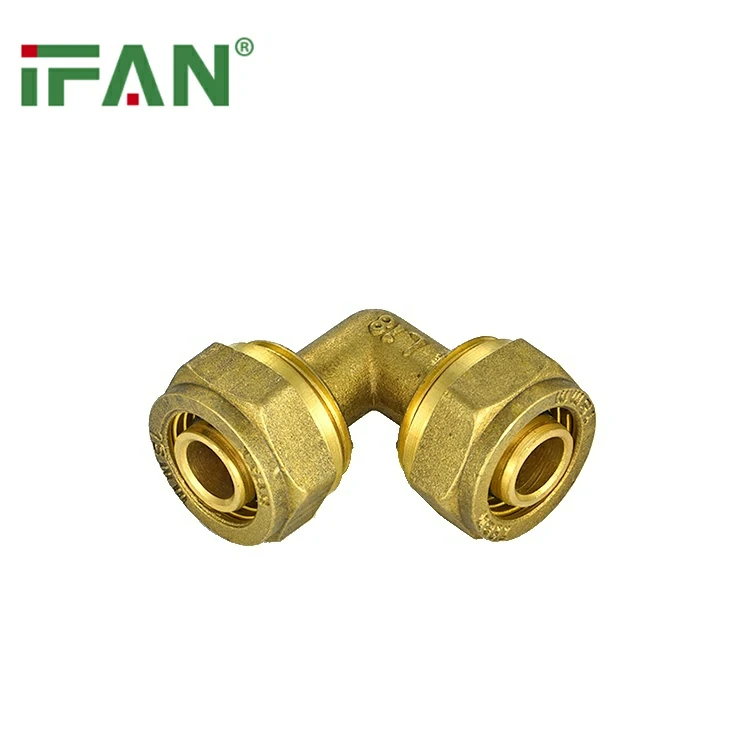
The structural reason is straightforward. An insert fitting works by pushing a barbed shank inside the tube and squeezing a copper ring around the outside, so the tube’s inside diameter sets the outside limit of the shank. Everything the designer wants — burst strength, resistance to the crimp ring’s sustained squeeze, enough meat around the barbs not to split — has to come out of the wall thickness between that fixed outer surface and the bore.
Sulfone plastic has a fraction of the yield strength of a copper alloy, so a moulded body needs a materially thicker wall to pass the same hydrostatic burst and sustained-pressure tests. That wall can only be taken from one place: the bore. The restriction is not a manufacturing shortcut, it is arithmetic.
What that costs in practice is smaller than the argument suggests, and it is concentrated in a specific place. A single fitting’s pressure drop is trivial against the friction loss of the run it sits in. The problem is cumulative and it lands on branch lines: a 1/2 in run feeding a shower through a tee, two elbows and a stop has four restrictions in a few metres of pipe, and that is where a homeowner notices pressure. On a 3/4 in trunk with two direction changes, the same fittings are close to irrelevant.
We are deliberately not printing a bore table here. IFANPRO has no published dimensional data of its own for these fittings, and the honest alternative — reproducing a competitor’s submittal sheet and letting it read as ours — is how bad numbers get laundered through the industry.
If bore is the deciding factor for your project, measure it. Take calipers to the actual sample from the actual supplier, at the actual size you are buying, because the variation between brands within one standard is larger than most buyers expect. Our companion guide on PEX fitting sizes and thread specs sets out what the standards require and states plainly where its own figures come from.
Chlorine, Chloramine and the Ghost of Polybutylene
Every time plastic fittings come up, someone raises polybutylene: the plastic plumbing system that failed across North America in the 1980s and 90s and generated one of the largest construction-defect settlements in US history. The inference — plastic plumbing fittings failed once, so avoid them — is the single most common piece of bad reasoning in this comparison, and it survives because the detail that refutes it is rarely quoted.
The Plastics Pipe Institute is explicit about what broke. Many of those failures were attributed to the polyacetal material — polyoxymethylene, or POM — used to mould the plastic fittings in those systems. POM is a different polymer family from the sulfones used in PEX fittings today, and PPI states directly that PEX systems do not use polyacetal insert fittings. The PB tubing standard, ASTM D3309, was withdrawn in 2010 and the material was removed from US and Canadian codes. Condemning PPSU because POM failed is like condemning stainless because cast iron rusts.
On chlorine specifically, the polymer side of this comparison is genuinely strong. PPI names polysulfone (PSU) and polyphenylsulfone (PPSU) as fitting polymers that have demonstrated very high levels of chlorine resistance. Chlorine and chloramine attack polyolefins by oxidation, which is why PEX tubing itself must be tested to ASTM F2023 and demonstrate a minimum extrapolated lifetime of at least 50 years before it can be used for potable water. Sulfones are not polyolefins and do not degrade by the same route.
There is a detail here worth carrying into a technical conversation with a supplier. ASTM F2023 is a system test, and the recommendation is that the end-use fitting type and material be included in the test circuit, because some fitting types and materials are known to affect failure times. A chlorine-resistance claim made for a tube tested with different fittings than the ones in the box is a weaker claim than it appears. If a supplier — us included — cites F2023 data, the correct question is which fittings were in the loop.
What we cannot tell you
IFANPRO holds no ASTM F2023 chlorine-resistance test data of its own that we can publish, and this guide does not imply otherwise. Where you need a documented chlorine result for a specific fitting material, ask whichever supplier you are evaluating for the report number, the laboratory, the test temperature and which fittings were in the circuit. A supplier who has the data will hand over all four.
Where Brass Actually Fails
Brass does not corrode uniformly like steel. It fails by two distinct mechanisms that get conflated constantly, and telling them apart changes what you ask a supplier for.
Dezincification is selective leaching: zinc leaves the alloy and what remains is a porous, copper-rich structure that holds the shape of the fitting while losing most of its strength. It is driven by water chemistry — stagnant, soft, chlorinated or high-chloride water accelerates it. Stress-corrosion cracking is different: it needs sustained tensile stress plus a specific chemical agent, classically ammonia, and it produces cracks in a fitting whose surface still looks like healthy brass.
The second one is why brass PEX fittings have a litigation history. In the Zurn PEX multidistrict litigation, the US District Court for the District of Minnesota recorded the mechanical point plainly: when the PEX system is properly assembled, the crimp design places stress on the brass fitting. Read that again, because it is the whole problem. The sustained tensile stress that stress-corrosion cracking requires is designed into a crimp joint — it is not a symptom of a bad installer.
In the same class-certification opinion, plaintiffs stated that Minnesota alone saw 884 failures attributed to stress-corrosion cracking between 2001 and 2008, against an estimated 50,000 Minnesota homes with the system. Those figures are plaintiffs’ assertions recorded in a class-certification ruling rather than findings of fact by the court, and they should be read that way. But the underlying allegation — that high-zinc brass in a permanently stressed joint is a poor combination — is exactly the failure mode the metallurgy predicts.
This is the honest core of the case for plastic. A sulfone fitting has no zinc to lose and no stress-corrosion mechanism in potable water. In aggressive water chemistry, that is not a marginal advantage — it removes the failure mode instead of managing it. Where brass remains the right answer — above 1 in, on threaded connections, and in markets that expect metal — the mitigation is alloy selection and documented testing rather than hope, which is what separates one brass PEX pipe and fittings range from another that looks identical in a photograph.
“DZR” Is a Test Result, Not a Grade Name
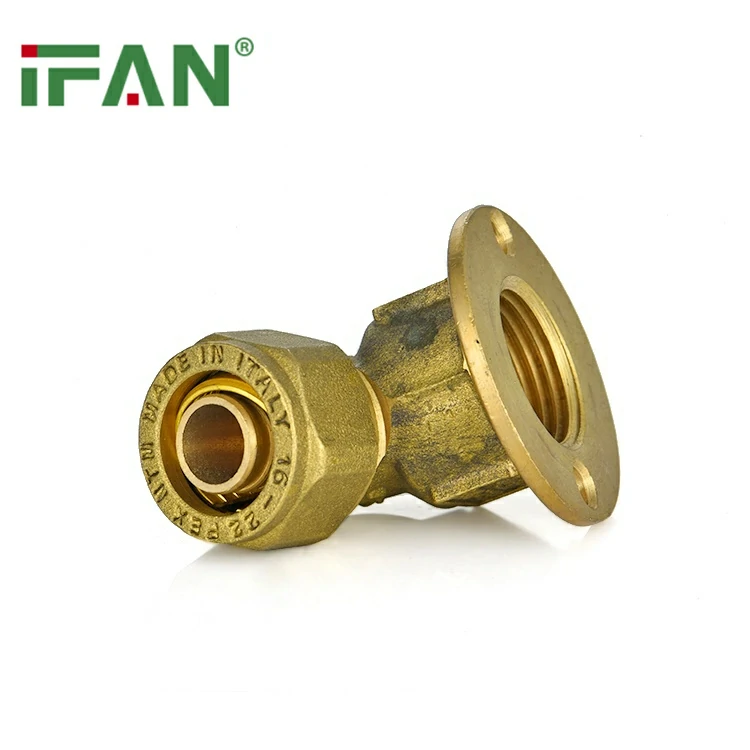
If you take one purchasing habit from this guide, take this one. Dezincification-resistant brass is defined by passing a test, and buyers routinely treat it as a property that comes free with an alloy designation on a purchase order.
The test is ISO 6509. A technical class published by the brass mill Chase Brass sets out the regime: the sample sits at 75 °C for 24 hours, and the depth of the dezincified layer is then measured under a microscope. The widely used pass criterion is a maximum depth of 200 µm. That document also shows something most fitting datasheets never mention — NSF 14 applies that 200 µm maximum plus a separate ASTM B858 ammonia stress-corrosion-cracking test. Two failure modes, two tests. A certificate covering one says nothing about the other.
The same mill document dismantles the rule of thumb most buyers rely on. The traditional 15% maximum zinc limit for avoiding dezincification is not universal: inhibitors and thermal treatment can protect brasses with up to 35% zinc. So a high-zinc alloy that has been correctly inhibited and heat treated can outperform a nominally safer alloy that has not been. Dezincification resistance is delivered by process control — alloy chemistry, inhibitor addition and heat treatment together — and process control is precisely what varies between two suppliers quoting the same grade name.
Chase Brass is also candid about the test’s limits, and this is the caveat to carry into any negotiation: ISO 6509 is an accelerated 24-hour test designed to give comparative information, and real-world dezincification may take 30 or more years to appear depending on alloy, manufacturing controls and operating conditions. A pass is a comparative quality signal, not a guarantee of service life. Treat a supplier who presents it as a lifetime warranty with the scepticism that deserves.
| Failure mode | What triggers it | The test that covers it |
|---|---|---|
| Dezincification | Soft, stagnant, chlorinated or high-chloride water | ISO 6509 — 75 °C, 24 hr, 200 µm max depth |
| Stress-corrosion cracking | Sustained tensile stress plus ammonia | ASTM B858 ammonia SCC test |
| Excess lead content | Alloy chemistry, independent of corrosion | NSF/ANSI 372 — 0.25% weighted average |
| Leaching into water | Any wetted material, metal or polymer | NSF/ANSI 61 — chemical extraction |
Lead-Free Rules and What They Do Not Cover
Lead content and corrosion resistance are separate regulatory questions, and conflating them is a reliable way to buy a compliant fitting that fails anyway.
Under the US Safe Drinking Water Act, as set out by the EPA, “lead free” means a weighted average of 0.25% lead calculated across the wetted surfaces of a pipe, pipe fitting, plumbing fitting and fixture, and 0.2% for solder and flux. The final rule establishing certification requirements was published on 1 September 2020, with manufacturers required to certify compliance within three years. Certain products are exempt — plumbing devices for non-potable service, toilets, bidets, urinals, fill and flushometer valves, service saddles, water distribution main gate valves 2 inches and larger, and fire hydrants.
Read that definition again for what it does not say. It caps how much lead the alloy may contain. It has nothing to say about zinc, about dezincification, or about ammonia cracking. A fitting can be fully lead-free compliant and still be the wrong alloy for the water it will carry — the two questions are answered by different documents.
The certification marks trip people up in the same way. NSF/ANSI 61 and NSF/ANSI 372 are not interchangeable. A document published by the Illinois Pollution Control Board records the history: in 2010 the lead-content evaluation procedures of NSF/ANSI 61 Annex G were moved into NSF/ANSI 372, and Annex G was updated to simply reference it.
In practice, 61 is a chemical-extraction and health-effects evaluation of what migrates out of a product into water; 372 evaluates the weighted-average lead content of the wetted materials. A bare “NSF 61” claim is not by itself a lead-content statement — look for 61-G or 372 when lead content is what you need to prove.
Because market rules differ and change, confirm current requirements for your destination with the relevant approvals body or a compliance consultant before committing a container. Our guide to lead-free brass, DZR and what the compliance labels mean goes further into the alloy families and the market-by-market picture.
What Goes Wrong on the Factory Floor
Standards describe what a compliant fitting looks like. They do not describe how a non-compliant one gets made, and that is where a fitting manufacturer sees things a specification cannot tell you.
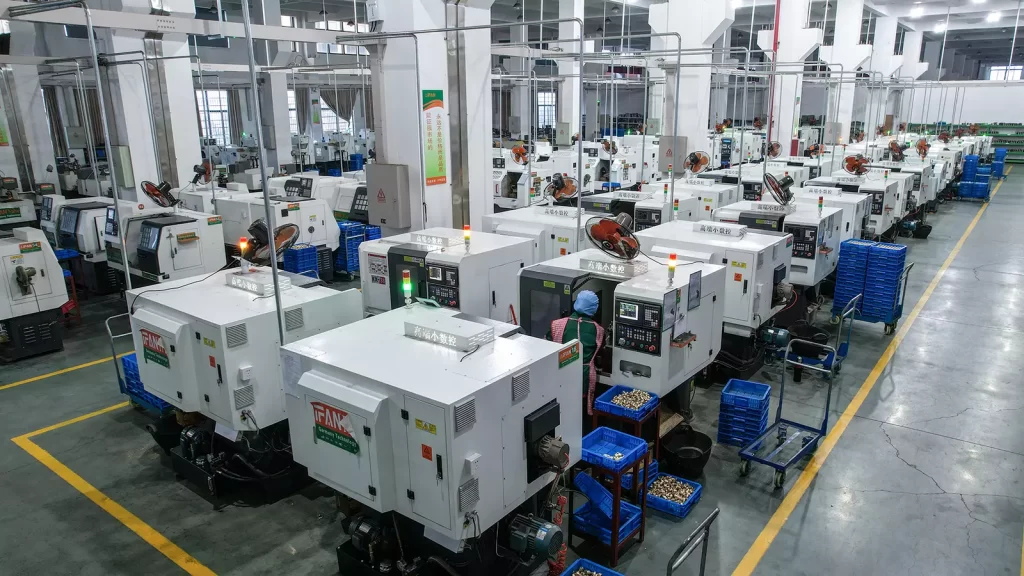
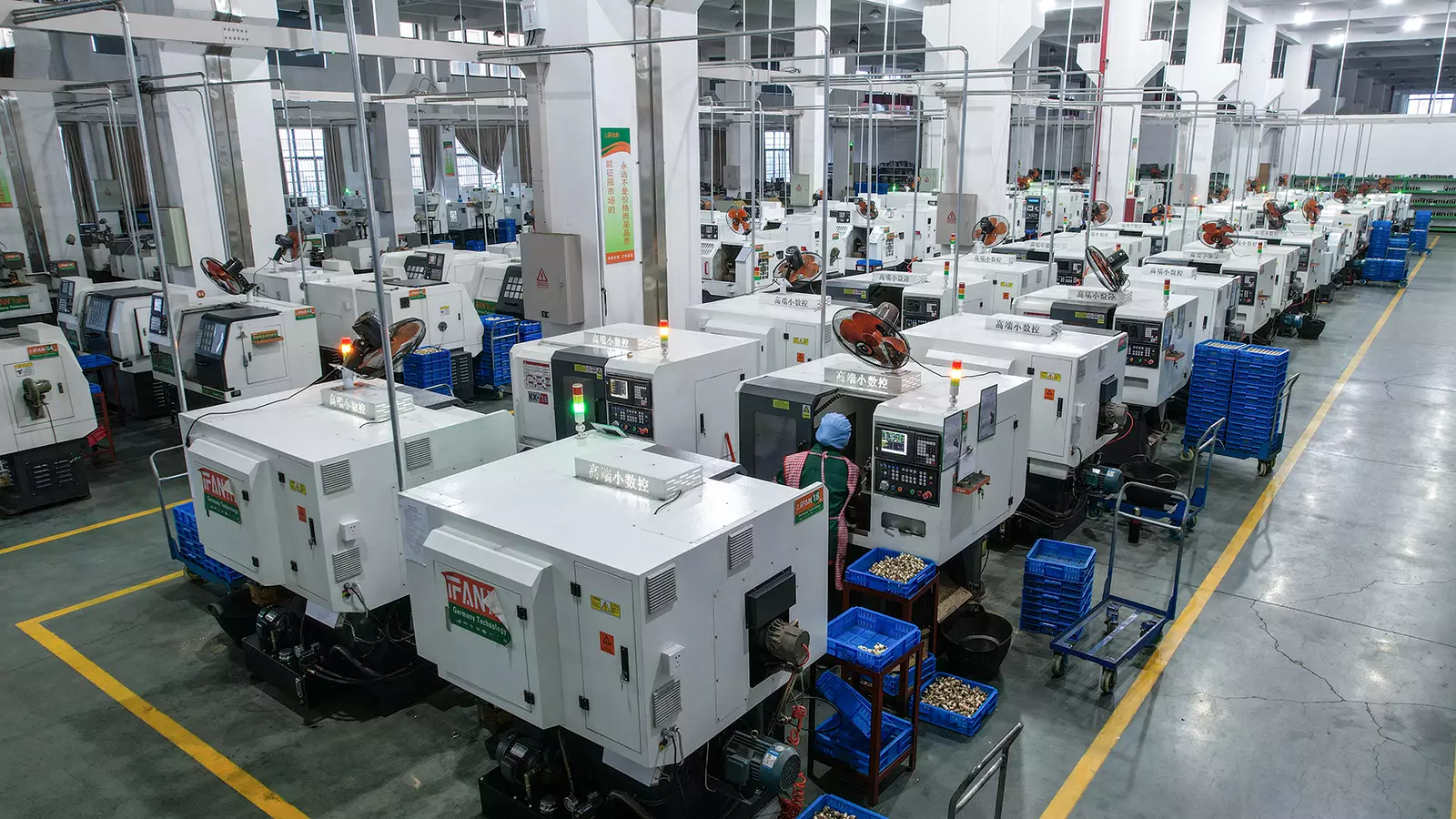
Brass fittings of this type are bar-turned: a CNC lathe takes a length of drawn rod and machines the body, the barbs and the seat. Almost everything that goes wrong is upstream of that machine. The rod arrives with a certified chemistry, and the certificate belongs to a heat of material, not to the box on the floor.
So when a workshop runs low mid-order and pulls a bar from another rack to finish a run, the parts come out dimensionally perfect and metallurgically unknown. Nothing about the finished fitting reveals it. This is the substitution risk that a mill certificate traceable to the specific production lot exists to close — and it is why a certificate photocopied for every shipment is worth very little.
Machining itself leaves signatures worth checking. A worn insert or a chatter cut leaves a rougher surface in the bore, and dezincification starts preferentially where the surface is disturbed. Swarf is the other one: brass chips are springy and cling, and a fitting that has not been properly deburred and washed can carry a chip in the seat that a pressure test will pass and a customer’s tap will find months later.
So look into the bore of a sample under a light. If you can see machining marks that catch the light, or a bright curl of swarf, that is a housekeeping problem — and housekeeping problems are rarely confined to one station.
The polymer side has a different profile. A moulded sulfone fitting is dimensionally consistent shot to shot in a way a machined part is not, so gross variation is rarer — but the failure modes are hidden rather than visible. Insufficiently dried resin, an over-hot barrel, or a weld line where two flow fronts meet behind a barb produce a part that looks perfect and is weaker exactly where it is stressed. You cannot inspect for that on a bench; it is caught by burst testing samples from the run, not by looking at them.
That is the honest trade for a buyer. With brass, more of what can go wrong is visible to a careful person with a sample and a light. With polymer, more of it is invisible, and you are relying on the moulder’s process discipline and test records instead of your own eyes.
Temperature, Freezing and Cost
Three practical factors decide more stocking arguments than metallurgy does.
Temperature headroom. Both fitting standards stop at 180 °F, so on paper there is nothing to choose. The polymer’s margin above that line is nonetheless real: the reference PPSU grade for plumbing, Solvay Radel R-5000, has a glass transition temperature of 220 °C measured to ASTM E1356 — far above anything a potable system sees. Excursion behaviour is where it matters: a brass fitting is unbothered by a brief overtemperature event, and PPSU has enough headroom that it is not the component that gives up first either. PSU is a different matter, which is the next point.
Not all “poly” is the same polymer. This is the plastic-side equivalent of the DZR trap. F2159 says sulfone plastic; it does not say which one. The published notched Izod impact strength of Radel R-5000 PPSU is 690 J/m to ASTM D256. Standard polysulfone is typically an order of magnitude lower — figures around 69 J/m are commonly quoted, though we have not verified that number against a primary datasheet the way we did the PPSU figure, so treat the ten-to-one ratio as indicative rather than exact.
The point stands regardless. Two fittings can both be honestly described as “poly alloy” and differ enormously in how they take a knock on a cold site. Ask which sulfone, by name.
Freezing. Neither material makes a system freeze-proof. PEX tube tolerates ice expansion better than rigid pipe; the fittings are the rigid points, and that is where a frozen line splits. Brass yields — it can bulge and stay together, or split. A polymer fitting at sub-zero temperature is at its most brittle exactly when the ice is loading it. Practically, PPSU’s toughness is an advantage in cold-climate work, and both materials should be treated as the vulnerable point in a line that may freeze rather than a solution to it.
Cost. Plastic is cheaper per fitting, and the gap widens with size and with the copper price, because brass carries a metal cost that moves with the commodity market while polymer carries a resin cost that does not move the same way.
We are not publishing a price ratio. IFANPRO has no current indicative FOB figure on file for this line that we could stand behind, and inventing a plausible-looking multiple would be exactly the kind of number this guide is arguing against. Price both from your actual supplier on the actual sizes, and price the whole assembly — ring, tool compatibility and the fitting together — because a cheaper fitting that needs a different tool is not cheaper.
| Propiedad | Brass | PPSU | What it means for you |
|---|---|---|---|
| Fitting rating | 100 psi to 180 °F | 100 psi to 180 °F | No difference on paper — discount claims of a gap |
| Thermal headroom | Far above any service temperature | Tg 220 °C (ASTM E1356) | Both survive brief overtemperature excursions |
| Impact toughness | Ductile — yields before it breaks | 690 J/m notched Izod (ASTM D256) | PPSU is tough; plain PSU is roughly ten times lower |
| Chlorine and chloramine | Drives corrosion rather than polymer attack | Very high resistance (PPI) | Aggressive water favours the polymer |
| Largest crimp size | 2 in (F1807, PEX) | 1 in (F2159) | Above 1 in the decision is already made |
Which Material Should You Standardize On?
There is no universal winner, and a supplier who tells you otherwise is describing their catalogue rather than your project. The decision resolves cleanly once you answer three questions: what is in the water, what sizes does the work need, and who signs off the installation.
Choose sulfone plastic when the water is aggressive toward brass — soft, high-chloride, heavily chlorinated or chloraminated supplies, and anywhere ammonia may be present. Choose it for high-volume residential work at or below 1 in where cost per joint compounds across thousands of connections, and where the removal of the dezincification failure mode is worth more than bore. It is also the safer choice where installation quality is variable and joints may sit in damp, poorly ventilated voids.
Choose brass above 1 in, where F2159 does not go. Choose it where the fitting carries a thread that will be made up and broken repeatedly, because a metal thread survives that and a moulded one degrades. Choose it for manifolds and mechanical rooms where fittings take physical abuse and where the assembly is supporting weight, and choose it in markets whose approvals bodies and inspectors still expect metal in potable service — which remains the case across much of Europe, the Middle East and Africa, and is a commercial fact whatever the metallurgy says.
For most distributors the honest answer is both, split by size and by market rather than picked as a philosophy. If you are building a stocking range from scratch, the pattern that survives contact with reality is polymer for volume residential branch work up to 1 in in soft-water markets, brass for everything from 1 in up, everything threaded, and everything going into a market whose inspector expects to see metal. Our comparison of PEX connection types — crimp, clamp, push-fit and expansion covers the other half of this decision, because connection method and body material constrain each other.
| Scenario | Better fit | Why |
|---|---|---|
| Soft or heavily chlorinated municipal water | Sulfone plastic | Removes dezincification instead of managing it |
| Anything above 1 in | Brass | F2159 is not published above 1 in |
| Threaded joints made and broken repeatedly | Brass | Moulded threads degrade with repeated make-up |
| High-volume residential branch lines to 1 in | Sulfone plastic | Cost per joint compounds; no corrosion exposure |
| Markets expecting metal in potable service | Brass | Approval and acceptance, not metallurgy |
Specifying a brass PEX range for a market that expects metal?
This is for distributors, importers and stocking wholesalers building a container-volume range — not for one-off project buys. IFANPRO manufactures brass PEX compression and press fittings against ASTM F877, ISO 15875, BS 7291, CSA B137, DIN 16892 and GB/T 18992, and we will tell you where a polymer fitting is the better answer for your water chemistry, including when that means we are not the supplier.
What We Check, and What You Should Check Before You Buy
Both materials are easy to fake on a datasheet and harder to fake on a bench. This is the sequence that separates a supplier who has the documents from one who has the adjectives — run it before a deposit, not after a container lands.
- Ask which standard, in writing, per SKU. F1807 or F2159, and the size range. A supplier offering a moulded plastic crimp insert above 1 in is outside F2159 and should be able to explain what it is listed to instead.
- For brass, ask for the ISO 6509 report and the mill certificate together. The report should state the test conditions on its face — 75 °C for 24 hours — and a measured maximum depth at or below 200 µm, not just the word “pass”. The mill certificate ties a specific heat of rod to your production lot. One without the other leaves the substitution gap open.
- Ask whether ASTM B858 ammonia SCC testing was done. Dezincification and stress-corrosion cracking are separate failure modes with separate tests, and NSF 14 applies both — the 200 µm depth limit plus the ammonia test. Most buyers ask about the first and get caught by the second.
- For polymer, ask which sulfone by name. PPSU and PSU are both “sulfone plastic” under F2159 and are not equivalent: the reference PPSU grade publishes 690 J/m notched Izod to ASTM D256, roughly ten times the figure usually quoted for standard PSU. Get the resin grade, not the family.
- Check the rating on the fitting’s own datasheet, not the tube’s. An insert fitting to F1807 or F2159 is listed at 100 psi to 180 °F. If the fitting page shows 160 psi at 73.4 °F or 80 psi at 200 °F, someone has copied the F877 tubing rating onto a fitting.
- Read the certificate, not the logo. Ask for the certificate number, the issuing body, the scope and the expiry date, then verify the number in the certifier’s own online database. Check that the scope actually lists the SKU you are buying — a listing covering one product family does not cover the range.
- Put a light in the bore of a sample. Machining marks that catch the light, a burr at the seat, or a curl of swarf are housekeeping failures, and housekeeping failures generalise.
On our own certifications, the same standard applies to us. IFANPRO states that it holds ISO 9001, ISO 14001, CE, WRAS, NSF/IAPMO, Intertek, EAC, Watermark and SAI Global marks, and the correct response to that sentence — from any supplier, including this one — is to ask for the numbered certificate and check its scope and expiry yourself. A list of logos is a claim. A certificate number you can look up is evidence.
Where we stop, and why we are telling you
It is worth being exact about the limits of what this page can prove, because those limits are the same ones you should probe in any supplier. IFANPRO manufactures brass PEX compression and press fittings across a 120,000 m² plant with over 600 employees, more than 50 R&D and technical staff and over 200 production and testing machines, and our published PEX fitting range is listed against ASTM F877, ASTM F2788, ISO 15875, BS EN ISO 15875, BS 7291, CSA B137, DIN 16892 and GB/T 18992.
What we have not put in front of you is equally specific: no measured bore dimension for our own fittings, no ISO 6509 dezincification result, no ASTM F2023 chlorine data, and no certificate number for any mark above. Those are gaps in our published data, not claims we have quietly rounded — and until they are filled, the honest instruction is the one this section already gave you: ask for the document, check the scope, verify the number. Any supplier who reacts badly to that sequence has told you something useful.

A Worked Example: Specifying for 400 Apartments
An illustrative case, to show how the criteria above resolve together rather than one at a time. A contractor is pricing potable distribution for a 400-unit residential development. The municipal supply is softened and chloraminated. Each unit takes a 3/4 in cold feed to a manifold, then 1/2 in branches to six fixtures, and risers run 1-1/4 in.
Work it size by size. The 1-1/4 in risers settle themselves: F2159 does not publish that size, so those fittings are metal whatever the water does. The 1/2 in branch work is the opposite case — roughly 2,400 fixture connections, in softened chloraminated water, at the size where the polymer’s cost advantage compounds hardest and where its immunity to dezincification is worth most. That is the strongest polymer case in the building. The 3/4 in feeds and manifold connections go brass: the manifold takes mechanical load and threaded connections, and the flow restriction matters more on a feed serving six fixtures than on a single branch.
The result is a split range, and the two decisions that actually mattered were the water report and the riser size — not a general belief about which material is better. Before ordering, the contractor should confirm the local approvals body accepts sulfone fittings in potable service, because in several of IFANPRO’s core markets that answer is no, and it overrides everything above.
Already know your water chemistry and your market’s approvals?
For importers, distributors and MEP procurement teams working at container volume: send the water analysis and the size schedule and we will spec the brass side against them — including telling you which lines would be better served by a polymer fitting we do not make.
Conclusión
Brass and sulfone plastic PEX fittings are rated identically to 100 psi at 180 °F and diverge everywhere else that matters: F1807 runs to 2 in on PEX while F2159 stops at 1 in, brass carries two corrosion failure modes that polymer does not have, and polymer carries process risks that are invisible on a bench. The water report and the size schedule decide this, not a preference for metal or plastic — and “DZR” and “poly alloy” are both labels that need a test report behind them before they mean anything.
If you are building or revising a PEX stocking range and want the brass side specified against real water chemistry and real market approvals, our technical team is happy to work through it with you.
About the author. Written by the IFANPRO technical team. IFANPRO has manufactured pipe and fittings in China since 1993, operating a 120,000 m² factory with over 600 employees, more than 50 R&D and technical staff and over 200 production and testing machines, supplying PPR, PEX, HDPE, PVC and brass systems to more than 200 countries. Published 26 July 2026.
Frequently Asked Questions
Are plastic PEX fittings code approved?
Sulfone plastic insert fittings are listed under ASTM F2159 and accepted in US and Canadian plumbing codes. Acceptance elsewhere varies — several European, Middle Eastern and African markets still expect metal in potable service. Confirm with the local approvals body.
Do brass PEX fittings leach lead?
Fittings meeting the US lead-free rule contain a weighted average of no more than 0.25% lead across wetted surfaces. That caps lead content, not leaching behaviour — NSF/ANSI 61 is the standard that evaluates what actually migrates into the water.
Can I mix brass and plastic fittings in one system?
Yes, and a split range by size is common practice. Both use the same copper crimp ring on the same SDR9 tube. Confirm your tool and go/no-go gauge suit both, since jaws are sized to the ring.
Which fitting handles freezing better?
Neither makes a line freeze-proof — fittings are the rigid points where a frozen pipe splits. PPSU’s high impact strength helps in cold climates, but both materials should be protected rather than relied on to survive ice.
Is poly alloy the same as PPSU?
Not necessarily. “Poly alloy” is a trade description, while ASTM F2159 requires sulfone plastic without naming which one. PPSU and standard PSU differ substantially in impact strength, so ask the supplier to state the resin grade.
Does a DZR certificate guarantee the fitting will not corrode?
No. ISO 6509 is an accelerated 24-hour comparative test at 75 °C with a 200 µm maximum depth criterion. It is a quality signal, not a service-life guarantee, and it does not cover ammonia stress-corrosion cracking, which is tested separately.







 Español
  English
  Français
  Русский
Comentarios recientes