
Most buyers meet HDPE corrugated pipe the same way: a drainage line on a tender drawing, a note saying “SN8 or equivalent”, and a supplier quote that comes in noticeably below the others. The quote is usually cheaper for a reason you cannot see from the outside, because everything that makes corrugated pipe work is either buried in the wall profile or buried in the trench. Once the backfill is in, the mistake costs an excavator to find.
The single most useful thing to understand before you buy any of it: ring stiffness in the European system is measured at 3% deflection, and pipe stiffness in the North American system is measured at 5% deflection. They are different tests producing different numbers, and a supplier who quotes “SN8, equivalent to AASHTO M294” is either being loose or hoping you will not check. This guide covers what to specify, what the numbers actually mean, and how to verify a shipment. It also says plainly, up front, that IFANPRO does not manufacture corrugated pipe — what we make is the pressure side of an HDPE network, and the section on that is honest about where the line falls.
Key takeaways
- EN 13476 defines four ring stiffness classes — SN2, SN4, SN8 and SN16. Below DN 500 only SN4, SN8 and SN16 are available; SN2 appears only above DN 500.
- SN is a minimum floor, not a measured value. EN 13476-1:2018 defines the class as “a convenient round number, indicating the minimum required ring stiffness”.
- EN/ISO ring stiffness is measured at 3% deflection per EN ISO 9969. AASHTO pipe stiffness is measured at 5% deflection. Never treat SN8 and an AASHTO psi figure as equivalents.
- Minimum cover in traffic areas is 1 ft (0.3 m) for 4–48 in pipe and 24 in (600 mm) for 54–60 in pipe, and flexible pavement thickness does not count toward it.
- ASTM F2306 requires virgin resin; ASTM F2648 permits recycled content. Two standards that look interchangeable are not.
- Specify the joint grade explicitly: soil-tight, silt-tight (2 psi) or watertight (10.8 psi per ASTM D3212). Unspecified defaults to soil-tight.
- Deflection is verified by mandrel no sooner than 30 days after backfill, against a 5% limit.
What HDPE Corrugated Pipe Is, and What It Is Not
HDPE corrugated pipe is a gravity-flow drainage product. The governing European standard states the boundary in its own title: EN 13476 covers “plastics piping systems for non-pressure underground drainage and sewerage — structured-wall piping systems”. Non-pressure is not a caveat buried in an annex. It is the first thing the standard says about the product category.
The reason is mechanical rather than regulatory. Corrugations are a stiffening geometry: they put material away from the neutral axis so the ring resists being squashed by earth load, which is a compressive problem. Internal pressure is a tensile problem — it tries to stretch the wall circumferentially — and a corrugated profile has no continuous solid wall to carry that hoop stress. This is why a supplier offering “corrugated pipe, PN4” is describing something that does not exist in any standard, and why the correct answer to “can we run this line at low pressure” is no, specify solid-wall pipe instead.
Single-wall, double-wall and the type designations
The North American system labels wall construction by type letters, and these appear on the pipe itself. Type S is double-wall — a corrugated exterior with a smooth interior liner fused to it. Type C is single-wall, corrugated inside and out. Add a P and you get the perforated variants, Type SP and Type CP, used where the line is collecting groundwater rather than just conveying flow.
The distinction matters hydraulically, not just structurally. A single-wall pipe’s corrugations are exposed to the flow, which raises roughness and cuts capacity for the same nominal diameter. That is acceptable in a field underdrain where you want water to enter along the length. It is a poor choice for a storm sewer sized on a flow calculation that assumed a smooth bore. The European equivalent of this split is the Type A / Type B distinction in EN 13476: Type A pipes have smooth internal and external surfaces, Type B pipes have a smooth internal and profiled external surface. Type B is the corrugated-exterior, smooth-bore construction most buyers mean when they say double-wall.
One detail worth knowing because it is a real failure mode: in Type S pipe the liner must be fused to the outer corrugated wall at every internal corrugation crest. Where that fusion is incomplete, the liner can delaminate and peel into the flow. AASHTO M252 sets minimum liner thickness at 0.02 in (0.5 mm) for 4 in and 6 in pipe and 0.025 in (0.6 mm) for 8 in and 10 in pipe — thin enough that a supplier shaving the liner to save resin is not visible without cutting a sample.
Ring Stiffness Classes: What SN Actually Guarantees
The EN 13476 series specifies four nominal ring stiffness classes: SN2, SN4, SN8 and SN16. Availability is size-dependent in a way most buyers do not expect. For DN 500 and below, the standard offers SN4, SN8 or SN16 — SN2 is not on the menu. For DN above 500, all four classes including SN2 become available. If a supplier quotes you SN2 in DN 300, they are quoting something outside the class structure of the standard they claim to be working to.
EN 13476-1:2018 defines the SN class as “a convenient round number, indicating the minimum required ring stiffness”. SN8 means at least 8, not exactly 8.
That definition has a practical consequence buyers routinely miss. Because SN is a floor, a batch that tests at 8.1 kN/m² and a batch that tests at 11 kN/m² are both honestly SN8 — but they will behave differently under the same cover, and only one of them has margin left after the resin’s long-term creep is accounted for. This is why serious specifications ask for the measured ring stiffness value from the test report, not just the class marking. The class tells you the pipe passed; the number tells you by how much.
How the number is produced
EN 13476-1 defines pipe stiffness as the resistance to ring deflection under external force “as determined in accordance with EN ISO 9969”. In that test a pipe ring is compressed between two parallel plates at a constant rate and the stiffness is calculated from the force needed to reach 3% diametric deflection. Two companion tests matter as much and are quoted far less often: ring flexibility per EN ISO 13968, which checks the pipe can be deflected without splitting or delaminating, and creep ratio per EN ISO 9967, which is what converts a short-term modulus into the long-term modulus a buried-pipe design actually needs. A supplier who can produce an ISO 9969 report but not an ISO 9967 creep ratio has tested the pipe on day one and told you nothing about year twenty.
There is also a fittings rule that gets skipped on mixed orders. EN 13476-1 Table B.1 sets the minimum fitting class to match the pipe class one for one: SN4 pipe takes SN4 fittings, SN8 pipe takes SN8 fittings, SN16 pipe takes SN16 fittings. Buying SN8 pipe and accepting whatever bends and junctions the supplier has in stock puts the weakest ring in the system at exactly the points where the soil load concentrates.
Which class, for which job
The standard itself gives one firm anchor rather than a table of applications. BS EN 13476-1:2018’s national foreword states that “SN4 and SN8 are the traditionally recommended classes used in the UK for water company adopted sewers and are to be used if the system is to be installed in accordance with BS EN 752:2017 or BS EN 1610:2015 to achieve the intended resistance to long-term deformation”. Beyond that, class selection is a structural design calculation for the specific cover, backfill and load — not a lookup.
In practice, Chinese suppliers working to GB/T 19472.1 tend to position SN4 for non-trafficked ground such as green belts and footways at shallow cover, SN8 for carriageways and parking areas at moderate cover, and SN12.5 or SN16 for arterial roads and deep fill. Treat that as a description of what sellers typically offer, not as a design rule — it is market convention, and it is the kind of shorthand that gets a pipe specified one class light when the site has a haul road across it during construction.
The Two Standard Families, and Why They Do Not Translate
Corrugated HDPE is governed by two largely independent standard families, and the most expensive sourcing errors happen at the boundary between them. The European family is EN 13476 with SN classes measured at 3% deflection. The North American family is AASHTO M252 and M294 plus the ASTM F-series, with pipe stiffness measured at 5% deflection. A single pipe can legitimately carry marks from both, but the numbers on those marks are not convertible, and no honest supplier will give you a conversion factor.
| Standard | Size range | Resin rule | Buyer note |
|---|---|---|---|
| AASHTO M252 | 3–10 in (75–250 mm) | Virgin PE, D3350 cell class 424420C | Type S min 50 psi at 5% deflection |
| AASHTO M294 | 12–60 in (300–1500 mm) | Virgin PE, D3350 cell class 435400C | Stiffness varies by diameter; read the table |
| ASTM F2306 | 12–60 in (300–1500 mm) | Virgin resin required | Gravity storm sewer and subsurface drainage |
| ASTM F2648 | 2–60 in (50–1500 mm) | Virgin and recycled permitted | Land drainage; check if your spec allows recycled |
| EN 13476-3 | By DN, Type B | Per the material clause of the part | SN class at 3% deflection, EN ISO 9969 |
| GB/T 19472.1-2019 | Double-wall corrugated | Per the Chinese national standard | In force since 1 March 2020; not AASHTO-equivalent |
The row that costs real money is the difference between ASTM F2306 and ASTM F2648. They cover the same product in overlapping sizes and their designations are one digit apart. F2306 requires virgin polyethylene resin. F2648 permits an engineered compound of virgin and recycled HDPE. If your specification says “corrugated HDPE to ASTM” without naming which one, a supplier can meet it with recycled-content pipe and be entirely honest about it. On a storm sewer that a highway authority will adopt, that distinction is the difference between acceptance and a rejected line.
A second boundary worth naming: pipe made to GB/T 19472.1-2019, the Chinese national standard for polyethylene double-wall corrugated pipes, is not AASHTO M294 pipe. GB/T 19472.1-2019 was issued 30 August 2019 and came into force 1 March 2020, replacing the 2004 edition. It is a legitimate standard, and pipe certified to it is legitimate pipe — but if your tender cites AASHTO M294 and the mill certificate cites GB/T 19472.1, you have a compliance gap to close before the container ships, not after.
Cover Depth: The Number That Decides the Class
Cover depth has two limits and buyers usually think about only one. The minimum protects the pipe from concentrated wheel load near the surface. The maximum protects it from the accumulated weight of fill. Corrugated pipe fails at both ends, and the minimum is where construction traffic does the damage before the road is even built.
Under AASHTO H-20, H-25 or HL-93 traffic loading, pipe from 4 in to 48 in (100–1200 mm) needs at least 1 ft (0.3 m) of cover over the crown, and 54 in to 60 in (1350–1500 mm) pipe needs at least 24 in (600 mm). Those figures come from Advanced Drainage Systems’ technical note TN 2.01 for its N-12 product line, and they carry a condition most people drop when they copy the number: the backfill envelope must be built to ASTM D2321, with Class III material at 95% standard Proctor or Class II at 90%, and structural backfill carried up to the crown.
The trap inside the minimum-cover rule is pavement. TN 2.01 states that flexible pavement thickness should not be counted toward minimum cover, while rigid pavement can be. A 300 mm asphalt build-up over 300 mm of fill is not 600 mm of cover for this purpose — it is 300 mm, and the pipe is at the limit. Getting this wrong is how a line survives the job and then deforms under the first loaded truck.
Maximum cover collapses with compaction
The maximum side is where the “pipe is the same, backfill is a detail” assumption breaks visibly. The same ADS technical note publishes maximum fill heights for the same pipe across backfill classes, and the spread is not marginal.
| Backfill condition | 24 in (600 mm) pipe | 48 in (1200 mm) pipe |
|---|---|---|
| Class 1, compacted | 28 ft (8.5 m) | 25 ft (7.6 m) |
| Class 2 at 95% | 20 ft (6.1 m) | 17 ft (5.2 m) |
| Class 2 at 90% | 13 ft (4.0 m) | 11 ft (3.4 m) |
| Class 2 at 85% | 7 ft (2.1 m) | 7 ft (2.1 m) |
| Class 3 at 90% | 10 ft (3.0 m) | 7 ft (2.1 m) |
Read the 24 in column downward. The same pipe, from the same factory, with the same SN marking, goes from 28 ft of permissible fill to 7 ft — a four-to-one reduction — purely on what the contractor puts around it and how hard they compact it. Nothing about the product changed. This is the strongest argument available for why a cheap pipe with an expensive installation beats an expensive pipe thrown into native spoil, and it is why “which SN class do I need” cannot be answered without knowing the backfill.
Two conditions attach to those figures and both are commonly violated on site. They assume zero hydrostatic load — groundwater above the pipe reduces the allowable fill height and the reduction has to be assessed by the design engineer, not assumed away. And they assume deflection is being controlled to the 5% design limit; ADS notes explicitly that with poorer backfill or lower compaction effort, deflection may exceed it.
Bedding and Haunching: Where the Strength Comes From
There is one sentence in Lane Enterprises’ HDPE specification guide that reframes the whole purchase: corrugated HDPE “is a flexible pipe material that derives structural rigidity from the strength and relative stiffness of the backfill envelope. The backfill-culvert interaction attained defines the ability of system to withstand service loads.” The pipe is half of a composite structure. The soil is the other half, and it is the half your supplier does not sell you.
A flexible pipe under load deflects vertically and bulges horizontally. That outward bulge pushes into the soil at the sides, and the soil pushes back. That passive resistance is what actually carries the load. If the material at the springline is loose, uncompacted, or simply absent because nobody worked it in, the pipe has nothing to push against and the deflection keeps going until the ring buckles. The wall was never going to carry it alone.
The haunch zone is the whole game
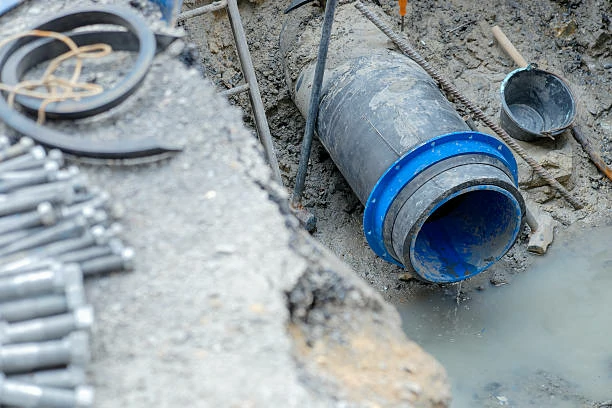
The embedment defined by ASTM D2321 has three parts — bedding under the pipe, the haunch zone from the bedding up to the springline, and initial backfill above that. The haunch is the awkward wedge under the lower quadrant, and it is the hardest to fill because a compactor cannot reach into it. On corrugated pipe it is harder still, because the material has to be worked into the corrugation valleys as well. ADS uses a specific word for this in its installation notes: material must be adequately “knifed” into the haunch and in between the corrugations. Shovel-slicing, not machine compaction.
This is the most commonly skipped step on a drainage job and the most expensive one to skip, because it is invisible the moment the trench is filled. A crew that dumps backfill from the side and runs a plate over the top produces a line that passes visual inspection, passes flow, and fails a mandrel test thirty days later — at which point the fix is excavation. Embedment classes I, II and III are the ones recommended for the embedment zone: Class I is generally manufactured aggregate such as crushed stone, Class II is clean sands and gravels. Class I earns its cost precisely here, because angular crushed stone reaches a workable density in the haunch with far less effort than a sand that needs moisture control to compact.
Joints: The Specification Line Buyers Forget
Corrugated pipe joints come in three performance grades and they are not priced the same, which means a supplier quoting to an unspecified joint will quote the cheapest one. Soil-tight joints prevent infiltration of soil particles larger than those passing a No. 200 sieve. Silt-tight joints use an elastomeric rubber seal and meet a laboratory pressure rating of at least 2 psi. Watertight joints are gasketed connections meeting a 10.8 psi laboratory test per ASTM D3212.
Here is the line that should go into your purchase order: joints meet the soil-tight performance requirement unless specified otherwise. That is the default in the manufacturers’ own specification guides. If your drawing says “gasketed bell and spigot” and nothing else, you have not specified a watertight joint — you have specified a bell and spigot that may well be soil-tight, and the gasket standard you actually need to name is ASTM F477 for the elastomeric seal together with ASTM D3212 for the joint.
The consequence of getting this wrong is not usually leakage out. It is infiltration in, and then loss of the ground around the pipe. A soil-tight joint below the water table lets fines migrate into the line; the fines wash away downstream; the void they leave behind is directly above the pipe, which is where you least want a void under a road. The pipe is still intact when the pavement above it dips.
How to Verify a Corrugated Pipe Shipment
Verification splits into what you can check on the pipe itself, what you must demand on paper, and what only the finished installation can tell you. Most buyers do the first and skip the second, which is backwards — the marking is the cheapest thing for a supplier to get right and the test report is the expensive one.
On the pipe, at the yard
Corrugated PE drainage pipe must be marked at intervals of not more than 11.5 ft (3.5 m), and the marking must carry the manufacturer’s name or trademark, the nominal size, the specification designation, the plant designation code, and the date of manufacture or a date code. Walk a length and check the interval is real — a pipe marked once at each end tells you nothing about what happens when the line is cut into three pieces on site. Check that the specification designation on the pipe is the one your order named, not a different one from the same family. And note the plant code: on a large order it is how you tell whether the container came from one production line or was assembled from whatever three plants had in the yard.
Cut a sample ring. On Type S pipe, look at whether the liner is fused to the outer wall at every internal corrugation crest, and measure the liner thickness against the 0.02 in / 0.025 in minimums for the small sizes. Carbon black content is capped at 4% when tested to ASTM D4218 — you cannot check that by eye, but you can check that the pipe is uniformly pigmented, because non-uniformly pigmented pipe is a stated visible defect and a sign of poor compounding.
On paper, before the container ships
Ask for four documents and read them in this order. First, the resin cell classification to ASTM D3350 — 424420C for pipe in the 4–10 in range and 435400C for 12–60 in, with a statement of whether the material is virgin or reworked, because both standards permit clean reworked material only if it still meets the cell class. Second, the ring stiffness test report with the measured value, not just the class, and with the test standard named so you know whether you are reading a 3% number or a 5% number. Third, the creep ratio to EN ISO 9967 if you are buying to the European family, because that is the only document addressing long-term behaviour. Fourth, the brittleness and stub compression results if you are buying to AASHTO M294: brittleness allows five nonfailures out of six impacts, and profile compression capacity must be at least 50% of the gross cross-sectional area times the minimum specified yield strength.
One caution on stiffness figures specifically. The per-diameter minimum pipe stiffness values for AASHTO M294 live in a table inside the purchased standard, and they vary with diameter. AASHTO M252 is quotable — Type S pipe requires a minimum of 50 psi (340 kPa) at 5% deflection — but the M294 values are not published free, and numbers of that shape circulating on supplier websites are not a safe basis for a tender document. If your specification turns on a stiffness figure, buy the standard and read the table.
In the trench, thirty days later
The final check is a deflection test, and its timing is not arbitrary. Deflection testing confirms the pipe has no more than 5% deflection and is performed no sooner than 30 days after backfilling the line segment, before final acceptance. The delay exists because the soil-pipe system keeps moving after the trench is closed; a test run the same week measures the installation before it has settled into whatever it is going to be. A mandrel pre-set to the minimum allowable inside diameter for a 5% (or, where specified, 7.5%) limit is pulled through the line, and it either passes or it does not.
Put the mandrel clause in the contract before work starts, with the 30-day wait written in. A deflection test is the only measurement in this entire process that tests the pipe and the installation together, which is exactly why it is the one contractors most often argue out of the specification.
What IFANPRO Supplies, and What We Do Not
IFANPRO does not manufacture HDPE corrugated pipe, double-wall corrugated pipe, or culvert pipe. There is no SN4, SN8 or SN16 line here and no structured-wall extrusion. We are saying that on a page targeting the term because the alternative — a vague “we supply a full range of HDPE solutions” that lets a buyer assume otherwise — wastes a procurement team’s time and ends in an awkward call.
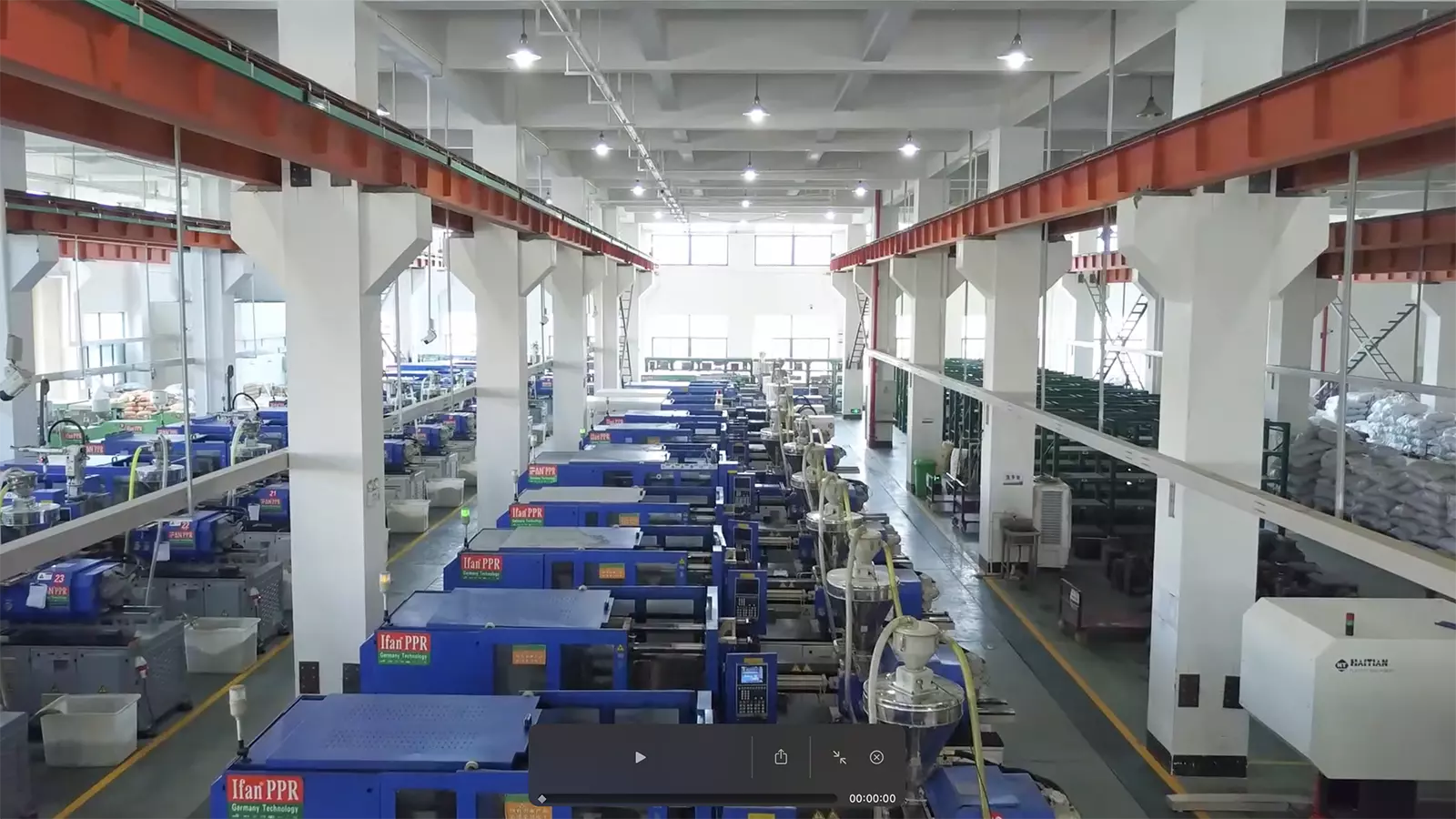
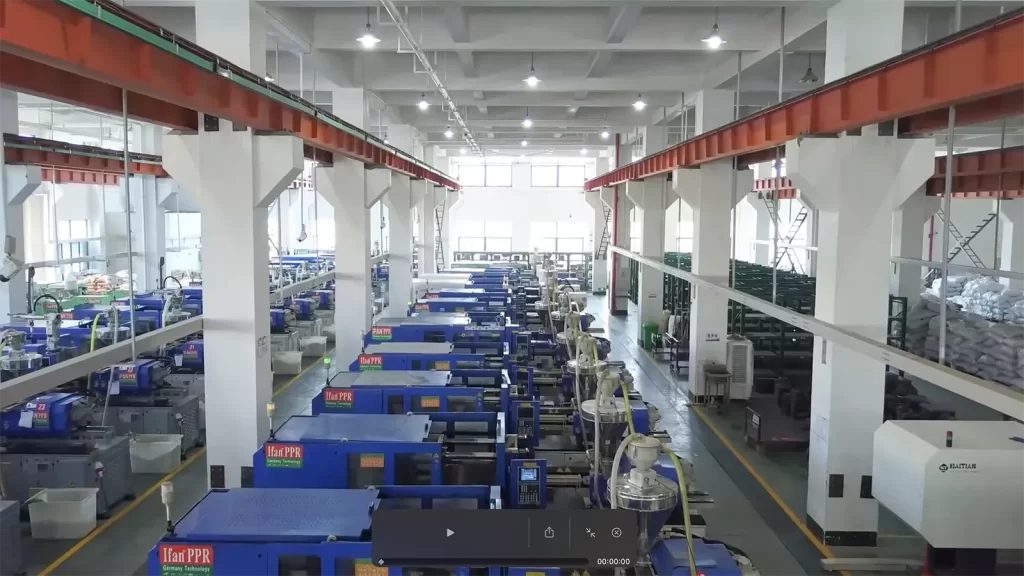
What IFANPRO makes is the pressure side of an HDPE network. Founded in 1993 and established in 2001, the company runs a 120,000 m² factory with over 600 employees, more than 50 R&D and technical staff, and over 200 production and testing machines across PPR, PEX and PEX-AL-PEX, HDPE, PVC, PPH, brass fittings and valves, and sanitary ware. Within HDPE, the range is mechanical jointing components rather than pipe: compression fittings, saddle clamps, and ball valves.
| Requirement | Corrugated HDPE specialist | IFANPRO |
|---|---|---|
| Gravity storm sewer, culvert, land drain | Yes — this is their product | No — not manufactured |
| SN4 / SN8 / SN16 structured-wall pipe | Yes, by class and DN | No |
| Pressurised HDPE branch connections | Usually outsourced | Saddle clamps PN10, Φ25–Φ110 |
| HDPE compression fittings | Usually outsourced | 606 series, Φ20–Φ90, inch threads |
| Single-source multi-material order | Drainage only | PPR, PEX, HDPE, PVC, PPH, brass |
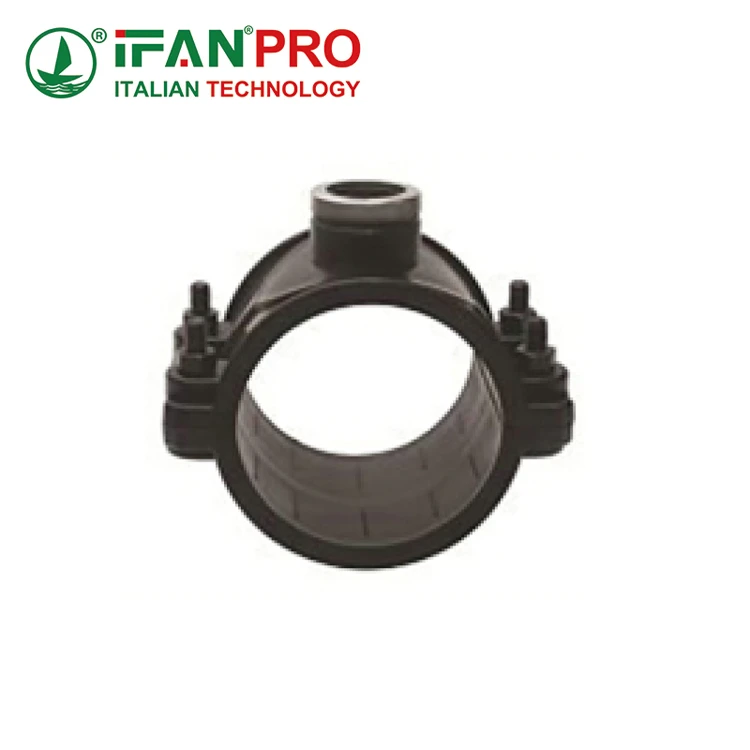
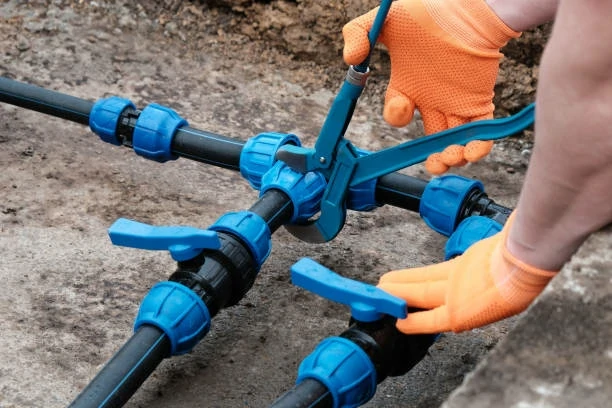
The saddle clamp is worth a paragraph because it is the component that most often sits in the same trench as a drainage run. IFANPRO publishes the PN10 saddle clamp in a size grid that pairs pipe outside diameter with branch thread: Φ25, Φ32, Φ40, Φ50, Φ63, Φ75, Φ90 and Φ110 bodies, with branches from 1/2 in up to 2 in on the Φ90 body and 1-1/2 in on Φ110. The point of a saddle is that it taps a live main without cutting it, which is why irrigation and rural water schemes buy them by the pallet. The 606-series compression fittings cover Φ20 to Φ90 with inch female threads — for example the female tee runs from T20x1/2 F up to T90x3 F.
On standards, IFANPRO’s own HDPE saddle clamp product lines reference GB/T 13663, BS 6572, JIS K6760 and ASTM D3350, which reflects the export markets the range is built for. At company level IFANPRO holds ISO 9001, ISO 14001, CE, WRAS, NSF/IAPMO, Intertek, EAC, Watermark and SAI Global marks. We are deliberately not printing certificate numbers, scopes or expiry dates in an article, because a certificate reference is only useful to a buyer if it is current and verifiable — ask for the specific certificate covering the specific SKU and market you are buying for, and check its scope covers that product.
Choosing Between Corrugated and Solid-Wall HDPE
Once the pressure question is settled, the choice is usually straightforward — but the two products get compared on the wrong axis. Buyers ask which is stronger. The honest answer is that they are strong against different things, and a corrugated pipe and a solid-wall pipe of the same diameter are not competitors for the same job in most cases.
Choose corrugated when the line is gravity flow, the diameter is large, and the cost driver is material per metre of buried capacity. The corrugation buys ring stiffness with far less resin than a solid wall of equivalent stiffness would need, which is exactly why it dominates storm sewer and culvert work. Choose solid-wall when there is any internal pressure, when the line will be pressure-tested, when the fluid is potable and the joint has to be permanent, or when you intend to join by butt fusion or electrofusion into a continuous monolithic line. Corrugated pipe is joined mechanically with bells and gaskets; it does not fuse into a continuous line the way solid-wall HDPE does.
There is a third case that catches people: a site with both. A pumped irrigation main at PN10 and a gravity field drain in the same trench are two different products with two different supply chains, and it is entirely normal to buy the corrugated drainage line from a drainage specialist and the pressure fittings from a fittings manufacturer. If you are working through the pressure side, our HDPE pipe sizing and SDR/PN reference covers how pressure class relates to wall thickness, and the guide to butt fusion, electrofusion and compression joints covers which joining method suits which diameter and site condition. For the narrower question of whether a given drain should be rigid PVC or corrugated, we have a separate piece on choosing between PVC and corrugated pipe for drainage. The full HDPE fittings and valves catalogue lists what we hold by size.
Conclusión
Corrugated HDPE is an unusually forgiving product that is unusually easy to specify badly. The pipe itself is rarely the failure — the failure is a class chosen without knowing the backfill, an ASTM number that permitted recycled resin, a joint grade left blank so it defaulted to soil-tight, or a haunch nobody knifed. Every one of those is a purchase-order line rather than an engineering problem, which means every one of them is fixable before anything ships.
If your project has a pressurised HDPE line running alongside the drainage, that half is where we can help; you can look at the fitting and valve range by size and tell us the diameters and thread standard your market needs.
Frequently Asked Questions
Is SN8 the same as AASHTO M294?
No. SN8 is an EN 13476 ring stiffness class measured at 3% deflection per EN ISO 9969, while AASHTO M294 specifies pipe stiffness at 5% deflection. They are different tests and the values do not convert.
Can HDPE corrugated pipe be used for pressurised water?
No. EN 13476 covers non-pressure drainage and sewerage only. Corrugations resist external earth load in compression and cannot carry the hoop tension of internal pressure. Use solid-wall HDPE for any pressurised line.
What is the minimum cover over corrugated pipe under traffic?
Per ADS technical note TN 2.01, 4–48 in pipe needs at least 1 ft (0.3 m) over the crown under H-20, H-25 or HL-93 loading, and 54–60 in pipe needs 24 in (600 mm). Flexible pavement thickness does not count toward it.
Does ASTM F2648 allow recycled resin?
Yes. ASTM F2648 permits an engineered compound of virgin and recycled HDPE for land drainage, while ASTM F2306 requires virgin resin. Name the standard explicitly in your specification or you may receive either.
When should the deflection test be carried out?
No sooner than 30 days after the line segment is backfilled and before final acceptance, using a mandrel set to a 5% deflection limit. Testing earlier measures the trench before the soil-pipe system has settled.
Does IFANPRO supply corrugated or culvert pipe?
No. IFANPRO manufactures pressure-side components — HDPE compression fittings in Φ20–Φ90, PN10 saddle clamps in Φ25–Φ110 and HDPE ball valves — plus PPR, PEX, PVC, PPH and brass lines. Corrugated drainage pipe is not in the range.
Do fittings have to match the pipe’s SN class?
Yes. EN 13476-1:2018 Table B.1 sets the minimum fitting class equal to the pipe class — SN8 pipe takes SN8 fittings. Mismatched fittings put the weakest ring where soil load concentrates.






 Español
  English
  Français
  Русский
Comentarios recientes