
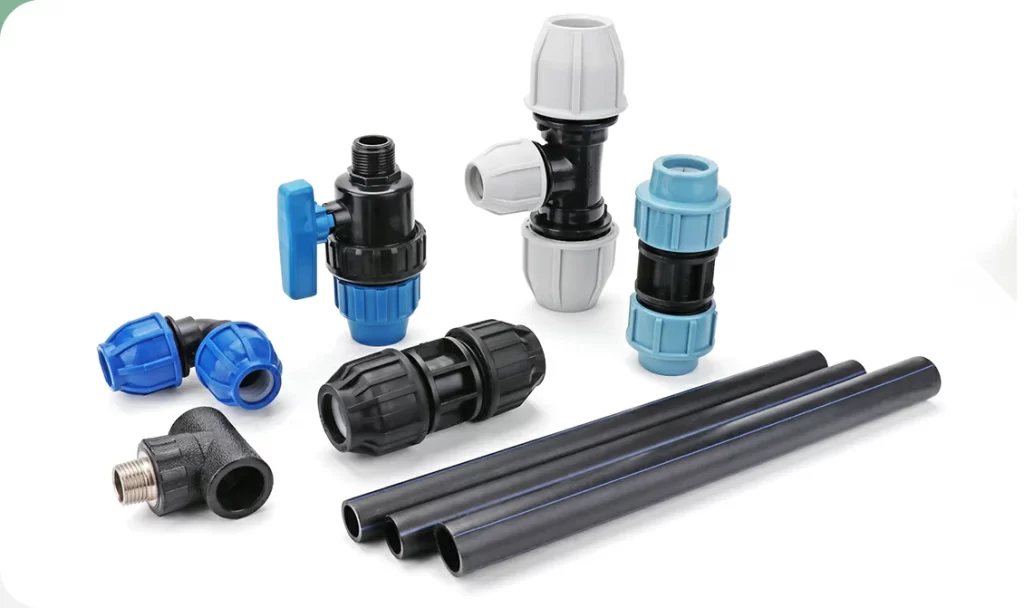
HDPE pipe is pressure pipe extruded from high-density polyethylene, a thermoplastic that is joined by melting rather than gluing or threading. That one property drives almost everything else about it: because a correctly made heat-fusion joint is as strong as the pipe wall itself, an HDPE line has no gasket to fail, no thread to corrode, and no joint to pull apart under ground movement. It is the material most water utilities and gas distributors reach for when they want a buried line they will not have to dig up.
Where buyers get into trouble is the specification, not the material. A purchase order that says “DN110 HDPE pipe” has specified almost nothing — it leaves the wall thickness, the pressure class and the resin classification all open, and those three decide whether the pipe that arrives is worth 10 bar or 20. What follows covers what the designations actually mean, how to audit a pressure claim with arithmetic you can do in your head, what the printed line on the pipe must tell you, and one standard clause still sitting in a great many tender documents that now points at a specification which no longer exists.

Key Takeaways
- HDPE stands for high-density polyethylene. PE100 means the compound has a Minimum Required Strength of 10.0 MPa; PE80 means 8.0 MPa — the number is simply the MRS times ten.
- SDR is outside diameter divided by wall thickness. Pressure follows PN = 20 x 8 / (SDR – 1) for PE100, so SDR17 gives PN10 and SDR11 gives PN16. Quoting a diameter without an SDR quotes nothing.
- The industry’s conservative service-life estimate is 50 to 100 years, and many water installations have already passed 50 years in service.
- A fused HDPE system is self-restrained, so it needs no thrust blocks — provided the whole system is fused and not part-fused, part-compression.
- Butt fusion runs at a heater surface of 400–450 °F (204–232 °C) and 60–90 psi interfacial pressure, and that pressure figure is the same on every pipe size.
- Reject pipe with gouges deeper than 10% of the wall thickness. AWWA M55 says such pipe should not normally be used, and it is the fastest receiving check you have.
- PAS 1075, the specification most buyers still name when they ask for PE100-RC, has been withdrawn. Cite EN 1555 or ISO 4437 instead.
What HDPE Pipe Is, and What the Letters Mean
HDPE stands for high-density polyethylene. As a pipe material it sits in a family with MDPE and PE-RT, and what separates the grades is not the plastic’s name but its measured long-term strength. The designation you will see on a quotation — PE100 or PE80 — comes from a property called Minimum Required Strength, and the number is the MRS multiplied by ten. PE100 means an MRS of 10.0 MPa. PE80 means 8.0 MPa. That naming convention is fixed by ISO 12162, so it means the same thing on a Turkish quote as on a Chinese one.
MRS is not a marketing figure. It is derived by running long-term hydrostatic pressure tests on real pipe, then applying a regression analysis to ISO 9080 and extrapolating the result out to 20 °C and a 50-year design lifetime. In other words, a compound earns the PE100 label by surviving a statistically modelled half-century, not by a supplier’s assertion. This is worth knowing because it is the reason a PE100 pipe from a competent factory and a PE100 pipe from a good one should perform within the same envelope — the classification itself carries a test burden.
PE100 versus PE4710: two systems, not two quality levels
North American buyers see PE4710 where European and Asian buyers see PE100, and a great many sales pages will tell you one is superior. The Plastics Pipe Institute, which owns the North American designation, says otherwise in writing: many PE4710 compounds also achieve PE100 classification under ISO 9080 and ISO 12162, and many PE100 compounds achieve the PE4710 designation.
PPI states directly that its comparison is “not intended to make any statements or claims of technical superiority.” Treat them as two accounting systems for the same underlying performance, and be sceptical of any supplier who frames one as an upgrade over the other.
Where the systems genuinely diverge is at the top end. In the Canadian standards, PE4710 compounds achieving a minimum 2,000-hour PENT result are designated PE 4710 PLUS, and that added confidence buys a higher design factor: 0.40 rises to 0.45 for gas distribution and 0.63 rises to 0.71 for water, per CSA B137.4 and CSA B137.1 respectively. The practical effect, in PPI’s own worked comparison, is that a PE 4710 PLUS pipe at a design pressure of 230 psig now sits level with a PE100 pipe at 232 psig. If someone quotes you those two as materially different products, they are selling a rounding error.
PE100-RC, and the spec clause that is now obsolete
PE100-RC — “Resistant to Crack” — is a genuinely different animal, and it matters when pipe goes in without a sand bed: trenchless pulls, rocky backfill, ploughing. The qualifying test is brutal. Under the notched pipe test to ISO 13479, a PE100-RC compound must survive more than 8,760 hours at 80 °C under 4 N/mm² tensile stress in a 2% surfactant solution. That is one full year of continuous testing on a single sample, which is why RC compounds cost what they do.
Here is the part that catches experienced buyers out. PAS 1075, the 2009 German specification that originally defined PE100-RC and which is still named in a great many purchase specifications, has been withdrawn. The requirements were absorbed into EN 1555 and ISO 4437, and are in progress within EN 12201 and ISO 4427. If your tender document asks for “PAS 1075 compliance,” you are asking suppliers to certify against a standard that no longer exists, and the honest ones will come back with a question while the others will simply say yes. Cite the live standard instead.
There is a second, time-sensitive wrinkle. The test surfactant Arkopal N-100 became unavailable in several markets, and the PE100+ Association’s interim position was to accept existing accelerated notch pipe test reports obtained in Arkopal N-100 only until the end of 2025, with lauramine oxide (sold as Dehyton PL) as the intended replacement.
That acceptance window has now closed. If a mill certificate you are handed rests on an ANPT report dated before 2026, ask the supplier which solution was used and whether the certifier has re-qualified the compound. The pipe is not necessarily wrong — but it is the kind of question that quickly reveals whether you are talking to someone who reads their own paperwork.
SDR, PN and Wall Thickness: The Number That Actually Matters
The single most common sourcing mistake in HDPE is ordering by diameter alone. “DN110 HDPE pipe” describes an infinite family of products with wildly different pressure ratings, weights and prices. The missing variable is SDR — the Standard Dimension Ratio, which is simply the outside diameter divided by the wall thickness. A lower SDR means a thicker wall, a higher pressure rating, a smaller bore, more resin per metre and a higher price.
The relationship between SDR and pressure class is arithmetic, not a lookup table you have to trust. Nominal pressure follows PN = 20σ / (SDR − 1), where σ is the design stress. For PE100, the MRS of 10.0 MPa is divided by the 1.25 design coefficient used for water, giving σ = 8 MPa.
Run the numbers yourself: SDR17 gives 20 × 8 / 16 = 10 bar, SDR11 gives 20 × 8 / 10 = 16 bar, and SDR9 gives 20 × 8 / 8 = 20 bar. You will also see the S-series on European datasheets, where S = (SDR − 1) / 2, so SDR11 is S5. Knowing this formula means you can audit any pressure claim on any quotation in about ten seconds.
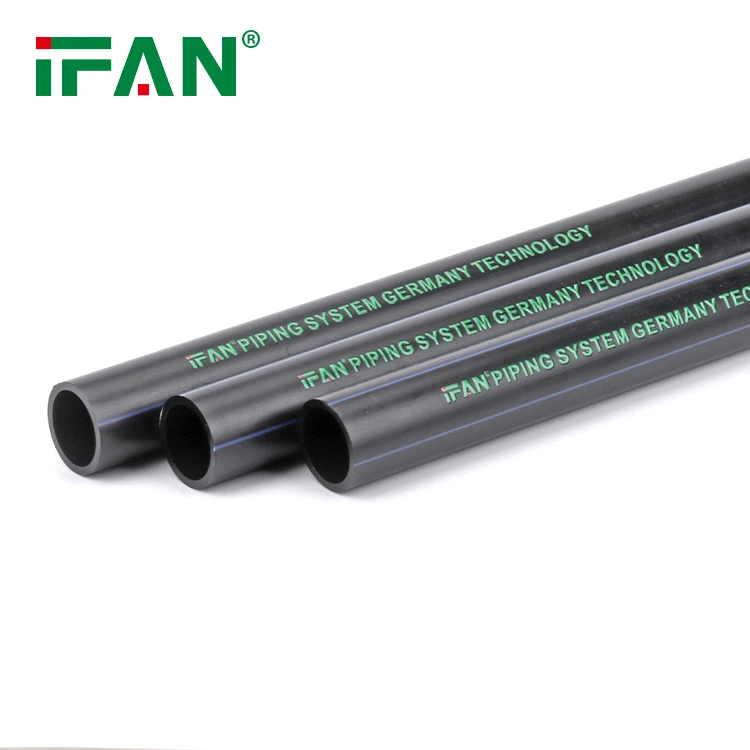
The arithmetic also tells you what a wall thickness should be, which is a useful anti-fraud check. A DN110 pipe at SDR11 must have a 10.0 mm wall, because 110 divided by 11 is exactly 10. At SDR17 the calculation gives 6.47 mm, and published datasheets list 6.6 mm — standard walls round up to the next increment, never down. If a supplier’s DN110 SDR11 pipe measures 8.5 mm on a caliper, it is not SDR11 pipe regardless of what the invoice says, and you have just found a 15% resin saving that came out of your pressure rating.
| SDR | PE100 pressure class | Wall at DN110 | Typical use |
|---|---|---|---|
| SDR9 | PN20 (20 bar) | 12.3 mm | Pumped mains, mining slurry |
| SDR11 | PN16 (16 bar) | 10.0 mm | Potable distribution, trenchless pulls |
| SDR13.6 | PN12.5 (calc. 12.7 bar) | 8.1 mm | General water supply |
| SDR17 | PN10 (10 bar) | 6.6 mm | Gravity-fed and low-head irrigation |
One detail in that table is worth flagging, because it trips people who check the arithmetic. SDR13.6 computes to 12.7 bar, but the pipe is designated PN12.5. Nominal pressure classes are drawn from a standard preferred-number series, so the calculated value is rounded down to the next class in the series — never up. Where a calculated figure and a designated class differ, the designated class is the one that governs, and it is always the more conservative of the two.
Pressure classes assume water at 20 °C. Polyethylene loses strength as it warms, so a line running hot process water or sitting exposed in a desert climate must be de-rated against the manufacturer’s temperature table — a PN16 pipe is not a PN16 pipe at 40 °C. If you need the full diameter-by-diameter breakdown rather than the four rows above, our HDPE pipe sizes reference sets out the dimensional ranges in detail.
How to Read an HDPE Pipe Marking Line
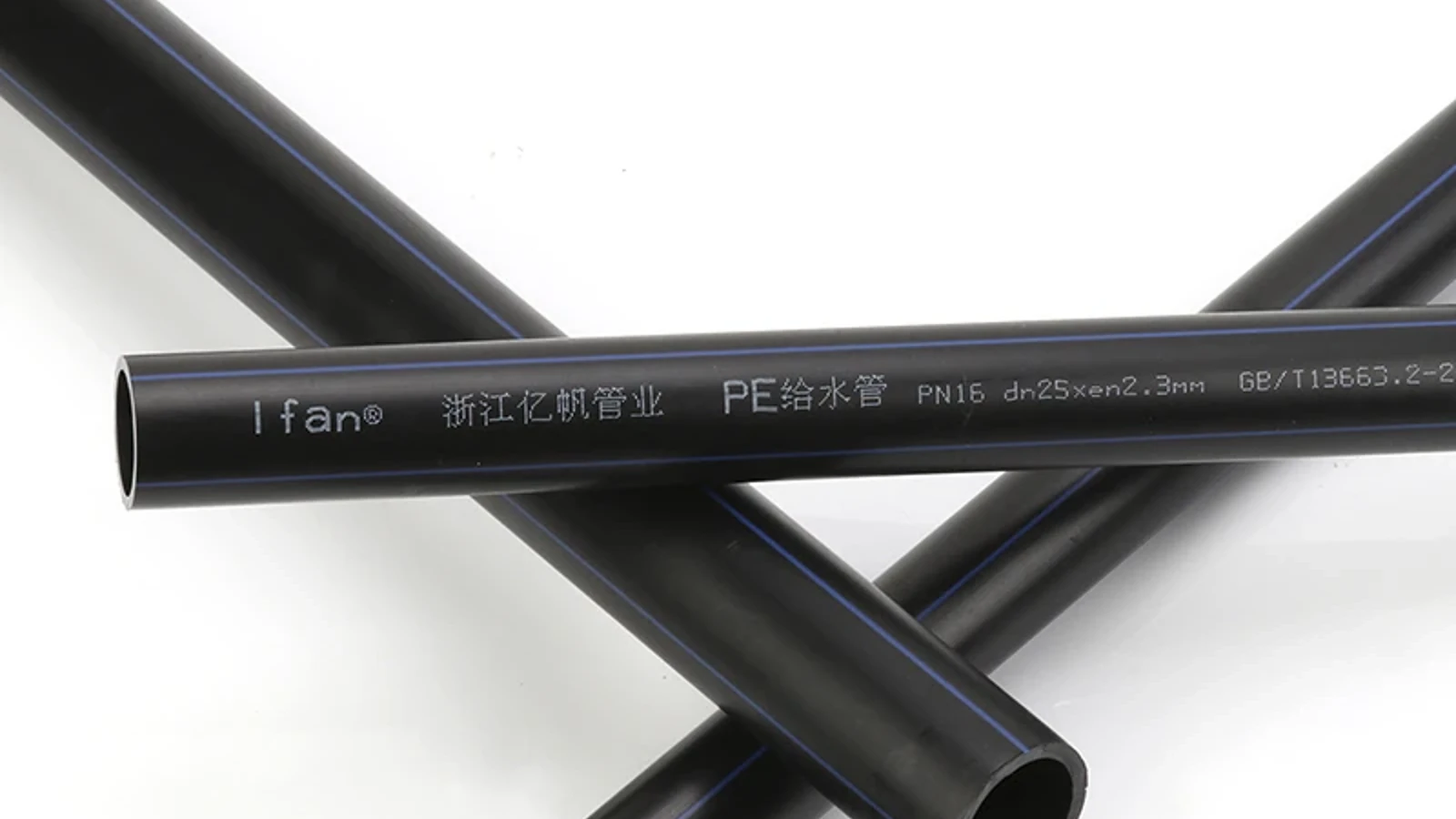
Every legitimate length of HDPE pressure pipe carries a printed line running along its wall. This is not decoration and it is not branding — it is the pipe’s identity document, and it is the only piece of evidence that travels with the product all the way to the trench. A certificate can be emailed for a batch you never received. The marking line is physically on the pipe in your hand.
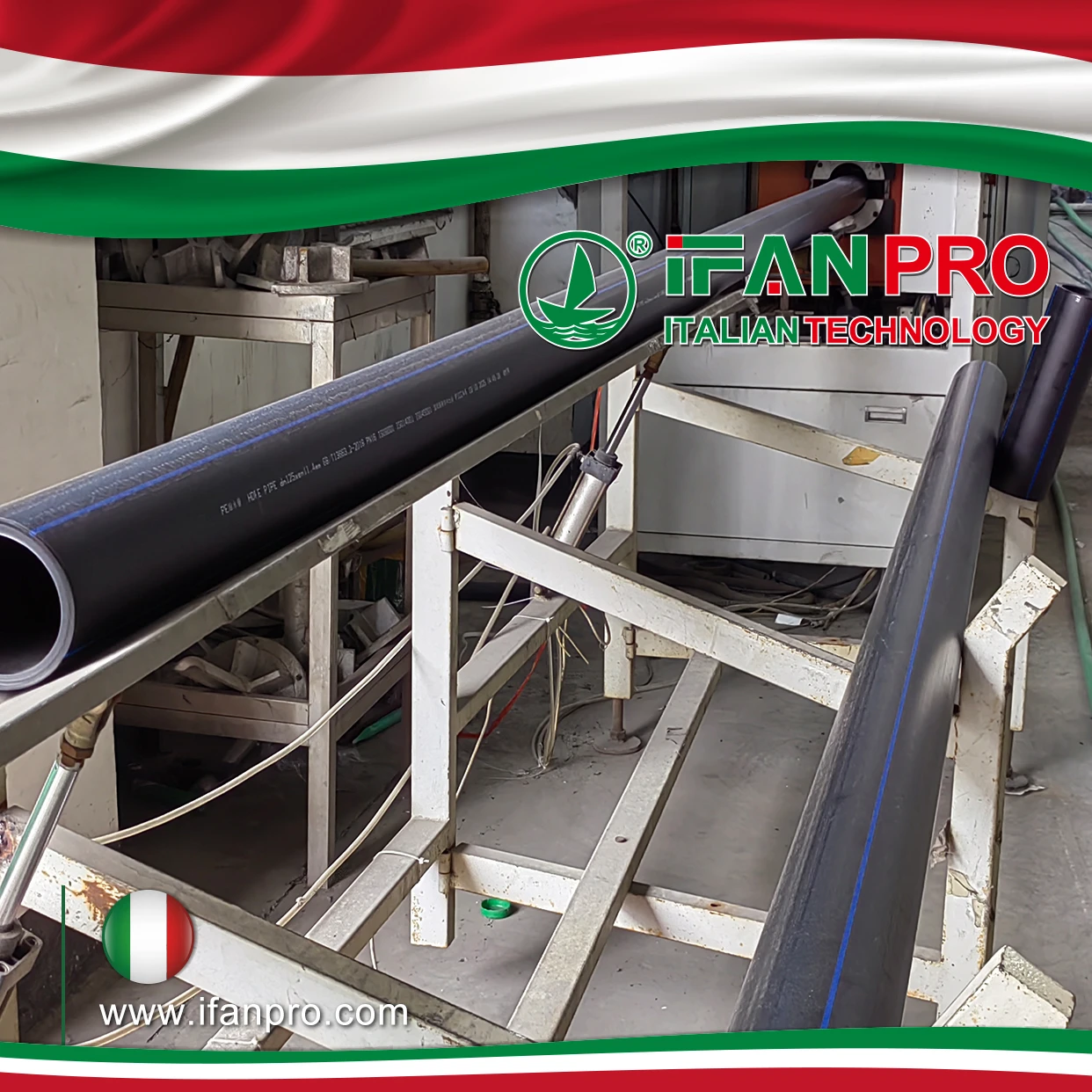
A complete marking line should let you reconstruct the entire specification without opening a single document. Expect to find the manufacturer’s name or mark, the material designation (PE100, PE80, or PE100-RC), the nominal diameter and SDR or wall thickness, the pressure class, the product standard the pipe was made to, the application, and a production date and batch or shift code.
Colour coding carries meaning too. Black pipe with blue co-extruded stripes signals potable water in most markets and yellow or orange stripes signal gas, but the stripe convention varies enough between countries that it is worth confirming against local practice rather than assuming.
The batch and date code is the field most buyers skip and the one that matters most when something goes wrong. Without it, a failure eighteen months into service is untraceable — you cannot tell the factory which production run to investigate, and you have no way of proving the failed length came from the consignment in dispute. A marking line that carries a brand and a diameter but no standard, no SDR and no date code is not a compliant marking; it is a label. Photograph the marking line on arrival, before the pipe goes anywhere near a trench.
One insider warning on colour. Black is not an aesthetic choice. Carbon black is the most effective ultraviolet stabiliser available for polyethylene, which is why black is the recommended colour for long-term exposed service or outdoor storage — the same reason power-line cable jacketing is black.
HDPE pipe in non-black colours can be supplied for outdoor use, but its life expectancy is much shorter and is normally specified for a defined exposure period. If a supplier offers you an all-blue or all-green pipe for an above-ground run at a tempting price, that is a specification decision with a service-life consequence, not a cosmetic upgrade.
How HDPE Pipe Is Joined
HDPE cannot be solvent-welded like PVC and cannot be threaded without losing wall. It is joined by melting, and there are three practical routes: butt fusion, electrofusion, and mechanical compression. The first two produce a monolithic joint. Butt fusion facing two pipe ends and pressing them together under controlled heat and pressure produces a joint where, when it is destructively tested, failure occurs outside the fused area entirely — the joint is stronger than the pipe.
The parameters are not negotiable and they are not proprietary. The Plastics Pipe Institute’s generic procedure, which underpins ASTM F2620, specifies a heater surface temperature of 400–450 °F (204–232 °C) and an interfacial pressure of 60–90 psi (4.14–6.21 bar).
The detail worth internalising is that the interfacial pressure figure is constant across every pipe size and every fusion machine. What changes is the gauge pressure the operator dials in to achieve it, which depends on the machine’s cylinder area and the pipe’s cross-section. An operator who runs the same gauge reading on a DN63 and a DN250 joint has made one good joint and one bad one.
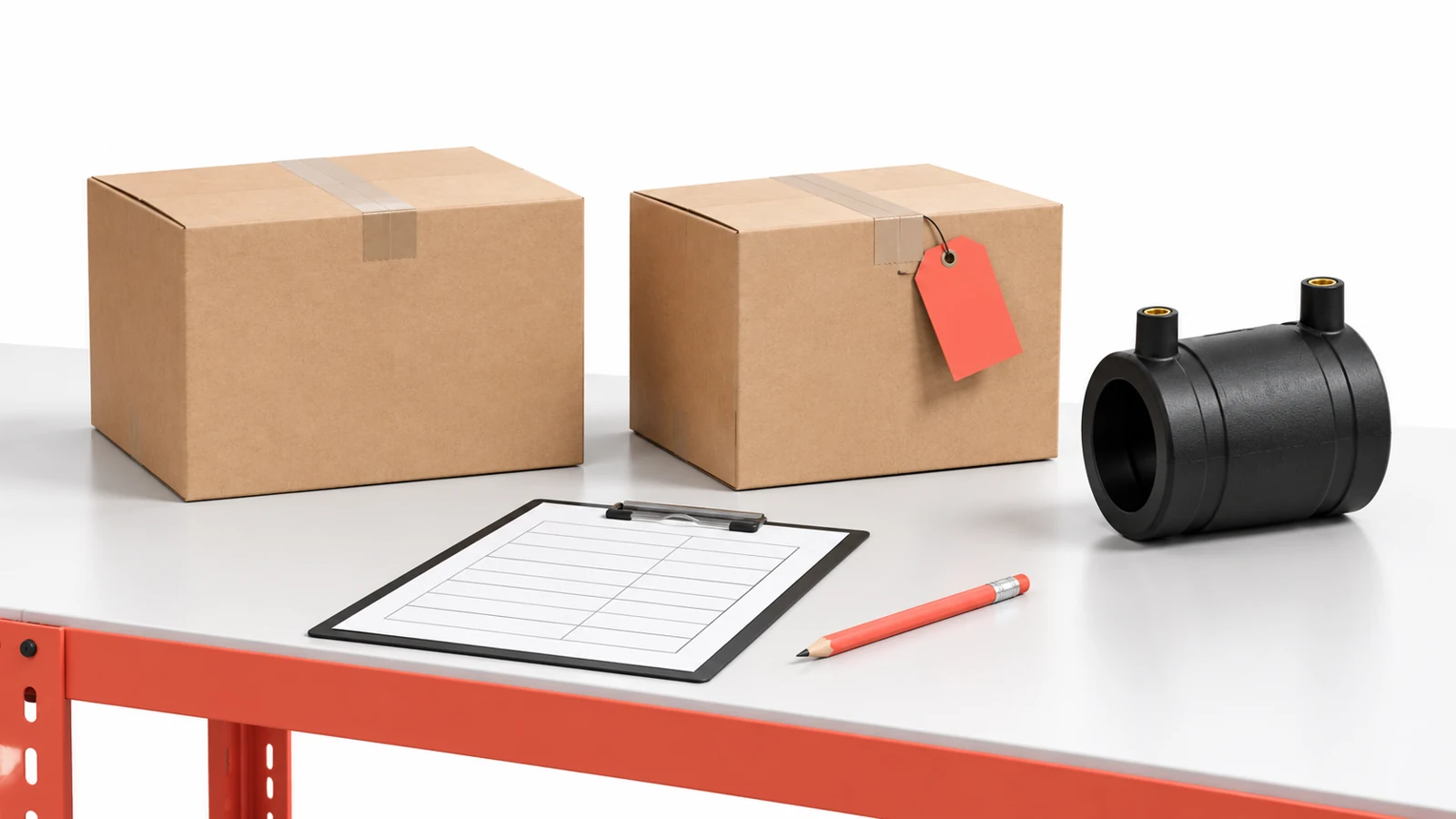
Electrofusion works differently: a moulded coupler with an embedded resistance wire is slid over two prepared pipe ends and energised, melting the interface from within. It is covered by ASTM F1055 for the fittings and ASTM F1290 for the joining practice.
As a rule of thumb, butt fusion tends to win on cost and speed once you are running long stretches of larger pipe, while electrofusion earns its higher per-joint cost on tie-ins, repairs, small-diameter services, and anywhere a trench is too tight to swing a butt machine into. Most real projects use both — butt fusion for the trunk, electrofusion for the connections.
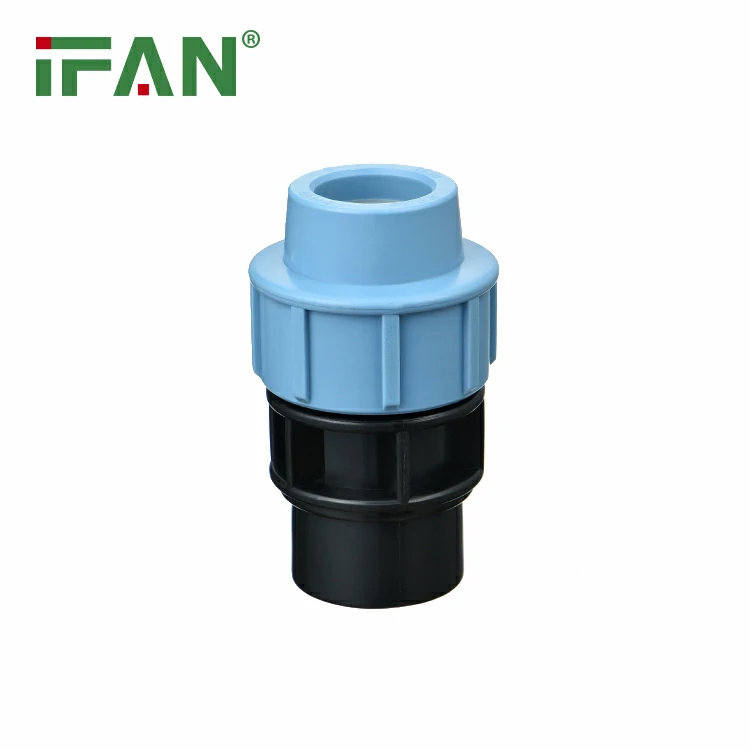
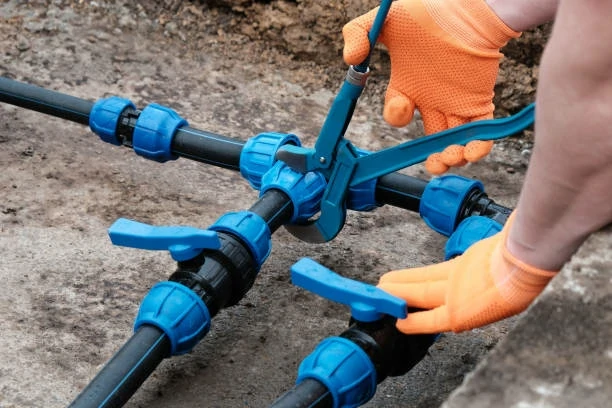
Mechanical compression is the third route, and it is the one most buyers of small-diameter HDPE actually encounter. It needs no power, no machine and no certified operator, which is why it dominates irrigation and rural water work.
One consequence of fusion that shows up in the civil budget rather than the pipe budget: a fully fused HDPE system is self-restrained in all applications and therefore needs no thrust blocks. That deletes concrete, formwork and cure time from every bend and tee on the job. The caveat carries real teeth, though — the exemption holds only if the entire system is fused. Introduce gasketed mechanical fittings at the bends and the restraint assumption breaks, and thrust blocks come back. Our guide to HDPE pipe fusion covers the procedure and the joint-inspection detail in full.
What IFANPRO Supplies, and Where We Stop
Most pages answering this question are written by companies selling extruded pipe, which quietly shapes what they tell you. It is worth being explicit about the opposite case. IFANPRO’s HDPE line is fittings and valves, not pipe. The live HDPE pipe and fittings catalogue lists 37 products — compression sockets, elbows, tees, cross tees, end caps, ball and equal valves, saddle clamps and alignment nerves. There is no extruded pipe in it, and you should not read this article as an argument that there is.
The range has a hard dimensional ceiling that is worth knowing before you build a bill of materials around it. Compression elbows and equal valves run D20, D25, D32, D40, D50, D63, D75 and D90 — the range stops at D90. Saddle clamps go further, from Ø25 up to Ø110, with threaded outlets from ½ in to 2 in depending on the body size, and they are rated PN10. That PN10 figure is the one to hold on to: a PN10 saddle on a PN16 main caps that branch at 10 bar no matter what the pipe is rated for.
So the honest boundary is this. Below D90, compression fittings are a legitimate and often better answer than fusion — no machine, no operator qualification, no power on site. At D90 and above, and on any main where every joint must be monolithic, you need butt fusion or electrofusion, and you need a pipe supplier rather than a fittings supplier. A vendor who tells you compression will serve a DN200 pressure main is selling you what they stock instead of what the job needs.
On the manufacturing side, IFANPRO has been making piping products since 1993 and runs a 120,000 m² plant with more than 600 employees, over 50 R&D and technical staff and more than 200 production and testing machines. Company-level approvals across the wider product range include ISO 9001 and ISO 14001 alongside CE, WRAS, NSF/IAPMO, Intertek, EAC, Watermark and SAI Global.
What none of that tells you is which resin grade an individual HDPE fitting is moulded from, or which certificate number covers it. Ask for the specific mill certificate and the certificate serial for the exact SKU and market you are buying for — from us or from anyone else. A company-level certification list is not the same document as a product-level certificate, and treating the two as interchangeable is how non-compliant material reaches a site.
Where HDPE Pipe Is Actually Used
The headline applications are potable water distribution, gas distribution, sewer and industrial effluent, mining slurry, irrigation, fire mains, and electrical and telecoms conduit. For potable water, the governing North American standards are ANSI/AWWA C906-21 for 4 in through 65 in (100 mm through 1,650 mm) and AWWA C901-25 for ¾ in through 3 in (19 mm through 76 mm).
Both editions are worth quoting precisely, because a great many supplier pages still cite C906-15. The 2021 revision widened the top of the size range from 63 in to 65 in and retitled the standard from “water distribution and transmission” to “waterworks.” Internationally the equivalent references are ISO 4427 and EN 12201; the current published ISO edition is the 2019 text, with a revision in committee.
For drinking-water work, the certification to look for is NSF/ANSI/CAN 61, which sets minimum criteria for evaluating the health effects of materials in contact with drinking water. Its scope explicitly covers pipes and fittings, couplings, tubing, service saddles and valves, and names polyethylene among the plastics it addresses. It is required by most states and provinces across the United States and Canada, though what a specific project needs depends on the market, the application and the specifying authority — confirm current requirements with the relevant authority rather than assuming a certificate travels.
Supply format shapes freight cost more than most first-time importers expect. HDPE pipe ships as coils, reels or straight lengths. Coils are normally available at 2 in and smaller, and a single coil may hold 1,000 feet or more of pipe; 3 in, 4 in and 6 in can be coiled or reeled as well, but at 3 in and above straight lengths are common and typically run 40 ft or 50 ft.
The trade-off is direct. Coiled pipe means dramatically fewer joints per kilometre of trench, which is where HDPE’s installed-cost advantage actually comes from, but straight lengths load more predictably into a container. Work this out before you fix an Incoterm, not after.
Burial depth is a question that gets answered badly online. Safe depths should be calculated for the actual soil and loading. In lieu of calculation, AWWA guidance — as summarised by PPI — is that for an embedment soil with an E′ of 1000 psi and no surface water, HDPE pipes in the DR 7.3 to 21 range can be safely buried from 2 ft to 25 ft where no traffic load is present, and from 3 ft to 25 ft under H20 live load.
Those soil and water conditions are part of the figure, not footnotes to it. Strip them out, as most sites quoting “2 to 25 feet” do, and the number stops being usable by anyone actually specifying a job.
Is HDPE Pipe Right for Your Project?
HDPE is not universally the right answer, and a supplier who says it is has stopped being useful to you. Its advantages cluster around ground movement, corrosion, joint integrity and installed cost per joint. Its disadvantages cluster around temperature, UV exposure of non-black product, the capital and skill required for fusion, and the fact that it needs more wall than a stiffer material to hit the same pressure — which means more resin, more weight and more freight per metre of bore.
| Best for | Not ideal for |
|---|---|
| Buried mains in unstable, seismic or expansive soils | Hot water and process lines above ambient, where PE de-rates fast |
| Trenchless work — directional drilling, pipe bursting, slip-lining | Exposed runs in non-black pipe, where UV life is much shorter |
| Corrosive ground, saline soils, aggressive effluent, mining slurry | Small one-off jobs where no fusion machine or trained operator exists |
| Irrigation and rural water, where coils cut joint counts per hectare | Tight-bore retrofits where wall thickness steals too much flow area |
| Freeze-prone lines — frozen HDPE expands with the ice rather than rupturing | Uncased crossings beneath railway mainlines, which specs usually forbid |
Two of those rows deserve expansion because they are commonly misreported. On freezing: when water freezes solid inside an HDPE pipeline it will not rupture the pipe — the pipe expands with the ice. This is a genuine and unusual advantage over rigid materials. It does not make the line usable while frozen, and thawing must be done with heat tracing or blankets, never with a torch or arc welder, which will destroy the pipe.
On flow: the internal bead left by butt fusion is frequently raised as an objection, and field testing settles it. A Hazen-Williams C-factor of 150 correctly predicts real flow in fusion-joined PE pipe with the internal bead present, and PPI states the bead is of no hydraulic significance for either pressure or flow.
On service life, be careful which number you repeat. The polyethylene pipe industry’s own conservative estimate is 50 to 100 years, and many water installations are already past 50 years of successful service. PPI separately notes that the 500-hour PENT requirement behind PE4710 translates to well over 100 years of service life — but attaches the condition “for properly installed and operated systems,” and that condition is doing real work.
A century-long design life describes the material’s potential under correct installation, not a warranty on a badly fused joint in a rocky trench. If you want the comparison against the obvious alternative, our HDPE versus PVC underground durability guide takes it further.
What to Check Before You Accept a Delivery
This is a documented receiving procedure any buyer can run without specialist equipment. None of it requires trusting the supplier’s word, which is the point — every item is something you can verify with a caliper, a tape and a camera on the day the truck arrives.
- Measure the wall, do not read it. Caliper the wall at four points around the circumference on at least three random lengths per batch. Divide the OD by your measurement: it must return the SDR on the invoice. This single check catches the most common and most profitable form of substitution.
- Photograph the marking line before offloading. Confirm it carries material designation, diameter, SDR or wall, pressure class, standard, and a date and batch code. A marking without a batch code leaves you unable to trace a failure later.
- Apply the 10% gouge rule. Scarring up to 10% of the wall thickness is generally tolerable, and AWWA M55 states that minor scratches or scuffing will not impair serviceability. Pipe with gouges or cuts deeper than 10% of the wall should not normally be used. On a 10.0 mm wall, that threshold is 1.0 mm — shallower than most people assume when they wave a damaged coil through.
- Check the standard named on the pipe against the one in your contract. A pipe marked to a national standard you have never specified is not automatically wrong, but it is a conversation to have before the pipe is in a trench rather than after.
- Ask which material designation and which test basis the mill certificate rests on. If PE100-RC is specified, check the standard cited is a live one — EN 1555 or ISO 4437 — and not withdrawn PAS 1075, and ask which surfactant the notch testing used given the post-2025 transition.
- Verify colour against the application. Black with the correct stripe convention for your market, and black rather than a solid colour anywhere the pipe will be stored outdoors or run exposed.
A note on what these checks cannot do. None of them proves the resin was virgin rather than recycled, and no visual inspection will. That determination requires a melt flow rate test, a density check, or a carbon black content and dispersion test against the relevant standard, run on a sample by a third-party laboratory. If you are buying at container volume from a new supplier, the cost of one independent test on the first shipment is trivial against the cost of discovering the answer through a burst main.
A Worked Example: Specifying a DN110 Irrigation Main
Take an illustrative case: a buried irrigation main, DN110, running at a working pressure of 9 bar with a pump on the line, in ordinary soil at ambient temperature, with branch offtakes to lateral lines. Here is how the decisions chain together, and where each number in this article actually lands.
Start with pressure and work backwards to SDR. A 9 bar working pressure rules out SDR17 immediately, because PN10 leaves almost no margin for the surge a pump start puts into the line. SDR11 at PN16 gives 16 bar against a 9 bar duty — comfortable headroom for surge without paying for SDR9. Fix that and the wall thickness follows arithmetically: 110 ÷ 11 = 10.0 mm, and that is the figure your caliper must find on delivery.
Material is PE100 unless the installation method argues otherwise. If the line is being ploughed in or pulled through rocky ground without a sand bed, the case for PE100-RC becomes real, and the specification should then cite EN 1555 or ISO 4437 rather than the withdrawn PAS 1075.
Now the joints, which is where the cost sits. At DN110 the pipe arrives in straight lengths rather than coils, so the trunk is butt-fused at 400–450 °F and 60–90 psi interfacial pressure, with the operator computing gauge pressure from the machine’s cylinder area rather than reusing yesterday’s setting. Because the trunk is fully fused, no thrust blocks are needed at the bends — a genuine saving in concrete and cure time.
The branch offtakes are a different decision. Tapping a live main for laterals is precisely what a saddle clamp is designed for, and at Ø110 with a 1 in or 1½ in threaded outlet, that is inside the range of a PN10 saddle clamp. Note the mismatch to watch: a PN10 saddle on a PN16 main caps that connection at 10 bar, which is fine against a 9 bar duty but leaves no room if the system pressure is later raised.
Finally, burial. In an embedment soil around E′ 1000 psi with no surface water and no traffic, the AWWA-derived envelope for DR 7.3 to 21 puts safe cover between 2 ft and 25 ft; where farm vehicles cross the line, the H20 live-load case lifts the minimum to 3 ft. Specify cover against the crossing points, not the easy stretches. The whole chain — 9 bar duty, SDR11, 10.0 mm wall, PE100, butt-fused trunk, PN10 saddles at Ø110, 3 ft minimum cover under crossings — comes from four numbers and one standard, and every one of them is checkable on site.
Conclusión
HDPE pipe earns its place through fused joints that outlast the pipe wall, tolerance of ground movement and corrosion, and a service life the industry conservatively puts at 50 to 100 years. But almost every expensive mistake with it comes from an incomplete specification rather than a bad material — a diameter with no SDR, a colour chosen for looks, a withdrawn standard copied forward into a tender, or a caliper that never came out of the toolbox on delivery day.
If you are specifying or buying HDPE, the highest-value next step is to fix your SDR and pressure class before you request pricing, so the quotes you receive are actually comparable. From there you can work out whether your connections fall inside the compression range or need fusion, and what documentation you will ask for on arrival.
Frequently Asked Questions
What does HDPE stand for?
High-density polyethylene. In pipe, it is graded by long-term strength rather than by name, so a quotation will say PE100 or PE80 rather than simply HDPE.
Why is most HDPE pipe black?
Carbon black is the most effective UV stabiliser for polyethylene, so black is the recommended colour for exposed service or outdoor storage. Non-black pipe can be supplied but its outdoor life expectancy is much shorter.
Does the internal fusion bead restrict flow?
No. Field testing confirms a Hazen-Williams C-factor of 150 correctly predicts flow in fusion-joined PE pipe with the bead present, and PPI states the bead has no hydraulic significance for pressure or flow.
Will HDPE pipe burst if the water inside freezes?
It will not rupture; the pipe expands with the ice. Thaw it with heat tracing or heat blankets only — never a torch or arc welder, which will damage the pipe permanently.
How long is HDPE pipe supplied in?
Coils are normal at 2 in and smaller and may hold 1,000 ft or more; 3 in to 6 in can be coiled or reeled. At 3 in and above, straight lengths are common and typically run 40 ft or 50 ft.
Can HDPE pipe be buried under a railway line?
It is structurally capable, but direct burial under a railway mainline is not recommended unless encased. Most railway specifications require encasement for pressurised pipes regardless of material.










 Español
  English
  Français
  Русский
Comentarios recientes