
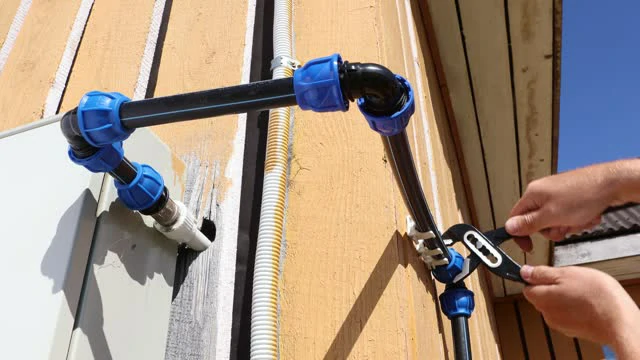
The number in PE80 and PE100 is not a pressure rating, a wall thickness, or a quality score. It is the resin’s minimum required strength in megapascals, multiplied by ten. PE100 means MRS 10,0 MPa. PE80 means MRS 8,0 MPa. That single number is the largest cost-and-performance lever in an HDPE tender, and it is invisible once the pipe is in the trench.
PE100-RC adds a third option that confuses procurement more than either of the first two, because it changes nothing a buyer can measure with a tape. Same MRS. Same wall for the same SDR. Same pressure class. What it changes is how long the pipe survives a stone pressing into its wall — and whether your installer can skip the sand bed entirely.
Key takeaways
- The grade number is the MRS in MPa times ten. ISO 4427-1:2007 Table 3 assigns PE 100 an MRS of 10,0 MPa and a design stress of 8,0 MPa; PE 80 gets 8,0 MPa and 6,3 MPa.
- That design stress comes from dividing MRS by an overall service coefficient of C = 1,25. It is the design stress, not the MRS, that sizes your wall.
- PE100-RC has the same MRS as PE100. It buys no extra pressure and no extra wall — only slow-crack-growth resistance.
- The headline “500 hours versus 8,760 hours” is a real test, but only means something with its geometry attached: notched pipe, 110 or 125 mm SDR 11, 80 °C, water-in-water.
- PAS 1075 — the German specification most RC marketing still cites — was withdrawn in February 2020. PE100-RC now lives in the revised EN 12201 and ISO 4427 series.
- Substitution is caught at the marking line and the compound certificate, not by looking at the pipe.
On this page
- What the number in PE80 and PE100 actually certifies
- How a resin earns its MRS: inside ISO 9080 regression
- The test grid that separates PE80 from PE100 in an actual batch
- What PE100-RC buys, and what it does not
- When RC stops being optional: laying method decides
- The specification trap: PAS 1075 was withdrawn in 2020
- Verifying the grade you actually received
- Specifying the grade with confidence

Background viewing: “HDPE Pipe Standards” from the Alliance for PE Pipe, an independent industry association. Click to play on YouTube.
What the Number in PE80 and PE100 Actually Certifies
Minimum required strength is a stress value, expressed in megapascals, that the resin is certified to withstand continuously for fifty years at 20 °C. ISO 12162 defines how that value is classified and designated. The naming convention is simply the MRS multiplied by ten, which is why the ladder has gaps in odd places — PE63 exists because 6,3 MPa is a step on a preferred-number series, not because someone chose a round figure.
Here is the part that matters for your wall thickness, and the part most buyer-facing pages leave out. The MRS is not the stress your pipe is designed against. It gets divided by an overall service (design) coefficient before anything is sized.
| Designation | MRS (MPa) | Design stress σs (MPa) | What it means on a tender |
|---|---|---|---|
| PE 100 | 10,0 | 8,0 | Thinnest wall for a given pressure class; the default for new mains |
| PE 80 | 8,0 | 6,3 | Needs more wall for the same pressure; still a valid designation |
| PE 63 | 6,3 | 5,0 | Legacy and low-pressure duty |
| PE 40 | 4,0 | 3,2 | Small-diameter and service-connection duty |
Source: ISO 4427-1:2007, Table 3. The design stress column is derived from the MRS by applying the overall service coefficient C = 1,25. The standard notes that a higher coefficient may be used — at C = 1,6, PE 80’s design stress falls to 5,0 MPa.
Why the PE80-to-PE100 step is worth arguing over
Going from PE80 to PE100 raises design stress from 6,3 to 8,0 MPa — about 27% more allowable stress. In practice that means a thinner wall at the same pressure, or a higher pressure at the same wall. A supplier who quotes PE100 pricing and ships PE80 has sold you a pipe that is under-rated for the class printed on the drawing, and nothing about its appearance will tell you.
What the grade number says nothing about
The designation is a long-term hydrostatic strength classification and nothing else. It does not describe the pipe’s dimensions — that is the job of the SDR and pressure class, covered in our HDPE pipe sizing and pressure rating reference. It does not describe how the pipe is joined, and it does not, on its own, tell you how the material behaves once its surface is scratched. That last omission is exactly the gap PE100-RC exists to fill.
How a Resin Earns Its MRS: Inside ISO 9080 Regression
Nobody waits fifty years to certify a resin. The MRS is an extrapolation, and knowing how it is produced tells you which document to ask for and, more usefully, whom to ask.
The chain runs like this. Pipe samples are pressure-tested under ISO 1167-1 across a spread of stresses and temperatures. Those failure points feed a regression analysis under ISO 9080 — Determination of the long-term hydrostatic strength of thermoplastics materials in pipe form by extrapolation. The regression produces σLPL: the 97,5 % lower confidence limit of predicted hydrostatic strength at 20 °C for fifty years. ISO 12162 then rounds that value down to the next smaller step on a preferred-number series, and the result is the MRS.
The clause almost nobody quotes. ISO 4427-1:2007 clause 4.6 adds a disqualifier for PE 100 specifically: in the ISO 9080 determination, the detection of a knee on the 80 °C extrapolation curve before 5 000 h is unacceptable. A “knee” is the point where the failure mode turns brittle and the curve bends downward. A resin that bends early cannot be classified PE 100 no matter how well it performs in short tests.
Who holds the certificate — and it is not your pipe supplier
The same clause states that the ISO 9080 classification of the compound shall be certified by the compound producer. This is the single most useful procedural fact on this page. The MRS classification belongs to the resin maker — the company that polymerised the compound — not to the extruder who turned it into pipe.
So when a supplier answers a grade query with their own ISO 9001 certificate or their own factory test report, they have answered a different question. The document that establishes PE100 is the compound producer’s classification, plus a traceable link from that compound batch to your pipe batch. Ask for both, by name, in the RFQ rather than after delivery.
The Test Grid That Separates PE80 From PE100 in an Actual Batch
A certificate covers a compound. A batch test covers what actually arrived. ISO 4427-2:2007 sets three hydrostatic conditions that every pipe must survive, and the stress values differ by grade — which is precisely why this grid catches substitution when a visual inspection cannot.
| Condition | Test period | Hoop stress, PE 80 | Hoop stress, PE 100 |
|---|---|---|---|
| 20 °C, water-in-water | 100 h | 10,0 MPa | 12,4 MPa |
| 80 °C, water-in-water | 165 h | 4,5 MPa | 5,4 MPa |
| 80 °C, water-in-water | 1 000 h | 4,0 MPa | 5,0 MPa |
Source: ISO 4427-2:2007, Table 3. Three test pieces per condition, with no failure of any test piece during the test period.
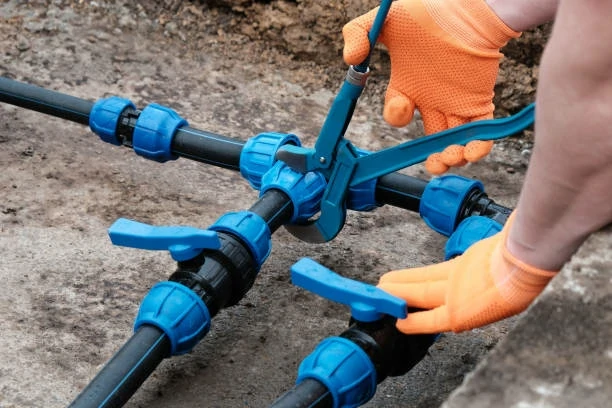
Read the failure mode, not just the clock
The 80 °C / 165 h condition carries a rule that matters if you ever read a test report properly. A fracture in a brittle mode in less than 165 h is a failure, full stop. But if a sample fails in a ductile mode inside 165 h, the standard allows a retest at a lower selected stress, against a longer required time taken from a defined stress-time line. Ductile failure means the material stretched and tore; brittle failure means a crack ran through it.
A report showing a retest is not automatically a red flag — but a report showing brittle failure inside 165 h is a rejection, and a report that does not state the failure mode at all is incomplete for the purpose you are using it for.
What PE100-RC Buys, and What It Does Not
Start with the negative, because this is where most procurement money is wasted or most engineering confidence is misplaced. PE100-RC has the same MRS as PE100. Same 10,0 MPa. Consequently the outer diameter, wall thickness and SDR relationship are identical, and the pressure class is identical. Specifying RC does not let you go thinner, and it does not let you go to a higher PN.
RC stands for resistance to crack, or raised crack resistance — the PE100+ Association’s designation guidance sets out the naming. Outside Europe the same material is designated PE100-HSCR, for high stress crack resistance. The entire difference between PE100 and PE100-RC is confined to one property: resistance to slow crack growth, the mechanism by which a small surface defect propagates through the wall over years under stress.
The baseline the famous number is measured against
You will see “500 hours versus 8,760 hours” quoted constantly with no context, which makes it useless in a purchase order. Here is the context. ISO 4427-1:2007 Table 2 sets the slow-crack-growth acceptance for a PE 100 compound as an ISO 13479 notch test on 110 mm or 125 mm SDR 11 pipe, at 80 °C, water-in-water, at an internal test pressure of 9,2 bar, for 500 h with no failure. For PE 80 the pressure is 8,0 bar; for PE 63, 6,4 bar.
The 8,760-hour figure — one calendar year — is the same test run to a far longer endurance. Australia’s PIPA guideline states the correlation explicitly: the requirement corresponds to an ISO 13479 test on DN110 SDR11 pipe at 0.92 MPa, 80 °C, water-in-water, with no failure in 8,760 hours. Now the number is specifiable, because it names a pipe size, a pressure and a temperature you can write into a document.
Four tests, not one — the modern RC qualification set
A year-long test is unusable for batch release, so the standards bodies built accelerated equivalents. A resin qualifies as PE100-RC only by passing all four of these, which is a deliberate design decision: it prevents a compound being tuned to win one test.
| Test | Standard | Typical PE100 | Required for PE100-RC |
|---|---|---|---|
| Notched pipe test (NPT) | ISO 13479 | ≥ 500 h, water, 80 °C | ≥ 8 760 h, water, 80 °C — or accelerated ANPT ≥ 300 h in 2% Arkopal N100 at 80 °C |
| Full notch creep test (FNCT) | ISO 16770 | ≥ 300 h, 80 °C, 2% Arkopal N100 | > 8 760 h — or accelerated AFNCT > 550 h at 4 MPa, or > 300 h at 5 MPa, at 90 °C in lauramine oxide |
| Strain hardening test (SHT) | ISO 18488 | <Gp> ≥ 40 MPa | <Gp> ≥ 53 MPa for resin, ≥ 50 MPa for pipe and fittings |
| Cracked round bar (CRB) | ISO 18489 | > 0,9 × 10⁶ cycles | > 1,5 × 10⁶ cycles |
Source: the comparison table reproduced in Annex A of EN 1555-1 and Annex C of EN 12201-1, as published by TEPPFA, the European Plastic Pipes and Fittings Association. The thresholds are independently corroborated by PIPA POP016 Issue 3 (April 2024), which specifies the same SHT ≥ 53 MPa, the same CRB ≥ 1.5 × 10⁶ cycles at an interpolated stress range of 12.5 MPa at 23 °C, and the same AFNCT conditions.
The practical consequence for a buyer: “PE100-RC” on a quotation is meaningless without naming which of these four the supplier can evidence. A single ANPT report is not qualification. Ask which four documents exist and which laboratory issued them.
For distributors and project procurement buying at container volume. Our published HDPE range is compression fittings and valves — saddle clamps and the 606 series — so browse it for the fittings side of a schedule. Pipe grade and pressure-pipe supply are quoted separately on request.
When RC Stops Being Optional: Laying Method Decides
The RC decision is not made by pressure, diameter or fluid. It is made by how the pipe goes into the ground and what sits against it afterwards.
The default installation guidance in most markets is a sand bed around the pipe. That sand exists for one reason: to keep stones from pressing into the pipe wall and creating point loads that initiate slow crack growth. Sand is also expensive to import to site, expensive to place, and it means hauling the excavated soil away. Network owners want to backfill with the material they just dug out, and PE100-RC is the material property that makes that defensible.
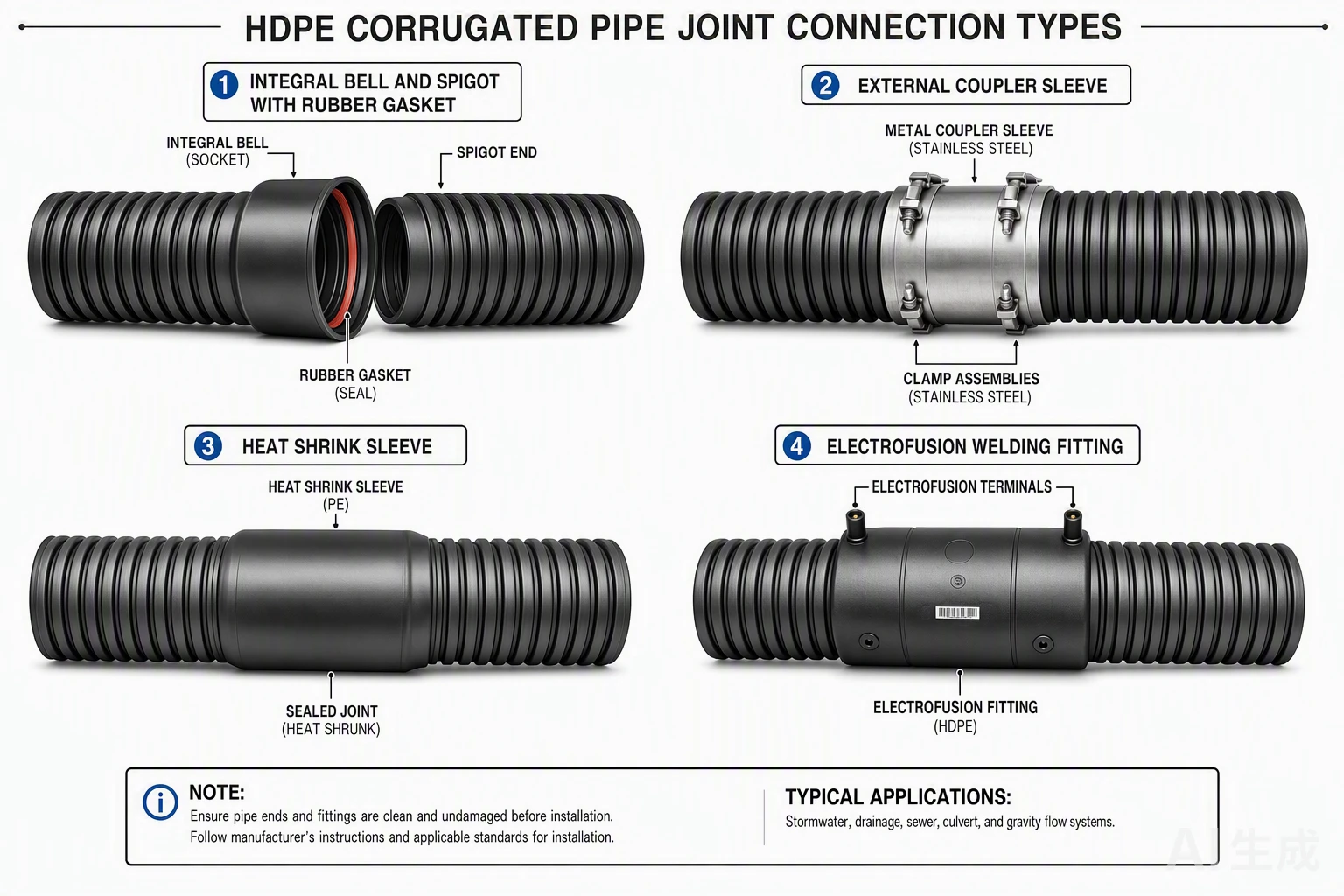
Specify RC when any of these are true
- Trenchless installation. Horizontal directional drilling, mole ploughing, pipe bursting and close-fit relining all drag the pipe against unpredictable ground. These methods are covered by EN ISO 21225-1, EN ISO 21225-2 and EN ISO 11295, and they are where RC’s margin was designed to be spent.
- Sand-free trench with reused excavation soil. The whole commercial case for RC. If the bid assumes native backfill, the resin grade is not optional — it is what makes the backfill assumption survive a design review.
- Stony or rubble-laden native ground. Point loads are the failure mechanism RC is qualified against.
- Abrasive or heavily handled service where scratching during transport and installation is realistically unavoidable.
Standard PE100 remains the right answer when
- The pipe is laid open-cut in a properly sand-bedded trench to the classic guidance, and the bedding line item is actually funded.
- The line is above ground, in-plant, or inside a duct where point loading is not the governing risk.
- Budget is genuinely constrained and the installation method is fully controlled — paying an RC premium to then sand-bed it anyway buys margin you have already bought once.
A worked scenario you can reuse
The situation. A municipal distribution main, DN110, PN16, roughly 4 km, through ground the survey describes as stony clay with cobbles. The contractor proposes open-cut with reused excavated backfill to avoid importing sand, and one 300 m river crossing by HDD.
The decision. Two of the four RC triggers are live at once — trenchless installation on the crossing, and sand-free backfill in cobbled ground over the rest. Standard PE100 here would either force the sand bed back into the budget or accept point-load exposure across 4 km of cobbles for fifty years.
What goes in the specification. PE100-RC to the current EN 12201 series, with the compound producer’s ISO 9080 classification, plus evidence against all four SCG tests — ANPT, AFNCT, SHT and CRB — with the issuing laboratory named. Wall thickness and SDR stay exactly as they would have been for PE100, because the MRS has not changed. That last sentence is the one that stops a value engineer “saving” money by re-deriving the wall.
The Specification Trap: PAS 1075 Was Withdrawn in 2020
Search PE100-RC and you will find PAS 1075 cited as though it were a live German specification. It is not. PAS 1075:2009-04 was published by DIN in 2009 and withdrawn in February 2020. If you are writing a specification today, this matters more than any performance number on this page.
The withdrawal was administrative rather than technical. DIN retired the PAS document class entirely — every PAS document was withdrawn centrally, with DIN SPEC as the successor format — and no DIN SPEC was ever issued carrying PAS 1075’s content. DIN CERTCO, the certification body, absorbed the essential content into its certification scheme, so a DIN-certified PE 100-RC pressure pipe still reflects current practice. But the standard number itself no longer points at a maintained document.
Where PE100-RC actually lives now
The replacement is better than the thing it replaced. With the revision of the EN 1555 and EN 12201 series — and correspondingly ISO 4437 and ISO 4427 — PE100-RC was integrated as a separate material designation, implemented as of 2021. All PE100 requirements still apply to PE100-RC; the RC designation adds the higher slow-crack-growth requirements in the four-test table above. That means the requirement is now publicly standardised and transparently testable rather than resting on a national specification or a private end-user scheme.
The Type 1 / 2 / 3 language you will still be quoted
Suppliers continue to sell against PAS 1075’s pipe-type classification because the market understands it: Type 1 is a monolayer pipe of PE100-RC; Type 2 is a multilayer pipe with at least the outer layer in PE100-RC; Type 3 adds a separate mechanical protective outer layer. The vocabulary is still commercially useful — just recognise that it originates in a withdrawn document, and pair it with the EN/ISO material requirement when you write it down.
Two dated details that catch people out
First, the point load test. PAS 1075’s PLT — the test that simulated a stone pressing on the pipe wall — has no standardised successor. An ISO working group tried, three test institutes could not establish repeatability or a proven correlation, and the draft work ISO/DIS 22102 was stopped. PLT is not part of the revised EN and ISO pressure pipe standards. PE100-RC materials do sustain more than 8 760 hours of PLT at 80 °C with 2% Arkopal N-100 and a hoop stress of 4 N/mm², so a supplier quoting a PLT result is quoting something real — just not something currently standardised.
Second, and more urgent for anyone reading a test report handed over this year: Arkopal N100, the nonylphenol-ethoxylate detergent used in the accelerated tests, has ceased production. The PE100+ Association set an interim measure accepting existing ANPT reports obtained in Arkopal N100, and existing one-year NPT reports where no recipe change had occurred, until the end of 2025. That window has now closed. Lauramine oxide, sold as Dehyton PL, is the intended replacement — and note that it arrives pre-diluted to 30 wt%, so 6,67 wt% of Dehyton PL is needed to reach the specified 2 wt% concentration. If a supplier hands you a qualification report, check which detergent and which date it carries.
Verifying the Grade You Actually Received
Everything above is procurement theory until a truck arrives. Substitution gets caught in two places, and both are checkable on site by someone who knows what to look at.
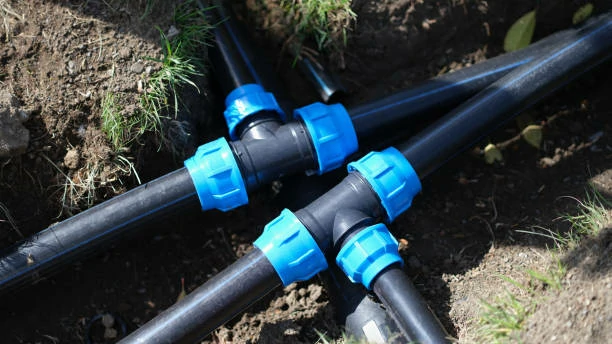
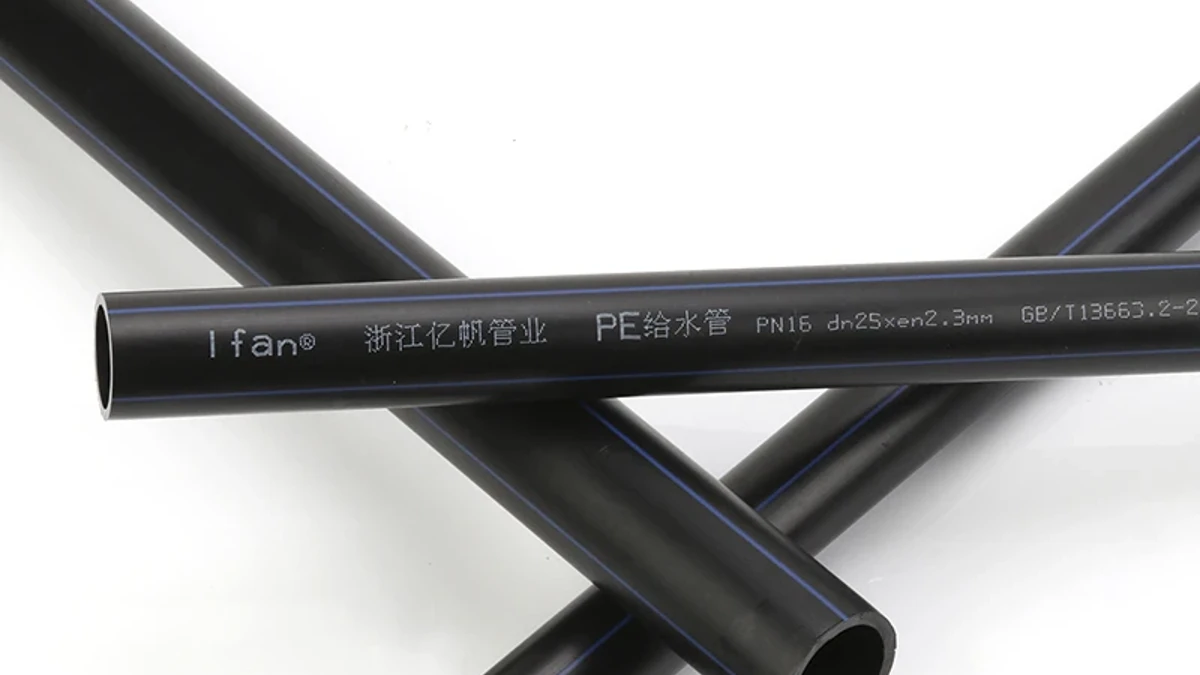
The seven fields on the marking line
ISO 4427-2:2007 specifies a minimum required marking and a frequency of not less than once per metre. Seven fields must be present:
| Field | Standard’s own example |
|---|---|
| Standard number | ISO 4427 |
| Manufacturer’s identification | Name or symbol |
| Dimensions (dn × en) | 110 × 10 |
| SDR series (for DN > 32) | SDR 11 |
| Material and designation | PE 80 |
| Pressure rating in bar | PN 12,5 |
| Production period (date or code) | 0204 |
Note that the standard’s own worked example for the material field reads “PE 80” — the standard is illustrating the format, not recommending the grade. The marking must be permanent, legible without magnification, and printed in a colour that differs from the pipe’s own colour. Coils carry sequential metreage marking showing the length remaining.
The production code is the traceability handle
The production-period field is the one an inspector skips and an auditor lives on. The standard requires it to be in clear figures or in a code providing traceability to the production period within year and month — and, where the manufacturer produces at different sites, to the production site as well. That code is how you tie the pipe in front of you to a specific batch test and to a specific compound delivery.
Why the marking line alone proves nothing
Print is print. Anyone can run “PE 100” through a coder. The marking line is a claim, and it becomes evidence only when it is paired with two documents: the compound producer’s ISO 9080 classification for the resin, and the batch test results against the ISO 4427-2 hydrostatic grid for the production period the code names. A supplier who can produce the marking, the code, the compound certificate and a matching batch report has demonstrated the grade. A supplier who can produce only the marking has demonstrated a printer.
One extra check for layered and RC pipe
If you are buying Type 2 or Type 3 construction, the layers themselves are governed. ISO 4427-2:2007 carries a normative annex for layered pipes covering both a co-extruded outer layer of the same MRS rating and a non-bonded contiguous additional outer layer, with additional marking requirements of its own. A protective skin is not a free-form supplier decision, and asking which annex construction is being supplied is a fast way to establish whether the person quoting you knows their own product.
Where IFANPRO sits, stated plainly
One honest note, because this article is published by a manufacturer and you should be able to calibrate it. IFANPRO’s published HDPE range is compression fittings and valves — saddle clamps and the 606 series — rather than pressure pipe, and our public catalogue does not currently state a resin grade, SDR or pressure-pipe standard for those items. Rather than assert a grade we have not published, we would rather you use the verification method above on whoever supplies your pipe, including us. If you need a grade or a standard confirmed for a specific fitting, ask for it in writing and expect a document, not a reassurance. The same test applies to every supplier on your list.
Specifying the Grade With Confidence
The resin grade is decided by two questions, and only two. What pressure and wall does the design need — which is the MRS question, and PE100’s 10,0 MPa answers it for almost every new main. And what will happen to the pipe wall during and after installation — which is the RC question, and the trench answers it, not the sales sheet.
Write both into the enquiry rather than one. Name the material designation, name the current EN 12201 or ISO 4427 series rather than a withdrawn PAS number, and, where you are specifying RC, name the four tests and ask which laboratory issued each report. On the receiving end, read the marking line at any metre of the delivery and match the production code back to a batch report. A supplier who can answer all of that in one email is a different proposition from one who answers with a brochure — and if you are still assembling the shortlist, our HDPE pipe supplier selection guide covers what else to verify before an order goes out. For the material fundamentals underneath all of this, start with what HDPE pipe is and how it is rated.
Frequently Asked Questions
Does PE100-RC have a higher pressure rating than PE100?
No. Both have an MRS of 10,0 MPa, so for a given SDR the wall thickness and pressure class are identical. RC buys slow-crack-growth resistance only.
What does the 100 in PE100 stand for?
The minimum required strength in megapascals, multiplied by ten. PE100 means MRS 10,0 MPa; PE80 means 8,0 MPa. ISO 4427-1:2007 Table 3 lists the ladder down to PE 40.
Is PAS 1075 still a valid standard for PE100-RC?
No. PAS 1075:2009-04 was withdrawn by DIN in February 2020 when the PAS document class was retired. Specify PE100-RC to the revised EN 12201 or ISO 4427 series instead.
How can I tell PE80 from PE100 on delivery?
Not by eye. Read the marking line, which ISO 4427-2:2007 requires at least once per metre and which must state the material designation, then match the production code to a batch test report.
Which tests must a PE100-RC compound pass?
All four: the notched pipe test or its accelerated ANPT form, the full notch creep test or accelerated AFNCT, the strain hardening test to ISO 18488, and the cracked round bar test to ISO 18489.
Do I need PE100-RC for a normal open-cut trench?
Usually not, if the sand bed is specified and actually funded. RC earns its cost when you skip the sand bed, reuse stony excavated backfill, or install trenchlessly.
Is PE80 obsolete?
No. PE 80 remains a valid designation in ISO 4427-1:2007 Table 3 with a design stress of 6,3 MPa. It simply needs more wall than PE100 for the same pressure class.
What is PE100-HSCR?
The same material class under a different regional name. RC (resistance to crack) is the European designation; HSCR (high stress crack resistance) is used elsewhere, including in Australian industry guidance.











 Русский
  English
  Français
  Español
Последние комментарии