

Keep an HDPE internal fusion bead unless the actual application and project requirements justify removing it. A visible bead or a low-flow complaint does not authorize cutting. First establish the reason for removal, the governing specification and the approved method, then record who can release the work.
This guide helps a pipe buyer, site engineer or installation coordinator prepare that decision. The deliverable is a removal request that distinguishes a documented requirement from an assumption about flow. It does not supply cutting settings or replace the pipe manufacturer’s procedure.
Key Takeaways
- Internal and external beads serve different clearance and inspection questions. Identify which bead the request concerns.
- PIPA’s March 2025 guideline treats internal removal as an exceptional operation, with a possible contaminant-catching case.
- A project specification can require removal even when a general guide describes retaining the bead.
- Tool availability does not establish that the tool, pipe size and procedure are approved for this joint.
- Record joint identity and inspection evidence before removal changes the visible record.
- Cooling, avoiding pipe-wall damage and recovering removed material belong in the proposed method.
Fusion context from ISCO
ISCO’s educational webinar discusses the formation and application context of fusion beads. It does not authorize removal on your project or establish an IFANPRO method. Playback has not been independently witnessed.
View Fusion School House: Conjunction Junction Butt Fusion Function
Identify the actual removal requirement
Start by writing down the operation requested. An internal bead projects into the bore. An external bead projects from the outside surface. Removing an external bead for insertion clearance does not establish an internal hydraulic requirement. A photograph of the outside joint cannot, by itself, describe the complete internal condition.
Then locate the requirement in the documents adopted for the project. Use a specific specification clause, approved drawing or written technical decision. Record its revision and scope. An instruction to inspect fusion joints is different from an instruction to remove internal beads, and an equipment brochure describes capability rather than the authority to alter a pipeline.
PIPA POP003, issue 8.1 of March 2025, describes internal debeading as a significant additional cost that generally provides no hydraulic benefit. It identifies low-flow fluids carrying material that may catch on a bead as a possible reason to specify removal. That guidance supports a conditional decision. It does not prove that every bead has zero effect in every application.
The Alliance for PE Pipe model specification, revision 6/2024, offers another useful reference. Its bead-removal provisions address equipment approval and execution. Treat it as model language for reviewing a proposal unless the project has actually adopted it. A document found online cannot silently become the contract for an existing installation.
A practical first record contains the requested operation, the reason given, the exact authority document and the person responsible for resolving a missing requirement. If the authority field is empty, keep the decision open.
Choose retain, review or controlled removal
A removal request needs an explicit outcome. “Check with the engineer” leaves a crew uncertain about whether work can begin. Name the missing decision, the evidence needed and the release authority. The following table is an editorial coordination aid, not an engineering acceptance standard.
| Evidence available | Provisional outcome | Record before progressing |
|---|---|---|
| No project requirement or demonstrated application reason for removal | Retain the bead while completing ordinary joint acceptance | Applicable procedure and reason removal was not added |
| Flow complaint, debris concern or an unclear instruction | Hold removal and request a defined technical decision | Observed problem, supporting information, unresolved requirement and named decision owner |
| Applicable requirement plus accepted pipe-specific method and authority | Release only the defined removal scope | Joint list, approved equipment and procedure, readiness and inspection requirements |
Retaining a bead is not acceptance of an otherwise defective joint. Joint quality still needs the applicable inspection and testing process. Equally, deciding removal is necessary does not make every proposed cutter suitable. Keep the reason for doing the work separate from the evidence that a method can perform it without unacceptable damage.
Scope matters when passing the decision to a subcontractor. A release for particular joints in an accessible pipe string should not be copied to different pipe dimensions, a different tool configuration or a buried section without checking the new conditions. List the joints and boundaries of the authorized operation so the record survives the handover.
Separate a flow complaint from permission to cut
A line delivering less flow than expected gives the project team an investigation task. It does not identify the internal fusion bead as the cause. Gather the design basis, actual pipe dimensions, installed route, component information and the conditions under which flow and pressure were observed. Keep measured values separate from estimates and catalogue values.
A dated engineering discussion from May 2005 asked whether internal beads explained an HDPE line’s unexpectedly high pressure loss. The author later reported finding rocks inside the line. That historical account shows how a plausible initial explanation can change after investigation. It is not a calculation method, a diagnosis of another pipeline or evidence of current enquiry volume.
The useful question is what evidence would distinguish the proposed bead explanation from other explanations for the observed result. Ask the responsible designer to identify the dimensions and operating information needed for that assessment. Do not infer a universal loss coefficient, a promised flow gain or a safe removal depth from the discussion.
If the suggested next action is pigging, use the separate HDPE water-main pigging readiness guide to organize that proposal. A pigging route review does not authorize a change to a fusion joint. The two decisions may share information about the bore, but their methods, risks and approvals remain distinct.
Complete the removal request
Prepare one request that the project authority can actually decide. Avoid sending only a tool quotation and asking whether it is acceptable. The reviewer needs to understand the proposed change, the affected pipe and the evidence supporting it. The fields below are a proposed coordination record, with no claim that they reproduce a mandatory universal form.
| Record field | What to supply | What an unanswered field means |
|---|---|---|
| Reason and authority | Application need and governing document or written decision | Removal necessity remains unresolved |
| Pipe and joints | Manufacturer, material designation, diameter, wall or SDR and joint identifiers | Tool and procedure applicability remain unresolved |
| Proposed method | Equipment configuration, access and reach, material retrieval and wall-protection provisions | Capability is not established by the tool’s name |
| Readiness | Applicable cooling requirements and confirmation responsibility | A ready-looking bead is not a release criterion |
| Acceptance and authority | Inspection requirements, disposition of damage, decision owner and release reference | Completion and acceptance cannot be signed off |
Attach existing joint records before the work changes what can be observed. Preserve the location and identity of the joint, applicable fusion information and the inspections required by the project. This enables the eventual completion record to refer to the same joint instead of a photograph with no traceable location.
Make the proposed acceptance process explicit. Who checks for damage, what procedure supplies the criteria and who decides what happens when an observation falls outside them? A generic statement that the pipe “looks smooth” does not answer those questions. Neither does a statement that a later pressure test will be performed, because that does not define the removal inspection itself.
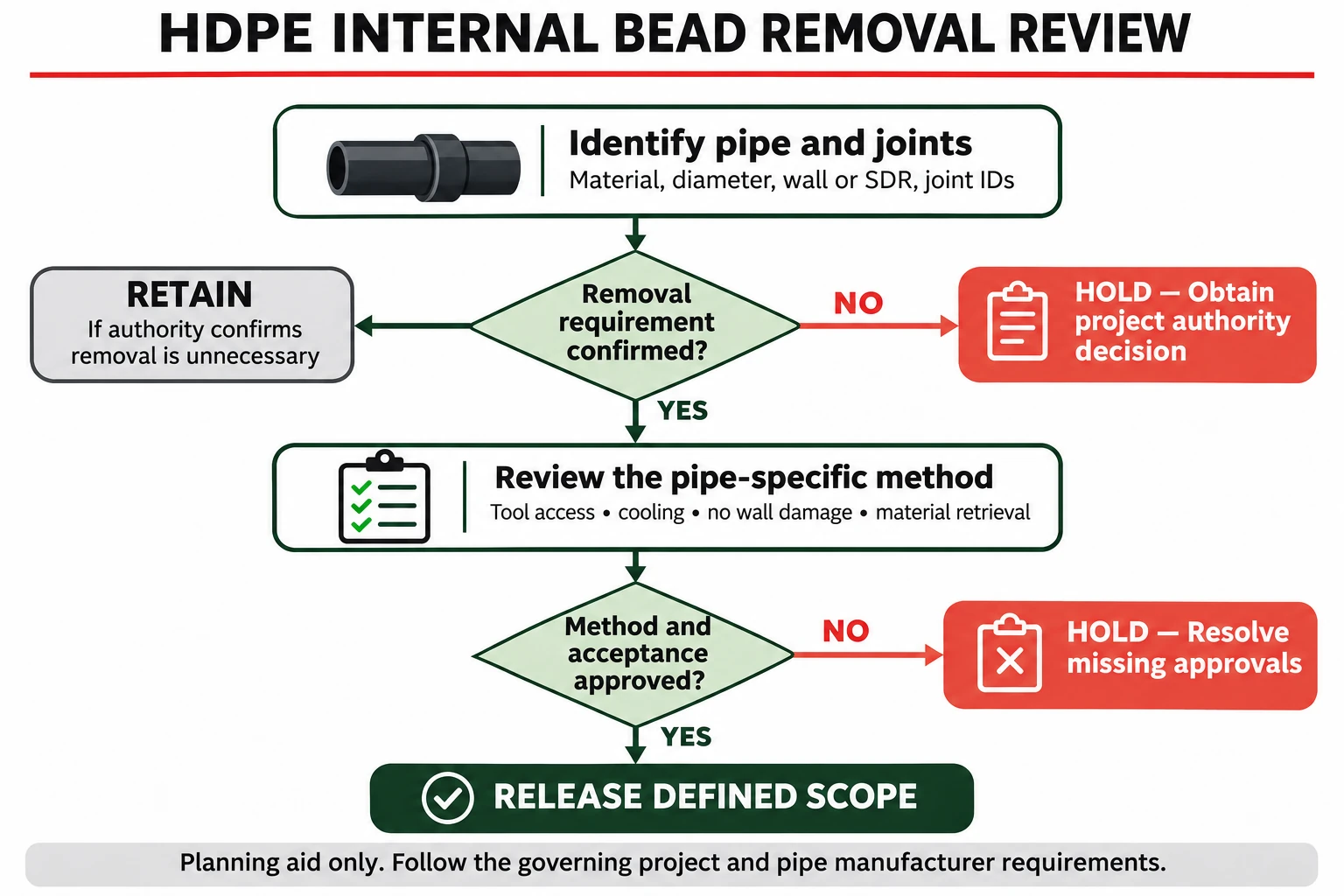
- Identify the actual pipe and affected joints.
- Resolve the governing removal requirement with the project authority. Hold if unresolved, or retain if removal is confirmed unnecessary.
- Review the pipe-specific method, access, cooling, wall protection and material retrieval.
- Release only the defined scope after method and acceptance requirements are approved. Hold unresolved approvals.
Work through an incomplete request
Consider an illustrative request for a newly fused HDPE pressure-water pipe string. The coordinator has the pipe diameter and SDR, a joint list and a tool supplier’s brochure. A supervisor wants internal beads removed because the line should have a clear bore. No governing removal clause or pipe-specific method approval has been supplied. These are invented planning inputs, not a customer case or a field test.
The provisional result is hold removal. The brochure helps identify proposed equipment, but it does not resolve whether removal is needed or whether that equipment and method are accepted for the identified joints. The coordinator records the missing authority document and sends the pipe information, stated reason and proposed method to the responsible project decision maker.
The completed decision record at this stage can be quite short. Operation requested is internal bead removal. Purpose is a claimed bore requirement that remains unverified. Pipe and joint identity are available. Governing requirement and approved method are missing. Decision is hold. Next action is a written response from the named project authority. No cutting is released.
Now change one condition. Suppose the governing project specification is produced and it requires internal removal for the defined application. That resolves the necessity field, but the request still needs an applicable method, readiness and inspection requirements. The decision changes to prepare controlled removal for approval. It becomes a work release only when the responsible authority has accepted those remaining items.
If the authority instead confirms that removal is unnecessary, close the removal request with a retain decision and its reference. Continue normal joint acceptance under the applicable requirements. The record explains why the bead remains, without pretending that a generic guide approved the individual joint.

Check the proposed method before release
The Alliance model specification describes cooling before bead removal, avoiding gouging and providing for withdrawal of removed material. These are useful questions to raise when reviewing the method. Apply the actual manufacturer and project requirements to determine how they will be demonstrated on the identified pipe.
Cooling is a readiness question rather than a visual guess. Identify the procedure that defines it and the person who confirms it. This article supplies no universal waiting period because one duration would erase differences between procedures and pipe conditions. Do not shorten the applicable requirement because a bead appears firm.
Tool reach also needs a real basis. Compare the proposed configuration with the pipe string and access arrangement. Explain how removed material will be recovered and how the operator will avoid cutting into the pipe wall. An available cutting head does not prove the assembled equipment can reach every listed joint or retrieve the material from the actual string.
Any observed damage needs a disposition under the governing requirements. Stop the affected operation and preserve its joint identity while the responsible person assesses the observation. Do not borrow a damage allowance from an unrelated document to accept a tool mark. A general material description cannot establish that a particular notch is acceptable.
For the broader joining-method context, see HDPE pipe fusion methods. This removal decision does not change a fusion procedure’s parameters or establish that a visually altered joint is sound.
Keep the supply enquiry specific
After the project decision is defined, a pipe supply enquiry can state the material, dimensions, applicable specification, quantities and required interfaces. Include the relevant approved documents so the proposed supply can be discussed against the same scope. Keep site-work approval with the responsible project authority.
Prepare the pipe specification before asking for availability
Contact IFANPRO with the pipe specification and quantities for a supply discussion. Identify the project location and application. Availability and suitability need confirmation for the actual request. This article does not establish an IFANPRO bead-removal service or approval of a contractor’s tools and method.
Заключение
An internal bead removal decision is complete when the application reason, governing requirement, affected joints, method and release authority agree. Keep the bead when no justified requirement calls for removal. Hold an unclear request while the missing evidence is obtained. Release a defined removal operation only through the project’s approval and acceptance process.
The avoidable mistake is allowing a plausible flow explanation or a tool purchase to become permission to cut. A traceable decision record makes that transition visible and keeps unresolved conditions attached to the actual joints.
ЧАСТО ЗАДАВАЕМЫЕ ВОПРОСЫ
Does every HDPE internal fusion bead need removal?
No. Review the actual application and governing requirements. PIPA’s cited guideline generally discourages internal removal unless it is necessary, with a possible contaminant-catching exception.
Can an internal bead explain low flow?
A flow complaint needs an assessment using the actual pipeline and operating information. The complaint alone does not identify the cause or authorize bead removal.
Does a tool brochure count as approval?
It identifies equipment capability within its stated scope. Project authority and pipe-specific method acceptance remain separate requirements.
Can removal proceed while the specification is missing?
Hold removal until the responsible authority resolves the requirement and accepts the applicable method. Record the missing inputs and the person responsible for the decision.







 Русский
 English
 Français
 Español
Последние комментарии