
A tapping-tee cutter should finish in the service position specified for that exact fitting—not at a universal height copied from another tee. Radius describes a cutter remaining in the fitting with its top flush with the stack. GF Central Plastics distinguishes the position of its service-tee cutter from the upper-seal position used by its high-volume design. Identify the manufacturer, series and instructions before accepting the final arrangement.
The cutter is not packaging to remove after making the hole. Never remove a self-tapping cutter from a pressurised fitting. This page helps a supervisor or component buyer resolve a documentation and handover question; it is not a live-tapping procedure, operator qualification or permission to work on a gas main.
Key takeaways
- The retained cutter and retained pipe coupon are part of the designed assembly.
- “Flush with the stack” belongs to an identified design and document.
- A different tee can use another final sealing position.
- A cutter, tapping tool and thread follower are different components.
- Neither extra retraction nor a tighter cap is a generic remedy for uncertainty.
- An unidentified assembly stays on hold until its instructions and competent disposition are established.
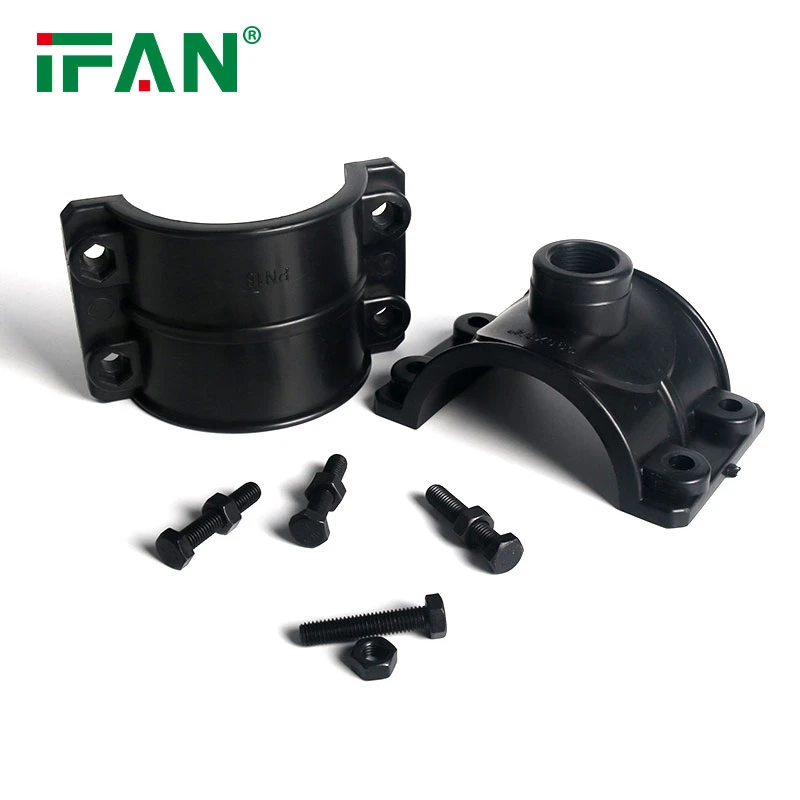
A retained cutter is part of the assembly
A tapping tee includes a cutting mechanism within the fitting. After the main is opened, that mechanism is placed in its specified service position. The main practical distinction from a branch saddle remains important: a branch saddle requires a separate cutting operation and associated equipment. But choosing the right fitting family does not complete the final-position check for an installed tee.
The Radius electrofusion brochure includes a manufacturer-authored FAQ asking where the cutter should be after commissioning. Its answer keeps the cutter in the tapping tee and locates its top flush with the stack. Treat that as the published instruction for the described Radius product, not evidence that an IFAN fitting has the same geometry or sealing arrangement.
Do not confuse removing the operating tool with removing the integral cutter. A document may also describe a removable thread follower used during commissioning. Identify each part by the manufacturer’s diagram and terminology before interpreting a removal instruction. The fact that one component is removed does not authorise removal of another.
Why the same verbal shortcut can be wrong
The GF Central Plastics installation and training manual distinguishes its service tapping tee from its high-volume tapping tee. The service example uses a cutter flush with the top of the chimney; the high-volume example locates the cutter at an upper O-ring seal as described in its procedure. Its warnings expressly prohibit removing the cutter from the fitting.
Those descriptions should not be blended into a general instruction to keep retracting until a resistance is felt or the assembly looks flush. The correct endpoint depends on the actual fitting, associated tooling and documented indicators. A photograph of a different tee cannot settle which stop or sealing surface is present in the installed one.
| Identified example | Published service-position description | Acceptance boundary |
|---|---|---|
| Radius tee described in its FAQ | Cutter remains inside; its top is flush with the stack. | Confirm the actual Radius product and applicable instructions. |
| GF service tapping tee | The manual describes a flush-with-chimney position. | Do not extend that rule to GF’s different high-volume design. |
| GF high-volume tapping tee | The manual describes engagement with the upper O-ring seal. | Use its complete product-specific procedure and tooling requirements. |
| Unidentified or other-brand tee | No endpoint is established by these examples. | Hold acceptance and obtain the applicable maker’s direction. |
The comparison explains why the rule differs. It does not reproduce a complete tapping sequence or supply the training, operating controls and equipment needed to perform one. The named manuals must be used in their full context by the competent operator.
What the cap can and cannot prove
A cap sitting on the fitting is not a complete record of the cutter’s position beneath it. Nor is an absence of visible external leakage proof that every internal component has reached its specified state. The relevant handover evidence includes the fitting identity, actual applicable procedure and the checks that procedure requires.
Cap requirements are also product-specific. GF’s cited manual calls for hand-tightening in its described arrangement. Do not convert that statement into a universal torque value or use it to override another manufacturer’s purpose-designed tooling instruction. If a cap appears not to seat, the response is to investigate the actual assembly under the correct safe procedure, rather than increasing force by guesswork.
An uncertain position is not resolved by retracting further “to make sure.” Overtravel can have consequences that the operator cannot infer safely from feel alone. Stop and obtain a competent, model-specific disposition instead of experimenting on a live connection.
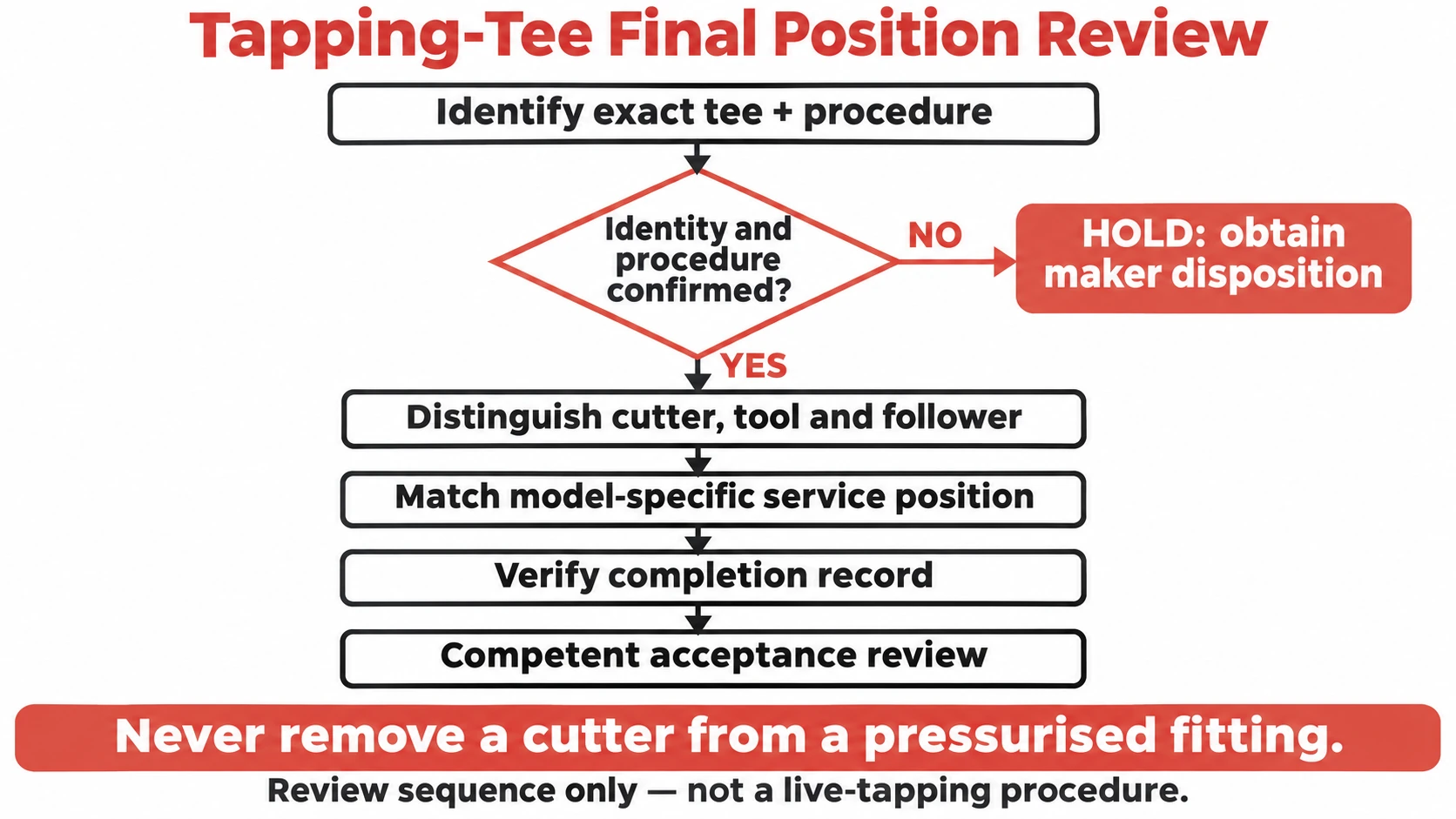
Review sequence shown in the flowchart
- Identify exact tee and procedure
- Missing identity leads to HOLD
- Distinguish cutter, tool and follower
- Match model-specific service position
- Verify completion record through competent acceptance review
Build a model-specific acceptance record
Record the main-pipe identity, fitting manufacturer and part designation, outlet configuration, operating service, applicable instruction and the tooling used. Retain the actual final-position evidence required by that procedure and the completion-cap check. If the installed tee cannot be identified, record that fact rather than attaching the nearest-looking manual.
Keep fusion completion, cooling, any required testing and tapping completion as separate stages in the job record. A successful earlier stage does not establish a later one. In particular, a fusion-cycle record says nothing by itself about where the cutter was left after the main was opened.
- Confirm the exact fitting and associated procedure.
- Identify which component is the cutter and which components the procedure removes.
- Match the required final-position description to that specific design.
- Check the retained completion evidence through the responsible competent operator.
- Keep any missing identity, uncertain position or unresolved leakage as an acceptance hold.
This is a review sequence. It does not tell an unqualified reader how to operate, retract or expose a pressurised tapping assembly.
Two handovers with different outcomes
Illustrative record A: an identified Radius tee with its applicable instructions and complete competent commissioning record. The acceptance review uses the documented Radius final-position rule and associated completion checks. The generic fact that a cutter remains in the fitting is consistent with that design. It is not treated as a defect simply because another connection family uses a removable drill.
Illustrative record B: a tee with an unreadable designation and a photograph labelled “cutter flush.” That image does not establish which model or final sealing arrangement applies. The review remains on hold for identification and the manufacturer/operator’s disposition. Copying the Radius FAQ or the GF service-tee wording would conceal the missing input rather than answer it.
Change record B by identifying a GF high-volume tee. The identity gap may be resolved, but the acceptance criterion changes to that product’s actual final-position and completion requirements. A previously recorded “flush” observation cannot be assumed to satisfy the newly identified criterion.
Keep a supply enquiry within its evidence
For an HDPE pipework and fitting enquiry, send the main-pipe details, proposed branch, service conditions and exact required fitting designation. Ask for current product and compatibility evidence for the offered part. The third-party examples here do not establish IFANPRO’s availability, operating instructions or permission for a particular live tapping application.
| Record | What is established | Disposition |
|---|---|---|
| Known Radius tee and applicable complete record | Named completion criterion is available | Review against exact procedure |
| Unreadable model, photo labelled flush | No applicable design criterion | HOLD for identity and competent disposition |
| Later identified GF high-volume model | Criterion changes to exact design | Recheck against correct procedure |
Заключение
The final cutter position is a model-specific acceptance condition. Retain the cutter where the applicable instructions require it, keep tools and followers distinct, and never use a different tee’s endpoint to approve an unidentified assembly. Missing identity or completion evidence requires a competent disposition before acceptance.
Frequently asked questions
Should the cutter be removed after tapping?
Not in the retained-cutter designs discussed here. Never remove a cutter from a pressurised fitting; follow the actual manufacturer’s instructions.
Should every cutter finish flush with the stack?
No universal rule follows. Some named designs use that position, while others specify a different final sealing position.
Is the tapping tool the same as the cutter?
No. Identify the operating tool, integral cutter and any thread follower separately from the applicable manufacturer’s diagram.
What if the fitting model cannot be identified?
Keep acceptance on hold and obtain the responsible manufacturer/operator’s disposition. A similar-looking fitting or generic internet instruction does not fill that gap.
Written by Justin.












 Русский
 English
 Français
 Español
Последние комментарии