
If an electrofusion controller rejects a fitting’s resistance before heating starts, keep the cycle on hold and preserve the exact fault record. Match the message to the identified controller’s manual before deciding what can be checked or who must take over. A resistance mismatch and a calibration-related prohibition are different dispositions: on the named Kerotest models below, Code 109 prevents fusion and requires calibration.
A fitting is connected, the label has been read, and the crew is ready. The rejection can look like a small obstacle between preparation and welding. Treating it as a prompt to find another way to start would lose the most useful information: which equipment rejected which component, at what stage, and for what stated reason. This guide helps a qualified operator or site QA lead preserve that information and select the applicable handover branch.
Related video: IFAN HDPE Electrofusion Socket Wire Laying Process — IFANGroup.
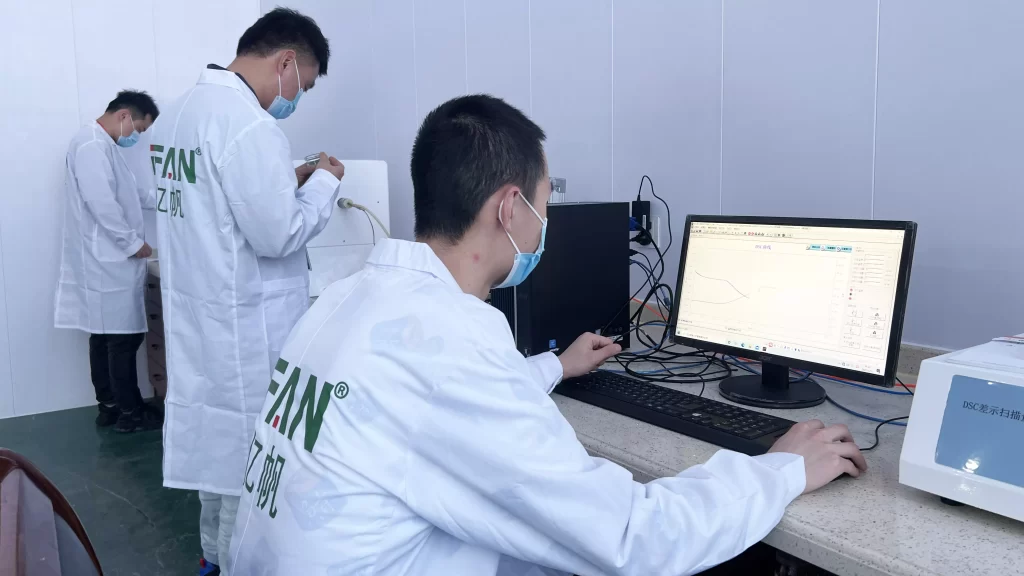
Own-channel manufacturing context only. It does not demonstrate controller fault diagnosis, establish resistance tolerances or approve a joint. Use the cover to open the manufacturing-context video.
Preserve the code and the point where work stopped
Start with the event that is actually evidenced. Copy the controller message without turning it into a diagnosis such as “bad fitting” or “scanner problem.” Record whether heating began, using the available controller record and the operator’s contemporaneous observation. If those disagree or the stage is unknown, retain the uncertainty. Do not label an interrupted cycle “not started” merely because the screen now shows a resistance error.
Give the record a joint or intended-location reference, even though no completed joint is being accepted. Connect that reference to the fitting manufacturer, product identity, size and batch where available, and to the controller model, serial number and relevant manual revision. This proposed record makes later decisions traceable; it is not a claim that every controller automatically exports all these fields.
Keep the displayed result or original event export with the note. An explanation typed later should supplement that evidence, rather than replace it. If component identity cannot be established, record that missing input and hold disposition. A readable label from a similar fitting cannot establish the identity or required settings of the component in front of the crew. The welding and traceability barcode guide explains those separate identification roles.

Heating not started: Pre-cycle rejection: preserve fault; match exact manual. Heating already started: Different event scope; applicable procedure required. Start status unknown: HOLD classification; retain uncertainty.
Apply the exact controller’s fault branch
The UNIDELTA EASY 160 manual, printed page 31, describes Error 3 as a difference between measured and declared fitting resistance where the barcode supplies that value. Its stated check concerns terminal-connector condition. It also flags exposure of the fitting to summer sunlight. Those are named-manual observations, not proof that a connector or temperature caused this particular event.
The Kerotest Portafuse 4 Lite/Max manual K-1304 Rev A, printed page 45, identifies Code 102 as a measured-versus-barcode resistance mismatch. Its resolution addresses lead-end wear or damage and fitting-adapter condition; persistence can indicate a calibration or output-cable issue. Code 109 instead concerns the reference voltage and explicitly requires return for calibration, with fusion prohibited.
| Equipment and message | What the cited manual establishes | Disposition boundary |
|---|---|---|
| UNIDELTA EASY 160, Error 3 | Resistance differs from the declared value; terminal-connector condition is a stated check. | Keep the rejection unresolved until the applicable procedure resolves it. |
| Kerotest Portafuse 4, Code 102 | Resistance mismatch; named external connection/adapter checks; persistent fault may concern calibration or cable. | Follow the complete matching manual and service route; no generic retry authorization. |
| Kerotest Portafuse 4, Code 109 | Reference-voltage fault requiring calibration. | Do not fuse; return the processor for calibration. |
Do not substitute a fault table from another machine. The Kerotest manual’s safety section, printed page 1, limits operation to trained, qualified personnel and prohibits opening the enclosure. This article summarizes the disposition categories; it does not teach electrical repairs, adapter replacement, live measurements or internal adjustment. No universal resistance value or acceptable percentage is established here.

UNIDELTA EASY160 · Error3: Resistance differs from declared value. Kerotest Portafuse4 · Code102: Mismatch; named external-condition branch. Kerotest Portafuse4 · Code109: Do not fuse; return processor for calibration.
Make the next owner of the problem explicit
A useful handover distinguishes a documented operator check from an unresolved component question and an equipment-service requirement. Write which branch applies and why. “Checked connections” without the controller identity, applicable instruction or observation gives the receiving person little basis for deciding what remains open.
For a named-manual external-condition check, the qualified operator must follow the complete equipment instructions and site procedure. Record the actual finding, including an inconclusive result. If the fault persists, do not transform that check into permission to repeat the cycle, change parameters or override the rejection. Identify the manufacturer’s service contact or responsible site QA function through the approved project route.
A calibration prohibition is a different handover. For the cited Kerotest Code 109, a fitting substitution does not satisfy the stated requirement to return the processor for calibration. Preserve the equipment’s identity in the record so an unresolved processor cannot be mistaken for released equipment. Any later return to use requires the applicable service documentation and site authorization; neither is supplied by this article.
Preparing a fitting enquiry? Browse the IFANPRO HDPE pipe and fitting category, then send the required component specification through the site’s enquiry route. Include application, pipe dimensions/material, fitting identity and the controller compatibility documentation you need confirmed. Availability and compatibility require confirmation; this is not a processor calibration or repair service.
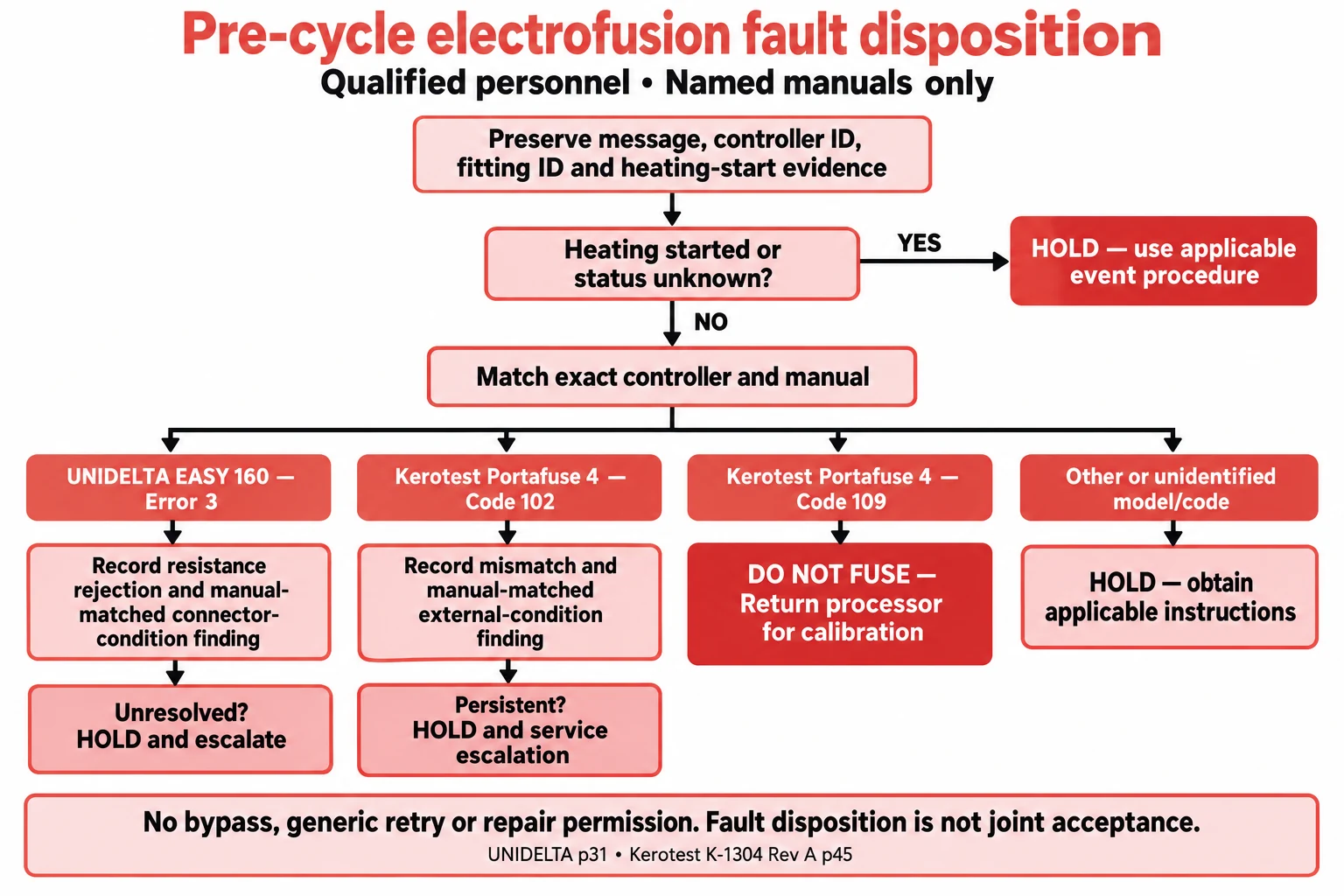
- Preserve exact message, controller and fitting identity
- Did heating start? Unknown or yes: HOLD; use applicable event procedure
- Established pre-cycle rejection: match exact controller manual
- UNIDELTA EASY160 Error3: record rejection and named connector-condition check; unresolved: HOLD and escalate
- Kerotest Portafuse4 Code102: record mismatch; named external-condition branch; persistent: HOLD and service escalation
- Kerotest Portafuse4 Code109: DO NOT FUSE; return processor for calibration
- Other/unknown code or model: HOLD; obtain applicable instructions
- Keep fault disposition separate from joint acceptance
Worked example: a rejection before heating
The following is an illustrative record format, not an IFANPRO field case or a manufacturer-mandated form. Assume the operator’s contemporaneous observation and retained controller event both establish that heating did not begin. The identified processor is a Kerotest Portafuse 4 Max, and its recorded message is Code 102.
| Field | Example entry |
|---|---|
| Event reference | Planned joint J-A; retain actual location and event file reference in the site record. |
| Equipment | Portafuse 4 Max; enter actual serial number. Manual K-1304 Rev A, printed page 45. |
| Component | Enter actual fitting manufacturer, product/batch and label reference. Leave unknown fields explicitly unresolved. |
| Observed stage | Pre-cycle rejection; heating not started, supported by the retained event and observation. |
| Fault | Code 102; preserve exact displayed wording separately. |
| Action and result | Hold. Record any authorized manual-matched check and actual finding; no finding is invented here. |
| Handover | Responsible operator/site QA identifies the applicable next action or service route; release remains unresolved. |
This record produces a usable result even when the fault has not been resolved: the intended operation remains held, the original event is preserved, and the receiving person can identify the relevant manual branch. “Heating not started” narrows the event classification; it does not establish that the fitting, controller or prepared assembly is suitable for use.
Now change one input: the actual recorded code is 109. The disposition must change to the named calibration prohibition. It is no longer enough to hand over a generic fitting-resistance enquiry. If evidence instead shows that heating had already begun, leave this pre-cycle example and consult the applicable interrupted-cycle procedure. The interrupted electrofusion guide explains why a restart exception cannot be borrowed from a different fitting system.

Fault disposition record: Event identity, original message, finding and handover. Installation acceptance evidence: Preparation, restraint, cooling and required inspection. Keep the boundary: Resolving an electrical fault does not certify the joint.
Close the fault without certifying the joint
Keep separate records for fault disposition and eventual installation acceptance. Resolving an equipment rejection answers what happened to that fault. It does not inspect preparation beneath a fitting or demonstrate that restraint and cooling requirements were met. The project’s applicable installation, inspection and testing requirements still govern the joint.
The handover therefore needs a clear status: unresolved and held, sent for specified service, or resolved under identified documentation with a separately authorized next operation. Avoid “passed” unless the record states what passed and on what basis. A completed electrical cycle, a restored processor and an accepted pipeline joint are different claims.
Conclusion
Keep the fault message, component identity, controller identity and heating-start evidence together. Use the exact manual to assign the next action, and preserve a calibration prohibition as a prohibition. For a supply enquiry, carry the fitting specification and requested compatibility evidence forward; keep processor service and joint acceptance with their responsible procedures.
FAQ
Does every resistance mismatch mean a defective fitting?
No. The named manuals include connection-condition or equipment-related possibilities. The fault alone does not establish which component is defective.
Can I use a generic resistance tolerance?
No tolerance is supplied here. Use the exact fitting and controller documentation; an unrelated value cannot authorize a rejected cycle.
Can Code 109 be handled like Code 102?
Not on the cited Kerotest models. Code 109 requires return for calibration and prohibits fusion; Code 102 has a different stated resolution.
Does resolving the error approve the joint?
No. Fault disposition and joint acceptance are separate. Follow the applicable preparation, installation, cooling, inspection and testing requirements.










 Français
 English
 Русский
 Español
Commentaires récents