
Do not automatically restart an interrupted electrofusion weld. The fitting manufacturer’s instructions and the pipeline owner’s procedure decide whether re-fusion is permitted. A documented input-power interruption may qualify under a named GF Central Plastics procedure; Kimplas gives a replacement instruction after power failure. An unidentified fitting or unexplained termination has no established restart permission.
Power has returned, the processor is ready and the fitting is still clamped. None of those observations answers the important question: what happened during the interrupted cycle, and what disposition applies to this joint? Preserve the first record before creating another cycle.
Key Takeaways
- A failed cycle and an input-power interruption are not interchangeable descriptions.
- Restart permission belongs to the identified fitting system and the owner’s procedure.
- Where the cited GF procedure permits re-fusion, complete cooling and the full prescribed cycle are required.
- A second successful processor record does not erase the first event or establish service acceptance.
- An owner prohibition closes the restart branch even when a manufacturer describes an exception.
Keep the event separate from the explanation
Write down what the control unit actually reported. Save its cycle log, error message and joint identifier. Then record the observed event: for example, the generator stopped, a lead disconnected, or the unit ended the cycle with a fault. Avoid converting “the screen went blank” into “a harmless power cut” without checking the record and the applicable procedure.
The distinction matters because a restart exception can be limited to a particular cause. If the fitting was incorrectly assembled or the unit detected a fitting fault, restoring the electricity does not resolve that condition. A partly completed heating operation also does not become an unstarted fitting simply because the processor can read its barcode again.
This is separate from identifying the barcode’s purpose. The welding and traceability barcode guide explains why cycle information and component identity serve different functions. After an interruption, keep both: identify what was being joined and retain what happened during the attempted operation.
Find the applicable restart branch
On printed page 27, GF Central Plastics’ Electrofusion Installation and Training Manual limits its re-fusion route to input-power interruption and requires checking the company or pipeline owner’s operation-and-maintenance guidance. If that guidance prohibits restarting, its prohibition applies. Other termination causes lead to removal or abandonment and replacement under the cited instructions.
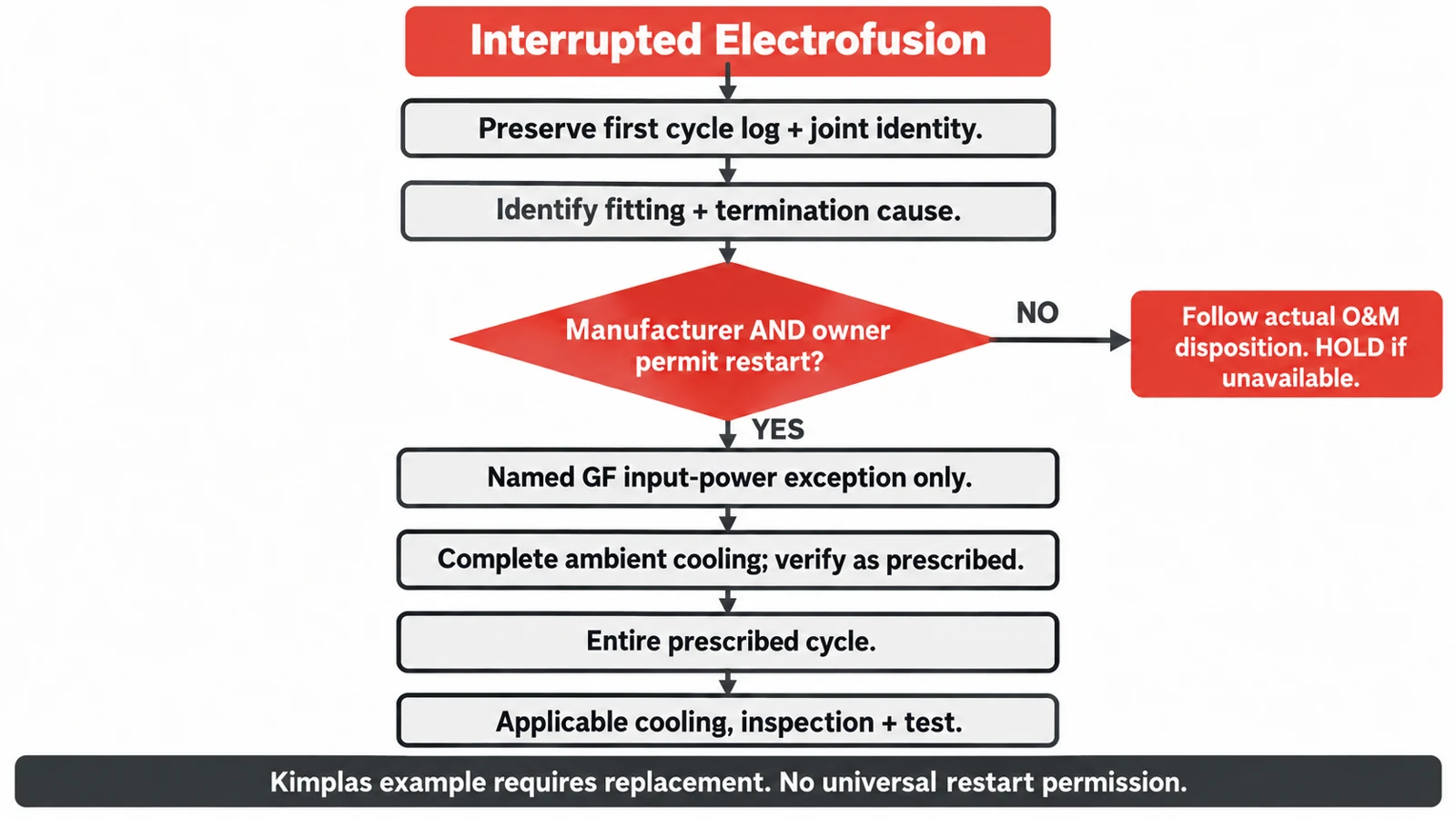
By contrast, Kimplas’s answer to “What happens if power fails during the fusion process?” says the interrupted joint cannot be salvaged and calls for cutting out the fitting and affected pipe section. Its instruction does not become permissive because a different manufacturer describes a restart route.
| Condition | Applicable evidence | Decision |
|---|---|---|
| Covered GF fitting; input-power interruption; owner permits | Named GF re-fusion procedure | Proceed only through all prescribed re-fusion conditions |
| Covered GF fitting; owner prohibits restart | Owner’s O&M guidance | Do not restart; follow actual company/owner O&M disposition. Hold if unavailable. |
| Kimplas fitting after power failure | Manufacturer’s published replacement instruction | Replace; do not borrow the GF exception |
| Unknown fitting or unexplained termination | No applicable restart permission established | Hold the joint for the responsible procedure owner |
Source: the cited GF Central Plastics re-fusion section and Kimplas FAQ. This is a comparison of named instructions, not a universal restart authorization.
For a transparent example, assume the fitting is confirmed as covered by the GF manual, the log and site investigation establish an input-power interruption, and the pipeline owner expressly allows the procedure. That establishes a possible re-fusion branch. Change just one condition—an owner prohibition—and the restart branch closes. Follow the actual company or owner O&M disposition, holding the joint if that disposition is unavailable. Prohibition alone does not decide replacement. The elapsed heating time does not reopen the restart branch.
For another brand supplied through a distributor, obtain that brand’s applicable instruction. A compatible processor, matching nominal voltage or similar-looking coupler does not establish identical restart rules. An IFANPRO product category is likewise not evidence that the named GF or Kimplas instructions apply to an IFAN component.
Cooling and cycle time are separate conditions
Under the cited GF re-fusion route, the assembly must first cool completely to ambient temperature. The manual requires a pyrometer check against pipe temperature at least two feet away. A fitting surface that initially feels cool is not sufficient: heat can take time to migrate outwards. This is not a universal waiting time measured in minutes.
If the permitted restart conditions are satisfied, that procedure calls for the entire prescribed fusion cycle. It expressly rejects subtracting the time spent in the first attempt. A site calculation such as “the first cycle was half done, so run the other half” is therefore not the cited re-fusion method.
These conditions answer two different questions. Temperature establishes whether the assembly has reached the required restart state. The specified cycle establishes the authorized new heating operation. Meeting one does not waive the other, and neither grants permission if the fitting or owner’s rule has already ruled restarting out.
Keep the assembly under the applicable alignment and restraint instructions while the disposition is resolved. The trained installer and responsible pipeline operator must determine the exact intervention. This guide does not authorize cutting a live line, handling energized equipment, or putting an interrupted joint into service.
Close the joint record before release
The useful output is a disposition record that another qualified person can follow. Retain the original cycle, identify the decision authority and attach either the replacement record or the authorized re-fusion record. A later successful cycle should be linked to the earlier interruption, not substituted for it.
| Record item | What to preserve | Decision served |
|---|---|---|
| Identity | Joint location, fitting model, pipe and operator | Find the applicable procedure |
| First event | Original log, error and observed cause | Classify the interruption accurately |
| Authority | Manufacturer instruction and owner permission or prohibition | Choose restart, replacement or hold |
| Completion | Replacement or permitted re-fusion; required inspection and testing | Support the responsible release decision |
Editorial record aid based on the two cited instructions; the project’s mandatory records and acceptance procedure still govern.
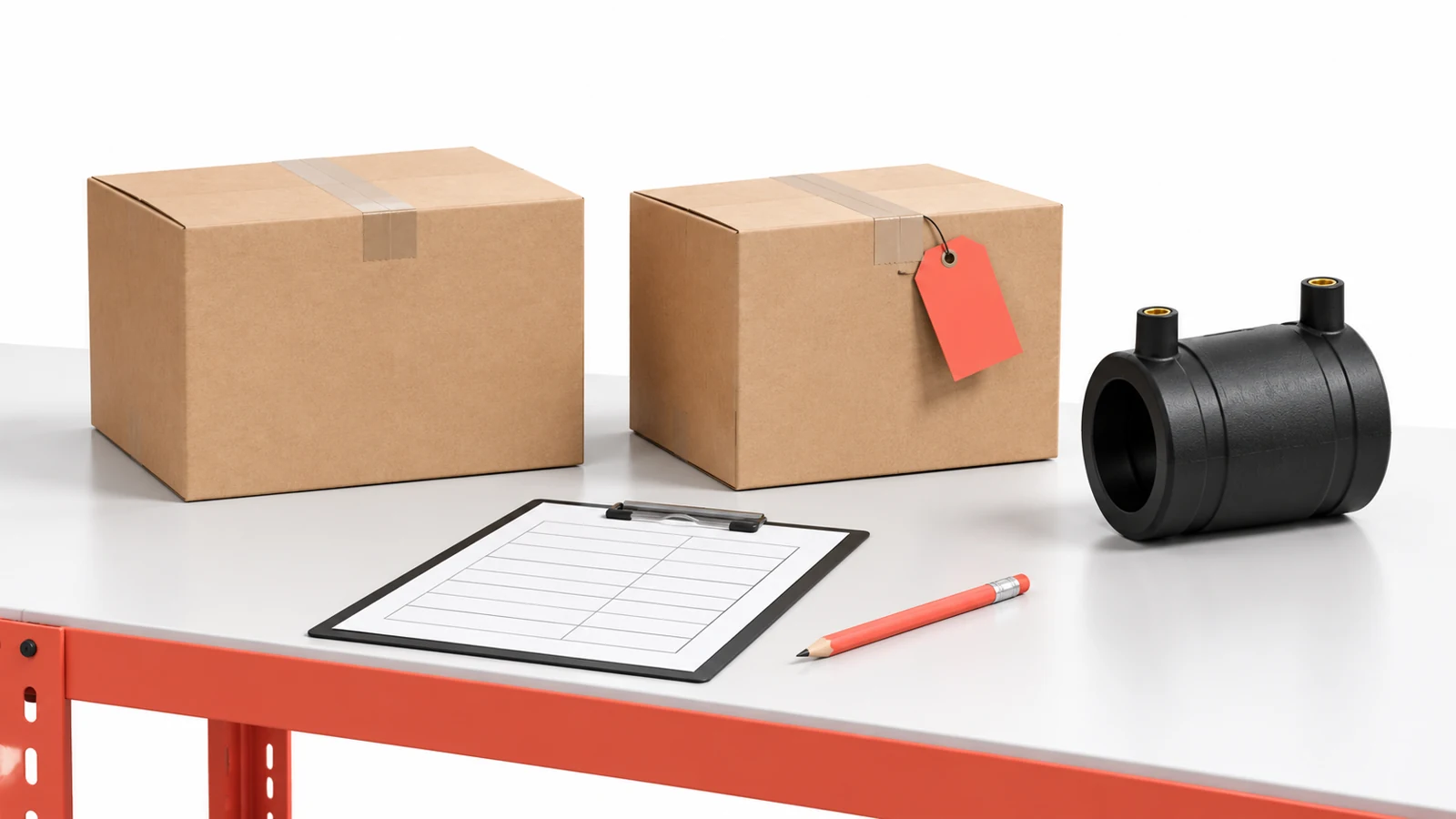
If replacement components are required, use the HDPE pipe-and-fitting category to frame a specification enquiry. Submit the specification for an availability check, including project country, application, pipe OD and DR/SDR, fitting model, required approvals and the owner’s joining procedure. No matching electrofusion fitting, stock, restart permission or delivery time is confirmed by this article.
Conclusion
Power restoration starts an investigation, not an automatic second weld. Keep the first log, identify the fitting and termination cause, apply the manufacturer and owner’s disposition, and preserve the completed record. Restart only where the actual procedure permits it and every condition has been met.
Frequently asked questions
Can I finish only the remaining seconds?
Not under the cited GF re-fusion procedure. Where restart is permitted, it requires the entire prescribed fusion cycle after complete cooling.
Does a cool outer surface prove that restart cooling is complete?
No. The cited GF procedure requires temperature verification; surface touch alone is insufficient.
Does a processor’s successful second cycle approve the joint?
No. The restart must first have been permitted. Applicable cooling, inspection, testing and owner acceptance remain necessary.










 Français
 English
 Русский
 Español
Commentaires récents