
For a low-head water line, select a brass check valve against the pressure difference available across it, the loss at the required flow and its documented resealing conditions. Cracking pressure marks the start of flow; it does not prove useful delivery or reverse-flow sealing. A high body pressure rating answers none of these three questions.
Key Takeaways
- Compare inlet minus outlet pressure at the valve.
- Keep first opening separate from delivery at flow.
- Check resealing against the stopped condition.
- Keep mounting tied to the exact model.
- Treat the worked figures as assumptions only.
- Confirm availability against the completed duty record.

Three pressure questions belong on separate lines
A buyer can receive a valve that withstands the line pressure and still cannot deliver water through it. The mistake is using the pressure cast into the body as evidence of easy opening. Body pressure capability concerns containment under its stated conditions. The opening requirement concerns a difference between the two ports. A third record describes closure. They answer different operating states, so put them on different lines of the schedule.
Swagelok’s check-valve catalogue defines cracking by the first indication of flow and resealing by the absence of indicated flow under its test conditions. Its tables separate opening and resealing information. Those definitions are useful here; its product values are not specifications for an unidentified brass valve. Ask which test medium, direction, spring and mounting condition the offered figure actually describes.
The practical consequence is simple. An acceptable first-opening figure keeps a candidate in review. It does not release the order. Delivery needs the candidate’s pressure-loss information at the required flow; reverse-flow duty needs the relevant sealing conditions. A missing record stays an unresolved selection input rather than becoming a presumed zero.
Read the pressure difference before choosing the spring
Use inlet pressure minus outlet pressure, expressed in the same units and referred to the valve locations. A gauge at the pump and another far beyond a rising pipe do not automatically provide that comparison. The designer must account for where pressures are taken and the operating state. A static reading with every outlet closed is not the pressure budget during delivery.
Low head can occur even when both gauges show substantial pressure. If the downstream side retains pressure, little forward difference may remain. Conversely, a modest inlet pressure can create enough difference when the outlet side is nearly unpressurized. Describe the worst intended opening condition, not just the highest source reading. Changes in tank level, outlet demand or pump control can change that condition.
For a proposed gravity arrangement, identify the lowest usable source level and the receiving condition. For a pumped arrangement, use the system’s operating duty rather than treating pump shutoff pressure as its delivered pressure. The valve supplier needs the resulting available differential. The system designer owns the calculation that produces it. Keep these responsibilities visible so an attractive cracking figure does not conceal an incomplete line design.
A transparent example: opening passes, delivery remains open
The following numbers are teaching assumptions only. They are not an IFANPRO product test, a recommended pressure range or an actual customer installation. Assume the pressures immediately at the candidate’s inlet and outlet are 0.30 bar and 0.22 bar under the stated initial condition. Available forward differential is 0.30 − 0.22 = 0.08 bar. Assume a documented candidate cracking requirement of 0.05 bar in the proposed mounting position. The initial difference exceeds that assumed opening requirement by 0.03 bar.
That arithmetic supports only an initial-opening screen. It cannot establish delivery at the requested flow. Once water moves, the pressure distribution changes, and the candidate’s curve must show its loss at the required rate. Do not subtract the cracking figure from the system allowance and treat the remainder as a universal valve-flow calculation. First opening and the operating curve describe different states.
Now change one input while holding the assumed outlet pressure fixed: inlet pressure falls to 0.25 bar. The available difference becomes 0.03 bar, below the assumed 0.05 bar requirement. That candidate fails this opening condition. A larger nominal pipe connection does not reverse that result unless the replacement model’s actual opening data changes.
Finally consider pump-off or source interruption. Neither calculation gives the reverse pressure at which the valve seals or the permitted leakage. The same candidate could pass opening and fail the closure duty. Its disposition is therefore conditional: opening screened at the first condition, delivery and reverse sealing unproved, second opening condition rejected. This is a usable result without inventing a complete valve specification.
| Review item | Required relationship | Result |
|---|---|---|
| First opening | Available differential exceeds documented requirement | Only opening screened |
| Delivery | Model curve covers required flow within allowance | Hold until demonstrated |
| Resealing | Stopped-state differential and leakage criterion match | Independent closure decision |

A weaker spring changes the closure question too
Selecting the lowest listed opening figure can look like the obvious answer when head is scarce. It removes one obstacle only if the exact candidate meets the remaining duties. Swagelok documents resealing separately and notes mounting effects for its series. Never assume that a change to the spring preserves every closure characteristic, or that all spring checks behave alike.
Write the reverse-flow requirement in terms the offered model can answer. Identify the expected pressure relationship after source shutdown, the fluid, the acceptable leakage criterion and the condition under which closure must occur. “Non-return” alone leaves the test and operating state undefined. A potable-water cross-connection protection requirement also needs its own approved-device review; an ordinary check valve is not automatically an approved backflow assembly.
If a supplier proposes a lower-cracking alternative, reopen the resealing line of the schedule. Ask for documented conditions for that exact spring and seat combination. If no reverse differential is available in the intended shutdown state, do not borrow a sealing result obtained with a different back pressure. The designer must decide whether the model’s demonstrated closure answers the actual duty.
Avoid modifying a spring to obtain an easier opening. A field alteration destroys the basis of the original selection unless the manufacturer expressly supports and documents it. This article is a specification review, not a procedure for dismantling or testing a pressurized line.
Mounting, flow range and materials can change the shortlist
Orientation belongs beside the opening record. Gravity acts on the moving closure element, and manufacturers specify permitted positions for particular designs. An arrow identifies intended flow direction but does not, by itself, authorize every mounting angle. Read the drawing for the exact product and preserve its mounting restriction in the purchase description.
ISM’s sizing discussion distinguishes detectable initial flow from full-open flow. That distinction explains why matching the pipe’s nominal size alone is inadequate. A proposed valve must operate across the required flow range. Where the documented curve or operating information does not cover the low-flow state, the reviewer cannot infer stable operation simply because the high-flow point looks acceptable.
Brass identifies the body material category, not every wetted part. Seat, seal and spring information still matters for the specified water, temperature and treatment. Thread or flange compatibility is a separate interface check. A matched nominal diameter cannot establish thread form or sealing arrangement. Keep these details tied to the model rather than making broad suitability claims from a catalogue photograph.
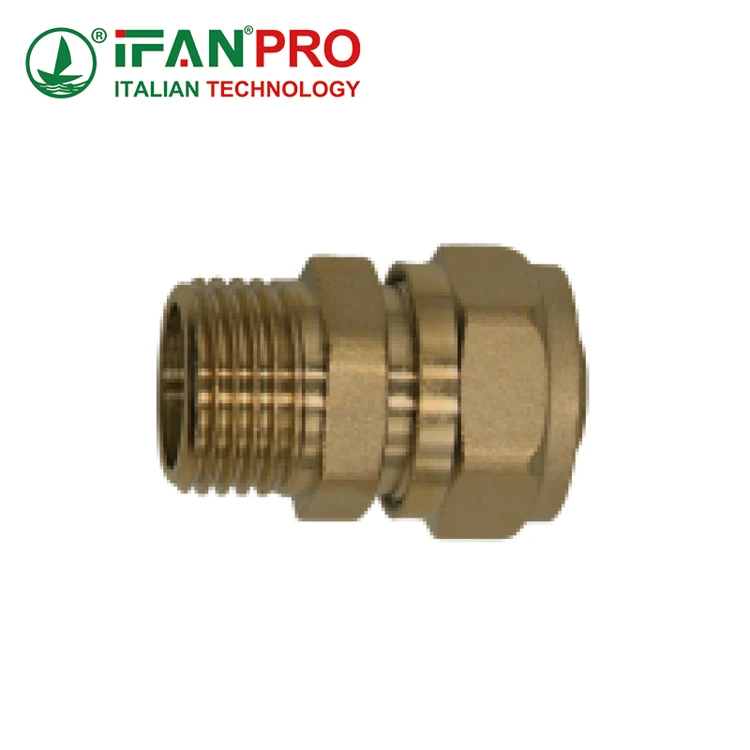
The IFANPRO brass valve category is a starting point for discussing component availability. Its category name does not prove a low-head check model, opening pressure, potable-water approval or a particular closure test. Request confirmation against the completed duty record.
Turn the comparison into a release, hold or reject decision
Record three independent results: initial opening at the least favorable intended condition; delivery at the required flow; reverse sealing in the relevant stopped condition. Add orientation and compatibility alongside them. Release a candidate only when every mandatory line has supporting model data and the designer accepts the system conditions. Hold missing data with a specific reconsideration rule. Reject a documented mismatch.
For example, a missing operating curve is a hold: obtain the curve or an accepted manufacturer statement covering the duty, then compare the loss with the designer’s allowance. A documented opening requirement above available differential is a mismatch: select a different supported candidate or revise the system design. Repeating “please confirm suitability” cannot close either issue because it leaves the comparison unstated.
Send the model, connection, quantity, project country and required date with the technical record. Ask availability, MOQ and lead time only after identifying what is being requested; no delivery period is established by this explanation. If an alternative is offered, compare it against the same inputs and preserve any exception. Substituting a different spring, mounting position or internal material reopens the affected selection line.
Technical basis: the named manufacturer’s official manual. Its product-specific instructions and values do not establish an IFAN model specification.
Review flow
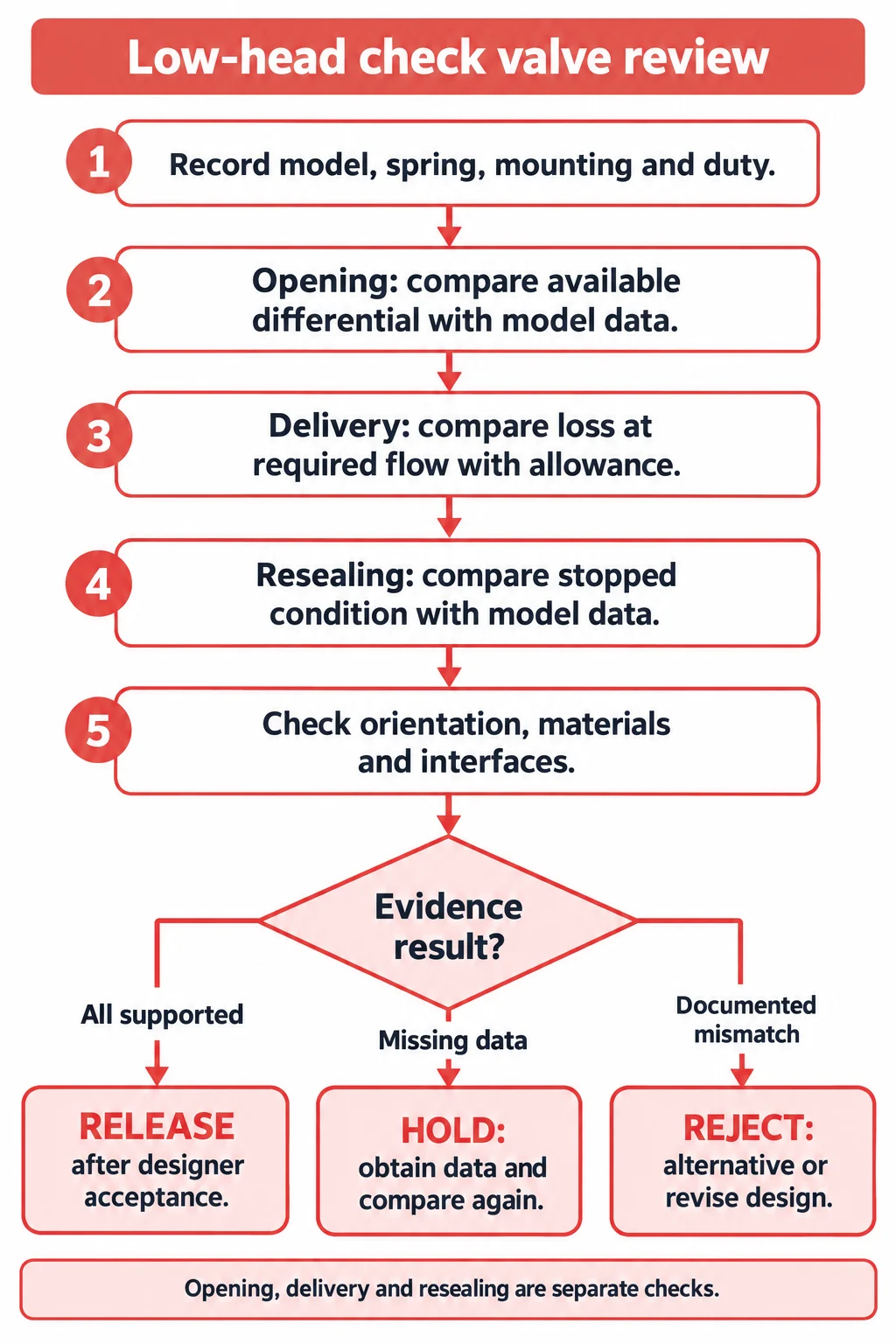
- Record model, spring, mounting and duty.
- Opening: compare available differential with model data.
- Delivery: compare loss at required flow with allowance.
- Resealing: compare stopped condition with model data.
- Check orientation, materials and interfaces.
- Evidence result: all supported → release after designer acceptance; missing data → hold, obtain data and compare again; documented mismatch → reject, choose alternative or revise design.
Evidence that closes each selection line
| Selection line | Required model or duty input | Disposition |
|---|---|---|
| Opening | Available inlet minus outlet pressure and documented opening requirement | Reject a documented opening mismatch |
| Delivery | Model pressure-loss information at required flow and the allowed loss | Hold missing data until obtained and compared |
| Resealing | Stopped-state differential, exact spring and seat combination, permitted leakage | Make an independent closure decision |
| Interfaces and mounting | Model connection, orientation and wetted materials | Release only when all mandatory lines are supported and accepted |
Conclusion
Decide whether a candidate brass check valve clears low-head opening, delivery and resealing duties without confusing body rating with differential pressure. Use the completed decision record to distinguish a demonstrated match, a specific missing input and a documented mismatch before releasing the purchase.
Frequently asked questions
Does a high pressure rating mean easy opening?
No. Body pressure capability and opening differential are separate properties. Use the exact model’s cracking-pressure data.
Is cracking pressure the loss at the required flow?
No. It marks first detected flow. Use the model’s pressure-loss information at the intended operating flow.
Can I assume the lowest-cracking model seals best?
No. Check the resealing conditions and leakage criterion independently for the exact model, spring and shutdown duty.








 Français
 English
 Русский
 Español
Commentaires récents