

EN 13501-1 classifies a construction product’s reaction to fire; it does not give every plastic pipe a fixed fire rating. For a European pipe purchase, check the complete classification, the report’s product and installation coverage, the applicable market-document route, and the project requirement. A label such as B-s1,d0 answers only part of that review. This guide helps importers and MEP procurement teams assess a supplier’s submission before accepting a quotation or releasing material.
This independent laboratory demonstration shows the Single Burning Item test setup; it does not classify the offered pipe.

Read the complete class and the product category
BSI lists BS EN 13501-1:2018 as current. Its classification considers end use and separates general construction products, floorings and linear pipe thermal insulation. Establish which product the document describes. An insulation classification with an L designation is not automatically a classification of the pipe beneath it. For thermal insulation, request a classification report that identifies the insulation product and its covered pipe installation.
For the general-product category, Regulation (EU) 2016/364, Annex Table 1 gives the following selected B, C and D criteria. They explain why the letters differ; they are not the full requirements for obtaining a class. The classification also depends on the other applicable criteria and the stated test conditions.
| Class, Table 1 | Selected SBI FIGRA maximum (W/s) | Underlying test methods |
|---|---|---|
| B | 120 W/s | EN 13823 and EN ISO 11925-2 |
| C | 250 W/s | EN 13823 and EN ISO 11925-2 |
| D | 750 W/s | EN 13823 and EN ISO 11925-2 |
For a PP-R specification, use the IFANPRO PP-R catalogue to identify the offered product, then request the classification evidence for that item.
Read the suffixes too. The s classes address measured smoke production; they do not establish smoke toxicity. In the SBI test, d0 means no flaming droplets or particles within 600 seconds. It does not promise that molten material cannot occur in another fire scenario. F denotes performance below E under this classification system, rather than simply “not tested”.
Do not shorten the complete class to “fire-rated plastic” in the purchasing record. Preserve the report’s product category and suffixes in the comparison sheet. If the sales brochure omits them, request the underlying document instead of guessing the missing result. That makes later technical review traceable to a particular submission, rather than to a supplier’s general advertising phrase.
Match the classification report to the offered pipe
Start with the classification report’s title, issuer, report number and product description. Record the manufacturer, trade name and formulation identifier where provided. Match those details with the supplier’s offered item and current technical sheet. A report for a different manufacturer or an unspecified “polypropylene product” does not, by itself, resolve coverage for the pipe on your bill of quantities.
Then compare the proposed pipe dimensions, wall construction, coatings or insulation, and installation arrangement with the report’s field of application. Ask where the offered size and mounting are covered. Do not impose an invented rule that every variation must have been tested separately: a valid classification can include permitted variations. Equally, do not extrapolate an unlisted diameter or support arrangement merely because the polymer name stays the same.
Keep the supporting test evidence and the classification conclusion distinct. The test report records what happened to the submitted specimens; the classification report identifies the resulting class and its scope. Request the relevant pages and any referenced basis for allowed variations. If only a cropped certificate image arrives, treat the scope question as unresolved rather than assuming the unseen annex confirms your installation.
Use a discrepancy register for substitutions. Write down the proposed change, the original covered condition, the supplier’s evidence and the reviewer’s decision. For example, changing a bare-pipe submission to a supplied pipe-and-insulation assembly calls for a coverage check. This is a procurement control method, not a claim that every substitution requires a new laboratory test. The objective is to establish the evidence that supports this offer.

Check the applicable CPR declaration route in 2026
A reaction-to-fire classification is not itself a complete route to CE marking. The European Commission’s CPR transition guidance explains that the outgoing and new Construction Products Regulations coexist while product families migrate. The applicable technical route matters. A document dated 2026 does not automatically fall under the new regime, and an older-style declaration is not automatically invalid because the calendar changed.
Ask the manufacturer to identify the applicable harmonised technical specification and its published reference, or the relevant European Technical Assessment route. Check that the product and intended use fall within the stated scope. EN 13501-1 supplies a classification method; quoting it alone does not identify the product’s harmonised market-access basis. Keep that distinction visible when a brochure places a CE logo beside a fire class.
Commission guidance distinguishes a Declaration of Performance under the outgoing CPR from a Declaration of Performance and conformity under the new CPR. Request the applicable declaration, its product identifier and the evidence supporting the declared performance. Match the declaration to the report and offered product. A generic company certificate or management-system certificate cannot make that product-specific connection for the buyer.
The absence of a harmonised standard does not close every possible route. The voluntary EOTA route can involve a Technical Assessment Body issuing an ETA based on a European Assessment Document. Establish the relevant EAD citation and transition conditions. Do not describe a laboratory classification report as an ETA, or assume that a supplier can issue an ETA by renaming its own technical sheet.
When the route remains unclear, ask for a written explanation before treating the offer as a completed European submission. Record the unresolved issue separately from the measured fire result. A plausible class and an incomplete declaration route are different findings and need different follow-up evidence.
Compare the documents with the project requirement
The Commission separates CPR market conditions from national rules governing use and installation. Therefore, compare the offered documentation with the applicable national requirements and the project’s approved specification. There is no single class in this article that makes all PP-R, PVC or HDPE pipe acceptable everywhere in Europe. Nor should a buyer infer a universal escape-route prohibition from one suffix without checking the actual requirement.
Build the comparison around the intended location and duty. Record whether the requirement concerns the exposed product, an insulated assembly or another defined application. Enter the required class exactly as specified and compare it with the complete offered class. Where the evidence covers a different application, the matching letter alone does not resolve the discrepancy. Ask the responsible project reviewer to settle the coverage question.
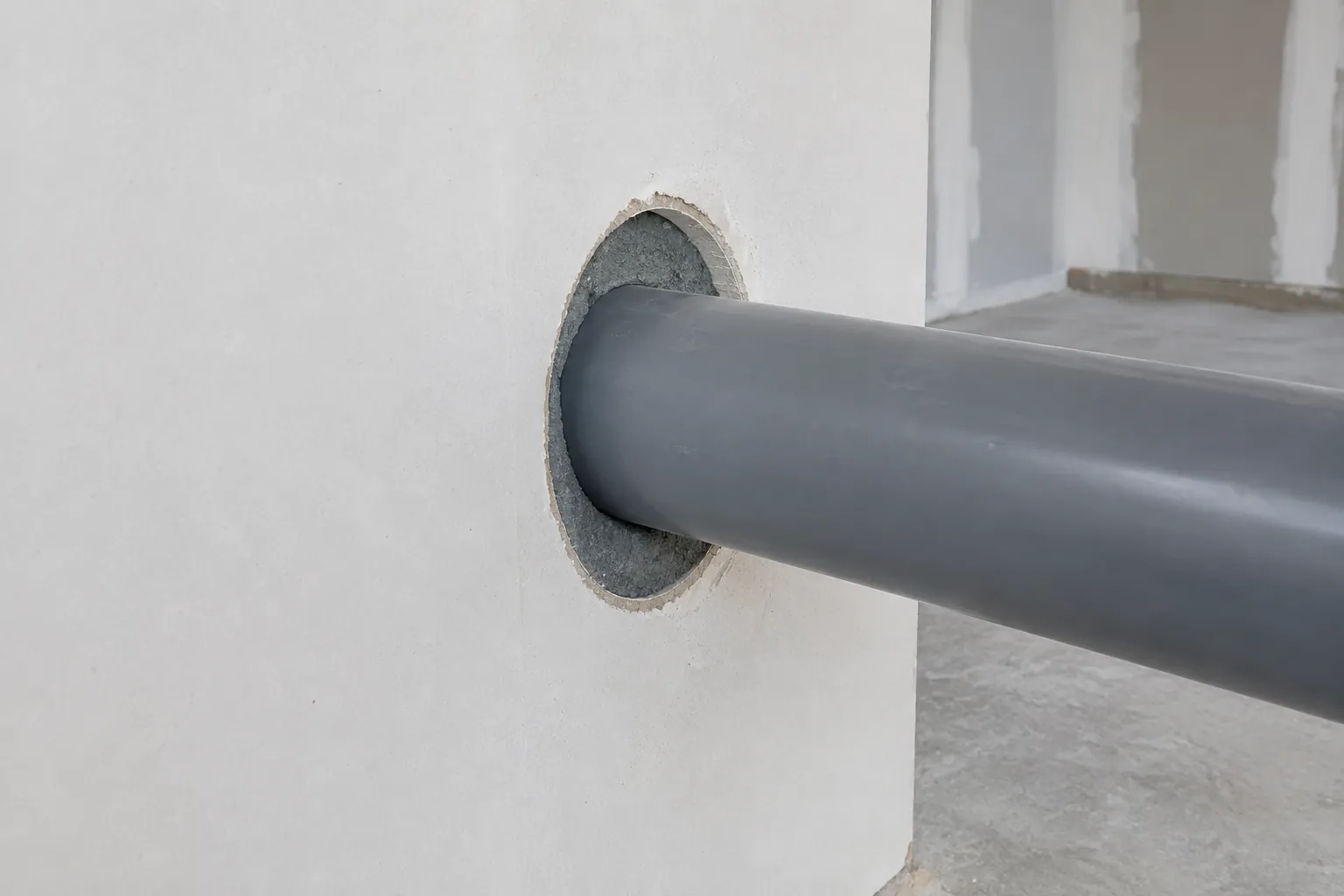
Keep fire resistance as a separate work package. BS EN 13501-2:2023 covers fire-resistance classification, including penetration seals. A pipe’s reaction-to-fire class does not prove that a wall or floor penetration maintains the required fire resistance. The installed penetration needs its own applicable evidence and accepted arrangement. This guide does not select a collar, seal or sprinkler system; it keeps those approvals separate from the European pipe-document review.
Set hold points before changing suppliers or releasing substitutes. If the required class is absent, the offered product lies outside documented coverage, or the declaration route is unresolved, record the precise gap. Do not convert “more documents needed” into “all plastic pipe is prohibited”. A clear discrepancy lets the supplier supply the missing evidence, propose another covered product, or withdraw the unsupported offer.
Request an evidence-linked quotation and delivery date
Send a product schedule with the destination country, intended installation, material, outside diameter, wall construction, required class and quantities. Ask the supplier to return a line-by-line product-to-evidence mapping. IFANPRO’s PP-R pipe and fittings range provides the product starting point; a catalogue listing is not a fire-classification claim. Do not assign the same class to green and white products without supporting coverage.
| Submission item | Request from the supplier | Buyer verdict |
|---|---|---|
| Product identity | Offered SKU, technical sheet and covered dimensions | Does the evidence describe this offer? |
| Classification | Complete class, issuer, report identity and field of application | Does the required installation fit the coverage? |
| Market documents | Applicable technical route and declaration, where required | Is the stated European route supported? |
| Supply timing | Stock or production basis, approval deadline and written dispatch date | Can the documented product reach the installation programme? |
No verified IFANPRO per-SKU fire-classification report or numeric lead time is available for this article. The checklist is a request for evidence, not a statement that the listed reports are already held or that any product achieves a particular class. Confirm availability against the exact product schedule before making a compliance claim to your customer.
Separate physical stock from document readiness when discussing delivery. Ask whether the offered batch is already manufactured and whether its identification matches the submitted evidence. Request a written dispatch date and identify any dependency on technical approval or further assessment. An available pipe does not necessarily mean the project submission is ready; a completed submission does not establish a warehouse balance.
If further testing or assessment is proposed, ask the supplier to distinguish its own production commitment from the external body’s confirmed programme. Avoid putting an assumed laboratory turnaround into the purchase order. Have the parties identify who submits the product information, who resolves coverage questions and which event permits dispatch. Record revisions when the product or installation changes, so the delivery promise still refers to the reviewed offer.
Before releasing the purchase order
Close the product identity, report coverage, declaration route and project requirement as separate checks. Retain the accepted evidence references beside the ordered items and the written dispatch commitment. If a check remains open, name the missing document and the person responsible for resolving it. This gives procurement a concrete decision record instead of an unqualified “EN 13501 approved” label.
Frequently asked questions
Does every PP-R pipe have the same EN 13501 class?
No. Request evidence for the offered product and its covered end-use conditions; material or colour alone does not establish a class.
Does B-s1,d0 prove a fire-resistant wall penetration?
No. Reaction to fire and fire resistance address different questions. The penetration arrangement needs its own applicable evidence.
Is a classification report a Declaration of Performance?
No. Establish the applicable CPR technical route and request the appropriate declaration where required.
Does the lack of a harmonised standard eliminate every CE route?
No. A voluntary ETA route may be available under the applicable conditions. A laboratory report alone does not establish that route.







 Español
  English
  Français
  Русский
Comentarios recientes