
A PEX-to-copper transition fitting is governed by two documents at once: a PEX joining standard at one end and ASTM B88 copper tube at the other. Get the pairing wrong and the joint is not merely weaker — it is outside the standard the inspector is reading, which is a different and more expensive problem. This guide maps the five transition families to the exact standards that govern them, so a distributor can decide what to stock and a specifier can write an order that survives approval.
Key Takeaways
- Four ASTM fitting standards and one ASSE standard cover the PEX side. All five share the same service envelope: 100 psi (689.5 kPa) at temperatures up to and including 180°F (82°C).
- The size ceilings differ sharply. ASTM F2159 covers only four sizes (3/8, 1/2, 3/4, 1 in.), while ASTM F1960 reaches 3 in. — that gap decides whether one family can cover your whole range.
- As ASSE/ANSI 1061-2025’s published scope is worded, push-fit is permitted onto hard drawn copper Types K, L and M, but annealed Type M only up to 3/8 in. nominal — soft copper above that size falls outside it. The standard is a purchased document; verify against your AHJ’s adopted edition.
- “Lead free” is a statutory number: a weighted average of 0.25% lead across wetted surfaces. Since 1 September 2023, certification — not a supplier declaration — is required of manufacturers and importers.
- Dezincification resistance is a separate question from lead content. ISO 6509-1 is only the test method — it sets no pass mark, so the acceptance limit (commonly 200 µm under NSF/ANSI 14) must be named separately on the order.
- No dielectric union is required at a PEX-to-copper joint. The code imposes that duty on copper-to-galvanized-steel joints; PEX cannot complete a galvanic cell.
On this page
- What a PEX-to-copper transition fitting actually has to do
- The five transition families, and the standard that governs each
- The copper side decides more than buyers expect
- Lead-free is a number and a certificate
- Dezincification is a different problem from lead
- No, you do not need a dielectric union here
- Choosing one family to stock: best for, not for
- What to put on the purchase specification
What a PEX-to-Copper Transition Fitting Actually Has to Do
Two joining systems meeting inside one body
Most plumbing fittings answer to a single specification. A transition fitting does not. One end must satisfy whichever PEX joining standard the installation was approved under; the other end must land correctly on seamless copper water tube manufactured to ASTM B88. The fitting is the physical seam between two engineering traditions, and the paperwork treats it that way.
This is why the transition is the part of a mixed-material system that most often gets flagged. A run of PEX is easy to approve because one standard covers it end to end. A run of copper is the same. The adapter between them is the point where a buyer has to prove two things at once, and where a fitting bought on price alone tends to fail the second test.
The practical consequence for a stocking decision: you are not buying “an adapter.” You are buying a specific PEX joining method, in a specific size range, in a body alloy that has to clear a potable-water rule, landing on a copper tube of a specific type and temper. Four variables, and the fitting families differ on every one of them.
Why the joint, and not the pipe, is what gets rejected
PEX tubing and copper tube are both mature, heavily documented products. Disputes at handover rarely concern either one. They concern whether the connector between them carries a marking that the adopting code recognises, and whether the person who bought it can produce the certification behind it. That is a procurement problem long before it is an engineering problem.

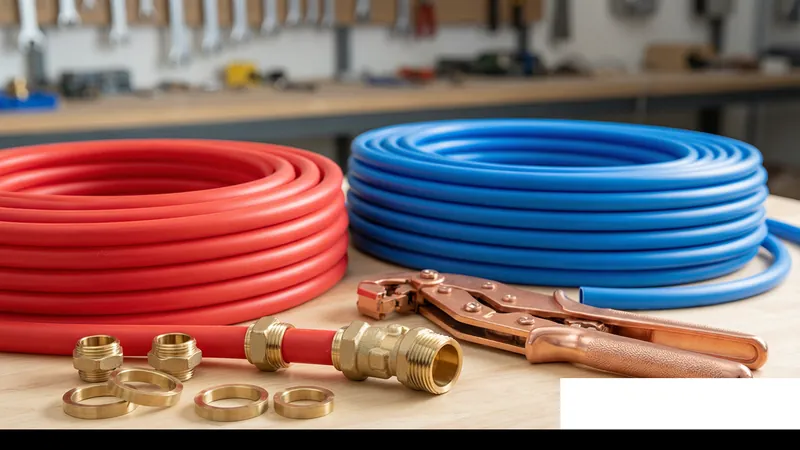
A two-colour brass compression fitting being assembled onto PEX — the mechanical family described below (IFAN Group).
The Five Transition Families, and the Standard That Governs Each
The four ASTM standards and the one ASSE standard
Five documents cover essentially all of the PEX-side joining you will encounter on a transition fitting. They agree on the service envelope and disagree on almost everything else, which is precisely why the mapping is useful.
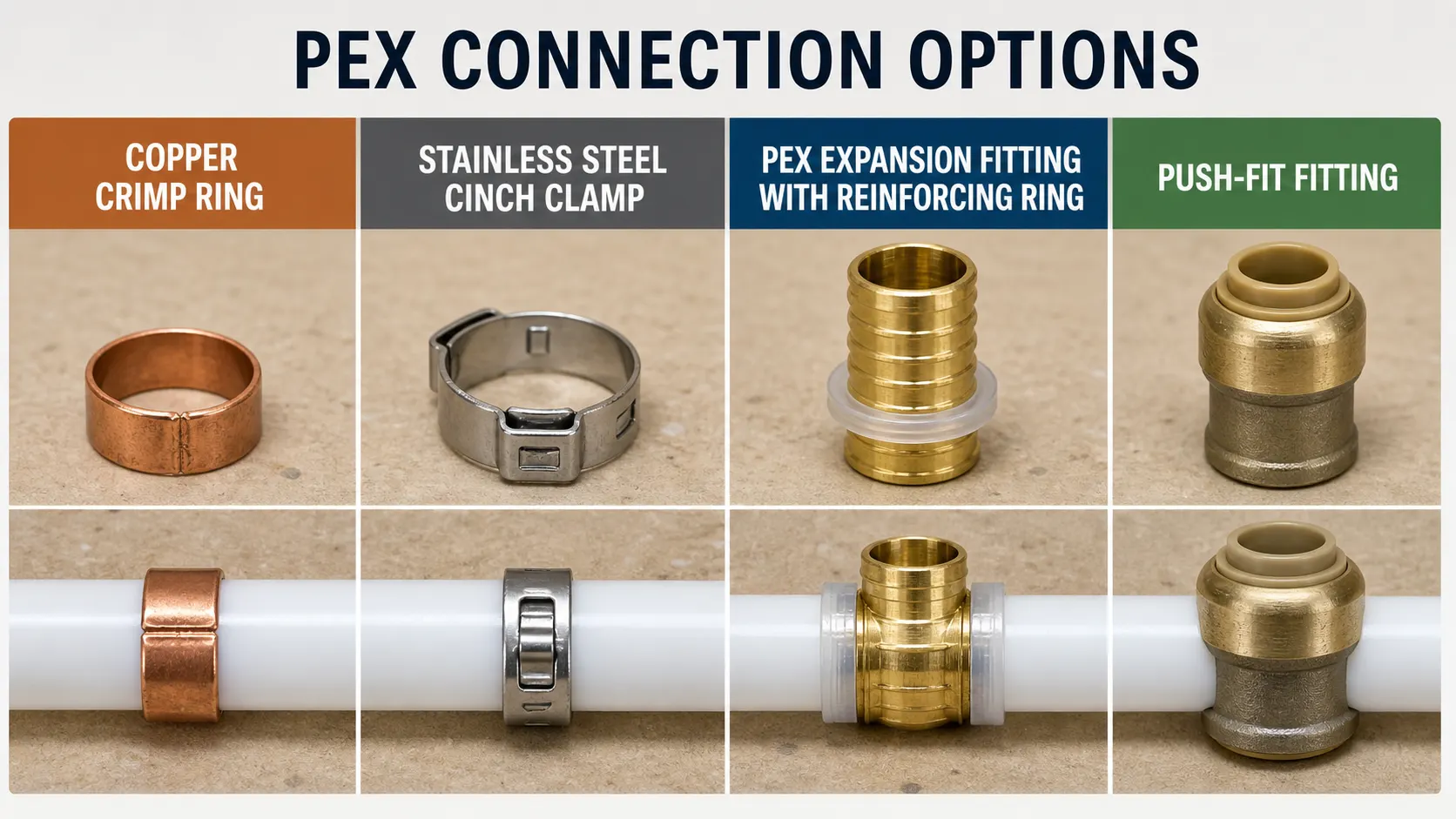
ASTM F1807 covers metal insert fittings with a copper crimp ring, or alternate stainless steel clamps, for SDR9 PEX and PE-RT tubing. Its published scope runs 3/8 through 2 in. nominal, and it states the fittings are intended for 100 psi (689.5 kPa) cold- and hot-water distribution operating at temperatures up to and including 180°F (82°C). The current edition is F1807-26 — note that the title itself now names the stainless clamp alternative, which older submittal sheets citing a 2013 or 2018 edition do not.
ASTM F2159 is the plastic-bodied sibling: sulfone plastic insert fittings with the same copper crimp ring or stainless clamp. Same 100 psi and 180°F envelope. The difference that matters commercially is the range — F2159 establishes requirements for four nominal tubing sizes only: 3/8, 1/2, 3/4 and 1 in. There is no F2159 route to a 1-1/4 in. transition.
ASTM F1960 covers cold-expansion fittings with a PEX reinforcing ring, and it is the widest of the five: nominal tubing sizes from 3/8 all the way to 3 in. If your range has to reach large-diameter branches without a second joining system, this is the family that gets you there.
The two cold-expansion routes, and push-fit
ASTM F2080 also covers cold expansion, but with a metal compression sleeve instead of a PEX ring, running 3/8 through 2 in. It is the only one of the four ASTM documents whose published scope enumerates the permitted body materials outright: machined brass, machined stainless steel, machined carbon steel, forged brass, or cast copper alloys.
ASSE/ANSI 1061 governs push-fit. The current edition is ASSE/ANSI 1061-2025, ANSI approved in June 2025 — worth checking against any supplier document you hold, because the 2011, 2015 and 2020 editions still circulate widely. It caps nominal size at 2 in. CTS and shares the same 100.0 psi (689.5 kPa) at 180.0°F (82.2°C) continuous service rating.
| Transition family | Governing standard | Nominal size range in scope | What the published scope states |
|---|---|---|---|
| Metal insert, copper crimp ring or stainless clamp | ASTM F1807 (current: F1807-26) | 3/8, 1/2, 5/8, 3/4, 1, 1-1/4, 1-1/2, 2 in. | 100 psi (689.5 kPa) to 180°F (82°C) |
| Sulfone plastic insert, crimp ring or clamp | ASTM F2159 (current: F2159-23) | 3/8, 1/2, 3/4, 1 in. only | 100 psi (690 kPa) to 180°F (82°C) |
| Cold expansion with PEX reinforcing ring | ASTM F1960 (current: F1960-24) | 3/8 through 3 in. | 100 psi (690 kPa) to 180°F (82°C) |
| Cold expansion with metal compression sleeve | ASTM F2080 (current: F2080-23) | 3/8 through 2 in. | Scope names permitted body alloys: machined or forged brass, machined stainless or carbon steel, cast copper alloys |
| Push-fit | ASSE/ANSI 1061-2025 | Up to 2 in. CTS | 100.0 psi (689.5 kPa) at 180.0°F (82.2°C) |
What the inspector actually reads off the fitting
The reason this mapping is worth carrying on a spec sheet rather than in someone’s head is that the model code recognises a closed list. Under the International Plumbing Code, fittings for cross-linked polyethylene tubing must comply with ASSE 1061, ASTM F877, F1807, F1960, F2080, F2098, F2159, F2434, F2735 or CSA B137.5. A transition fitting whose marking names none of these has no route to approval, however well it performs on a bench.
That closed list also explains a recurring dispute at goods-in. A fitting can be entirely fit for purpose and still be refused because the marking cites a withdrawn edition or no standard at all. The marking is the claim; everything else is commentary. For the PEX-to-PEX side of the same system, our comparison of crimp, clamp, push-fit and expansion connection types covers how these families behave once installed.
The Copper Side Decides More Than Buyers Expect
Types K, L and M are wall thickness, not quality grades
ASTM B88 establishes requirements for seamless copper water tube in UNS C12000 and C12200. Types K, L and M under that standard are wall-thickness designations at the same outside diameter — K thickest, M thinnest. They are not tiers of quality, and a building that specifies Type L is not asking for a better metal than one that specifies Type M. It is asking for a different wall.
Temper matters just as much and is more often missed. ASTM B88 notes that annealed tube is suitable for use with flared or compression fittings, and with solder-type fittings provided the tube ends are rounded and sized where needed; drawn temper tube is suitable for solder-type fittings. Soft coiled copper and hard drawn copper are not interchangeable at a mechanical joint just because the diameter matches.
The push-fit limit almost nobody quotes
ASSE 1061’s own scope draws a line that decides a great many retrofits. As the standard’s published scope is worded, push-fit fittings may be used with copper tubing that is hard drawn Type K, L and M, and annealed Type M not to exceed 3/8 in. nominal, complying with ASTM B88. One caveat on how to use that line: ASSE/ANSI 1061-2025 is a purchased document, so what appears here reproduces its published scope wording rather than a clause we can link you to — confirm it against the purchased standard, the fitting maker’s own listing documentation, or the edition your AHJ has adopted before it goes into a submittal.
Read that carefully, because the consequence is specific. On a renovation where the existing copper is soft annealed tube at 1/2 in. or 3/4 in. — common in older domestic work and in anything that was coiled to get around an obstruction — a push-fit transition is outside the scope of the standard that governs push-fit. It may well seal. It is not covered. If your market does a lot of retrofit work on soft copper, that single sentence should change what you stock.
Lead-Free Is a Number and a Certificate, Not a Marketing Word
The number: 0.25% weighted average
Section 1417 of the US Safe Drinking Water Act defines “lead free” as a weighted average of 0.25% lead calculated across the wetted surfaces of a pipe, pipe fitting, plumbing fitting and fixture, and 0.2% lead for solder and flux. The calculation is across wetted surfaces, not across the mass of the part — a distinction that occasionally surprises buyers who have been quoted a bulk alloy analysis instead.
The statute prohibits introducing non-lead-free pipe or plumbing fittings into commerce, with the use prohibition running from June 1986. A brass transition fitting on a potable line sits squarely inside that scope.
Compliance and certification are not the same date
The change that catches importers is more recent. As of 1 September 2023, lead-free certification is required for manufacturers and importers who introduce into commerce plumbing products regulated under the Lead Free Rule. Meeting 0.25% is the substance; holding the certification is now the separate, documented obligation. A supplier’s own declaration that an alloy is compliant is not the same instrument.
It is also worth checking whether an exemption applies before assuming one does. The Act exempts devices used exclusively for non-potable service, plus a specific list — toilets, bidets, urinals, fill valves, flushometer valves, fire hydrants, tub fillers, shower valves, service saddles, and water distribution main gate valves 2 inches in diameter or larger. A transition fitting on a potable branch appears nowhere on that list.
IFANPRO operates under ISO 9001 and ISO 14001 quality and environmental systems and holds scheme registrations including WRAS, NSF/IAPMO, Intertek, Watermark and SAI Global at company level; per-product listings should always be requested and read for the specific item and size you are ordering, because a company-level scheme registration and a product listing are different documents. Our guide to the certifications importers must verify for potable PEX goes through what to ask for.
Dezincification Is a Different Problem From Lead
What dezincification does, and how it is tested
Dezincification is selective corrosion: zinc leaves the brass and what remains is a porous, copper-rich skeleton that holds its shape until it is asked to hold pressure. Fittings fail this way without warning, months or years after a joint tested fine.
Resistance is tested rather than assumed — but the standard splits the job across two documents, which is the detail purchase specifications get wrong. ISO 6509-1 is only the test method, covering copper alloys above 15% zinc in fresh, saline or drinking water. In its own words it “describes only the test methodology and does not set out criteria for acceptability” — those live in ISO 6509-2. So a supplier answering “tested to ISO 6509” has told you a sample was measured, not that it passed.
The pass mark comes from whichever product standard the market applies. A brass rod manufacturer’s summary of those limits puts the common potable-water threshold at 200 µm maximum depth under NSF/ANSI 14, while ISO 6509-2 splits longitudinal and transverse limits on extruded rod rather than applying one figure. That is why “DZR” alone specifies nothing: name the depth limit and the standard imposing it. The alloy usually carrying this duty, CW602N or CZ132, is a leaded arsenical brass running 35.0–37.0% zinc and 0.08–0.15% arsenic with copper as the remainder — the arsenic being the inhibitor that suppresses zinc loss, present in tenths of a percent. Those are the supplier’s published ranges, not a measurement of any particular fitting.
The conflation to avoid on a purchase order. Lead-free is a health requirement measured as a weighted average across wetted surfaces. Dezincification resistance is a durability requirement measured as dezincification depth under ISO 6509-1. A fitting can satisfy one and not the other. Both belong on the order as separate lines — and the dezincification line has to name an acceptance limit, because the test standard alone does not carry one.
Where the risk is highest
Susceptibility starts with the alloy: ISO 6509-1 scopes its test to copper alloys above 15% zinc. Treat that as a screening line, not a safety guarantee — brasses well above it have served in enormous volumes without incident, and rod manufacturers dispute the figure’s historical basis.
What decides the outcome is the water, and the standard picture is less reliable than supplier guidance implies. Turner’s 1960s UK survey mapped dezincification against chloride and bicarbonate alkalinity, and that diagram is still widely quoted. A 2016 CEOCOR case study from the Slovenian National Building and Civil Engineering Institute documents dezincification — and consequent lead release into drinking water — in a supply with low chloride and high alkalinity, exactly the combination Turner classes as non-dangerous, attributing the divergence partly to pH below 8.3 where the original waters were all above it.
So no distributor can audit the water chemistry of every project a fitting reaches. Where supply is aggressive or simply unknown across a wide installed base, DZR is a warranty-exposure decision rather than a technical nicety — and the cost difference sits in the alloy, not the fitting’s geometry or its ASTM listing.
No, You Do Not Need a Dielectric Union at a PEX-to-Copper Joint
What the code actually requires, and of which joint
This is the most reliably mis-stated point in the whole subject, so it is worth quoting the structure of the rule. The International Plumbing Code requires joints between different piping materials to be made with a mechanical joint of the compression or mechanical-sealing type, or as permitted in its subsections, with connectors or adapters carrying an elastomeric seal conforming to ASTM F477.
Its dielectric subsection is specific about which pair it addresses: joints between copper or copper-alloy tubing and galvanized steel pipe shall be made with a brass fitting, a dielectric fitting, or a dielectric union conforming to ASSE 1079. Plastic-to-other-material joints are routed to a different subsection, which calls for approved adapters or transition fittings — and says nothing about dielectric separation.
Why PEX cannot complete the circuit
The physics behind that drafting is straightforward. Galvanic corrosion needs two dissimilar metals in electrical contact through an electrolyte. PEX is a non-conductive polymer. It cannot form half of a galvanic couple, so a PEX-to-copper joint does not create the condition a dielectric union exists to interrupt. Specifying one there adds a fitting, a leak path and a cost for no corrosion benefit.
One honest caveat, because the question deserves a complete answer rather than a satisfying one. The brass or stainless body of the transition fitting is metal, and it does contact the copper. That metal-to-metal pair is where dissimilar-metal questions genuinely live, and it is governed by alloy selection and water chemistry — the dezincification discussion above — rather than by adding a dielectric union at the plastic interface. Note also that code section numbering and adoption vary by jurisdiction and edition, so confirm the wording in the code your project is actually approved under.
Choosing One Family to Stock: Best For, Not For
Best for, not for, by family
A distributor rarely gets to stock every family. The size ceilings and the copper-side limits usually make the decision before preference does.
| Family | Best for | Not for |
|---|---|---|
| Metal insert / crimp (F1807) | High-volume repeat work up to 2 in.; the widest tool base in the trade | Ranges that must reach 2-1/2 or 3 in. in one system |
| Plastic insert (F2159) | Cost-sensitive small-diameter work where brass content is a concern | Anything above 1 in. — the standard does not go there |
| Cold expansion, PEX ring (F1960) | One system covering 3/8 to 3 in., including large branch work | Customers unwilling to buy an expander tool |
| Cold expansion, metal sleeve (F2080) | Buyers who want the body alloy named in the governing scope | Ranges needing to exceed 2 in. |
| Push-fit (ASSE 1061) | Repair and service work on hard drawn copper; no tool required | Annealed copper above 3/8 in.; anything over 2 in. CTS |
| Compression and union transitions | Joints that must be broken for service — meters, manifolds, appliances | Buried or inaccessible work where a serviceable joint has no value |
Why a serviceable joint earns its shelf space
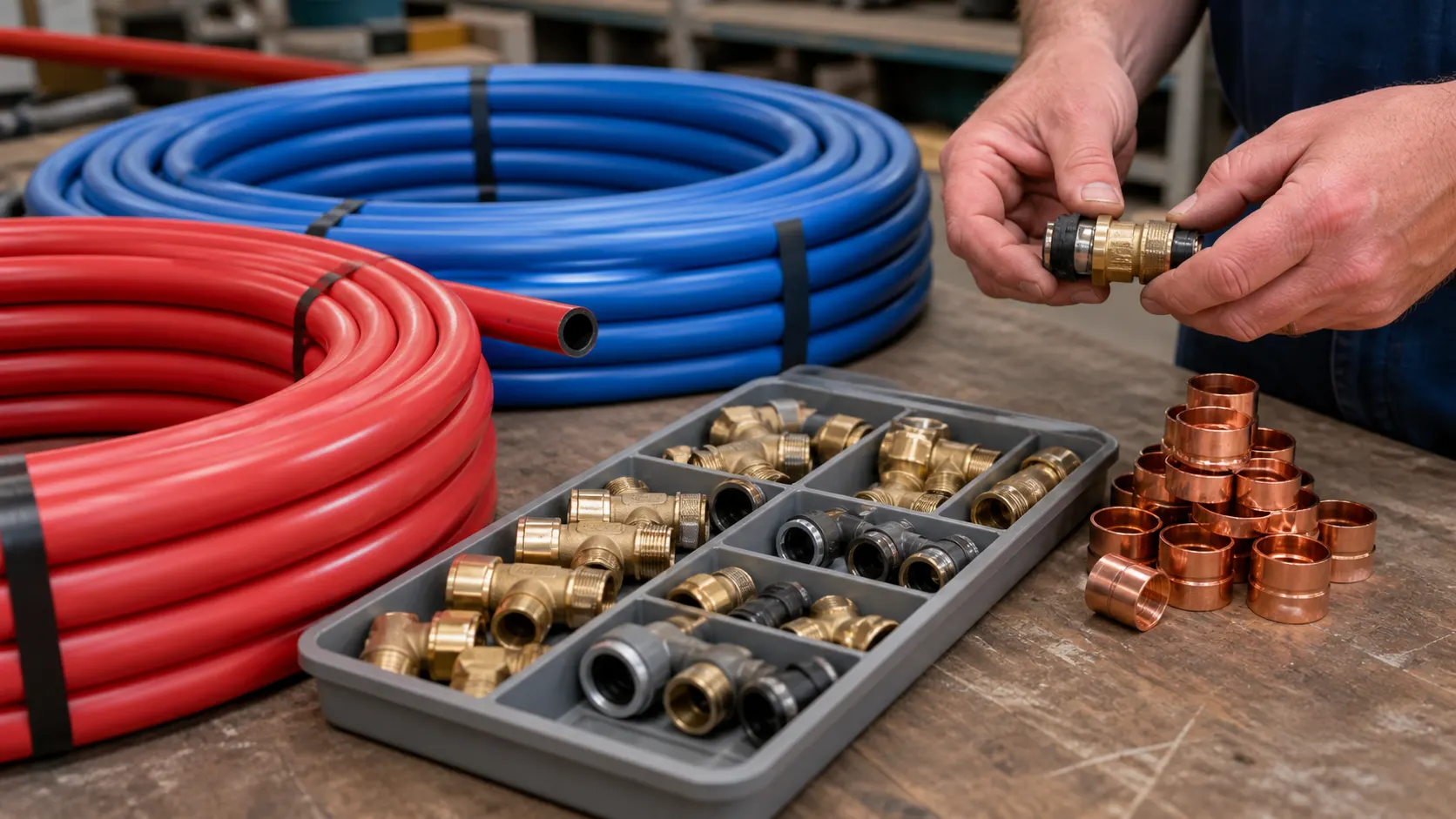
Crimp and cold-expansion joints are permanent by design, which is correct for most of a building. At a water meter, a manifold, a pump or an appliance isolation point, permanence is a liability — the joint will be broken deliberately within its service life, and a family that cannot be broken without cutting forces a repair every time maintenance happens. That is the argument for carrying a union-style transition alongside whichever permanent family you choose. Our notes on selecting the right 121UC female union size and on installation practice for threaded PEX unions cover that family in detail.
IFANPRO’s PEX range is built around these families: the PEX pipe and fittings catalogue lists the 121UC compression family — unions, elbow-with-union, male and female elbows, tees and reduced tees, end caps and valve sets — across 30 listed products, and the press and brass compression families appear alongside it in the wider range. If you are still weighing whether to run PEX, copper or PPR on a given project, our material decision matrix for PEX, copper and PPR works through the cost and durability trade-offs first.
Two commercial points buyers ask at this stage, answered honestly rather than invented. Minimum order quantity on transition fittings is set per project against your actual size mix, because a range spanning 3/8 to 2 in. behaves very differently in tooling terms from a single-size repeat order — it is quoted, not published. The same applies to price structure and lead time, which move with size mix, body alloy and whether the order is a stock item or a private-label run; the relevant figures come back with a quotation against a specific list. What is fixed and publishable is what appears above: the governing standard, the size ceiling and the service envelope for each family.
On verification, the practical route before a first order is to ask for two documents: the standard marking for the specific item and size you intend to buy, and the lead-free certificate covering it. Then check that certificate against the issuing body’s own listing rather than against a supplier document. That is a check you can complete yourself, without relying on anything a supplier tells you — including us.
For distributors and stocking wholesalers deciding which transition family to carry. The catalogue lists the 121UC compression range — unions, elbows with union, tees, reduced tees, end caps and valve sets — so you can see the shape of the range before asking for a quotation on your size mix.
What to Put on the Purchase Specification
Name the standard, not just the family
A purchase line that says “1/2 in. PEX x 1/2 in. copper adapter, brass” can be filled correctly by four different products, at least one of which will fail approval. The fix costs nothing at order time: name the joining standard and its edition, state the copper tube type and temper at the interface, and require the lead-free certification mark rather than a compliance statement.
A worked specification line you can reuse
Here is the same order written so that only one product can satisfy it:
“Transition fitting, 1/2 in. nominal PEX to 1/2 in. copper. PEX end to ASTM F1807 (current edition F1807-26), metal insert with copper crimp ring. Copper end to suit ASTM B88 Type L hard drawn tube. Body to be lead free per SDWA Section 1417 — weighted average 0.25% across wetted surfaces — supplied with third-party lead-free certification, not a supplier declaration. Body alloy to be dezincification resistant, tested to ISO 6509-1 with a maximum dezincification depth of 200 µm, the acceptance limit stated on the test report. Standard designation to be marked on the fitting.”
The four checks before you release the order
- Does the size exist in that standard? A 1-1/4 in. fitting cited to ASTM F2159 cannot be right — the standard covers four sizes and stops at 1 in.
- Does the copper side match reality on site? Hard drawn or annealed, and which type. On annealed copper above 3/8 in., push-fit falls outside ASSE 1061.
- Is the certification a certificate? Since 1 September 2023, certification is the obligation on manufacturers and importers, not a declaration of compliance.
- Is the standard marked on the part? The marking is what an inspector reads; an unmarked fitting is an argument you will have at handover.
For sizing across the rest of the system, our PEX pipe sizing chart covers the tubing side, and the PEX fitting size and thread reference covers thread designations you will need on the copper-side connection.
For importers and procurement teams with a specific list. Send the sizes, the joining standard you need and the destination market, and our export desk will come back on availability, MOQ against that mix, and pricing.
Заключение
The PEX-to-copper transition is a small part with an outsized paperwork footprint. Almost everything that goes wrong with it is decided before anyone picks up a tool: a family chosen without checking its size ceiling, a push-fit specified onto soft copper, a compliance statement accepted where a certificate was required. None of those are difficult to catch. They just have to be caught at the order, not at the inspection.
If you are building a range rather than filling a single order, work backwards from your market’s copper stock and water chemistry, then choose the joining family whose scope actually covers the sizes you sell.
Frequently Asked Questions
Do I need a dielectric union between PEX and copper?
No. Galvanic corrosion requires two dissimilar metals in contact through an electrolyte, and PEX is non-conductive. The code imposes the dielectric requirement on copper-to-galvanized-steel joints, not on plastic-to-metal ones.
What standard covers PEX to copper crimp adapters?
ASTM F1807 for metal insert fittings with a copper crimp ring or stainless clamp, and ASTM F2159 for sulfone plastic insert bodies. F1807 runs 3/8 to 2 in.; F2159 covers only 3/8, 1/2, 3/4 and 1 in.
Can push-fit fittings be used on any copper tube?
Not any. As ASSE/ANSI 1061-2025’s published scope is worded, it covers hard drawn Type K, L and M copper plus annealed Type M only up to 3/8 in. nominal. The standard is paywalled — confirm against your AHJ’s adopted edition.
What does lead-free actually require?
A weighted average of 0.25% lead across wetted surfaces under Section 1417 of the Safe Drinking Water Act, and 0.2% for solder and flux. Since 1 September 2023, certification is required of manufacturers and importers.
Is DZR brass the same as lead-free brass?
No. Lead-free is a health limit on lead content; dezincification resistance is a durability property measured by ISO 6509-1, which sets no pass mark of its own — the limit, commonly 200 µm, comes from the product standard. A fitting can meet one and not the other.
Which transition family reaches the largest sizes?
ASTM F1960 cold expansion, whose scope runs from 3/8 in. up to 3 in. nominal. F1807 and F2080 stop at 2 in., ASSE 1061 at 2 in. CTS, and F2159 at 1 in.








 Русский
  English
  Français
  Español
Последние комментарии