
A PE mechanical coupling needs an internal support liner when the exact coupling manufacturer’s instructions require one. Some designs expressly work without one. Identify the coupling model and the pipe before completing the accessory order. A generic “HDPE coupling” description cannot settle the question.
Two products from one manufacturer make the distinction useful. Viking Johnson specifies a stainless steel support liner for PE used with its UltraGrip Couplings. Its AquaFast Coupling 63–315mm is a different design advertised without a support liner, with stated pipe limits. Neither statement transfers automatically to an IFAN fitting or another manufacturer’s product.
Key Takeaways
- The exact coupling design decides whether a liner is required.
- Keep a required liner identifiable in the complete offer.
- A documented no-liner design still has pipe and application limits.
- Hold an unidentified model or conflicting SDR until clarified.
- Confirm pipe applicability separately from accessory inclusion and availability.
The product name changes the liner decision
Start with the precise product page or instruction supplied for the offered item. The current UltraGrip Couplings page, caveat 4, requires a Viking Johnson stainless steel support liner when the fitting is used on PE. A quote omitting that accessory therefore leaves a requirement unresolved; the absence of a line item does not waive it.
The AquaFast Coupling 63–315mm page states that no support liner is needed. The applicable OD63–315 installation instruction, DR11195 (02/2023) goes further: support liners should not be used with AquaFast. It lists PE SDR17/17.6 and SDR11. Check the exact pipe and supplied product against the controlling instruction; obtain clarification where the offer cites inconsistent scope.
Why can the designs differ? Viking Johnson’s 2010 UltraGrip NG FAQ explains the distinction through sealing loads: AquaFast’s pressure-responsive double O-ring seal applies a lighter initial load, while UltraGrip develops sealing compression during bolt tightening and needs internal support for PE. This dated explanation is context for those named designs; use the current product instruction for the offered assembly. It does not prove the behaviour of an unnamed coupling.
These are named product examples, not a ranking of the two designs. They establish why a universal yes or no is inadequate. Keep each requirement attached to its product identity. A photo of a similar-looking metal body is insufficient to transfer an accessory instruction.
Also separate the liner question from overall suitability. A confirmed accessory requirement settles one part of the assembly. It does not establish every operating limit, installation condition or project acceptance requirement. Read the complete applicable instructions before releasing a proposed connection.
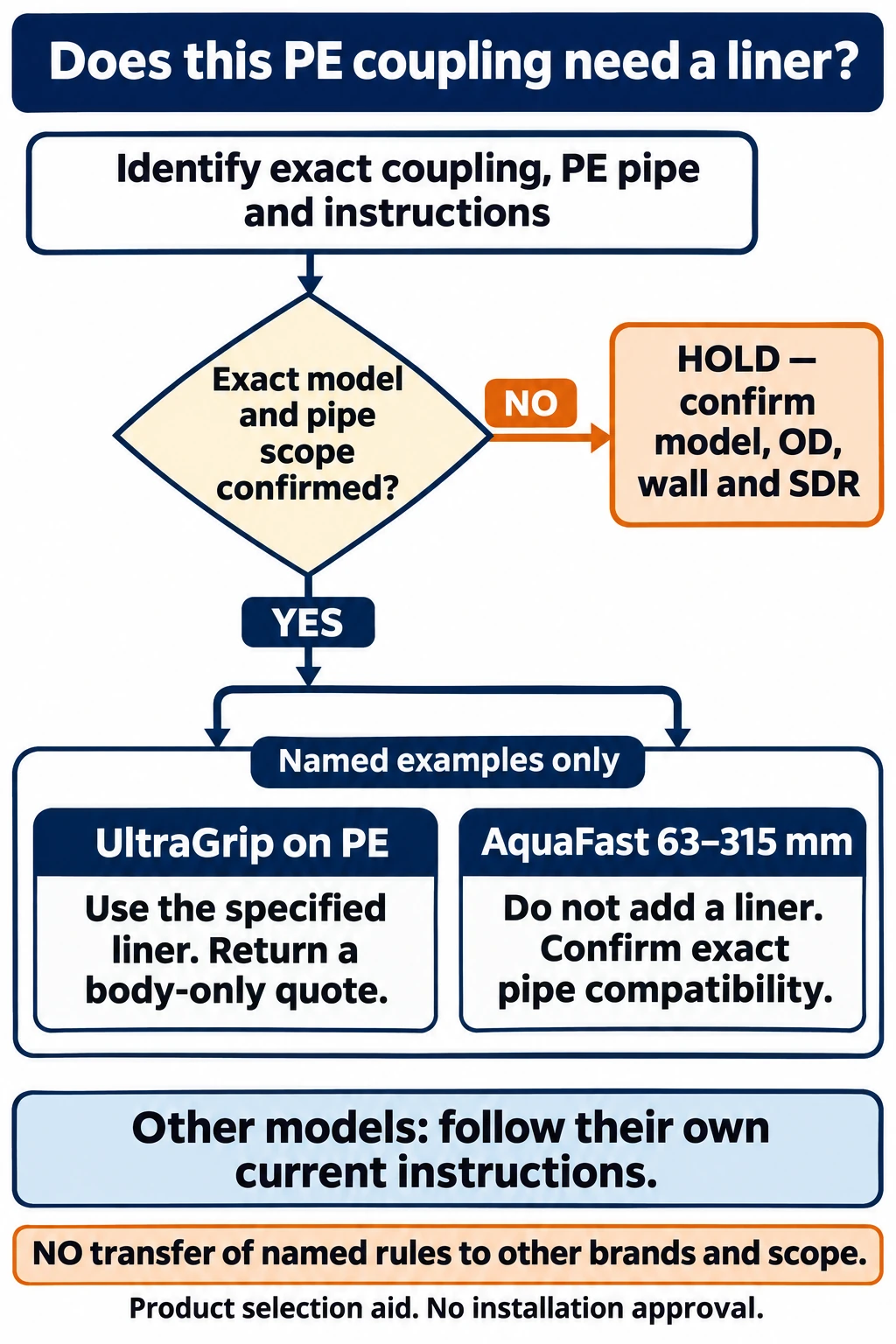
- Identify exact coupling, PE pipe and instructions
- Hold until exact model and pipe scope are confirmed
- UltraGrip on PE uses specified liner; AquaFast 63–315 mm follows exact no-liner instructions if compatible
- Other models use their own instructions
Record the pipe and the complete coupling kit
Put the actual PE pipe outside diameter and wall information beside the coupling reference. Include the pipe marking, SDR if available, intended service and the project specification. When markings or dimensions are uncertain, record the uncertainty for resolution; do not convert a nominal size on a delivery note into a measured pipe dimension.
Ask the coupling manufacturer which liner, if any, is specified for that exact combination. Where a liner is required, obtain its part reference, dimensional applicability and supply quantity. “Includes inserts” is a poor substitute for an identifiable accessory that can be checked against the manufacturer’s selection information.
Keep the offer’s scope explicit. Is the liner included in the coupling kit, separately priced, or unavailable in the proposed delivery? Does the quoted quantity cover the intended assemblies? Request a kit list or an annotated offer so a purchasing assistant can distinguish an accessory omission from an intentional liner-free design.
Do not invent a universal sleeve length, wall thickness or insertion detail. Those dimensions belong to the specified assembly. A local workshop making an insert that happens to slide inside the pipe has not thereby established an approved substitute. Obtain the manufacturer’s response before changing the bill of materials.
| Field | Record or request | Unresolved response |
|---|---|---|
| Coupling | Exact manufacturer, model, applicable instruction | Hold identity-dependent selection |
| Pipe | OD, wall or SDR, marking and intended service | Request confirmation rather than infer dimensions |
| Required accessory | Specified part reference and applicability, if required | Return incomplete accessory scope for clarification |
| Supply | Kit inclusion, quantity and availability | Obtain an explicit complete offer |
Three purchase records with different outcomes
The following records are illustrative purchasing examples. They are not IFAN customer orders, test results or installation permissions.
| Offer record | Established evidence | Purchase decision |
|---|---|---|
| A: UltraGrip on PE | Manufacturer requires its stainless steel liner | Return incomplete offer for matched accessory confirmation |
| B: identified AquaFast | No-liner design; pipe scope confirmed separately | Keep documented configuration; do not add generic liner |
| C: unnamed coupling | Model and instruction unavailable | Hold selection pending identifiable manufacturer requirement |
Record A: the offer identifies UltraGrip for PE but lists only the coupling body. The completed purchasing action is “Please confirm the specified liner reference, quantity, inclusion and availability.” The buyer has identified a missing requirement, not determined whether an unlisted part was physically packed in a box. Check the response and kit evidence before closing that exception.
Record B: the offer identifies the cited AquaFast model and the project reviewer confirms the actual pipe is within its documented scope. Preserve that supported no-liner configuration. Adding an arbitrary insert to make the offer resemble Record A would change the proposed assembly without supporting instructions. Complete the remaining application and installation checks separately.
Record C: the offer says only “universal coupling for HDPE.” Ask for the manufacturer, model and current instruction. Do not approve an empty accessory line as a no-liner design, and do not automatically add a sleeve. The information needed to choose between those actions is still missing.
Change one input and the outcome changes. If Record B’s pipe SDR is unresolved or falls at a conflicting published boundary, its earlier scope confirmation no longer holds. Return that point to the manufacturer. The documented product name remains useful, but it cannot answer an unverified pipe dimension.
Resolve a missing or conflicting requirement before ordering
Send a question that produces a specific answer: “For coupling model [reference] on the attached PE pipe [OD and wall/SDR], identify the required internal support liner or confirm that this configuration is designed without one. Please attach the applicable instruction and list any exclusions.”
Retain the response with the revised quotation and pipe information. A phone explanation can help resolve the issue, but ask for the final configuration in writing so purchasing, stores and the installation team receive the same requirement.
Where a brochure, product page and instruction differ, request the document and revision controlling the proposed supply. The AquaFast page’s differing SDR wording illustrates why copying one short sentence is insufficient. An article cannot resolve the manufacturer’s publication inconsistency for a live project.
A support liner decision also does not decide whether a repair clamp is a permanent repair. Those are different selections. The existing HDPE repair-clamp acceptance guide addresses the repair’s intended role; retain the separate evidence for whichever fitting and application are actually proposed.
Ask for a complete offer, including accessories
For an IFAN product enquiry, use the IFAN PRO product site to identify the relevant range and send the pipe specification, proposed connection, quantity and destination. Ask whether the offered model requires an internal liner and which accessories the offer includes. This article does not establish that IFAN supplies either named Viking Johnson product or an interchangeable alternative.
Ask for MOQ and pricing on the complete configuration rather than the coupling body alone. Request the lead time for the matched accessories as well as the fitting, and ask when the schedule begins. An accessory awaiting confirmation can leave a body-only delivery unusable for the intended assembly. No stock level, minimum quantity, price or dispatch date is established here.
The order can close the liner question when the named coupling, identified pipe and written accessory rule agree. If one of those is missing, keep that selection open and obtain the missing evidence before approving the configuration.
Заключение
Close the accessory question against the exact model and identified pipe. Require the specified liner where the manufacturer calls for one; preserve a supported liner-free configuration where it does not. Keep unresolved model or pipe-limit questions open before approving the purchase.
Frequently Asked Questions
Does a missing liner line mean no liner is needed?
No. It may mean an incomplete quotation. Check the exact coupling instruction and ask whether the matched accessory is included or separately supplied.
Can I add a generic liner to a no-liner coupling?
Do not change a documented configuration without manufacturer support. The liner-free design and the permitted pipe scope must be considered together.
Does this confirm that IFAN supplies these products?
No. The named products illustrate different technical requirements. Ask IFAN to identify its actual offered model, application limits and accessories before comparing a complete quotation.










 Русский
 English
 Français
 Español
Последние комментарии