
A PEX pipe size chart answers the one question that decides whether a plumbing job works or fails: is this line big enough to carry the water without starving the fixture at the end? Picking a PEX pipe size is not guesswork, and it is not “whatever’s on the truck.” It comes down to nominal size versus actual bore, flow rate at a safe velocity, and how much friction the run and its fittings will steal along the way.
This page gives you the numbers a contractor actually uses on site: CTS and metric size cross-references, flow rates by size, and fixture-to-line matching. It sits inside our complete guide to PEX pipe, so if you need material grades or connection methods, start there. Here, the sizing chart is the point. Undersize a trunk and you hand the customer cold showers; oversize every run and you burn money on pipe and invite stagnant water to sit in oversized lines.
Key Takeaways
- CTS PEX is sold by nominal size, not outer diameter: 1/2″ PEX has an OD of about 0.625″, and 3/4″ PEX is about 0.875″ OD.
- 1/2″ PEX serves most single fixtures, 3/4″ handles branch mains feeding several fixtures, and 1″ carries trunks and manifold feeds.
- At a safe 4–6 ft/s velocity, 1/2″ PEX moves roughly 2–4 gpm, 3/4″ around 5–9 gpm, and 1″ about 9–17 gpm.
- Metric PEX is measured by real OD (16, 20, 25, 32 mm), so 1/2″ CTS ≈ 16 mm in bore but the two do not share fittings.
- Barbed insert fittings neck down the inside diameter and add friction; on long runs, size up one step to hold pressure.
- PEX runs smoother than copper (Hazen-Williams C ≈ 150), so a same-size PEX line often carries flow with less pressure loss.
PEX Sizes at a Glance: CTS vs Metric
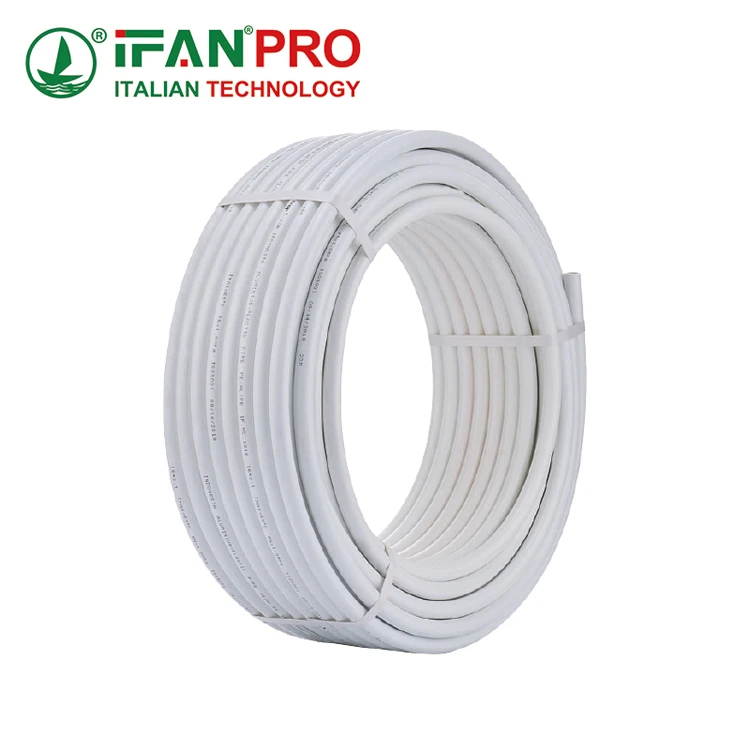
Two sizing systems dominate the PEX world, and mixing them up is where jobs go sideways. North American PEX follows CTS (Copper Tube Size) and is called out by nominal size in inches. Most of Europe, the Middle East, and Asia use metric PEX measured by true outer diameter in millimeters. This first pex pipe size chart lines the common sizes up side by side so you can spec a job in either system.
| Nominal (CTS) | Actual OD | Approx. ID | Nearest Metric OD | Common Use |
|---|---|---|---|---|
| 3/8″ | 0.500″ (12.7 mm) | ~0.35″ (8.9 mm) | — (12 mm close) | Fixture stub-outs, ice makers |
| 1/2″ | 0.625″ (15.9 mm) | ~0.475″ (12.1 mm) | 16 mm | Individual fixtures, home-run drops |
| 3/4″ | 0.875″ (22.2 mm) | ~0.671″ (17.0 mm) | 20–25 mm | Branch mains, multi-fixture runs |
| 1″ | 1.125″ (28.6 mm) | ~0.862″ (21.9 mm) | 25–32 mm | Trunks, manifold feeds, risers |
Read the OD column carefully. A 1/2″ CTS pipe is not half an inch across anything; its outer diameter is 0.625″. That naming convention is inherited from copper tube, and it trips up crews who assume the number on the coil is a real dimension. Dimensions here follow ASTM F876, the standard that governs CTS PEX tubing (ASTM F876). ID values are nominal for SDR9 wall and vary slightly by manufacturer and PEX type.
How to Read a PEX Size: Nominal, OD, and Wall (SDR)
The gap between what a PEX size is called and what it measures is the single most common source of ordering errors. CTS nominal size is a label, not a caliper reading. Metric PEX is the opposite: 20 mm means the outer diameter really is 20 mm. When someone hands you a spec in inches and your supplier quotes in millimeters, you have to translate by OD, never by the nominal number.
Wall thickness and SDR
SDR (Standard Dimension Ratio) is the outer diameter divided by the wall thickness. Most potable-water PEX is SDR9, meaning the wall is one-ninth of the OD. A thicker wall (lower SDR number) raises the pressure rating but shrinks the bore, which cuts flow. That trade-off matters: two coils labeled “3/4 inch” can carry different flow if their walls differ. Cross-linked polyethylene gets its pressure and temperature performance from the SDR9 wall, not from the label on the box (PEX).
Why 1/2″ CTS ≈ 16 mm but the fittings don’t cross over
A 1/2″ CTS pipe has an OD of 15.9 mm, which is close enough to 16 mm metric that people assume they interchange. They do not. CTS uses its own fitting standard (F1807 crimp, F1960 expansion, F2159 push, and press systems), and metric PEX uses metric compression, press, or push fittings sized to metric OD. Force a 16 mm fitting onto 1/2″ CTS and you get a joint that leaks under pressure or fails a hydro test. Insider warning: on export jobs where a US spec meets a metric supply chain, confirm the fitting system before you cut a single coil, because a mismatch here means re-doing every joint. Our breakdown of how fittings affect flow covers the systems in detail.
Flow Rate and Pressure by Size
Flow is where sizing stops being trivia and starts affecting the shower. Water velocity should stay between 4 and 6 ft/s in cold and hot lines. Below that, you’re carrying more pipe than the job needs. Above roughly 8 ft/s you get noise, water hammer, and long-term erosion of the pipe wall at fittings. The pex pipe sizes below are matched to that safe velocity band so you can read flow straight off the chart.
| Nominal Size | Flow at 4 ft/s | Flow at 6 ft/s | Rating @ 73°F | Rating @ 180°F |
|---|---|---|---|---|
| 3/8″ | ~1.2 gpm | ~1.8 gpm | ~160 psi | ~100 psi |
| 1/2″ | ~2.3 gpm | ~3.4 gpm | ~160 psi | ~100 psi |
| 3/4″ | ~4.5 gpm | ~6.7 gpm | ~160 psi | ~100 psi |
| 1″ | ~7.5 gpm | ~11.2 gpm | ~160 psi | ~100 psi |
Pressure ratings drop as temperature climbs. A typical PEX rating stack is about 160 psi at 73°F, 100 psi at 180°F, and roughly 80 psi at 200°F. Always design hot lines to the hot-rating column, not the cold one. Flow figures assume clear pipe bore; add barbed insert fittings and the usable flow falls (covered below). One structural advantage worth banking: PEX has a Hazen-Williams roughness coefficient near C ≈ 150, smoother than aged copper, so a PEX line of the same size loses less pressure to friction over distance (Hazen-Williams equation). Treat these as design-guide values and confirm against the manufacturer’s listing and your local code.
Which Size for Which Fixture and Line
Sizing a system means matching each line to the demand downstream of it. Individual fixtures rarely need more than 1/2″ PEX. The moment a line feeds two or more fixtures at once, step up. Trunks that feed a whole wing or a manifold need 3/4″ or 1″. The chart below maps line type to size for typical residential and light-commercial work.
| Line / Location | Recommended Size | Typical Fixture Units | Notes |
|---|---|---|---|
| Lavatory, toilet, ice maker | 3/8″ or 1/2″ | 1–2 | Low simultaneous demand |
| Shower, tub, kitchen sink | 1/2″ | 2–4 | Single high-flow fixture |
| Bathroom group / branch main | 3/4″ | 4–10 | Serves multiple fixtures |
| Main trunk / manifold feed | 1″ | 10+ | Whole-floor or building supply |
A real example makes it concrete. A two-bath house has a manifold fed from the water heater. The feed to that manifold carries every fixture that might run at once, so it gets 1″. Each home-run drop to a lavatory or toilet gets 1/2″. The shower drop also gets 1/2″ because a single showerhead pulls about 2 gpm, well inside 1/2″ capacity at safe velocity. If you instead ran a trunk-and-branch layout, the trunk after the heater would still be 1″, the branch feeding both bathrooms would be 3/4″, and the fixture stubs would be 1/2″. Fixture-unit tables and the exact demand method are set by your governing plumbing code, so confirm the local version before final sizing.
Sizing for Long Runs and Fittings
Friction loss grows with pipe length. A 1/2″ line that delivers 3 gpm at 10 feet may drop noticeably below that at 60 feet because every foot of wall drags on the water. When a run gets long, the fix is to size up one step and buy back the pressure. A 3/4″ line at the same flow moves water slower, so friction per foot falls sharply.
Barbed inserts neck down the bore
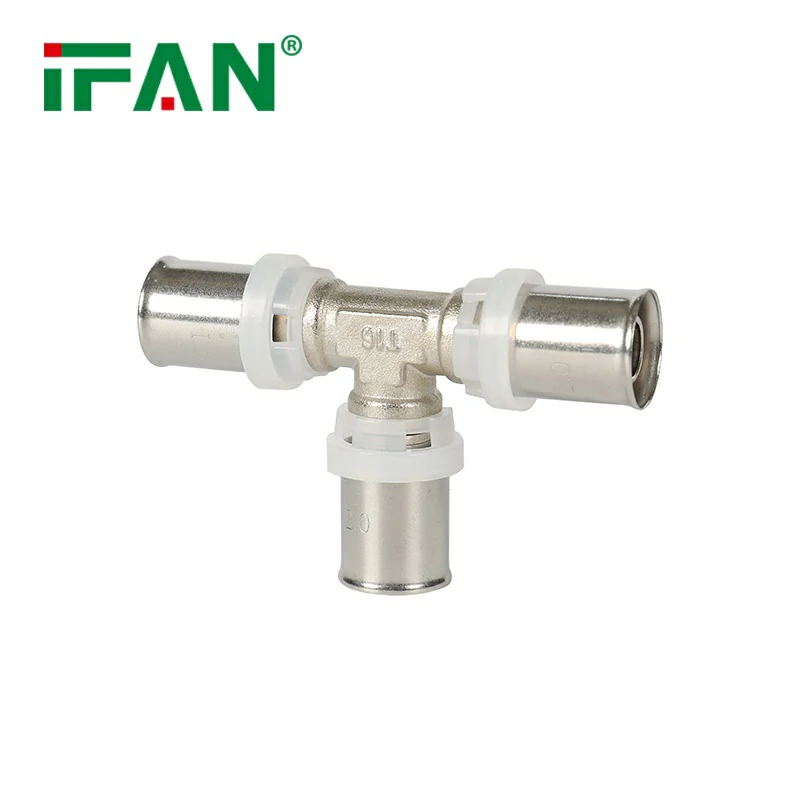
Barbed insert fittings, the kind crimp and clamp systems use, sit inside the pipe and shrink the inside diameter at every joint. That restriction cuts usable flow, and each fitting also adds “equivalent length” to the run as if you’d added several feet of straight pipe. String together a manifold feed with a dozen barbed tees and elbows and the friction adds up fast. Expansion and press systems that keep a fuller bore preserve more flow; the systems are compared in our guide to how fittings affect flow.
Hold velocity to protect the pipe
Keep velocity in the 4–6 ft/s band on every sized line. Push past 8 ft/s and you court water hammer, whistling, and erosion at the fittings where flow turns. Undersizing a long run is the fast way to blow past that limit, because the same demand through a smaller bore means faster water. Insider warning: on hot recirculation loops the erosion risk is higher, so size those a step up and keep velocity at the low end of the band.
Home-Run Manifold vs Trunk-and-Branch Sizing
Layout changes the size math. In a home-run manifold system, every fixture gets its own dedicated line straight from a central manifold, so each drop only ever carries one fixture’s demand. That is why home-run drops can nearly always be 1/2″ (or even 3/8″ for low-flow fixtures) while the manifold feed handles the combined load at 3/4″ or 1″.
Trunk-and-branch works the way copper always did: a large trunk runs the length of the building, and branches tee off to serve groups of fixtures. Here the trunk carries the whole building’s simultaneous demand and must be sized largest, branches step down as demand drops, and fixture stubs finish at 1/2″. The trade-off is real: manifolds use more total pipe but give balanced pressure and per-fixture shutoff; trunk-and-branch uses less pipe but the size of each segment depends on how many fixtures sit downstream. Neither is universally better, and the material choice behind the layout matters too, which is why it helps to know the difference between PEX-A, PEX-B, and PEX-C before you commit a manifold design.
Common Sizing Mistakes and What They Cost
Two failures show up again and again, and they cost in opposite directions. Undersizing starves fixtures: run a whole bathroom off 1/2″ and the shower drops to a trickle the moment someone flushes, because the demand exceeds what that bore can pass at safe velocity. The customer calls it “low pressure,” but the real cause is a line too small for the fixture units on it.
- Undersizing a trunk or branch: pressure drop, cold showers when a second fixture opens, and callbacks that mean opening a wall.
- Oversizing every line: wasted pipe and fitting cost, more water sitting in the line, and slower hot-water delivery because a bigger bore holds more cold water to purge.
- Ignoring fitting restriction: a line sized right on paper that underperforms because barbed inserts cut the effective bore.
- Mixing CTS and metric fittings: joints that leak or fail the hydro test.
Oversizing feels safe but has its own price. A trunk two sizes too big holds more standing water, wastes material on every foot, and slows hot-water arrival because there is more cold water to push out first. In hot lines that extra volume also loses more heat to the surrounding wall. The right answer is almost never the biggest pipe; it is the pipe matched to demand at safe velocity. The Plastics Pipe Institute publishes design resources that back the same principle (Plastics Pipe Institute).
What We Verify on Every Size Before Shipping
A sizing chart is only useful if the pipe in the box actually matches the dimensions on the chart. At IFANPRO, we verify every size against the dimensional standard before it ships, because a coil that measures out of tolerance throws off flow and fitting fit no matter how carefully you sized the job.
- We caliper OD, ID, and wall thickness on each production size against the CTS or metric target for that run.
- We check ovality so the pipe stays round enough for a reliable crimp, press, or expansion joint.
- We run temperature-rated pressure tests so the hot rating holds, not just the cold-water figure.
- We match each shipment’s certificates (WRAS, NSF/IAPMO, WaterMark as applicable) to the destination market’s requirements.
For buyers sourcing at volume, dimensional consistency across a container of coils is what keeps a crew’s sizing math honest on site. Our overview of how to wholesale PEX pipe from China walks through what to check on a supplier’s certificates before an order ships.
Frequently Asked Questions
What size PEX should I use for a whole house?
Feed the house with 3/4″ or 1″ from the meter or heater, run 3/4″ branch mains or manifold feeds, and drop 1/2″ to individual fixtures. The exact trunk size depends on total fixture units and your local code’s demand method, but that three-tier pattern covers most homes.
Is 1/2″ PEX enough for a shower?
Yes, for a single showerhead. A standard head pulls about 2 gpm, and 1/2″ PEX carries roughly 2–3.4 gpm at safe velocity. Problems appear when one 1/2″ line tries to feed the shower plus another fixture at the same time; then step the upstream line up to 3/4″.
Does 1/2″ CTS PEX equal 16 mm metric PEX?
They are close in bore, since 1/2″ CTS has an OD of about 15.9 mm, but they use different fitting standards and do not interchange. Never mix a metric fitting onto CTS pipe or the joint can leak. Match pipe and fittings within one system.
Why does the OD not match the nominal size?
CTS PEX inherits its naming from copper tube size, so the nominal number is a label rather than a measurement. A 1/2″ pipe measures 0.625″ OD and a 3/4″ measures 0.875″ OD. Always cross-reference by OD when translating between inch and metric specs.
Do PEX fittings reduce flow?
Barbed insert fittings used with crimp and clamp systems sit inside the pipe and shrink the bore, cutting flow and adding friction. Expansion and press fittings keep a fuller bore. On long runs with many fittings, size up one step to hold pressure.
Conclusión
Right-sizing PEX comes down to three moves: read the OD, not the nominal label; match each line to the flow its fixtures demand at 4–6 ft/s; and size up on long runs and fitting-heavy lines. Get those right and you avoid both the cold-shower callback and the wasted cost of oversized pipe. When you’re ready to spec real dimensions and certificates for a job or an order, start from our complete guide to PEX pipe and work down to the size chart above.










 Español
  English
  Français
  Русский
Comentarios recientes