
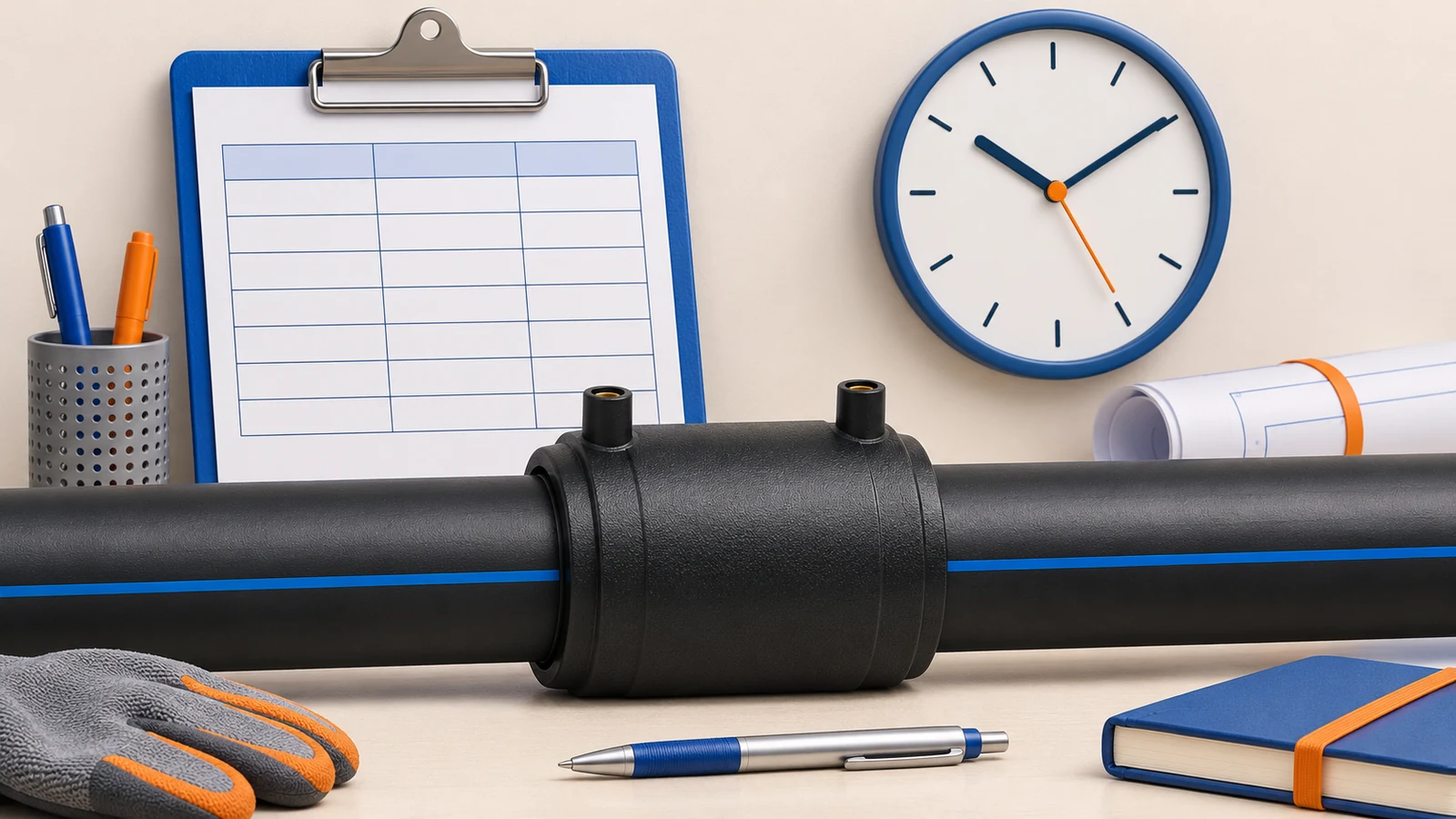
An electrofusion cooling timer does not necessarily release every later operation. GF Central Plastics distinguishes clamp time, rough-handling time and time before pressure testing or tapping. For qualified water-pipe work, create an operation-by-operation release record from the exact fitting instructions. Do not borrow a delay from another product or treat the clamp release as blanket permission.
Key Takeaways
- Map clamp removal, lifting/backfill and pressure/tapping to the matching CT/RH/TT definitions within GFCP scope; do not impose these labels universally.
- Build a release register from the documented fusion completion time and each applicable manufacturer delay, retaining units/reference conditions; no invented delay values.
- Keep an unsupplied operation blocked if only clamp cooling is known; do not infer readiness from touching the fitting, a successful indicator, or a universal multiple.
- Record the time origin and earliest release separately for every operation.
- A missing handling or test requirement remains on hold even after clamp time elapses.
Read the operation behind each cooling label
The source nomenclature here is GF Central Plastics’ Electrofusion Installation and Training Manual, revision 8/2022, page 22. Its CT entry concerns removal of clamping after fusion. RH concerns later forces such as lifting or backfilling. TT concerns pressure testing and tapping under the conditions stated there. These are that manual’s labels, not a guarantee that every manufacturer names its intervals in the same way.
The distinction changes the handover decision. “Cooling complete” is an incomplete instruction if one person means clamp removal while another intends to lift the pipe. Record the proposed operation explicitly. A processor ending its cycle is evidence of that event; it does not itself provide all the subsequent permission conditions.
| Operation | GFCP label | Record boundary |
|---|---|---|
| Clamp removal | CT | Source definition after fusion completion |
| Lifting or backfill | RH | Own handling requirement |
| Pressure test or tapping | TT | Own delay and stated test conditions |
Put three release events on the job record
Begin with the recorded completion of the fusion cycle and the exact joint identity. Locate each required release in the fitting instructions and identify its time origin: for the CT definition above it is after the cycle completes. For any other entry, use the origin its own instructions specify rather than assuming all clocks begin at the same event.
Create a separate row for clamp removal, rough handling and pressure testing/tapping. Each row needs the source revision and table row, the applicable fitting/size/conditions, the required delay and unit, the observed time origin, the calculated earliest time and a release status. A blank delay remains a hold. Copying CT into all three rows merely hides missing information.
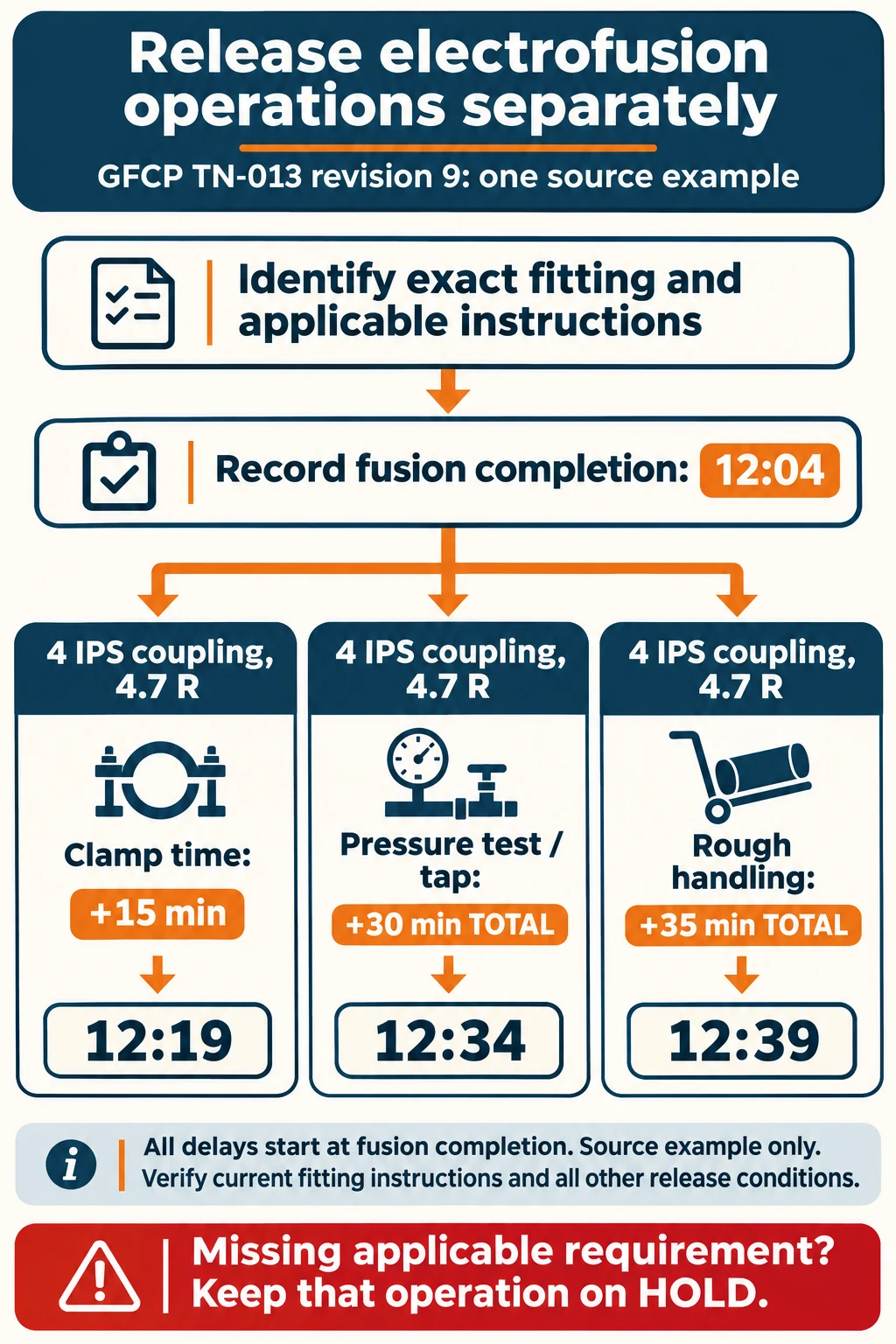
The technical note TN-013, revision 9, dated October 20, 2022, supplies a useful complete example. Its Couplings row for 4 IPS, connection 4.7 R lists a 200-second fusion cycle and three different cooling requirements: 15 minutes clamped, 30 minutes total before pressure test/tap, and 35 minutes total before rough handling. The chart’s own worked example starts at fusion completion, 12:04. It gives 12:19, 12:34 and 12:39 respectively. The cooling columns are minutes; the 200-second heating cycle has already finished at the stated origin.
At 12:25 in that example, the clamp-time threshold has elapsed; the test/tap and rough-handling thresholds have not. At 12:35, the test/tap timing threshold has elapsed but lifting or backfilling still waits until 12:39. These are total delays from 12:04, not successive intervals to add after clamp removal. Timing is one prerequisite: the qualified person must still confirm the fitting identity, applicable instructions, inspection and project procedure before releasing any operation.
| TN-013: 4 IPS coupling, 4.7 R | Delay after fusion ends | Source example release |
|---|---|---|
| Clamped cooling | 15 min | 12:19 |
| Pressure test/tap | 30 min total | 12:34 |
| Rough handling | 35 min total | 12:39 |
This row belongs to that GFCP document and fitting description, not to any 4-inch coupling. Check the current instruction supplied with the actual product before use. TN-013’s warnings specify an installation range of −10°F to 120°F and require a qualified installer with access to the installation manual. Its test/tap definition concerns 150% of MOAP; it does not authorize a project test pressure. Outside the row’s applicable conditions, retain the hold and obtain the correct instruction.
Use a manufacturer row without mixing fitting families
Read the actual row and its notes together. Coupling and saddle instructions, dimensions, service conditions and defined activities can differ. Keep the identifying fields next to the copied interval so that an otherwise accurate number cannot migrate to another joint. The record should distinguish a sourced requirement from an observation and from a calculated clock time.
- Identify the exact fitting and applicable instructions.
- Record fusion completion; the GFCP source example starts at 12:04.
- For the source 4 IPS, 4.7 R coupling example, clamp time is 15 minutes: 12:19.
- For that same example, pressure test/tap timing is 30 minutes total: 12:34.
- For that same example, rough handling timing is 35 minutes total: 12:39.
- Keep any operation on hold when its applicable requirement is missing.
The GFCP TT definition includes a stated pressure-test condition involving 150% of MOAP. That is a scope qualifier on this source’s definition, not a general instruction to test any installed water system at that pressure. The approved project test procedure still determines the permissible test and its prerequisites. These water-system timing checks do not authorize work on a gas system.
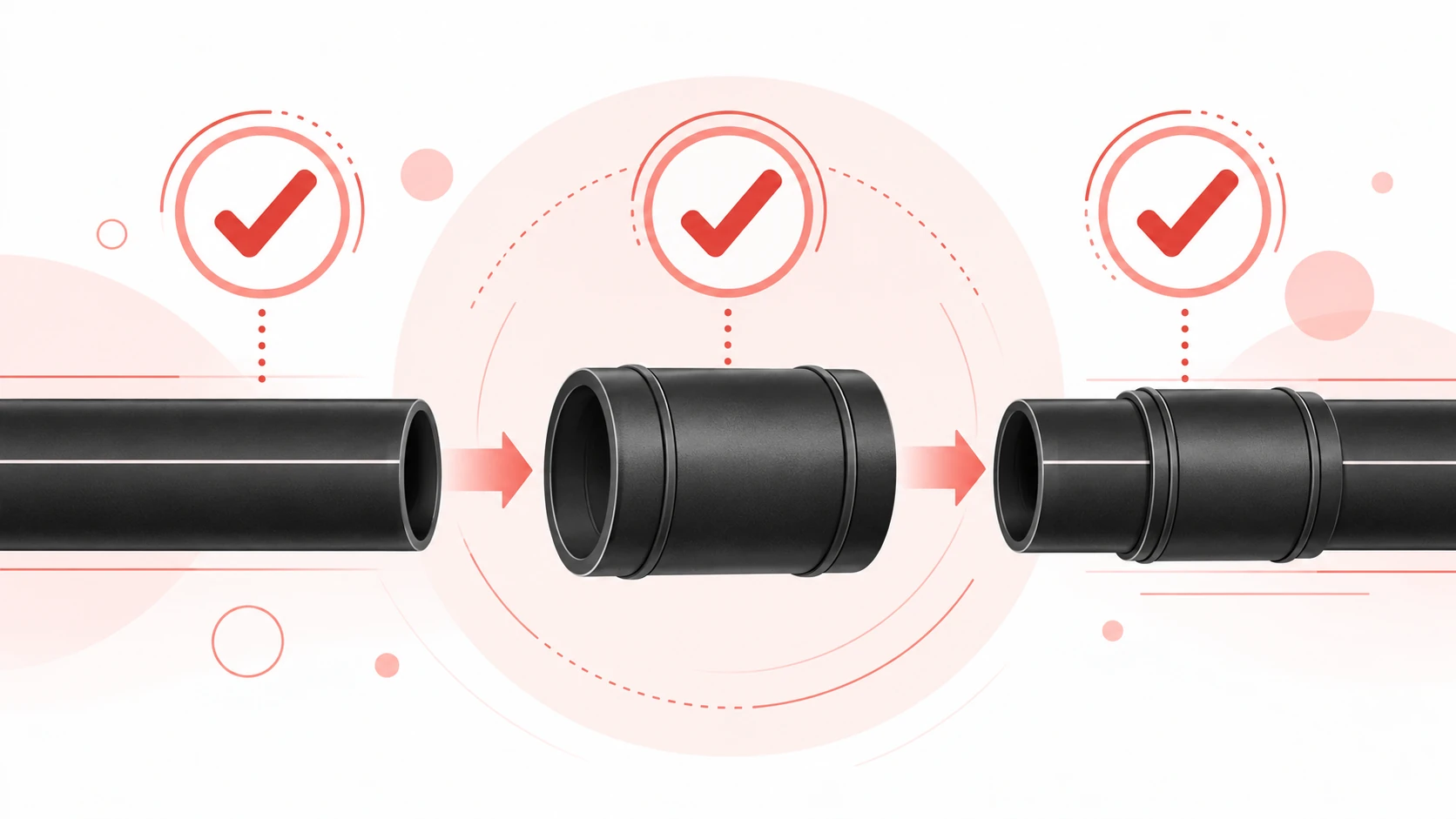
Keep the general HDPE joining-method guide as background. Use the joining-method guide for background; retain the release record beside the exact fitting instructions.
| Register field | Entry rule | If absent |
|---|---|---|
| Joint and source | Fitting/size; instruction revision and row | HOLD |
| Operation and conditions | Named action; applicable scope | HOLD |
| Delay and origin | Source value/unit; observed origin | HOLD |
| Earliest release | Origin plus applicable delay | No calculated release |
| Status and checker | Hold/released; authorized check | Do not hand over blanket permission |
Resolve a missing release time before work continues
When only CT is known, ask the exact fitting manufacturer or responsible procedure authority for the missing rough-handling and test/tapping conditions. Supply the joint identity, instructions already held, planned operation and service. Until that gap is resolved, retain the hold on that operation. An additional guessed margin cannot turn an unknown requirement into a documented release.
Do not infer readiness from a cool outer surface, the end of electrical heating or a visually acceptable indicator. Those observations do not supply an absent operation-specific requirement. If movement or an interrupted cycle has already occurred, stop and follow the manufacturer’s disposition procedure. A new wait period does not prove the joint has recovered; interrupted-cycle restart decisions are a separate task.
Keep the handover narrower than a complete fusion procedure
Hand over the register with the joint, source and event fields intact. The next crew should be able to identify which operation has been released, who checked it and which conditions remain outstanding. “Ready after cooling” loses this information and encourages a later crew to use one completed row as permission for another.
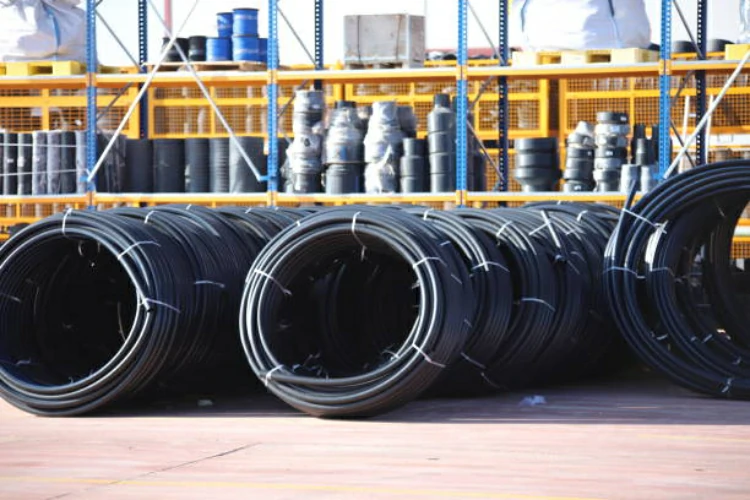
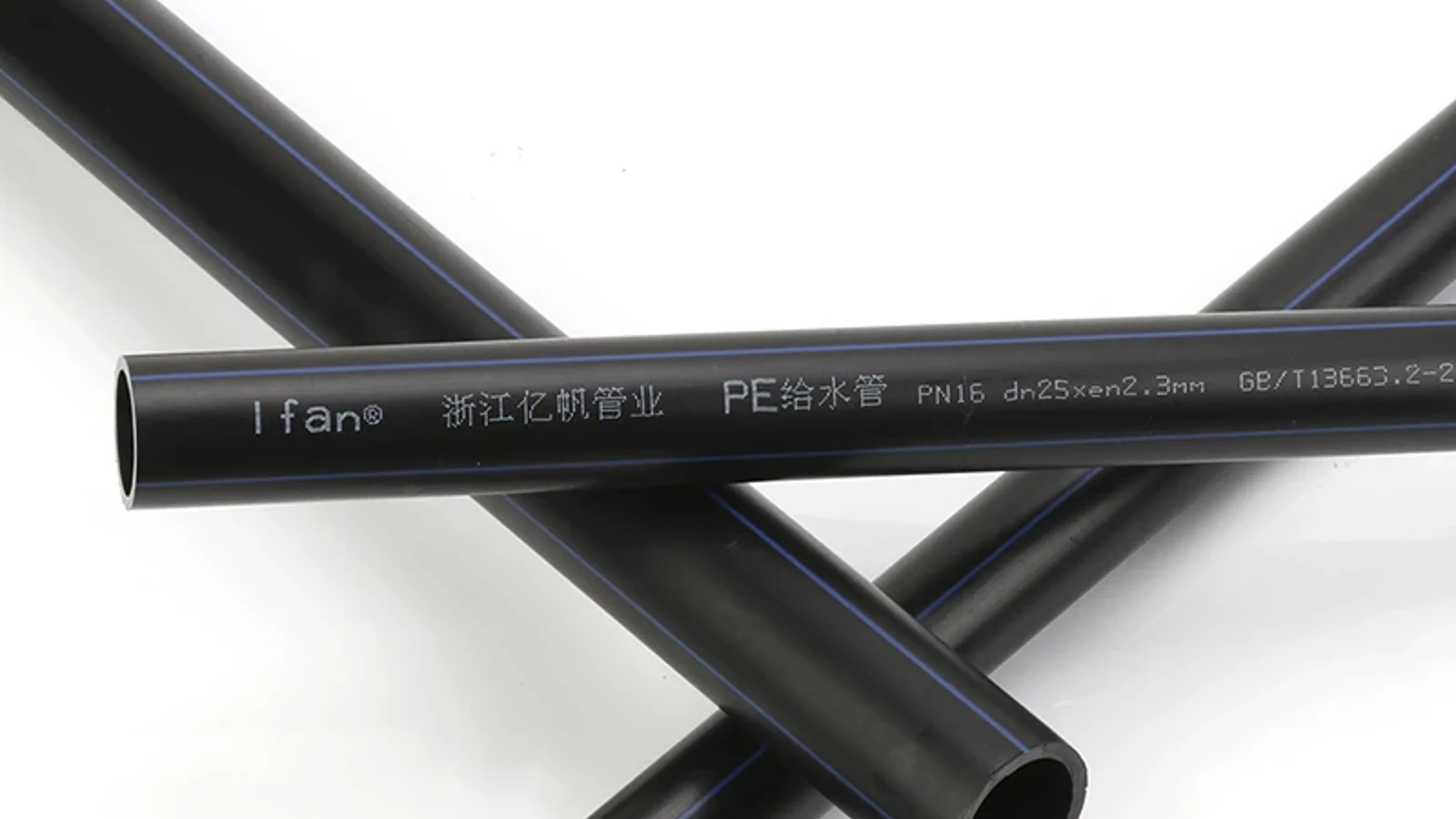
For an HDPE fitting availability discussion, submit the exact pipe, fitting and water-service specification. IFANPro’s category does not establish GFCP timing for an IFAN fitting or guarantee an equivalent product. Obtain the actual offered fitting’s instructions before replacing any row in the release register.
Conclusión
Release named operations against their own documented conditions. A completed clamp-time row cannot fill an empty handling or pressure-test row.
Frequently Asked Questions
Can I use another fitting brand’s delay?
No. Obtain the requirement for the actual fitting and operation; another manufacturer’s interval does not release it.
What if only clamp time is printed?
Keep other operations on hold until their applicable instructions are established. Do not copy clamp time into the missing rows.
Does a successful fusion indicator release pressure testing?
No. It does not supply the required test delay or replace the approved test procedure and its other conditions.
Technical source: GFCP TN-013 cooling chart; Manufacturer instructions. Named-system examples apply only within their documented scope.










 Español
 English
 Français
 Русский
Comentarios recientes