
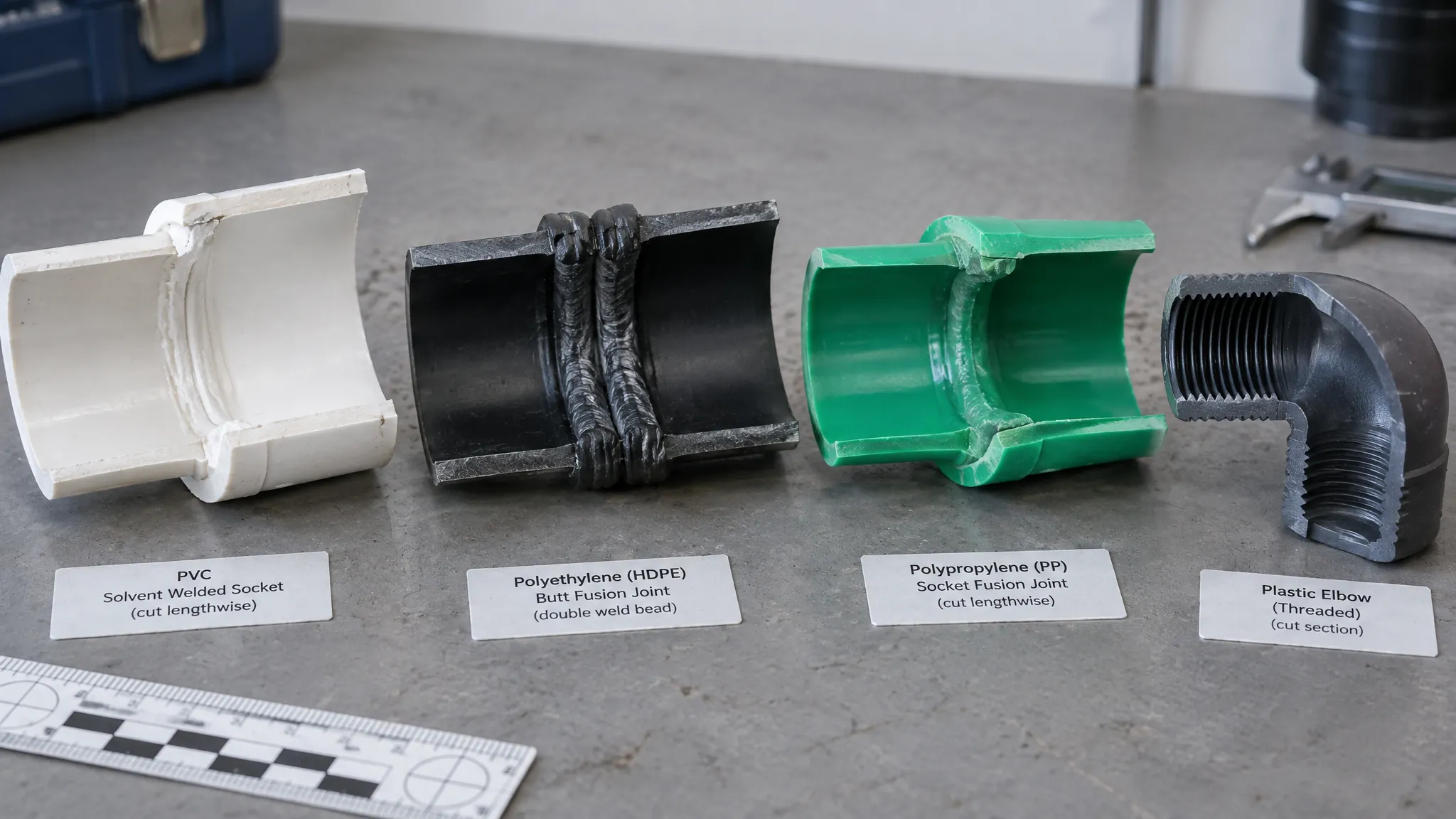
Plastic pipe joints fail in a small number of readable ways, and the joint surface is where the reading starts. This guide covers six failure modes across the four jointing methods a mixed-material project actually uses: solvent weld, socket and butt fusion, electrofusion, and mechanical or threaded transitions. Each mode leaves a different surface, arrives at a different point in service life, and is governed by a different published document. Name the mode first. The purchase-order clause follows from it.
The usual first move is to record where the leak was. Location is the least informative thing about a failed joint. A polyethylene main that splits after four years and a PVC socket that weeps on the day of the pressure test can sit a metre apart and share nothing. The first is judged by ASTM F1473-24a, a notch test run at 80 °C and 2.4 MPa on polyethylene only. The second is judged by ASTM D2855-20(2024), a joining practice that tests nothing at all. Cite the wrong one in a claim letter and the supplier is right to reject it.
Key Takeaways
- Six modes cover a mixed-material system: unwelded solvent socket, slow crack growth, cold fusion, rapid crack propagation, thread-root cracking, oxidative or stress cracking.
- PENT (ASTM F1473-24a) runs at 80 °C and 2.4 MPa, and its scope is polyethylene. Quoting it at a PVC supplier is a category error.
- ISO 13479:2022, third edition, tests notched polyolefin pipe and only accepts a wall thickness above 5 mm.
- ASTM D2855-20(2024) covers solvent-welded PVC and CPVC tapered sockets for pressurised liquids only.
- ASTM F2620-24 fusion parameters apply only to polyethylene of related polymer chemistry, never to PP-R.
- Threaded PVC fittings are Schedule 80 under ASTM D2464-23, and ASTM F1498-25 says “wrench tight” does not authorise a pipe wrench.
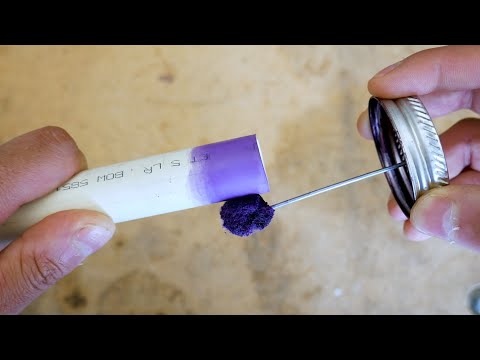
Before you call a fitting defective, watch how the joint is made: this independent walkthrough covers the burred cut, the dry fit, the skipped primer and the rushed cement that produce the bare socket of Mode 1.
Start With the Joint Surface, Not the Pipe Run
Two questions split six modes into a short list. First: is the broken face drawn and whitened, with a thick curled lip, or is it flat and glassy with no stretching at all? Ductile means the part was overloaded. Brittle means it was worn down slowly, by time, by chemistry, or by a joint that never formed in the first place. Second: did the separation happen at the joining interface, or through the wall of the pipe or fitting away from it?
Answer both before anyone cuts the sample out. Photograph the joint in place, mark flow direction, and cut well clear of the fracture so both mating faces survive. Then record the service history the laboratory will ask for anyway: age at failure, operating temperature in °C, the disinfectant the utility doses, and whether the line saw pressure cycling or a single surge. Wall thickness matters too, because the notched-pipe test that settles polyolefin arguments needs a wall above 5 mm and will not accept a thin service line.
Mode 1: The Solvent-Weld Joint That Was Never Welded
The signature is an absence. Pull the pipe from the socket and the two surfaces are clean, glossy and unmarked, with cement sitting in patches or in a single witness ring rather than as a continuous softened layer. These joints weep on the first pressure test or let go within days, not years.
ASTM D2855-20(2024) is the two-step primer and solvent cement practice for PVC and CPVC pipe and components with tapered sockets. Read what that sentence excludes. It is a practice, so a bare socket is evidence about how the joint was made, not proof that the fitting was defective. It assumes a tapered socket, so an oversized or parallel bore starves the interference the method depends on. Its scope covers pressurised liquids only, with an explicit warning about the hazards of testing with compressed air or other compressed gases. That is why solvent-welded PVC on a shop air line keeps reappearing as a joint failure.
The compound is a separate question from the joint. ASTM D1784-25 classifies rigid PVC and CPVC compounds containing at least 80 % vinyl chloride, and a cell class describes that material, not the finished fitting. Asking for one after a bare-socket failure answers a question nobody asked.
Mode 2: Slow Crack Growth, the Brittle Split That Takes Years
A slow crack growth failure looks wrong for the pressure it held. The break is a narrow axial slit, the fracture face is close to mirror-flat, and there is no drawing or stress whitening anywhere near it. It arrives years into service at a stress the line carried without complaint from day one, which is exactly why it gets misread as a manufacturing defect that somehow waited.
Two documents govern it, and both are polyolefin documents. ASTM F1473-24a is the notch tensile test known as PENT, and its standard condition is 80 °C at 2.4 MPa, with lower stresses permitted only where they stay low enough to preclude ductile failure. ISO 13479:2022, third edition, published on 3 June 2022, measures the same resistance as time to failure on pipe carrying machined longitudinal notches. It accepts specimens only above a 5 mm wall. Neither document may be quoted against a PVC, CPVC or PP-R failure. If a buyer sends a PENT demand to a PVC fitting maker, the reply will be a polite refusal, and it will be correct.
Mode 3: Cold Fusion, a Fusion Plane That Never Fused
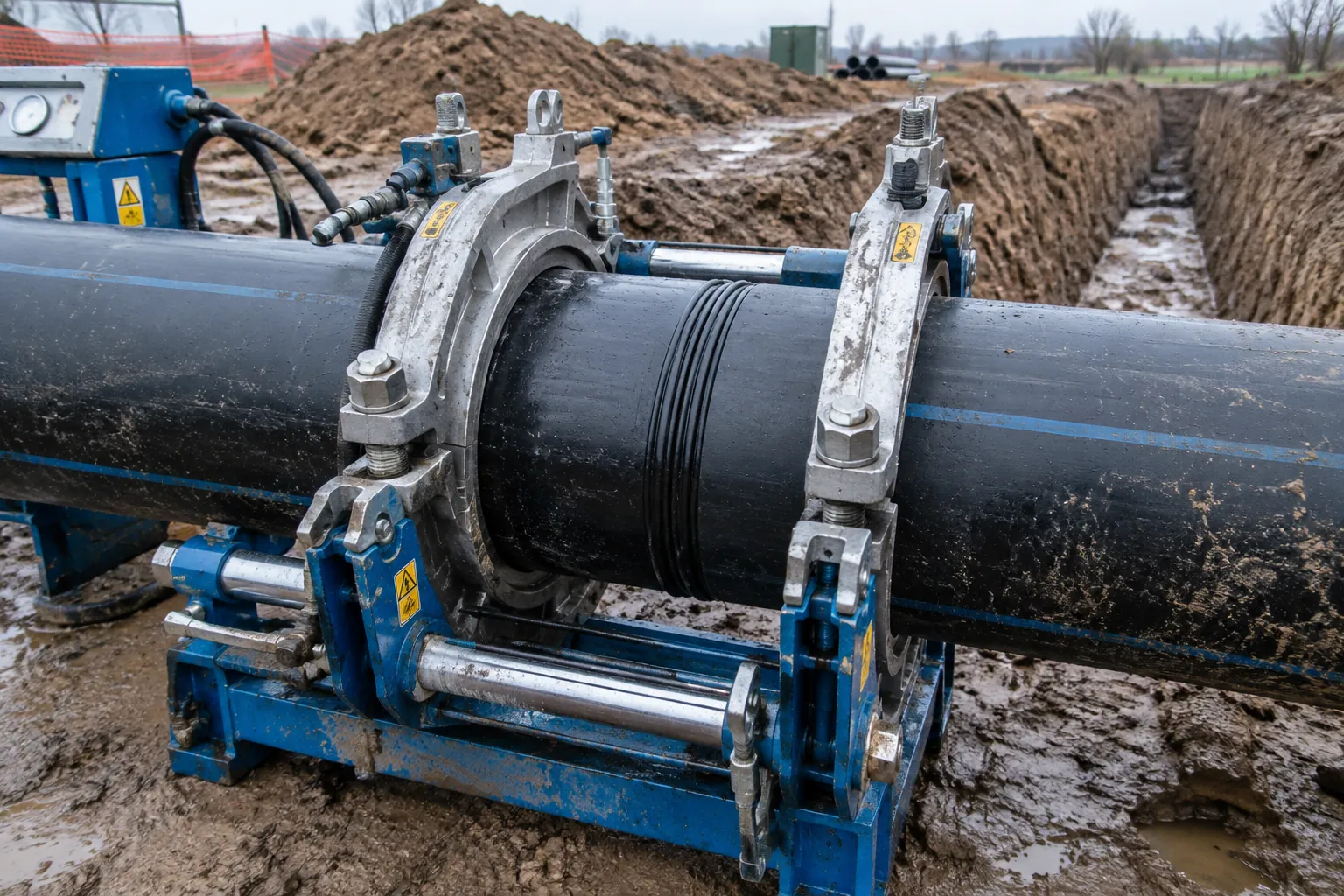
A sound heat-fusion joint is stronger than the pipe, so it fails somewhere else. When the separation follows the fusion plane itself and leaves a flat, featureless, slightly glassy disc, the two melts touched but never mixed. On butt-fused polyethylene the bead tells the rest of the story: a rollback that is uneven, one-sided, or too small for the wall points back at the heater plate or the fusion pressure. On electrofusion, look for a cold zone where no melt reached the wire, or wires pushed out of position by a pipe that was not scraped and clamped.
ASTM F2620-24 is the practice for heat-fusion joining of polyethylene pipe and fittings, and its scope says the parameters apply only to polyethylene of related polymer chemistry. A PE parameter set does not qualify a PP-R socket, and it does not bridge two polyethylene grades that were never qualified together. ASTM F1055-16a(2022) specifies the electrofusion fitting for outside-diameter-controlled PE and PEX pipe. It is a fitting specification, not a fusion cycle, so a coupler certificate says nothing about the joint a crew made on site. Neither document tests one field joint, and ISO 13479:2022 will not help either: it notches pipe, and only above a 5 mm wall.
Mode 4: Rapid Crack Propagation, One Crack and Many Metres
Rapid crack propagation is the mode people invoke when they mean slow crack growth. It looks nothing like it. One crack runs through several pipe lengths, sometimes wandering, and it does so in a fraction of a second. It needs stored energy: internal pressure, low temperature, a larger diameter, and often gas or entrained air.
ISO 13477:2008, second edition and confirmed current in 2023, is the small-scale steady-state S4 test. Note what it determines: whether a crack initiated at a specified temperature and internal pressure arrests or propagates. It is a pipe-body test for gas or liquid service. It does not explain a weeping socket, and it has no bearing on a domestic hot-water joint.
Mode 5: Cracks Radiating From the Thread Root
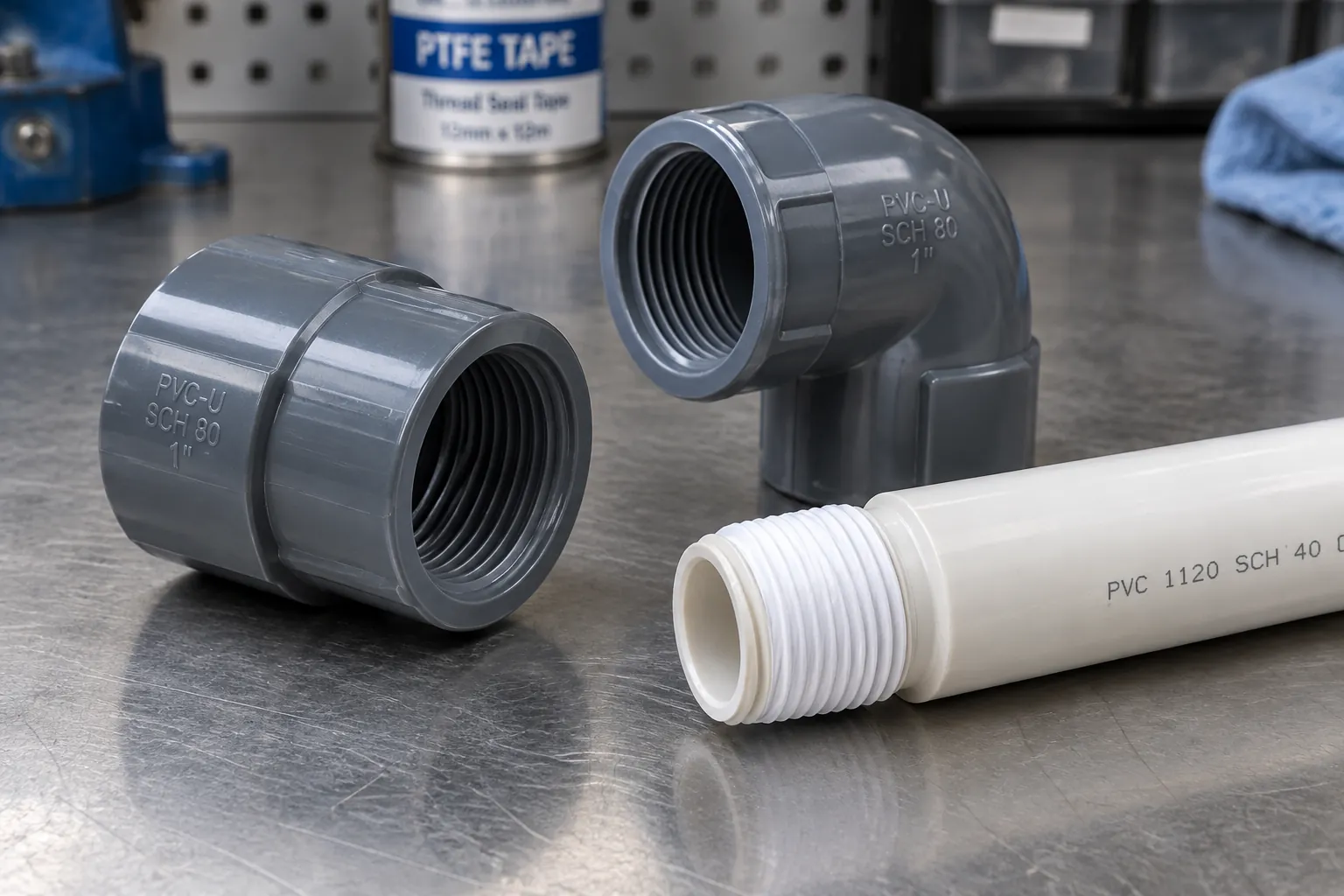
Cracks that start at the first engaged thread of a plastic female fitting and radiate outward are an installation signature, and they usually show up at commissioning or within the first week. Sometimes the crack is circumferential and the socket lets go as a ring. Either way the origin sits at the thread root, where the wall is thinnest and the hoop load from a tapered male thread is highest.
ASTM D2464-23 covers threaded PVC pipe fittings in Schedule 80 and states they are intended for pressurised liquids only, noting that some manufacturers do not permit pneumatic testing at all. Threaded CPVC Schedule 80 moved out to ASTM F437. ASTM F1498-25 covers taper pipe threads at 60° for thermoplastic pipe and fittings, and it is dimensional: it fixes thread form and gaging, not tightness. Its own note is the useful part, because it says the trade terms “wrench makeup” and “wrench tight” do not imply using a pipe wrench or any tool that would damage plastic. The standard publishes no torque figure, so nobody should quote one.
Mode 6: Oxidative Attack and Environmental Stress Cracking
Both look brittle and neither is a pressure problem. They separate on where the damage starts. Oxidative attack works from the bore outward, leaving a chalky, micro-cracked inner surface. Environmental stress cracking starts where something touched the outside: a thread sealant, a cutting oil, a plasticised sleeve, a cable tie. Crazing radiates from that patch and nowhere else.
ASTM F2023-21 evaluates the oxidative resistance of PEX pipe and tubing to hot chlorinated water in a pressurised flow-through rig. Its own note records that chlorine dioxide, ozone and chloramines are separate disinfecting systems, with free chlorine the most common in use. A supplier who answers a chloramine question with an F2023 result has answered a different one. Ask your utility what it doses before you specify. The stronger request is the tubing specification itself: ASTM F876-26 lists environmental stress cracking, stabilizer functionality and oxidative stability in potable chlorinated water among the requirements PEX tubing has to meet, alongside burst and sustained pressure. Both halves of this mode are already in it.
Turn the Diagnosis Into a Purchase Requirement
A certificate is the weakest thing a buyer can ask for, because it names a document rather than a condition. Name the condition instead. Ask for PENT hours at 80 °C and 2.4 MPa on the resin lot behind your order rather than a page that says the resin is compliant. Ask for the fusion data log from the machine that made the joints rather than a coupler specification. And check a potable-water listing in the certifier’s own register rather than in a supplied PDF, because the register is the record and the PDF is a copy of one.
| Failure mode | What the surface shows | Governing document (edition) | Verdict: what to demand |
|---|---|---|---|
| Unwelded solvent socket | Clean glossy bore, cement in patches, no softened layer | ASTM D2855-20(2024) | Written joining procedure and cure schedule, not a certificate |
| Slow crack growth | Narrow axial slit, mirror-flat face, no drawing | ASTM F1473-24a; ISO 13479:2022 | PENT hours at 80 °C and 2.4 MPa on the actual resin lot |
| Cold fusion | Separation along a flat, featureless fusion plane | ASTM F2620-24; ASTM F1055-16a(2022) | The fusion data log, plus operator qualification records |
| Rapid crack propagation | One crack through several lengths, often wandering | ISO 13477:2008 | S4 arrest result at your service temperature and pressure |
| Thread-root cracking | Radial or ring cracks from the first engaged thread | ASTM D2464-23; ASTM F1498-25 | Schedule 80 threaded bodies and a no-wrench install instruction |
| Oxidative or stress cracking | Chalky bore, or crazing only where something touched it | ASTM F2023-21 | Test result for your disinfectant, plus a contact-material list |
Source: ASTM International and ISO catalogue records, retrieved 10 September 2026.
One document behind that table is routinely misread as a guarantee. ASTM D2837-25 is how a hydrostatic design basis is obtained for a pipe material. That basis is what a pressure rating traces back to, and it is not a prediction of how long a joint will last.
If you are re-specifying after a failure, the honest scope of what a supplier can answer stops at the product. The HDPE pipe and fittings they ship can be documented. The joint your crew made on site cannot. Send photographs of both fracture faces if you want a second read on which mode you are looking at before the claim letter goes out.
Conclusión
Decide the mode before you decide who pays. A brittle axial slit in polyethylene and a bare PVC socket point at different parties, different documents and different remedies, and the surface in front of you separates them in minutes. The one condition that flips this reading is a sample that has been cut through the fracture or cleaned before photography, in which case the physical evidence is gone and only the service history remains.
Before your next order, write the condition you want tested into the specification: the resin data behind a polyethylene line, the joining procedure behind a solvent-welded one, the fusion log behind a fused one. You will get a straighter answer at quotation than you ever will after a failure.
Frequently Asked Questions
What is the average lifespan of plastic pipes?
There is no single figure, and a supplier who offers one is guessing. A pressure rating traces back to a hydrostatic design basis obtained under ASTM D2837-25, which is a design basis rather than a life prediction. Temperature, disinfectant and pressure cycling decide the rest.
How do you perform a failure analysis on a plastic pipe joint?
Photograph the joint in place, mark flow direction, then cut well clear of the fracture so both mating faces survive. Record age at failure, operating temperature, disinfectant and pressure history. Only then match the surface to a mode and name the governing test.
Can a PENT result be used to judge a PVC fitting?
No. ASTM F1473-24a states its scope as polyethylene materials, and the test is run at 80 °C and 2.4 MPa on that basis. For rigid PVC and CPVC the relevant material document is the compound classification in ASTM D1784-25.
Does an electrofusion fitting certificate prove the joint is sound?
No. ASTM F1055-16a(2022) specifies the fitting for outside-diameter-controlled polyethylene and PEX pipe. The joint depends on the fusion cycle, the scrape and the clamping, which is why the machine data log matters more than the coupler paperwork.
Why do solvent-welded PVC joints fail on compressed air lines?
ASTM D2855-20(2024) limits its scope to the distribution of pressurised liquids and warns explicitly about the hazards of testing with compressed air or other compressed gases. A joint used outside that scope is outside the practice that made it.
What causes cracks at the thread of a plastic fitting?
Load concentrated at the first engaged thread, usually from over-tightening a tapered male thread. ASTM F1498-25 notes that the trade terms wrench makeup and wrench tight do not imply using a pipe wrench or any tool that would damage plastic.










 Español
  English
  Français
  Русский
Comentarios recientes