NSF 61 certification is the health-effects standard that governs materials in contact with drinking water, and it decides whether the pipe or fitting you import can legally touch potable water in most US jurisdictions. In plain terms, NSF/ANSI 61 does not read a datasheet or a bill of materials — it measures what actually leaches out of a finished product into the water passing through it. A valve body, a PEX tube, a brass elbow, or a rubber gasket is soaked in test waters, and the lab checks whether any regulated contaminant migrates above safe limits. If the product stays under those limits, it earns the listing.
For an importer or wholesaler, the standard itself is the easy part. The hard part is proving that a supplier’s NSF claim will survive contact with your local authority — the exact fear that sends buyers back to renegotiate a shipment they thought was compliant. This guide explains what NSF/ANSI 61 tests, how it differs from NSF 372, 600 and 53, and — the part competitors skip — how to verify a factory’s certificate before you wire the deposit. Every product line we make, from PEX to brass, ships with listings you can check yourself; browse our certified pipe and fittings as you read.
Key Takeaways
- NSF/ANSI 61 is a performance-based health-effects standard: it measures what contaminants leach out of a drinking-water-contact product, not what the product is made of (source).
- NSF 61 tests for lead, antimony, arsenic, barium, cadmium, chromium, copper, mercury, selenium, thallium and nickel, plus organic contaminants, across pH-varied waters (source).
- NSF 61 vs 372 in one line: 61 checks what leaches out of the product (health effects); 372 checks how much lead is in the product (content) (source).
- NSF/ANSI 372 caps lead at a weighted-average of ≤0.25% across wetted surfaces, the figure written into the US Safe Drinking Water Act (source).
- NSF 61 is required by 49 US states and 11 Canadian provinces, so it functions as a de facto entry ticket to the US potable-water market (source).
- A certificate is only as good as its scope: verify the exact SKU or series on the official NSF or IAPMO online listing before you treat a supplier’s claim as real.
On this page
- What Is NSF/ANSI 61 Certification?
- What NSF 61 Actually Tests For
- NSF 61 vs 372 vs 600 vs 53 — Don’t Confuse Them
- The Lead-Free Rule: NSF 372 and the 0.25% Limit
- Which Materials and Products Carry NSF 61
- How a Product Gets NSF 61 Certified
- How to Verify a Supplier’s NSF Certification (Importer Checklist)
- What We Check Before Certified Products Ship
What Is NSF/ANSI 61 Certification?
NSF 61 certification confirms that a material or component in a drinking-water system does not release harmful contaminants into the water at levels that endanger health. The standard is performance-based, which is the single most important thing to understand about it. It does not audit a recipe or a chemical composition; it exposes the finished product to test waters and measures what actually migrates out (source). Two brass fittings with slightly different alloys can both pass, and two products with the same paperwork can get different results, because the water is the judge — not the datasheet.
That distinction has a direct consequence for buyers. A supplier can show you a material certificate, a raw-material analysis, or a spec sheet full of reassuring numbers, and none of that is NSF 61. The listing only exists once a recognized certification body has tested the actual product and published it. When a product is described as “NSF 61 approved,” it means an accredited third party ran the leaching test on that specific item and it passed — nothing more, nothing less. It does not automatically mean the water in your building will be safe forever; it means the component itself will not be the source of a regulated contaminant.
Why does this matter so much for market access? Because NSF 61 is required by 49 US states and 11 Canadian provinces, which turns a voluntary-sounding “standard” into a practical gatekeeper (source). A plumbing inspector, a municipal water authority, or a project spec can — and typically will — reject an uncertified product, even one that would have passed the test. Requirements vary by market and by product, so confirm current rules with the certification body or your local authority before you commit a shipment.
What NSF 61 Actually Tests For
The test regime targets a defined list of metals and a broad sweep of organic contaminants. On the metals side, NSF/ANSI 61 checks for lead, antimony, arsenic, barium, cadmium, chromium, copper, mercury, selenium, thallium and nickel (source). These are the elements most likely to migrate from alloys, coatings, solders and plastics into potable water, and they are also the ones drinking-water regulators watch most closely. The presence of copper on that list surprises some buyers, but even a benign-sounding metal has an exposure limit worth verifying.
Beyond metals, the standard evaluates organic contaminants that can come from plastics, resins, adhesives and protective linings (source). This is why a plastic pipe or a solvent-cement joint is not automatically “clean” just because it contains no metal. The test does not care where a contaminant originates — an additive, a stabilizer, or a bonding agent can all show up in the water, and the lab measures the total that leaches out.
Why the water chemistry is varied
A single test water would be easy to game. Real drinking water is not uniform — it ranges from acidic to alkaline, and pH strongly influences how aggressively water pulls metals out of a surface. NSF 61 accounts for this by running exposure across pH-varied test waters, so a product has to perform under conditions that mimic the range of real municipal supplies (source). A fitting that behaves in neutral water but sheds lead in slightly acidic water will be caught. For an importer, the practical takeaway is that the listing already bakes in a margin for variable water conditions in your destination market — a real advantage over an untested part.
NSF 61 vs 372 vs 600 vs 53 — Don’t Confuse Them
These four numbers get thrown around interchangeably in supplier emails, and mixing them up is how buyers end up with the wrong certificate for their market. Each governs a different thing. NSF 61 covers what leaches out of a system component. NSF 372 caps how much lead is in it. NSF 600 deals with the toxicology behind the leaching limits. NSF 53 is not about pipes at all — it covers point-of-use filters. The table below draws the lines cleanly.
| Standard | What it governs | Key point for buyers |
|---|---|---|
| NSF/ANSI 61 | Health effects of drinking-water-contact materials — what leaches out | Performance test on the finished product; the baseline most US states require |
| NSF/ANSI 372 | Lead content — how much lead is in the wetted surfaces | Weighted-average lead ≤0.25%; the “lead-free” rule from US law |
| NSF/ANSI 600 | Toxicology / health-effects criteria behind the leaching limits | Split out from NSF 61 in recent revisions; works alongside 61, not instead of it |
| NSF/ANSI 53 | Point-of-use drinking-water treatment units / filters | Contaminant reduction by a filter — a different product class from pipe and fittings |
The cleanest way to hold this in your head: 61 = what leaches out, 372 = how much lead is in, 600 = the toxicology math, 53 = filters (source). NSF 600 is the piece buyers see least often, so it deserves a sentence. It captures the toxicology and formulation criteria that were separated out from NSF 61 in recent revisions of the standard — the health-effects evaluation that sets where the leaching limits sit. It supports NSF 61 rather than replacing it, and you will often see the two referenced together on a listing.
The most common real-world mix-up is 53 versus 61. If a supplier sends you an NSF 53 certificate for a run of fittings, that certificate is for a filter, not for pipe, and it proves nothing about your product’s drinking-water contact (source). Treat any 53 document offered in place of 61 as a red flag worth a direct question.
The Lead-Free Rule: NSF 372 and the 0.25% Limit
NSF 372 exists because leaching tests alone were not enough for lawmakers worried about lead. The standard sets a hard content ceiling: a weighted-average of no more than 0.25% lead across the wetted surfaces of a product (source). “Weighted-average” is the operative phrase. A fitting is not judged on its worst single part; each wetted surface is weighted by its area, and the calculation — defined in the standard’s weighted-average formula — produces one blended figure that must land at or below the limit (source).
This number is not an NSF invention — it comes from the US Safe Drinking Water Act, whose 2011/2014 “lead-free” amendment redefined what may legally be sold for potable use in the United States (source). NSF 372 is the certification vehicle that demonstrates conformance with that law. For a metals importer, that lineage matters: the 0.25% ceiling is a legal requirement in the US market, not a nice-to-have, and an authority can enforce it independently of any leaching result.
Here is the trap that catches buyers: a product can be NSF 61 listed and still not satisfy NSF 372. The two answer different questions. A brass fitting might pass the leaching test today yet contain enough lead to fail the content rule, or a market may demand explicit 372 proof even where 61 already covers leaching. If you sell into US potable-water channels, ask for both, and match each certificate to the exact part. Our lead-free brass fittings are built to the content rule from the alloy up, so the two listings line up on the same SKU rather than fighting each other.
Which Materials and Products Carry NSF 61
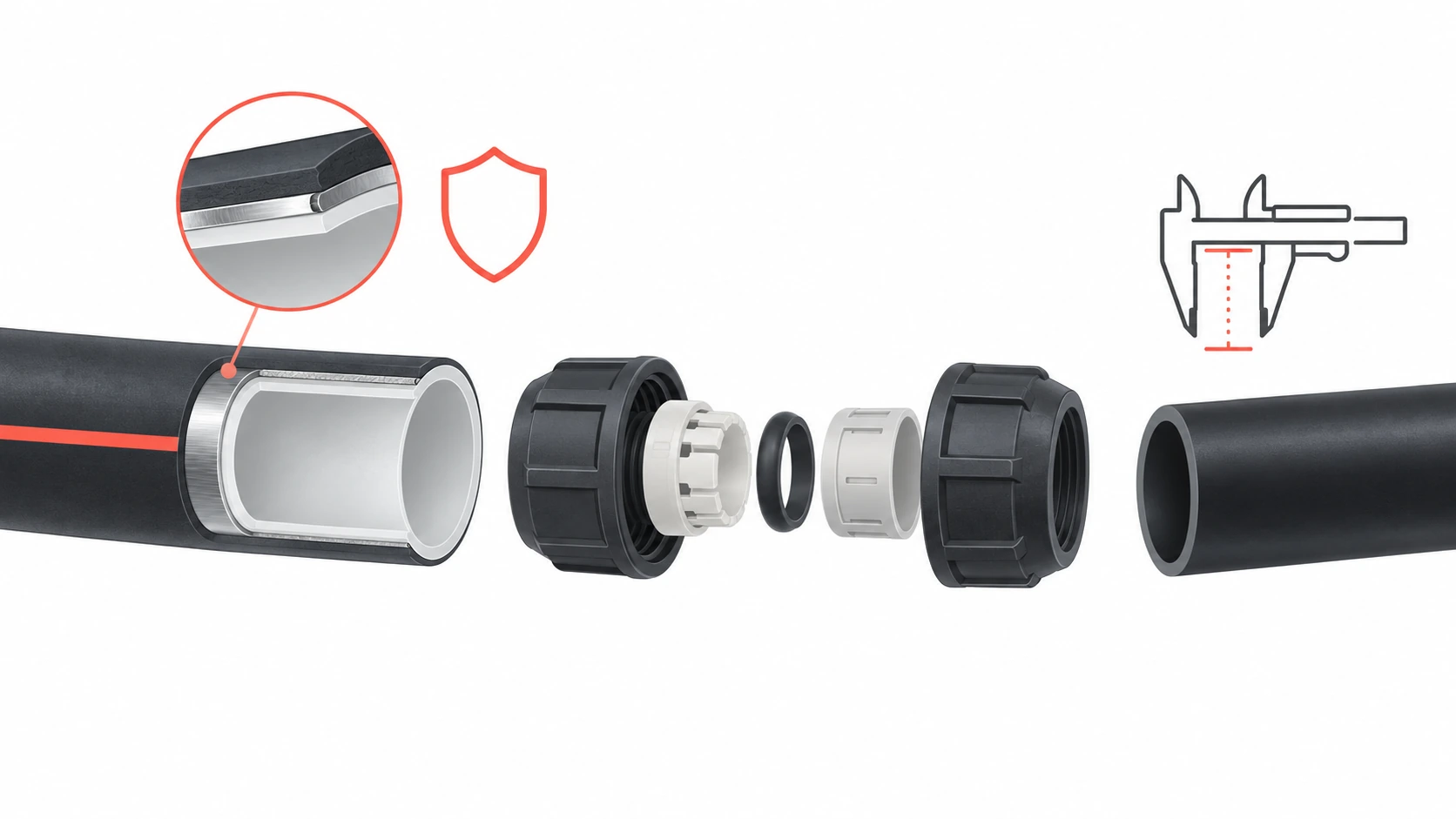
Because NSF 61 is performance-based, the material almost matters less than the finished part. A wide range of drinking-water components can and do carry the listing — plastic pipe in PEX, PPR, PVC and HDPE, along with brass fittings, valves, and even the gaskets and seals that touch water inside a joint. Every one of these is tested as the object it is, so a listing on a pipe does not extend to a fitting, and a valve body’s listing does not cover the elastomer inside it.
| Product / material | Typical role | What to check on the listing |
|---|---|---|
| PEX / PEX-AL-PEX pipe | Hot and cold potable-water distribution | Series name and diameters covered by the listing |
| PPR pipe | Hot and cold water supply lines | Whether both pipe and matching fittings are listed |
| PVC pipe | Cold-water supply and distribution | Potable-water listing vs. drain/waste (non-potable) grade |
| HDPE pipe | Water mains and service lines | Resin/compound and size range on the certificate |
| Brass fittings & valves | Connections, shutoffs, manifolds | NSF 61 and NSF 372 on the same model number |
Plastic pipes raise a fair question about safety, and the leaching test is exactly what answers it. A PEX line earns its potable listing by proving low migration under the same pH-varied waters as any other material — the reasoning behind why PEX is safe for drinking water when it carries the listing. PVC is similar but carries an extra warning: potable-grade PVC and drain-waste-vent PVC are different products, and a DWV listing is not a drinking-water listing. Our PVC pipe and fittings guide walks through which grade belongs where, so you don’t spec a non-potable part into a water line by mistake.
How a Product Gets NSF 61 Certified
Certification is not a one-time exam a factory passes and forgets. It combines third-party laboratory testing of the finished product with an ongoing relationship between the manufacturer and the certification body. First, an accredited body tests the actual product — the same leaching evaluation described above — and, once it passes, adds it to a public listing under a specific scope. That scope is the certificate: it names the manufacturer, the product series, and often the sizes and materials covered.
The part that keeps a listing honest is what happens after. Certification typically includes periodic, unannounced audits of the production facility, so the certifier can confirm the factory is still making the product the way it was tested (source). If a manufacturer quietly changes an alloy, a resin, or a supplier, the listing is supposed to reflect that — which is why a live online listing is more trustworthy than a PDF that may predate a formulation change.
Buyers often ask how long certification takes and what it costs. There is no honest single answer — it varies by product and by the number of materials involved, because each distinct formulation may need its own testing (source). A single-material plastic pipe is a smaller job than a multi-part brass valve with several wetted surfaces. Anyone quoting you a fixed universal price or timeline is guessing. Confirm current scope, fees and lead time directly with the certification body for your specific product.
How to Verify a Supplier’s NSF Certification (Importer Checklist)
This is where importers win or lose. A certificate image proves almost nothing on its own — logos are easy to copy, PDFs are easy to edit, and an expired or wrong-series document looks identical to a valid one at a glance. The only claim worth trusting is one you can confirm on the certifier’s own public database. Every credible body — NSF and IAPMO among them — publishes a searchable online listing, and matching a supplier’s paperwork to that live record is the single most valuable check you can run before paying a deposit.
The five checks that catch bad claims
- Look it up on the official listing. Search the manufacturer name on the NSF or IAPMO online database yourself. If the product is not there, treat the claim as unverified regardless of what the PDF shows.
- Match the scope to your exact SKU or series. A listing that covers “Series A” does not cover “Series B.” The model number, size range and material on the listing must match the parts you are actually buying.
- Separate a mark from a claim. A logo printed on a catalog is a claim. A named entry on the certifier’s database is a certification. Only the second one holds up with an inspector.
- Check the standard and the status. Confirm the entry actually cites NSF 61 (and 372 if you need lead-free), not 53 or an unrelated standard, and that the listing is active, not expired or withdrawn.
- Confirm the certificate holder. Sometimes a trading company shows a factory’s certificate for products it doesn’t actually make. The listed manufacturer should be the entity producing your goods.
The insider warning is simple: the most common failure is not a forged certificate but a real certificate applied to the wrong product. A factory genuinely holds an NSF 61 listing on one pipe series and lets a buyer assume it covers a different series, a different size, or a fitting that was never tested. That gap is invisible until your local authority pulls the listing and finds your SKU missing. Sourcing discipline here is the same discipline that protects any China order — the groundwork we cover in how to wholesale pipe from China applies directly to certification scope.
What We Check Before Certified Products Ship
We run the same verification on our side that we ask buyers to run on theirs, because a mismatch caught at the factory is far cheaper than one caught at your port. Before a certified order leaves us, we tie each certificate to the specific SKU on the packing list — not to a product family, but to the exact series and size a customer ordered. If a listing covers part of an order and not another line item, we flag it before production rather than after.
We also confirm our listings are live on the certifier’s online database, so what we hand a customer matches what an inspector will find. Across our materials we hold ISO 9001 and ISO 14001, CE, WRAS, NSF/IAPMO, WaterMark, Intertek, EAC and SAI Global certifications, and we map the right ones to each destination market instead of sending a generic certificate pack. For lead-sensitive channels, we verify both the leaching listing and the content rule sit on the same part.
Material traceability closes the loop. Because certification is only meaningful if the shipped product matches the tested one, we keep the raw-material and production records that let us show a customer why a given batch belongs under a given listing. As a manufacturer since 1993 running a 120,000 m² facility and shipping to 200+ countries, we have watched enough orders get stopped by a scope mismatch to make this the default, not an add-on.
Conclusion
NSF 61 certification comes down to a few ideas that protect a shipment. It is a performance-based health-effects standard that measures what leaches out of a finished drinking-water product; it is required by 49 US states and 11 Canadian provinces; and it is not the same as NSF 372, which caps lead content at a weighted-average of 0.25%. Keep the four standards straight, ask for 61 and 372 together where lead-free matters, and never accept a certificate you can’t find on the certifier’s own listing.
The buyer who verifies scope against the exact SKU is the buyer whose containers clear inspection. If you want products where the listing already matches the part and the destination market, tell us the SKU and the country you’re selling into, and we’ll match the certification before you order. Regulatory requirements change and vary by market, so confirm current rules with the certification body or your local authority for any specific project.
Frequently Asked Questions
Does NSF 61 certification expire?
A listing stays valid only while the manufacturer maintains it through ongoing audits and fees. It can lapse or be withdrawn, so always check the current status on the certifier’s online database rather than trusting an old PDF.
Is NSF 61 the same as NSF/ANSI/CAN 61?
They refer to the same standard; the “CAN” designation marks the jointly adopted US-and-Canada version. Confirm your market’s exact accepted designation with the certification body before shipping.
Can one certificate cover a whole product catalog?
Rarely. A listing covers a defined scope — specific series, sizes and materials. Products outside that scope are not certified even if they come from the same factory, so match the scope to your exact SKU.
Does NSF 61 apply outside the United States?
Some markets accept it and others require their own schemes like WRAS or WaterMark. It may satisfy local rules depending on the market and product; confirm current requirements with your local authority.
Can a certifier other than NSF issue NSF 61 certification?
Yes. Accredited bodies such as IAPMO certify products to NSF/ANSI 61. Look the listing up on that certifier’s own database; the standard is the same regardless of which accredited body issued it.


 English
  Français
  Русский
  Español
Recent Comments