
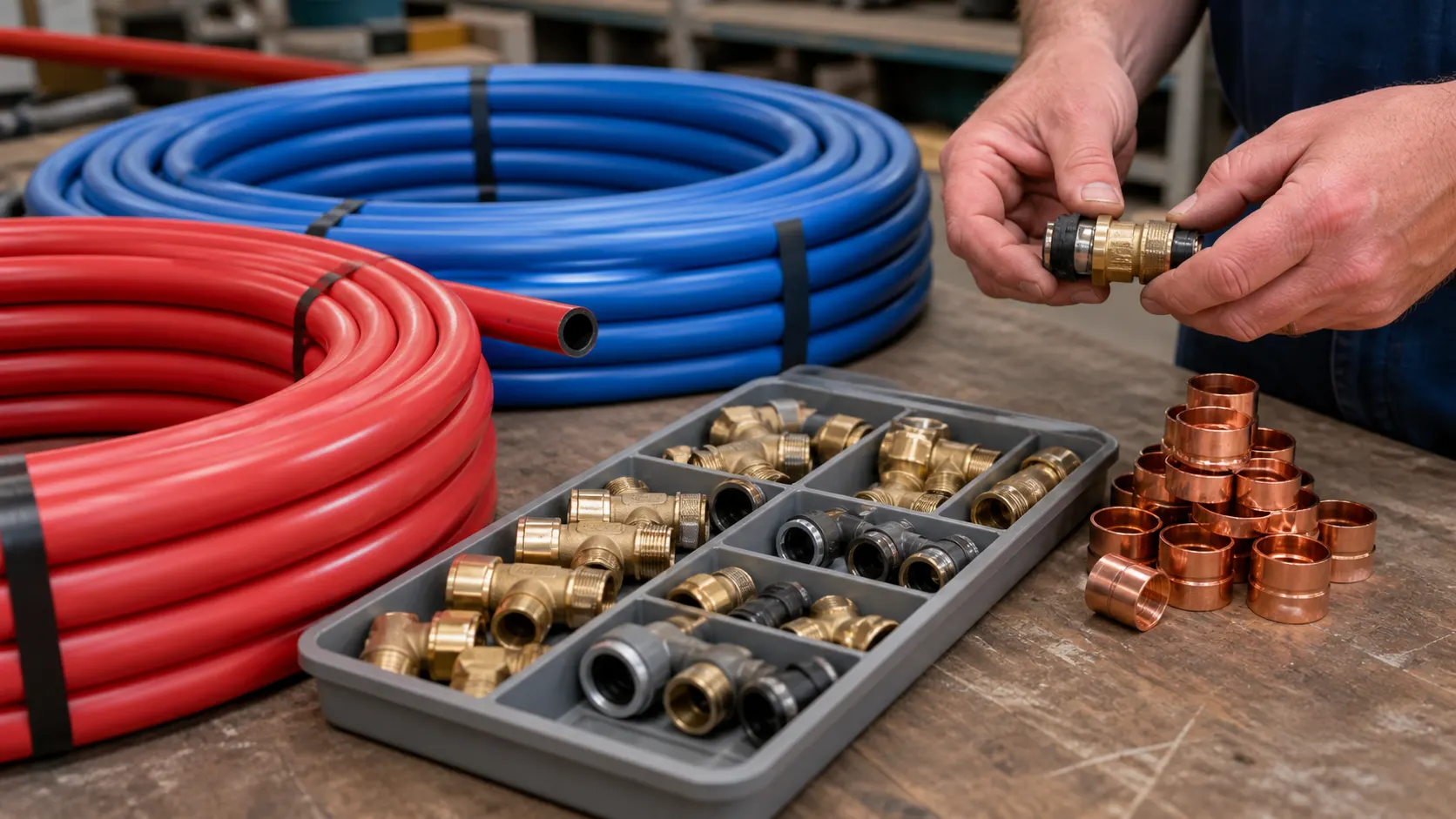
Viega’s PEX line is one of the most common names in North American plumbing, yet most buyers can only describe it the way the marketing does: red and blue coils, a crimp tool, a press tool, a warranty. That is where sourcing mistakes start. Ask a distributor why Viega’s crimp fittings are rated for potable water and the answer usually comes back “NSF certified” — true, and nearly useless, because it does not tell you which fitting standard the part was built to, whether that standard matches the pipe you are buying, or what changes when you mix brands on the same joint. This guide is for contractors, wholesalers and importers who need to verify a Viega specification before buying, and for buyers who want functionally equivalent fittings without guessing. Every standard number below is the designation printed on the fitting or its data sheet, and every claim about Viega’s products comes from Viega’s published technical data or its own blog. There is no price list here, because Viega does not publish list pricing.

Key Takeaways
- Viega’s own blog classifies Viega PureFlow PEX as PEX-b (silane process), not PEX-a. The tubing meets ASTM F876/F877 and carries designation PEX 5306, but the letter class changes which fittings you can safely pair with it.
- Viega’s crimp system is certified to ASTM F1807: zero-lead Eco Brass insert fittings with copper crimp rings, 3/8″ to 1″, rated 160 psi at 73°F and 100 psi at 180°F.
- Viega’s press system uses polymer or zero-lead bronze fittings with 304 stainless steel press sleeves, 5/16″ to 2″, and its own data sheet says the components are available only from Viega — not interchangeable.
- Viega ProPress is a copper and stainless steel press system, not a PEX system. Writing “ProPress PEX” on an order asks for something that does not exist.
- Cold expansion fittings (ASTM F1960) are built around PEX-a shape memory; Viega’s PEX-b line is rated for crimp and press only. And Viega’s crimp data sheet permits mixing with other brands’ parts only when both meet the same ASTM spec and the manufacturer approves — “compatible” and “warranted” are different answers.
On this page
- What Viega’s PEX Line Actually Is: PureFlow Tubing and the ViegaPEX Brand
- Crimp or Press: The Two Connection Systems Viega Sells
- The Connection Methods — and the Standards That Govern Them
- Expansion Fittings, PEX-a Memory, and Where Viega’s Line Sits
- Can Viega Fittings Mix With Other PEX Pipe? What the TDS Actually Says
- Materials, Certifications and Ratings to Verify Before You Source
- A Verification Checklist for Contractors and Distributors
- What to Ask an Alternative Fittings Supplier
- Frequently Asked Questions
What Viega’s PEX Line Actually Is: PureFlow Tubing and the ViegaPEX Brand
The first thing to get right is the name. Viega’s PEX tubing is sold as ViegaPEX and marketed in North America under the PureFlow umbrella. It is copper-tube-size (CTS) tubing with SDR-9 wall thickness, manufactured to ASTM F876 and F877, and its data sheet carries the material designation PEX 5306. That six-digit code is not a model number; under the ASTM F876 designation system it encodes chlorine resistance, UV rating and hydrostatic design stress, and it is printed on the coil if you know where to look.
The letter class matters more. Viega’s own blog on PEX types is explicit: “PEX-b, like Viega PureFlow, is created through the silane process,” while PEX-a uses peroxide and PEX-c uses electron beam irradiation. If a supplier tells you “ViegaPEX is PEX-a,” that claim does not survive contact with Viega’s documentation. Viega frames the letters as manufacturing process, not quality, and its data sheet backs that with specifics: NSF-pw chlorine resistance at the CL5 level, a supported bend radius of 5x outside diameter (8x unsupported), and six months of UV resistance.
The consequence is immediate. Cold expansion fittings under ASTM F1960 depend on PEX-a shape memory. Viega’s literature never pairs its PEX-b tubing with an expansion system; the PureFlow system page lists Press and Crimp as the connection routes. If your spec was written for PEX-a expansion fittings and someone substitutes ViegaPEX, you have changed the physics of the joint without changing the drawing.
Ratings worth writing into a purchase order, from Viega’s tubing data sheet: 160 psi at 73°F, 100 psi at 180°F, 80 psi at 200°F, with continuous recirculation allowed up to 140°F. The tubing is listed to CSA B137.5 (cNSFus), ICC-ES, HUD and the Uniform Plumbing Code. A quote with different numbers is either a different product or a different claim.
Crimp or Press: The Two Connection Systems Viega Sells
Viega sells two connection systems for its PEX tubing, and knowing which one you are holding changes the tool, the fitting, the repair path and the warranty. The crimp system is the familiar one. Its data sheet is unambiguous: Viega PureFlow Crimp fittings are zero-lead metallic insert fittings machined from Eco Brass (C69300 extruded, C87850 forged, some in copper), used with copper crimp rings in 3/8″, 1/2″, 3/4″ and 1″ sizes, assembled with a full-circle crimp tool. The rings are UNS C10200 or C12200 copper alloy annealed to 35-45 Rockwell 15T. The system is manufactured and certified to ASTM F1807, the standard for metal insert fittings secured by a copper crimp ring on SDR9 PEX tubing. Maximums: 160 psi at 73°F, 100 psi at 180°F, with NSF 61, NSF 61 Annex G and California AB 1953 lead-free compliance.
The press system is newer, faster and more proprietary. Viega PureFlow Press fittings are molded from polyphenylsulfone polymer (marketed as Radel R) or zero-lead bronze, each shipping with a factory-assembled 304 stainless steel press sleeve with three viewing holes and a color-coded tool locator ring. The connection is made with a Viega press tool, hand or power. Sizes run 5/16″ to 2″, with the 5/16″ and 5/8″ bronze pieces reserved for radiant systems. Operating parameters: 180°F maximum potable, 200°F hydronic, 160 psi at 73°F, 100 psi at 180°F, recommended test pressure 100 psi. Press tools have published minimums — 5,400 lb of ram output for compact tools up to 1-1/2″, 7,200 lb for standard tools up to 2″. The Smart Connect feature gives installers a real inspection point: an unpressed fitting leaks during pressure testing.
Here is the terminology trap. Viega ProPress is Viega’s press system for copper and stainless steel pipe — not a PEX product, and not PEX jaws. Both names contain “Press,” but a purchase order for “Viega ProPress PEX fittings” asks for something that does not exist. “ViegaPEX ProPress” is best read as two systems: ViegaPEX (PEX pipe) and ProPress (copper press). Our overview of PEX fitting connection types maps where each method sits in the wider market.
The commercial difference is the one distributors feel first. The crimp system’s components are interchangeable with other suppliers’ components under stated conditions. The press data sheet says the opposite: “Viega PureFlow Press Polymer fitting system components are available only from Viega and are not interchangeable with components and tubing from other suppliers.” A press spec is a single-source commitment.
For contractors, distributors and importers who need metal insert fittings and copper crimp rings built to ASTM F1807: compare the brass grade and ring metallurgy against your Viega-compatible line before you commit.
The Connection Methods — and the Standards That Govern Them
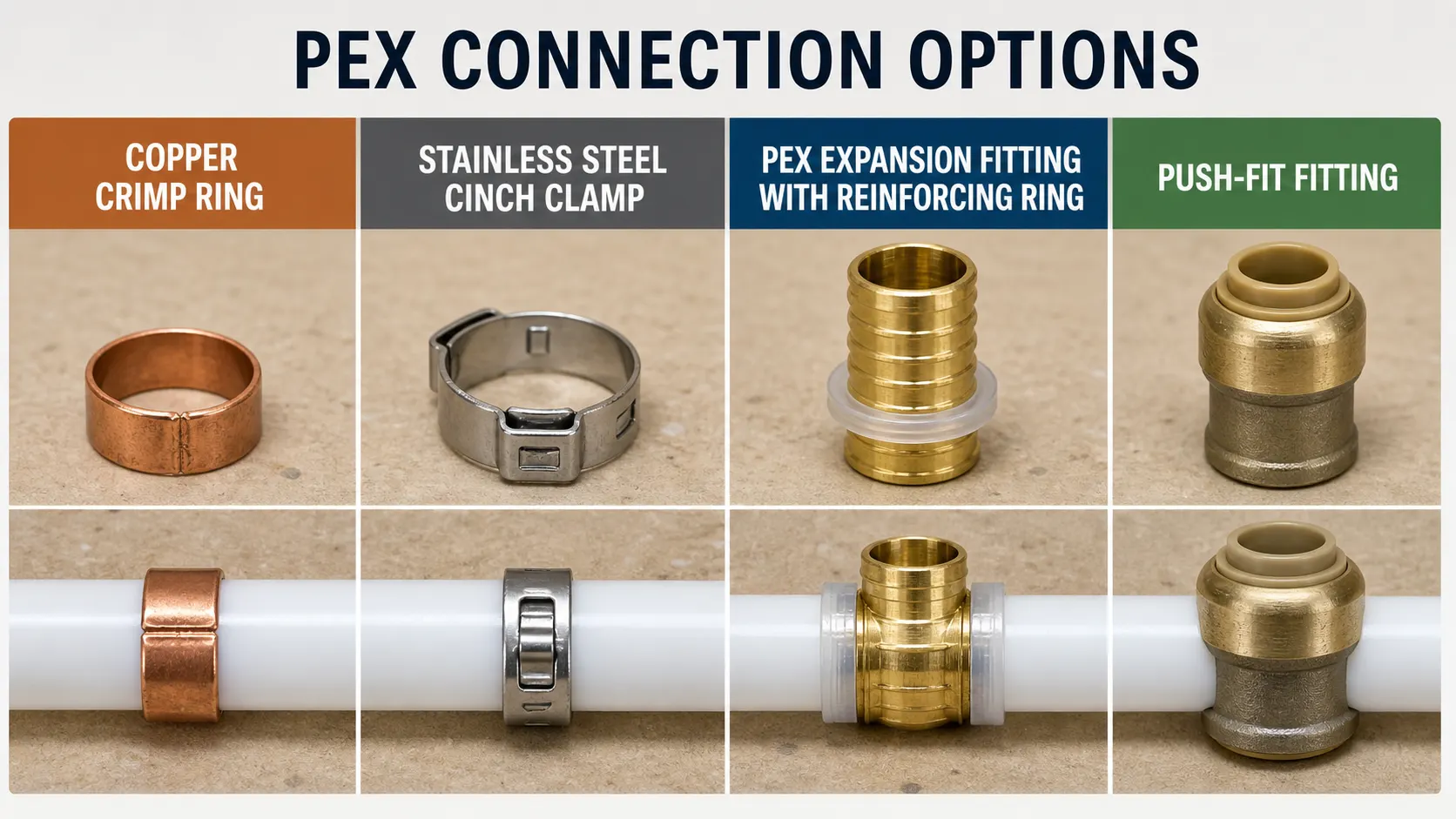
Every PEX connection on the North American market belongs to a small set of standards, and the standard is the load-bearing fact to check before the brand name. ASTM F1807 covers metal insert fittings with a copper crimp ring or alternate stainless steel clamps for SDR9 PEX. F2159 is the plastic-insert equivalent. F2098 covers the stainless steel clamps used in cinch-style connections. F1960 covers cold expansion fittings with PEX reinforcing rings. F877 is the system-level standard for crosslinked polyethylene hot- and cold-water distribution systems, which is why F877 appears on tubing and system components rather than on individual fittings. Push-fit fittings sit outside the ASTM set; the relevant performance standard is ASSE 1061.
| Method | Governing standard | Ring / sleeve | Tool | PEX types | Field notes |
|---|---|---|---|---|---|
| Crimp (metal insert) | ASTM F1807 | Copper crimp ring (or stainless clamp) | Crimp tool, full-circle jaws | PEX-a / b / c | Most widespread; brass insert; Viega’s crimp line sits here |
| Crimp (plastic insert) | ASTM F2159 | Copper crimp ring (or stainless clamp) | Crimp tool | PEX-a / b / c | Polymer insert; cheaper bill of materials; check chlorine and temperature ratings |
| Clamp / cinch | ASTM F2098 (clamps) with F1807/F2159 inserts | Stainless steel cinch clamp | Cinch / clamp tool | PEX-a / b / c | No ring-size inventory; clamp visually confirms the joint |
| Cold expansion | ASTM F1960 | PEX reinforcing ring on the fitting | Expansion tool | Designed around PEX-a memory | Expands the pipe, then it rebounds; verify pipe type with the maker |
| Press | ASTM F3347 (metal press insert) / F3348; system F877 | Factory-assembled stainless steel press sleeve | Press tool + jaws for that brand | Brand-dependent | Fastest to install; proprietary per brand — Viega’s press parts are single-source |
| Push-fit | ASSE 1061 | None — internal grab ring + O-ring | None | PEX-a / b / c | Tool-free; removal behavior varies by brand; keep a release tool on the truck |
The pattern to notice is which standards are brand-neutral and which are not. F1807, F2159, F2098 and F1960 describe an interface — a fitting dimension, a ring, a clamp, an expansion geometry — that any manufacturer can build to, which is why mixing brands in a crimp system is common practice. Press systems are tested as a package — sleeve, jaws, locator ring and pipe together — which is why the manufacturer controls the whole joint. When a spec says “press,” the brand is part of the specification whether you intended it or not.
Expansion Fittings, PEX-a Memory, and Where Viega’s Line Sits
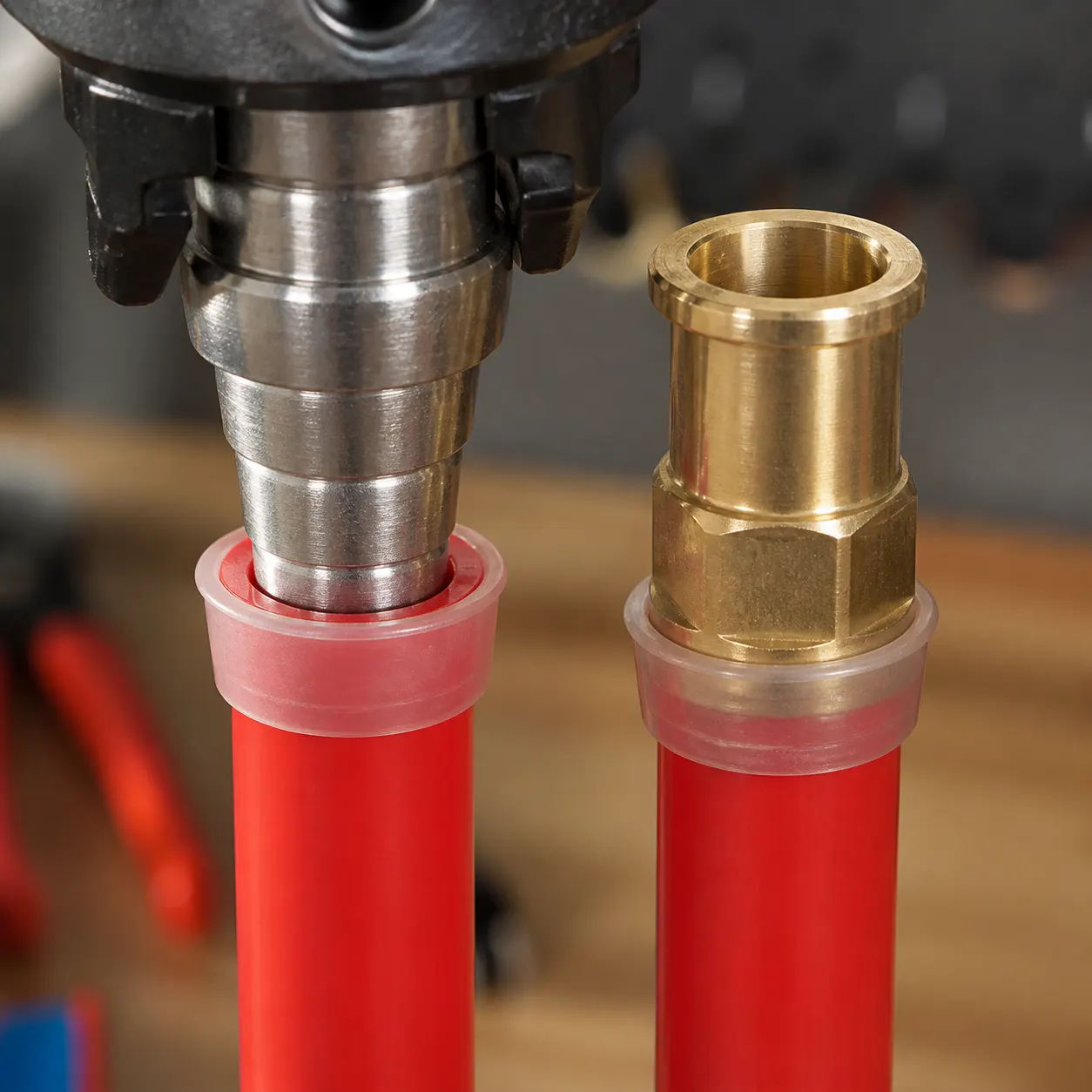
Cold expansion is the connection method most often misdescribed in sourcing conversations. The sequence looks simple: the installer opens the pipe end with an expansion tool, pushes the fitting in, and the pipe contracts back to grip it. What makes that work is shape memory — the pipe’s ability to return toward its original diameter after being stretched. That property is strongest in PEX-a, and the F1960 system was built around it. REHAU, which sells one of the best-known F1960 lines, states it on its product page: the system “takes advantage of the shape memory of PEXa for a one-step installation.” The rebound of the pipe is the mechanical basis of the joint.
That is where Viega’s line sits in a way that surprises buyers. Viega classifies its own tubing as PEX-b, made by the silane process. Its published documentation lists crimp and press as the connection routes — no expansion system, no F1960 line, no expansion tooling. That is not a gap a buyer should talk around; it is the manufacturer’s position that its pipe and its systems are paired as specified. The forum claim that “Viega PEX is PEX-a, so it works with expansion fittings” fails on the first half, and the second half should be verified against the actual pipe before anyone buys tooling.
The other side deserves equal care. Zurn, whose own PEX is PEX-b, publishes that “PEX b pipes are now fully certified for use with both ASTM F1807/F2159 crimp and ASTM F1960 expansion fittings,” and describes PEX-a’s “expandable nature, driven by memory features” as what ensures a snug fit. The industry is not uniform: some PEX-b makers now list expansion certification for their pipe. The practical rule is the one Viega itself states for mixing components — the pipe maker and the fitting maker both have to approve the combination.
For a buyer sourcing fittings, the takeaway is a question for every quote: which pipe type is this fitting certified against, and which standard is printed on the part? If the answer is F1960 and the pipe is PEX-b, stop and verify with both manufacturers. If the answer is F1807 or F2159, the joint is a crimp joint and the pipe class matters less — crimp tolerates all three PEX classes. Expansion is picky about the pipe; crimp is not.
Can Viega Fittings Mix With Other PEX Pipe? What the TDS Actually Says
This is the question every distributor eventually faces, and the answer is documented — but only for the crimp system. Viega’s PureFlow Crimp technical data sheet states: “Viega PureFlow Crimp zero lead metallic fittings system components are interchangeable with components and tubing from other PEX suppliers, providing they are manufactured to the same ASTM specifications and the manufacturer approves the mixing of components.” Two conditions, both mandatory: the same ASTM specification, and approval from the manufacturer whose parts are being mixed. The same page adds the warranty position: “Viega has no control over the quality of other manufacturers, therefore we do not extend any warranty to those components that are not supplied by Viega.”
In purchasing language: brand-neutral compatibility is real for F1807 crimp parts because the standard defines the interface, but “compatible” and “warranted” are different answers. A joint made of a Viega fitting on another brand’s SDR-9 PEX pipe can be a mechanically sound F1807 joint; it is simply not a joint Viega will warrant beyond its own components. Every crimp manufacturer draws the same line.
The press system is the opposite case. The press polymer data sheet states: “Viega PureFlow Press Polymer fitting system components are available only from Viega and are not interchangeable with components and tubing from other suppliers.” Not “not recommended” — not available. The sleeve, the locator ring, the jaws and the tooling are a closed loop, which is why a press-specified job is a single-source job.
The same logic governs the reverse direction: non-Viega F1807 fittings on ViegaPEX tubing. Because the tubing is SDR-9 CTS meeting ASTM F876/F877, an F1807 metal insert fitting sized for that nominal dimension will fit it — but the fitting maker’s approval and the pipe maker’s stated connection methods are the two documents that settle the question for a given job. Verify with both manufacturers, in writing, before the order. For the pipe side, our comparison of PEX-a vs PEX-b vs PEX-c walks through the chemistry and the substitution risk.
Materials, Certifications and Ratings to Verify Before You Source
A fitting spec is a stack of claims, and each should map to a document. On material: Viega’s crimp fittings are C69300 extruded or C87850 forged Eco Brass with copper rings in C10200 or C12200 alloy. Those designations are checkable — a mill certificate or spectro report confirms the alloy, and “brass” alone cannot. The press fittings are polyphenylsulfone with a 304 stainless steel sleeve. If a “comparable” press fitting shows up with a different polymer and a coated steel sleeve, the substitution is visible once you know to look.
On certifications, the set to require from any PEX fitting supplier in the US is stable: NSF/ANSI 61 for potable water health effects (with Annex G / NSF 372 for the lead-free claim), the fitting standard itself (F1807, F2159 or F1960), and ASTM F877 where the product claims system compliance. Viega’s crimp fittings carry NSF 61 and AB 1953 lead-free compliance; the press system lists NSF-pw 372, ICC-ES PMG 1038/1015, CSA B137.5 and UL 263. A certificate that names the right standard but the wrong product line is a red flag no brand name fixes.
On ratings, the numbers are public and should be quoted exactly. Viega’s tubing: 160 psi at 73°F, 100 psi at 180°F, 80 psi at 200°F. Crimp fittings: 160 psi at 73°F, 100 psi at 180°F. Press system: 160 psi at 73°F, 100 psi at 180°F, with maximums of 180°F potable and 200°F hydronic. When a supplier’s sheet rounds that to “100 psi hot water,” ask for the rest of the curve — the 200°F rating exists on the tubing but not on the crimp fitting.
Chlorine and UV resistance are where low-cost substitutions hide. Viega markets its tubing at the top chlorine resistance rating (CL5 under NSF-pw) and lists six months of UV resistance on the product page. A “same price” substitute coil with a lower chlorine rating will age differently in a hot recirculating loop, and the failure shows up years later in someone else’s wall — which is why the rating belongs in the specification even when it never appears on the invoice.
The verification pattern, stated once
Every load-bearing claim about a PEX fitting traces to one of three documents: the fitting standard (F1807, F2159, F1960, F2098, F3347), the system standard (F877), or the manufacturer’s data sheet. When a quote cannot point to one of those three, it is asking you to accept a claim on trust.
A Verification Checklist for Contractors and Distributors
Before an order, a reorder or a spec approval, run the parts against this list. Each line is a document check, not an opinion.
1. The fitting marking. The fitting or its packaging should carry the standard it was made to — F1807 for metal insert crimp, F2159 for polymer insert, F1960 for cold expansion. Viega’s crimp fittings are marked with F1807, PureFlow, the manufacturer’s mark and third-party certification marks. A part with no standard marking has no verifiable identity. Ask for the marking on the sample, not in an email.
2. The pipe marking. The tubing should show the ASTM F876 designation code — Viega’s is PEX 5306 — plus nominal size, pressure and temperature ratings. The designation’s first digit is the chlorine resistance cell; the difference between a CL5-rated coil and a “not tested” coil is a specification difference, not a cosmetic one. Our PEX pipe guide covers reading a full coil marking.
3. Pipe type vs fitting type. Write down the PEX class (a, b or c) and the connection method. If the fitting is F1960 expansion and the pipe is PEX-b, that pairing needs written approval from both manufacturers. If the fitting is F1807 or F2159 crimp, confirm the ring and tool match the fitting size, and check crimp depth and gap against the tool maker’s gauge.
4. Certification and listing. For potable water in the US, require NSF/ANSI 61 and, for lead-free claims, NSF 372 (or Annex G). For system compliance, ASTM F877. Look the listing number up at the issuing body. A certificate scan whose number does not resolve is worth less than no certificate.
5. Pressure and temperature curve. Get the full rating table, not the headline: 160 psi at 73°F and 100 psi at 180°F are the points that matter for potable systems, and the 200°F hydronic maximum exists on some components and not others. For continuous recirculation, ask for the chlorine resistance rating in writing.
6. Tooling and interchangeability. Confirm which tool the job needs — crimp, clamp, or press with the correct jaws for that brand — and whether the spec commits you to single-source parts. For press systems, the answer is yes by design.
The list is deliberately short because the expensive errors are not exotic. They are the F1960 fitting paired with PEX-b pipe, the ProPress name on a PEX order, the unmarked fitting, and the missing 180°F rating. Catch those four and the order has cleared most of the risk.
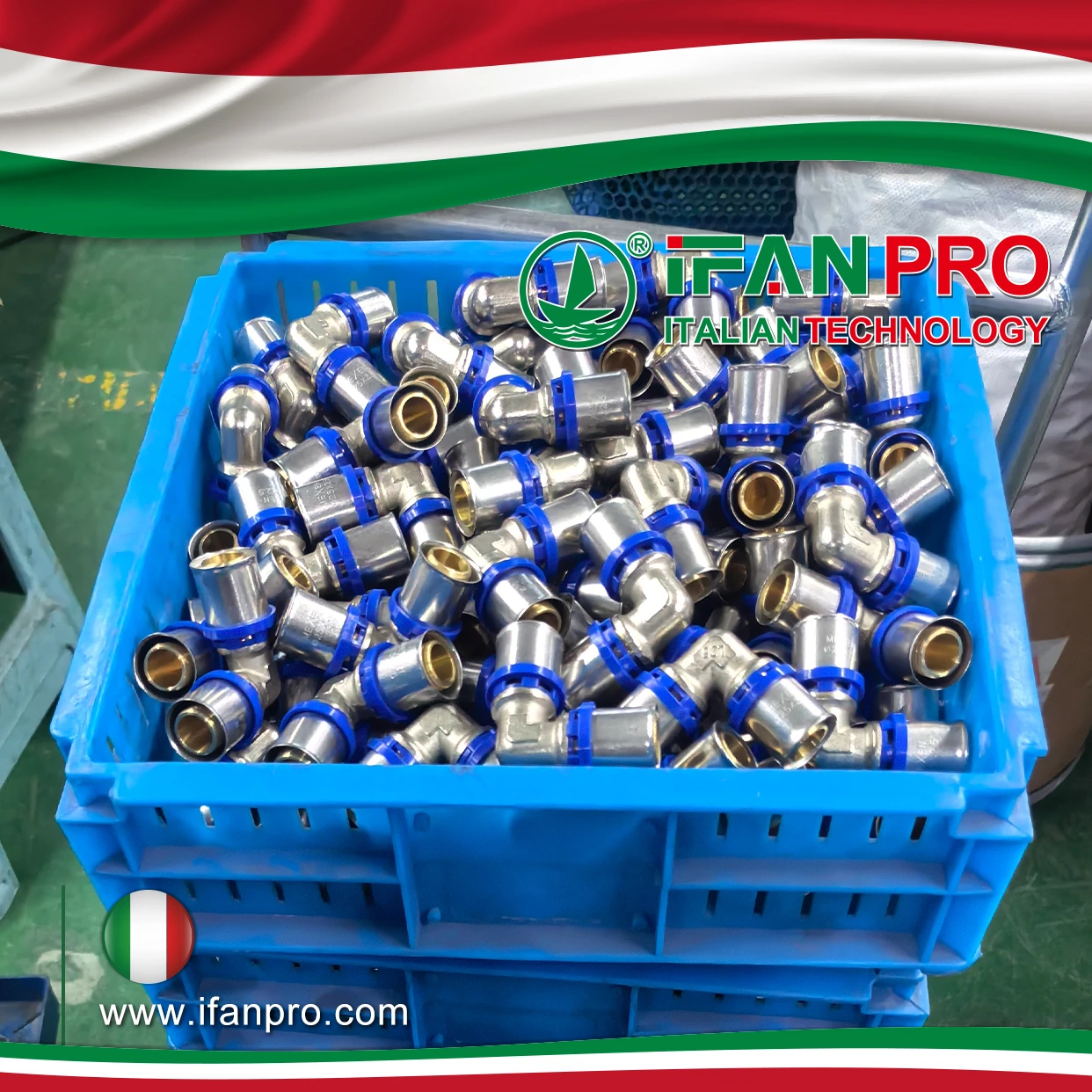
For contractors, wholesalers and importers buying PEX fittings at volume: send the fitting standard, pipe type and pressure rating from your spec, and compare the brass grade, ring metallurgy and certification marks line by line before production.
What to Ask an Alternative Fittings Supplier
When the goal is a functionally equivalent fitting line rather than a branded one, the questions change shape. Stop asking “are you like Viega?” — every supplier answers yes. Ask for the five documents that define the product: the fitting standard marking (F1807, F2159, F1960, F2098), the NSF/ANSI 61 listing with a resolvable number, the alloy or polymer specification, the full pressure-temperature table, and the QC test method for the crimp ring or sleeve. A supplier who can produce those five can be compared against a Viega spec honestly. A supplier who answers with a catalog photo and a price is selling a price.
Then test the claims that matter in the field. What is the brass alloy, and can you show the mill cert on the batch? What is the copper ring alloy and hardness range — Viega specifies C10200/C12200 annealed to 35-45 Rockwell 15T, and a comparable ring should name its own numbers. Which crimp tools is the fitting validated with — the answer should include tool brands and jaw sizes, not “standard tools.” What does the rating table say at 180°F, not just at 73°F? And for replacement business: is this an F1807 interface that mixes with branded pipe under the fitting maker’s approval, or a proprietary press system?
The same discipline applies to the pipe side. If the quote substitutes the tubing, check the ASTM F876 designation code, the CTS SDR-9 dimension, the chlorine cell and the UV rating against the original spec, then decide whether the substitution is equivalent or merely similar. “Similar” is how a recirculating loop gets a coil with a lower chlorine rating. If your supply chain runs factory-direct, our guide to wholesale PEX pipe from China walks through the verification steps for a container-level order.
Finally, price the whole system, not the fitting. The crimp route’s real cost is ring inventory, tooling and field labor. The press route’s real cost is single-source supply. The expansion route’s real cost is the tool and the pipe-type constraint. And none of this makes Viega’s line any less real — it makes it verifiable, which is what a buyer needs when the alternative is a supplier’s word. The standards do not belong to any brand; they belong to anyone who reads them.
Frequently Asked Questions
What is ViegaPEX?
ViegaPEX is the brand name for Viega’s PEX tubing, sold in North America under the PureFlow system umbrella. It is CTS SDR-9 tubing meeting ASTM F876 and F877, marked with the material designation PEX 5306, and offered in red and blue from 3/8″ to 1″ and in white from 3/8″ to 2″.
Is Viega PEX PEX-a or PEX-b?
PEX-b. Viega’s own blog states that “PEX-b, like Viega PureFlow, is created through the silane process,” while PEX-a uses peroxide and PEX-c uses electron beam irradiation. Viega’s system literature pairs its tubing with crimp and press connections, not with expansion.
Are Viega fittings compatible with other PEX pipe?
For the crimp system, Viega’s data sheet says its components are interchangeable with other PEX suppliers’ components when both are made to the same ASTM specifications and the manufacturer approves the mix — with no warranty on components Viega did not supply. The press system is not interchangeable; its data sheet states the components are available only from Viega.
What is the difference between ViegaPEX PureFlow and Viega ProPress?
ViegaPEX PureFlow is the PEX tubing and its crimp/press PEX systems. ProPress is a separate press system for copper and stainless steel pipe. They share the word “press,” but they use different fittings, different jaws and different tools, and a PEX order should never be written as ProPress.
Do I need special tools for Viega PEX?
Yes, and the tool depends on the system. Crimp needs a full-circle crimp tool sized to the fitting. Press needs a Viega-compatible press tool with the correct jaws — compact tools require at least 5,400 lb of ram output for up to 1-1/2″, standard tools 7,200 lb for up to 2″. The press system’s tooling is part of a single-source system.






 English
  Français
  Русский
  Español
Recent Comments