
A procurement officer opens three quotes for the same drainage line. All three list “HDPE corrugated pipe, DN 600, SN8.” All three prices sit within 8% of each other. One supplier ships pipe that passes the field mandrel test. One ships pipe that deflects past 5% within six months. The third arrives with joints that leak at the hydrostatic test. The difference is not in the line item — it is in the wall profile, the resin grade, the joint class, and the standard cited on the mill certificate. None of that shows up on a quote sheet unless you put it there.
This guide breaks down what HDPE corrugated pipe is, how the standards work, what the stiffness numbers mean, and what to put on a purchase order so the shipment that arrives matches the drawing on your desk.
Key takeaways
- AASHTO M294 classifies pipe into Type C (corrugated inside and out), Type S (corrugated outside, smooth inside), and Type D (smooth walls with ring or spiral support ribs). Type S is what most importers actually buy.
- European SN classes (SN2, SN4, SN8, SN16, in kN/m2) and North American PS values (in psi) come from different test methods at different deflection limits. SN8 does not equal any single psi figure.
- ASTM F2306 requires annular corrugation and virgin resin. ASTM F2648 permits recycled content. The two standards look interchangeable on a spec sheet but are not.
- AASHTO M294 minimum pipe stiffness drops as diameter increases: 50 psi at 12-inch, 34 psi at 24-inch, 22.5 psi at 36-inch, 15 psi at 60-inch — all measured at 5% deflection per ASTM D2412.
- Watertight joints must be tested at 74 kPa (10.8 psi) per ASTM D3212. If your PO does not specify the joint grade, the supplier defaults to soil-tight.
Video: Rubber ring sealed HDPE double-wall corrugated pipe connection demonstration. Source: JQ-Plastic Pipe YouTube channel.
What Is HDPE Corrugated Pipe?
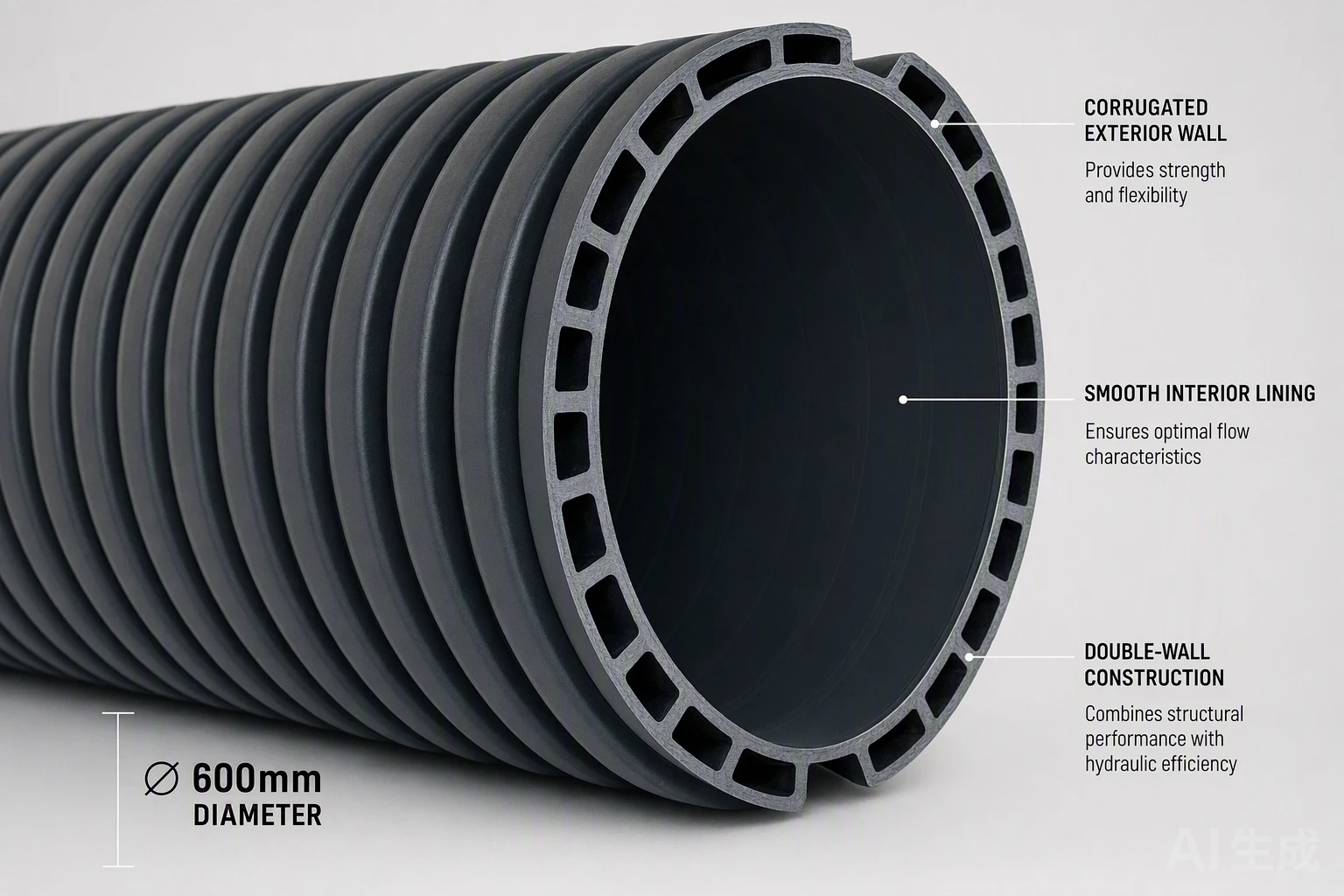
HDPE corrugated pipe is a flexible, non-pressure drainage pipe made from high-density polyethylene. The corrugated exterior gives the pipe ring stiffness — the resistance to crushing under soil and traffic load — while using roughly 30 to 50% less material than a solid-wall pipe of equivalent load capacity. That material saving is the entire economic reason corrugated pipe exists. The trade-off is that the pipe depends on the surrounding compacted soil for structural support, which makes installation quality as important as the pipe itself.
AASHTO M294, the dominant North American standard for corrugated polyethylene pipe from 300 to 1500 mm (12 to 60 inches), defines three structural types:
- Type C — Both the inner and outer walls are corrugated. The cheapest to produce. Rough interior reduces flow capacity and invites sediment buildup.
- Type S — Corrugated exterior with a smooth inner lining. This is the workhorse: the smooth bore gives a Manning’s n of 0.012, and the corrugated outer wall provides the stiffness. Most double-wall pipe imported under AASHTO M294 is Type S.
- Type D — Smooth inner and outer walls connected by ring or spiral support ribs. A newer profile, less common in standard municipal drainage.
For smaller diameters, AASHTO M252 covers 75 to 250 mm (3 to 10 inch) pipe. It uses the same Type C and Type S classification, with a minimum pipe stiffness of 340 kPa (50 psi) at 5% deflection tested per ASTM D2412. If your project calls for 4-inch or 6-inch highway edge drain, this is the standard that applies.
Single-Wall vs Double-Wall: What You Are Actually Buying
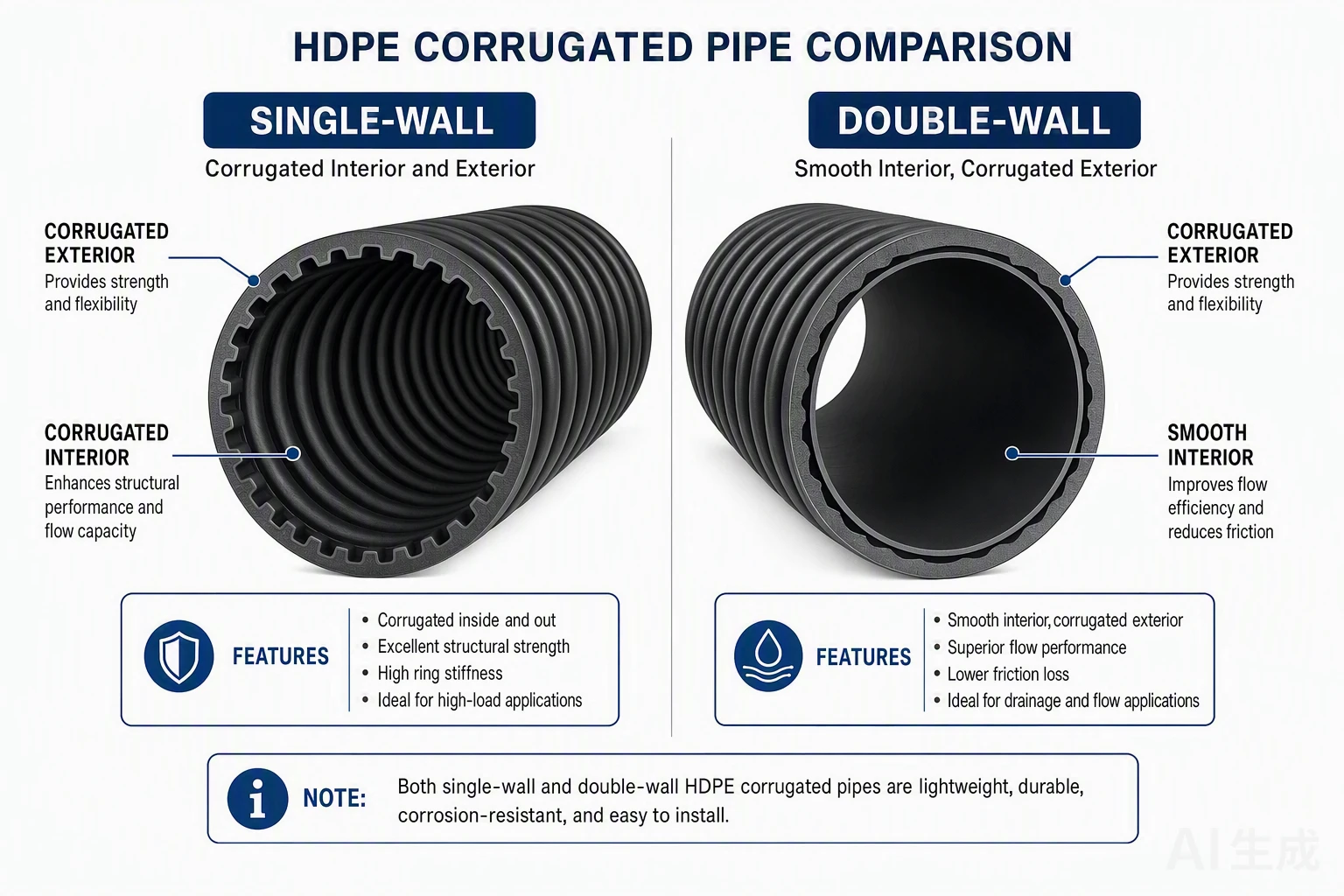
The single most consequential purchasing decision in corrugated HDPE is single-wall versus double-wall. They are different products for different jobs, and the price gap between them — typically 20 to 35% — is the first thing a buyer notices. The second thing, if the wrong type ends up on site, is the problem.
Single-Wall Corrugated Pipe
Single-wall pipe is corrugated on both the inside and the outside. The interior ridges create hydraulic friction — Manning’s n for small-diameter single-wall typically runs around 0.020 (estimated range 0.018-0.023), roughly double the 0.012 of smooth-bore double-wall. Sediment collects in the valleys. Flow capacity drops. The pipe is lighter, cheaper, and easier to coil into rolls, which makes it attractive for low-budget projects.
Typical diameter range: 75 to 600 mm (3 to 24 inch). Typical applications: agricultural subsoil drainage, interior wire conduit, air conditioning condensate lines, sports field drainage, and highway edge drains under light loads. A contractor who specs single-wall under a paved road or in a sanitary sewer main will face premature failure — the corrugated interior traps debris, and the lower ring stiffness cannot handle the load without exceptional bedding.
Double-Wall Corrugated Pipe
Double-wall pipe has a smooth interior and a corrugated exterior. The smooth bore delivers that 0.012 Manning’s n — the same hydraulic efficiency as smooth-wall PVC or concrete at a fraction of the weight. The corrugated exterior provides ring stiffness with less material. Double-wall pipe saves 30 to 50% material compared to solid-wall plastic pipe of equivalent stiffness.
Diameter range: 100 to 1500 mm (4 to 60 inch), with large-diameter structured-wall profiles reaching up to 3000 mm for trunk-line storm sewers. Applications: stormwater drainage, highway culverts, non-pressure sanitary sewer, leachate collection, retention and detention systems. ADS N-12, a widely specified double-wall corrugated HDPE brand in North America, is manufactured to AASHTO M252 (4 to 10 inch) and AASHTO M294 (12 to 60 inch), with a stated minimum design service life of 100 years. For pressure-side HDPE pipe that connects to these drainage networks, solid-wall PE100 pipe per ASTM F714 is the standard.
Corrugation Profiles: Annular and Helical
The corrugation itself runs in one of two patterns. Annular corrugation forms discrete rings perpendicular to the pipe axis — the pipe can be cut at any point without the profile unraveling. Helical corrugation follows a continuous spiral along the pipe length. ASTM F2306, which covers 300 to 1500 mm (12 to 60 inch) pipe for non pressure gravity-flow storm sewer, specifies an annular corrugated profile wall. If your spec sheet cites ASTM F2306, the pipe must have annular corrugation.
Helical profiles appear more often in large-diameter structured-wall pipe, where the continuous spiral can be wound onto a mandrel during manufacturing. The risk: if you order annular and receive helical, the joint geometry may not match the gasket design, and the supplier may argue the stiffness is equivalent. It is not the same product.
The Standards Map: AASHTO, ASTM, EN, and ISO
HDPE corrugated pipe is specified under two standard families that do not translate cleanly. North America uses AASHTO and ASTM. Europe and much of the international market uses EN and ISO. A supplier who writes “equivalent to AASHTO M294” on a spec sheet is telling you nothing verifiable unless they also state the test method and the measured values.
| Standard | Scope | Diameter Range |
|---|---|---|
| AASHTO M252 | Corrugated PE pipe, subsurface drainage, Type C and S | 75 to 250 mm (3 to 10 in.) |
| AASHTO M294 | Corrugated PE pipe, culverts and storm drains, Type C, S, D | 300 to 1500 mm (12 to 60 in.) |
| ASTM F667 | Corrugated PE pipe and fittings, land drainage | 3 to 24 in. |
| ASTM F2306 | Annular corrugated profile wall PE pipe, gravity storm sewer | 300 to 1500 mm (12 to 60 in.) |
| ASTM F714 | Solid-wall PE pressure pipe (DR-PR), water and sewage | DIPS, IPS, Metric sizing |
| EN 13476 | Structured-wall pipe for non-pressure underground drainage, PVC-U/PP/PE | DN/ID 100 to 1200 mm |
| ISO 21138 | Structured-wall pipe for non-pressure underground drainage, PVC-U/PP/PE | DN/ID 100 to 1200 mm |
EN 13476 and ISO 21138 classify structured-wall pipe into Type A (smooth internal and external surfaces) and Type B (smooth internal, non-smooth external surface). A corrugated double-wall pipe falls under Type B — Part 3 of both standards. The Esen manufacturer, for instance, certifies its double-wall corrugated pipe to TS EN 13476-3, the Turkish adoption of EN 13476 Part 3. If a European or Turkish supplier sends you a certificate referencing EN 13476-3, that is the Type B corrugated category.
One more distinction that catches buyers: ASTM F2306 requires virgin resin. ASTM F2648, which also covers 4 to 60 inch corrugated HDPE, permits recycled content. Two standards that look like they cover the same product do not — and a recycled-resin pipe may not pass the NCLS (notched constant tensile load) slow-crack-growth test that AASHTO M294 mandates. AASHTO M294 also requires the UCLS test specifically for any pipe containing recycled material, and subjects all pipe to a drop-weight impact test at minus 4 plus or minus 2 degrees Celsius.
Stiffness Classes: SN vs PS — Two Systems, Not Interchangeable
Ring stiffness is the single most important performance number on a corrugated pipe spec sheet. It tells you how much load the pipe wall can resist before deforming. The problem: Europe and North America measure it differently, and the numbers cannot be converted with a simple formula.
The SN System (Europe, ISO, EN)
EN 13476 and ISO 21138 define four ring stiffness classes, each representing the minimum ring stiffness in kN/m2, tested per EN ISO 9969. The test compresses a pipe sample between two parallel plates at a constant rate of 12 mm/min until 3% deflection, and calculates stiffness from the force-deflection curve.
| SN Class | Ring Stiffness (kN/m2) | Typical Application |
|---|---|---|
| SN2 | 2 | Light loads, shallow cover, no traffic |
| SN4 | 4 | Shallow cover, low traffic areas |
| SN8 | 8 | Standard municipal and highway class |
| SN16 | 16 | Heavy traffic, deep cover, industrial loads |
ISO 21138 recommends selecting the class based on burial depth (0.8 to 6 m) and soil compaction. SN8 is the default for most municipal storm sewer and culvert work. SN16 appears under deep cover, heavy traffic, or unstable soil where the pipe must carry more of the load. SN2 and SN4 serve non-traffic applications like agricultural drainage and light landscaping.
The PS System (North America, AASHTO)
AASHTO M294 measures pipe stiffness (PS) in psi, tested per ASTM D2412. The test also uses parallel-plate loading, but measures at 5% deflection rather than 3%. The minimum PS requirement decreases with diameter — larger pipes need less stiffness because the soil arch distributes load differently over a wider span:
| Diameter | Minimum PS (psi) | Test Method |
|---|---|---|
| 12 in. (300 mm) | 50 | ASTM D2412, 5% deflection |
| 24 in. (600 mm) | 34 | ASTM D2412, 5% deflection |
| 36 in. (900 mm) | 22.5 | ASTM D2412, 5% deflection |
| 60 in. (1500 mm) | 15 | ASTM D2412, 5% deflection |
The reason SN and PS are not interchangeable: different deflection thresholds (3% vs 5%), different test apparatus setups, and different calculation bases. A supplier who claims “SN8 equivalent to 50 psi” is conflating two tests. If your project requires AASHTO M294 compliance, demand the actual PS value from an ASTM D2412 test report — not a converted SN figure.
Diameter Ranges and What They Mean for Sizing
Corrugated HDPE pipe is sized by nominal inside diameter (DN/ID) or outside diameter (DN/OD), depending on the standard system. The ISO 21138 system defines dimensions from DN/ID 100 to 1200 mm and DN/OD 110 to 1200 mm. AASHTO M294 uses nominal inch designations from 12 to 60 inches. The practical ranges by pipe type:
- Single-wall: 75 to 600 mm (3 to 24 in.) — covered by ASTM F667 and AASHTO M252 for the smaller end.
- Double-wall (Type S): 100 to 1500 mm (4 to 60 in.) — the AASHTO M294 / ASTM F2306 range.
- Large-diameter structured wall: Up to 3000 mm — used for storm trunk lines and detention systems where standard double-wall stops.
One sizing trap: “DN 600” in EN 13476 refers to nominal inside diameter. The actual measured ID varies at the corrugation valley versus the crest. If your coupler is dimensioned by OD, the corrugation peak is the OD that matters. Check the manufacturer’s tolerance table before ordering couplers from a different supplier — cross-brand joint compatibility is not guaranteed. For guidance on transition fittings between different pipe systems, see our PEX to PVC fittings guide.
Joint Types: Bell-Spigot, Coupler, and Welded Connections
The joint is where most field failures happen. A pipe wall that meets AASHTO M294 stiffness is meaningless if the joint separates under load or leaks under groundwater pressure. Four joint systems are common in corrugated HDPE:
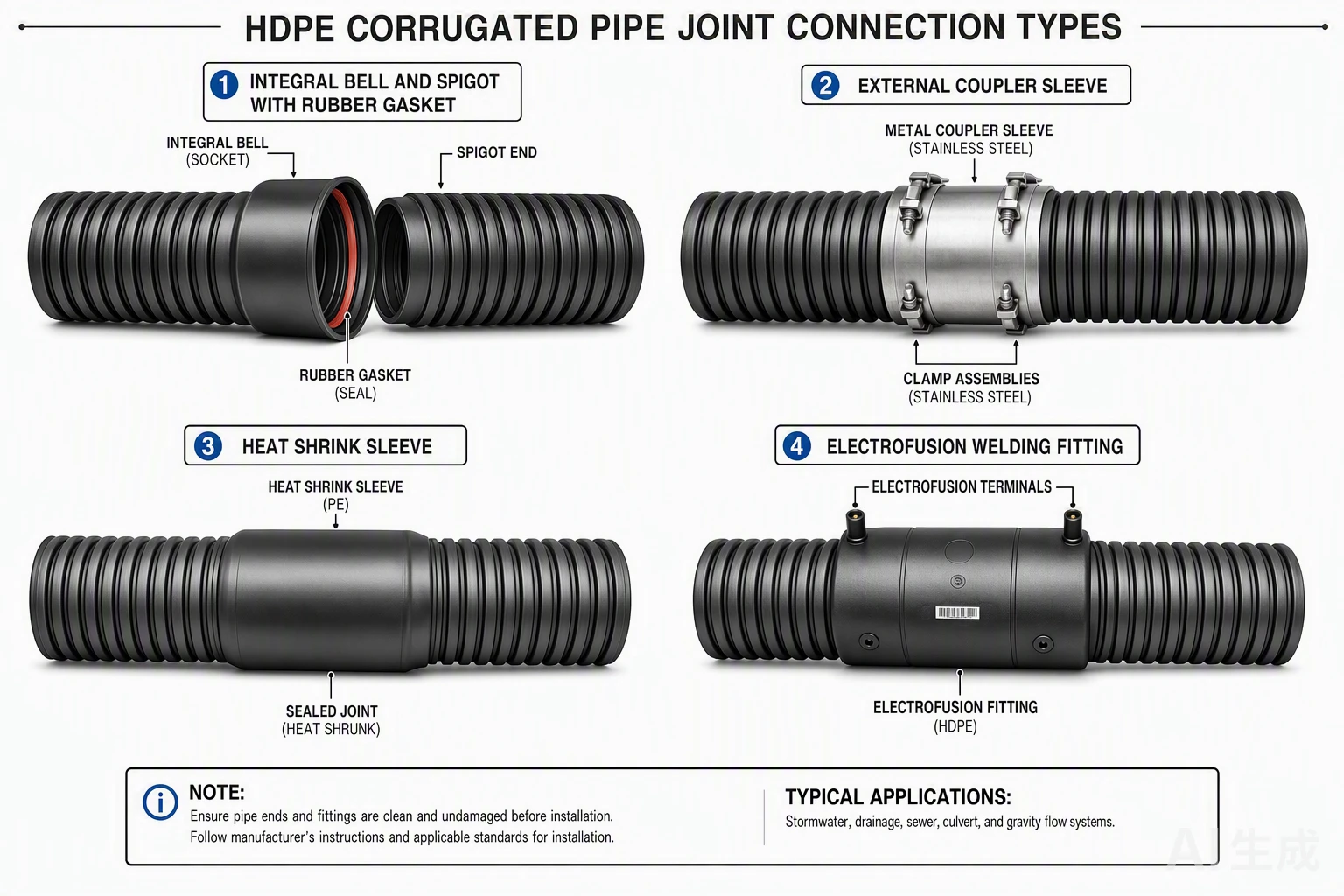
- Integral bell and spigot with rubber gasket. The bell is molded onto the pipe during manufacturing — no separate coupler needed. The rubber ring sits in a groove on the spigot end. Installers clean the groove, seat the gasket, apply lubricant, and push the spigot into the bell to the marked insertion depth. This is the most common joint for double-wall corrugated pipe. Pacific Corrugated Pipe’s StormTite system, for example, is certified watertight to 10.8 psi (74 kPa) per ASTM D3212 and AASHTO M294.
- External coupler or sleeve. Used with plain-end pipe. A separate sleeve bridges two pipe ends, sealed by rubber rings inside the sleeve or on the pipe exterior. Common for large-diameter or special-profile pipe where integral bells are impractical.
- Heat shrink sleeve. A polymer sleeve is positioned over the joint and heated with a torch or heat gun. The sleeve shrinks radially, and the internal hot-melt adhesive flows into the corrugation valleys to form a waterproof barrier. Used in high-water-table areas, corrosive environments, and projects where a continuous seal is required.
- Electrofusion welding. A fitting with embedded heating wires is placed over the joint. An electric current melts the wire and fuses the fitting to the pipe. Creates a permanent, monolithic joint — but requires power on site and trained operators.
The joint grade matters as much as the method. AASHTO M294 and ASTM D3212 define three grades: soil-tight (default, prevents soil migration but allows water seepage), silt-tight (low-pressure test), and watertight (10.8 psi / 74 kPa test). If your project sits below the water table or carries sanitary effluent, you need watertight. If your PO does not state the joint grade, the supplier ships soil-tight.
Illustrative scenario (not a surveyed benchmark)
Consider a contractor on a 4-km stormwater line in a coastal area who orders 600 mm double-wall corrugated pipe without specifying the joint grade. The supplier ships soil-tight joints. Groundwater infiltrates at every bell during the wet season. The line’s design capacity drops by an illustrative ~30%, and the municipality requires trench excavation and joint replacement at 12 months. The cost of writing “watertight per ASTM D3212, 10.8 psi” on the PO: zero. The cost of not writing it: on the order of ~40% of the pipe cost in this illustrative case.
Applications: Where Corrugated HDPE Goes Underground
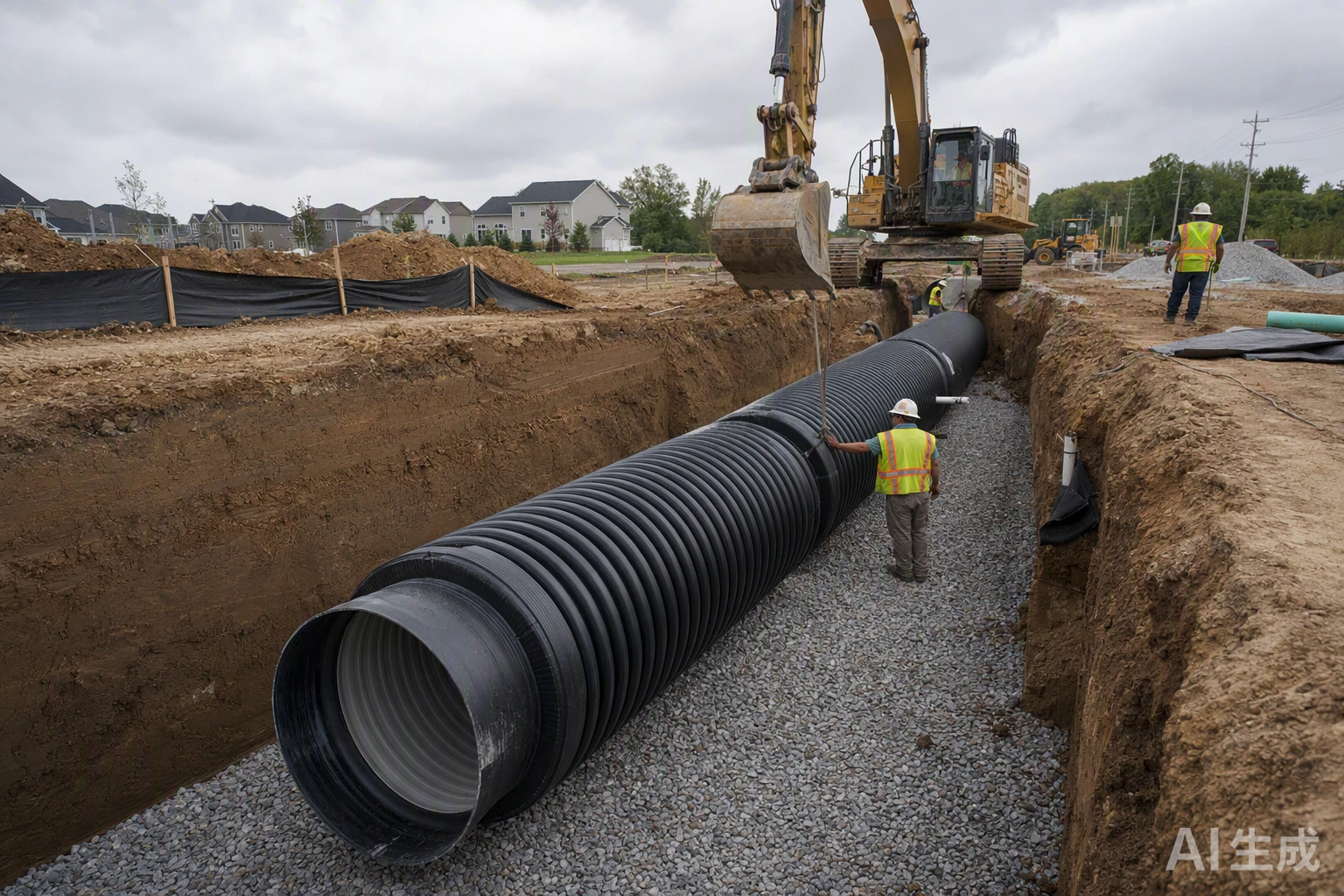
Corrugated HDPE is a gravity-flow, non-pressure pipe. It does not belong in pressurized water mains, fire suppression lines, or force mains. ASTM F714 governs solid-wall HDPE for pressure applications — that is a different product with a different wall structure, dimension ratio, and pressure rating. Knowing where corrugated pipe does and does not belong is the first line of defense against a misapplied spec. For PEX pipe fittings and other pressure-side connection components, different standards apply entirely.
| Application | Pipe Type | Typical SN / Standard |
|---|---|---|
| Stormwater drainage | Double-wall, solid or perforated | SN8 / AASHTO M294 |
| Highway culverts | Double-wall, solid | SN8 to SN16 / ASTM F2306 |
| Subsoil / land drainage | Single-wall, perforated | SN2 to SN4 / ASTM F667 |
| Sanitary sewer (gravity) | Double-wall, solid, watertight joints | SN8 / EN 13476 |
| Leachate collection | Double-wall, perforated | SN8 / ASTM F2306 |
| Retention / detention | Large-diameter structured wall | SN8 to SN16 / AASHTO M294 |
Perforation pattern changes by application. Class 1 perforation places holes in two equal groups on either side of the pipe’s lower quadrant — used where the pipe collects groundwater while also conveying surface flow. Class 2 distributes holes evenly around the full circumference — for subsurface drainage only. The wrong class means the pipe either does not collect enough water or collects it from directions the design did not account for.
Specifying for Procurement: What a Clean PO Looks Like
A purchase order for corrugated HDPE pipe should leave no room for substitution. Every line below either matches a standard or names a measurable value. If any line is blank, the supplier fills it with whatever is cheapest to produce.
- Standard and type: “AASHTO M294, Type S” or “EN 13476-3, Type B” — not “HDPE corrugated pipe, double-wall.”
- Diameter: Nominal ID in mm or inches, with tolerance reference. “DN 600 (ID), tolerance per AASHTO M294 Table X.”
- Stiffness class: “SN8 (8 kN/m2, tested per EN ISO 9969 at 3% deflection)” or “PS 34 psi minimum, tested per ASTM D2412 at 5% deflection.” Not “SN8 or equivalent.”
- Resin grade: “Virgin PE100, NCLS-tested per AASHTO M294.” If recycled content is acceptable, state the maximum percentage and require the UCLS test.
- Joint type and grade: “Integral bell and spigot, rubber gasket, watertight per ASTM D3212, 10.8 psi.” Not “bell and spigot.”
- Corrugation profile: “Annular” if ASTM F2306 is cited. State explicitly — do not leave to manufacturer default.
- Perforation: “Solid,” “Class 1 perforated,” or “Class 2 perforated” per AASHTO M294.
- Length per stick: State the nominal length and the tolerance. “6 m, plus 50 mm minus 0.”
- Mill certificate and test report: Require a certificate of compliance citing the standard, plus a copy of the D2412 or ISO 9969 test report with measured values — not just a pass/fail.
Common Sourcing Mistakes and How to Avoid Them
After years of reviewing procurement specs and field failures, the same mistakes recur. Each one is preventable with a single line on a PO.
1. Accepting “SN8, equivalent to AASHTO M294”
SN8 is tested at 3% deflection per ISO 9969. AASHTO M294 PS is tested at 5% deflection per ASTM D2412. The numbers come from different tests. A supplier offering equivalence is either uninformed or hoping you will not verify. Require the actual test report for the system your project uses.
2. Not specifying the joint grade
Unspecified joints default to soil-tight. In groundwater or sanitary applications, you need watertight (10.8 psi per ASTM D3212). The cost difference between soil-tight and watertight is marginal — roughly 3 to 7% of the pipe price. The cost of retrofitting joints after backfill is not marginal.
3. Ordering single-wall for a traffic application
Single-wall pipe has lower ring stiffness, rough interior, and traps sediment. Under a paved road or in a sanitary main, it will deflect and clog. The typical 20 to 35% price saving evaporates the first time the line needs jetting or replacement.
4. Not requiring the NCLS and UCLS test reports
AASHTO M294 mandates slow-crack-growth resistance via the NCLS test (and UCLS for recycled-content pipe). Slow crack growth is the failure mode that causes pipe to split longitudinally years after installation. If the supplier cannot produce the test report, the resin grade is unverifiable.
5. Mixing couplers from different manufacturers
Corrugation profiles vary between manufacturers. A coupler designed for one brand’s bell geometry may not seat properly on another’s spigot. If you buy pipe and couplers from different sources, test-fit a sample joint before committing to a full order. For compatible fitting systems across different pipe materials, our Viega PEX fittings guide covers cross-material connection standards.
Verifying a Shipment: QC Checks Before Backfill
Once the pipe arrives on site, three checks catch most problems before they become buried problems.
Check the mill certificate first. The certificate should cite the standard (AASHTO M294 or EN 13476-3), state the resin grade, and list the measured PS or SN value with the test method. If the certificate says “complies with” without listing measured values, send it back and ask for the actual test report.
Run a mandrel test on a sample. Pull a mandrel slightly smaller than the nominal ID through a stick of pipe. If it binds, the ID is under tolerance — a manufacturing defect that will cause flow restriction and joint misalignment. AASHTO M294 requires deflection verification by mandrel no sooner than 30 days after backfill, against a 5% limit. Do it on a sample stick before installation too.
Hydrostatic test the joints. Assemble a sample joint and pressurize to 10.8 psi (74 kPa) per ASTM D3212. Hold for the specified time. If water weeps at the gasket, the bell geometry or the gasket compound is wrong. Better to find this in the laydown area than under 2 meters of compacted backfill.
Inspect for impact damage. Look for cracks at corrugation valleys, deformed bells, and crushed spigot ends. A pipe that survives the minus 4 degree C drop-weight test in the factory can still arrive cracked if the trucker straps it too tightly across a corrugation crest.
Where IFANPRO Fits: Solid-Wall HDPE for the Pressure Side
IFANPRO does not manufacture corrugated pipe. What we make is the solid-wall HDPE pressure pipe and fittings that connect to the drainage network — the pressure side that ASTM F714 governs, not the gravity side that AASHTO M294 governs. The line between the two is clear: corrugated pipe carries gravity flow underground; solid-wall HDPE carries pressurized water from the pump to the manifold, from the treatment plant to the distribution point, and across any segment where the system operates above atmospheric pressure.
If your project includes both — a drainage network feeding into a pressurized transmission main, or a stormwater retention system with pumped discharge — the corrugated pipe and the solid-wall HDPE come from different suppliers with different standards. IFANPRO supplies the pressure side: PE100 solid-wall pipe in DR-PR dimensions per ASTM F714, with fusion fittings, mechanical couplings, and flange adapters rated for the operating pressure of your system. Browse our HDPE pipe catalog for specifications.
For the corrugated pipe itself, use the specification framework in this guide. For the solid-wall HDPE that connects to it, the next step is straightforward: tell us the diameter, the pressure rating, and the standard your project requires, and we will quote against it. For related fitting specifications, see our PEX to PVC fittings and PEX pipe fittings names guides.







 English
  Français
  Русский
  Español
Recent Comments