
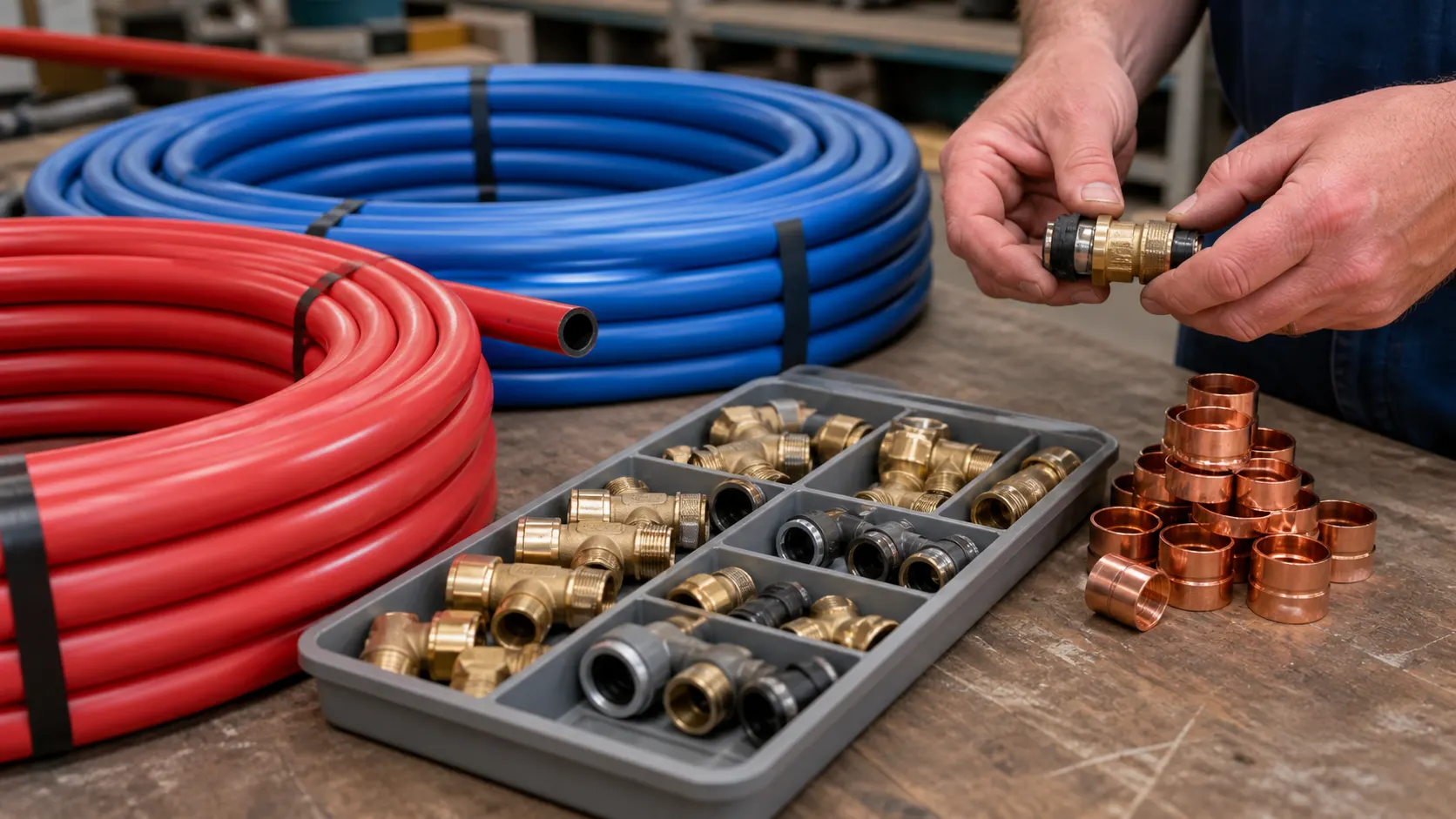
You can put a PEX-B crimp or clamp fitting on PEX-A pipe. It is a standard-compliant joint, not a workaround, and the reason is that the letters A, B and C do not describe three different pipe sizes. They describe three ways of crosslinking the same polyethylene, and all three land in the same dimensional specification.
The exception is the one that actually matters on site: cold-expansion fittings. That system does not travel freely between pipe grades, and the reason it does not is more specific than the internet consensus suggests. What follows is the compatibility matrix with the governing ASTM designation in every cell, and the distinction almost nobody draws between a fitting that fits, a fitting that is listed, and a joint an inspector will accept.
Key takeaways
- Yes for crimp and clamp. Fittings made to ASTM F1807 (metal) and ASTM F2159 (sulfone plastic) are specified against the tubing standard, not against the PEX type. Neither scope mentions A, B or C.
- Because there is only one dimension standard. ASTM F876 is outside-diameter controlled and nominal SDR9 whether the pipe was crosslinked by peroxide, silane or electron beam.
- No for cold expansion, in practice. But the ASTM F1960 scope itself does not say “PEX-a” — it keys on tubing meeting F876 or F3253. The PEX-A restriction comes from the fitting manufacturer’s listing.
- Some PEX-B is listed for expansion. At least one manufacturer lists F1960 among the approved fitting systems for its PEX-B tubing, which makes “PEX-B can never be expanded” false as a blanket statement.
- The binding authority is the fitting maker’s listing plus your local code — never a blog, and never this page.
On this page
- The short answer: yes for crimp and clamp, no for expansion
- Why one dimensional standard makes the fitting fit
- The compatibility matrix, with the governing standard in every cell
- Where expansion fittings actually stop — and why one brand proves it
- Fits, listed and approved are three different questions
- What this means if you stock mixed PEX inventory
- Frequently asked questions
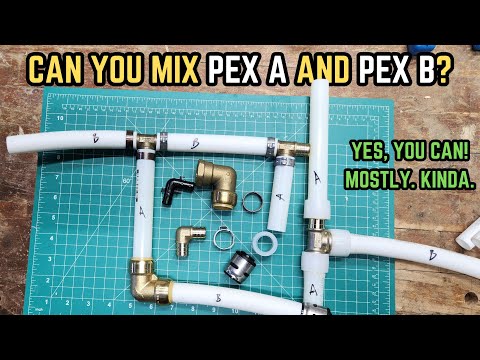
The Short Answer: Yes for Crimp and Clamp, No for Expansion
The question is usually asked with an apology attached, as though mixing were a compromise. It is not. A barbed insert fitting secured with a copper crimp ring or a stainless cinch clamp is designed against the dimensions of the tubing, and PEX-A, PEX-B and PEX-C tubing sold to the same specification carry the same dimensions. The fitting cannot tell which reactor the pipe came out of.
What the letters actually encode is the crosslinking route. ASTM F876 — the tubing specification — states that PEX tubing “shall be made from polyethylene compounds which have been crosslinked by peroxides, or silane compounds in extrusion, or by electron beam after extrusion, or by other means such that the tubing meets the performance requirements.” Three routes, one specification, one set of dimensions. That single sentence is the whole answer to the compatibility question, and it is why the fitting standards never needed to mention the letters at all.
The exception is cold expansion. That system does not clamp the pipe onto a barb from the outside — it stretches the pipe and a reinforcing ring, then relies on the material pulling itself back down onto the fitting. That mechanism asks something of the pipe that a crimp ring never asks, and it is the reason expansion is the one row in the matrix below where the answer changes. If you already know the difference between the grades, skip ahead; if not, our comparison of PEX-a, PEX-b and PEX-c covers how each is made and what it costs.
Why One Dimensional Standard Makes the Fitting Fit
ASTM F876 covers tubing that is, in its own words, “outside diameter controlled, made in nominal SDR9 tubing dimension ratios except where noted.” Two things in that phrase carry the entire compatibility argument. Outside diameter controlled means the OD is the fixed reference the fitting is cut to. SDR9 means the wall thickness is a fixed ratio of that diameter — so once the OD is set, the wall and the bore follow.
Because both are fixed by the standard rather than by the crosslinking method, a half-inch PEX-A pipe and a half-inch PEX-B pipe are the same object as far as a fitting is concerned. These are the figures a barb is machined against:
| Nominal size (CTS) | OD (in) | Wall (in) | Calculated ID (in) |
|---|---|---|---|
| 1/2" | 0.625 | 0.070 | 0.485 |
| 3/4" | 0.875 | 0.097 | 0.681 |
| 1" | 1.125 | 0.125 | 0.875 |
| 1-1/4" | 1.375 | 0.153 | 1.069 |
| 1-1/2" | 1.625 | 0.181 | 1.263 |
| 2" | 2.125 | 0.236 | 1.653 |
Those dimensions are published on a manufacturer’s Type-B tubing submittal, sourced from “ASTM F876 middle of spec.” That detail is worth pausing on: the numbers a PEX-B product is built to are the F876 numbers, the same ones a PEX-A product is built to. Nothing in the dimensional chain distinguishes them.
What the fitting standards key on instead
ASTM F1807 covers metal insert fittings with a copper crimp ring for SDR9 PEX, and it requires the tubing to meet Specification F876. ASTM F2159 does the same for sulfone plastic (PPSU) insert fittings. Read either scope looking for the words “Type A” or “Type B” and you will not find them — the standards point at the tubing specification and stop there. Both systems are rated for 100 psi (689.5 kPa) hot- and cold-water distribution at temperatures up to and including 180°F (82°C).
One fitting manufacturer states the consequence plainly, describing its stainless crimp range as “compatible with all types of PEX pipe, which includes either A, B or C.” That is not a tolerance being stretched. It is the standard working as designed.
The Compatibility Matrix, With the Governing Standard in Every Cell
This is the table the question deserves and the one page-one results do not print. Read the right-hand column first: the standard is what governs, and where a cell says no, it is a manufacturer listing rather than a dimension doing the blocking.
| Fitting system | Governing standard | PEX-A | PEX-B | PEX-C |
|---|---|---|---|---|
| Metal insert + copper crimp ring | ASTM F1807 | Yes | Yes | Yes |
| Metal insert + stainless cinch clamp | ASTM F1807 (alternate clamps) | Yes | Yes | Yes |
| Sulfone plastic (PPSU) insert + crimp ring | ASTM F2159 | Yes | Yes | Yes |
| Cold expansion + PEX reinforcing ring | ASTM F1960 | Yes | Only where the maker lists it | Generally not listed |
| Expansion + metal compression sleeve | ASTM F2080 | Yes | Where listed | Where listed |
| Push-to-connect | ASTM F1807 / F877 fitting listings | Yes | Yes | Yes |
The pattern is consistent. Every system that works by compressing the pipe from outside onto a barb crosses PEX types without qualification, because compression only needs the dimensions to be right. Every system that works by expanding the pipe and waiting for it to come back depends on how the pipe behaves, which is exactly what the crosslinking method changes.
The reverse direction, which people ask second
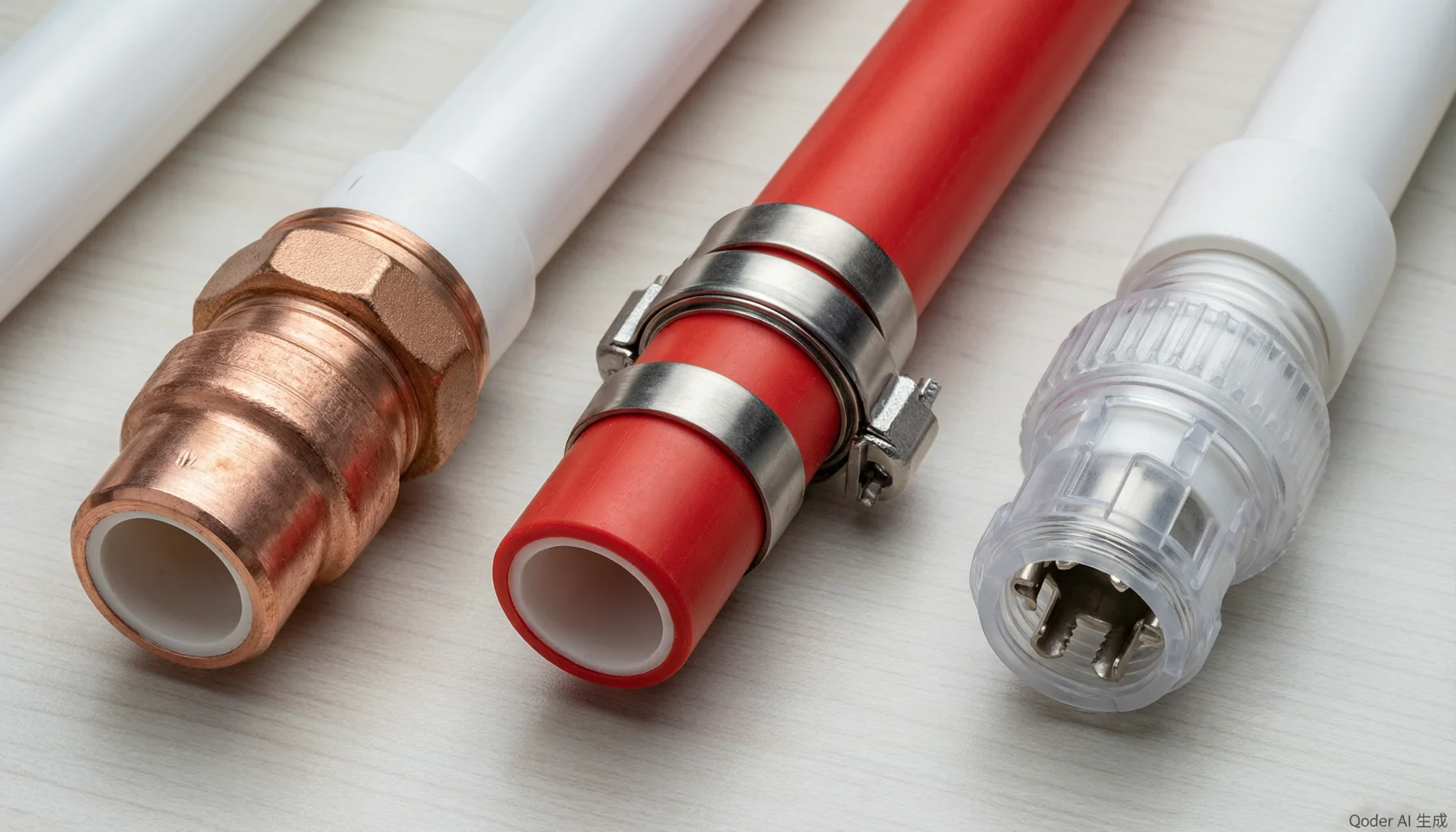
Putting a so-called PEX-A fitting on PEX-B pipe is the same question wearing a different hat, and it splits the same way. If the “PEX-A fitting” is an F1807 or F2159 insert fitting that happened to be sold in a PEX-A kit, it fits PEX-B perfectly — it was never a PEX-A part to begin with. If it is an F1960 expansion fitting, then you are asking whether your PEX-B is listed for expansion, which is the subject of the next section. The trap is the packaging, not the metal.
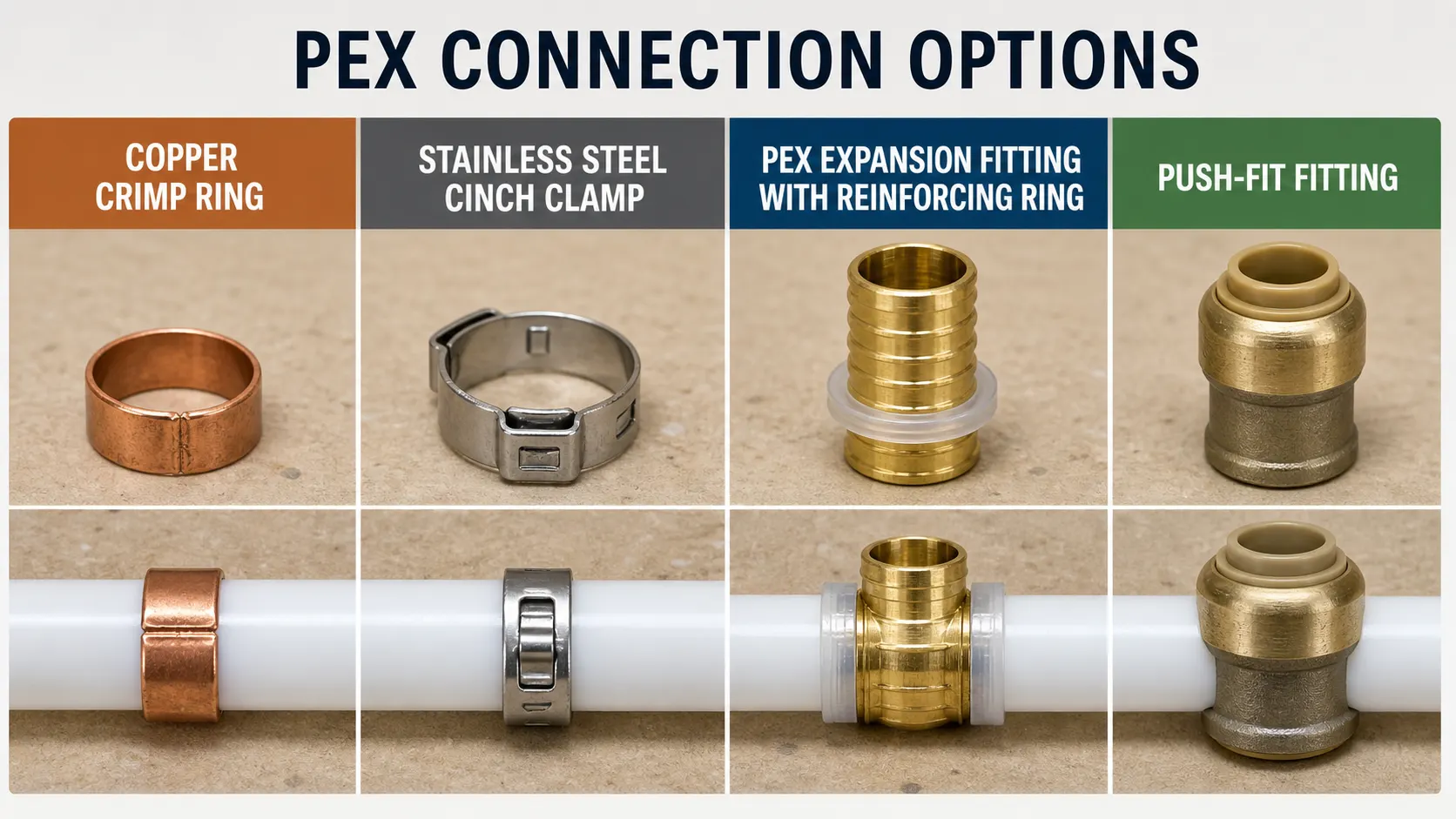
Push-fit sits outside the argument entirely. It seals on the pipe OD with an O-ring and grips with a stainless collet, so like crimp it only needs F876 dimensions. For how the four systems compare on cost, tooling and rework, see our breakdown of PEX fitting connection types.
Where Expansion Fittings Actually Stop — and Why One Brand Proves It
Search this question and you will be told, repeatedly and confidently, that cold expansion requires PEX-A because only PEX-A has shape memory. That is a good working rule and a bad description of the authority behind it. The ASTM F1960 scope covers cold expansion fittings and PEX reinforcing rings for tubing “that meet the requirements of Specification F876 or F3253.” It keys on the tubing specification. It does not say PEX-a.
So where does the restriction come from? From the fitting manufacturer’s listing — and the cleanest proof available comes from a single brand contradicting itself in public, for entirely legitimate reasons.
One manufacturer, two documents, two different answers
Sioux Chief’s PowerPEX tubing submittal lists the approved fitting systems for its Type-B tubing as “ASTM F1807 / ASTM F2080 / ASTM F1960 / ASTM F2159” — the identical list it gives for its Type-A tubing. By that document, its PEX-B is approved for expansion fittings.
Its PowerPEX installation manual, describing its own fittings, states: “Sioux Chief PEX-A tube can be used with all of Sioux Chief’s PowerPEX fitting systems. However, PowerPEX ASTM F1960 fittings can only be used with PEX-A tubing.”
Both statements are true, and the difference is the whole point. The tubing sheet describes what the pipe is certified to work with. The fitting manual describes what that brand’s fittings are listed for. A joint needs both ends approved. Read only the tubing sheet and you will specify an assembly the fitting maker does not stand behind.
Zurn states the same thing from the pipe side, saying PEX-b pipes “are now fully certified for use with both ASTM F1807/F2159 crimp and ASTM F1960 expansion fittings and accessories.” So the blanket claim that PEX-B can never be expanded is out of date. What remains true is that most PEX-B is not listed for it, and that you cannot tell by looking — you read the print stream on the pipe and the fitting maker’s literature.
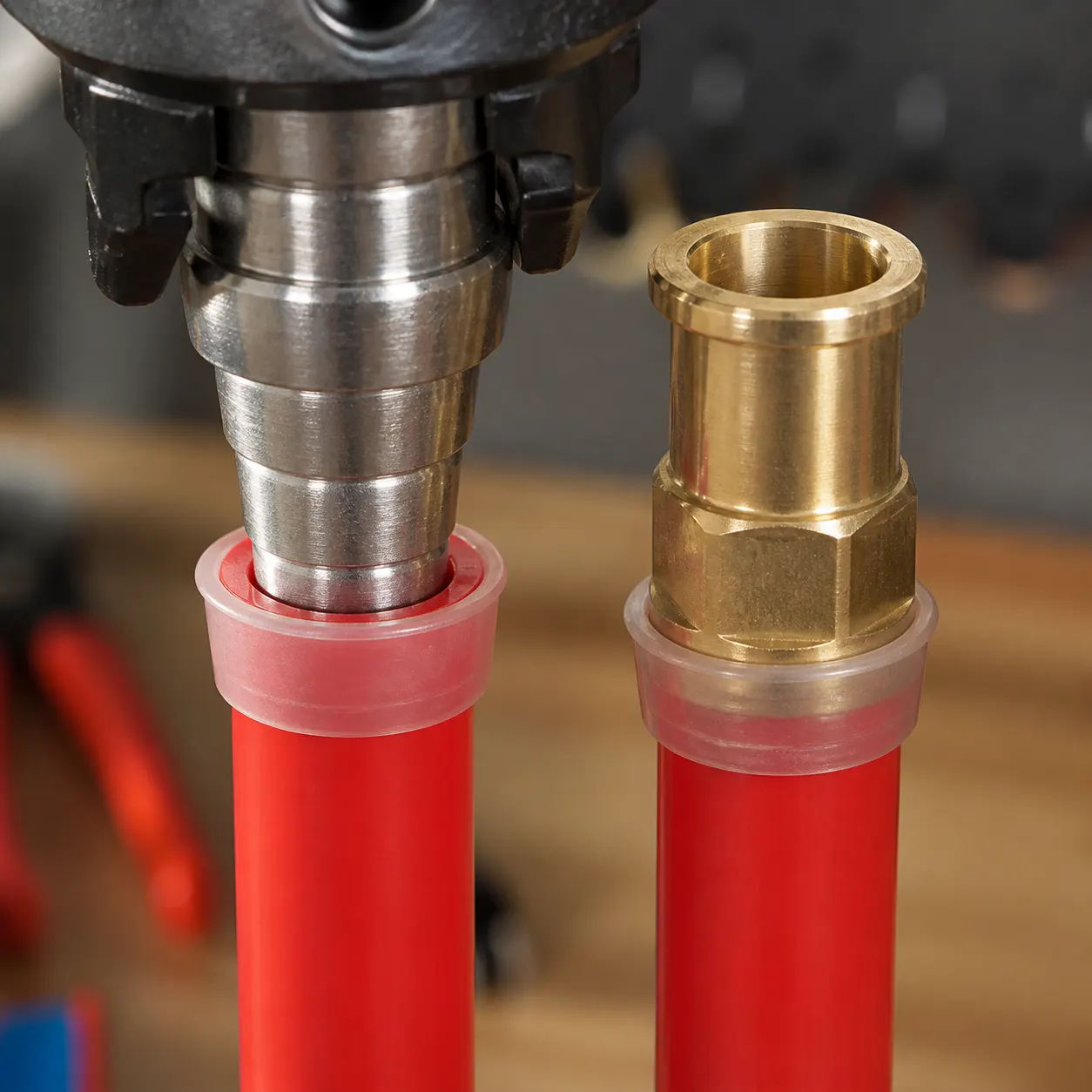
Where PEX-B expansion is listed, the technique is not identical to PEX-A. The same manual instructs that “PEX-B tube expansions MUST be made slowly,” rotating the expander head between expansions, and warns that cold tubing needs more caution than tubing at 55°F or warmer. A crew that expands PEX-B at PEX-A speed is the realistic failure mode here — not the material choice itself.
Fits, Listed and Approved Are Three Different Questions
Most arguments about mixing PEX collapse three separate questions into one. Pulling them apart is what turns this from trivia into something you can defend to an inspector.
| The question | What answers it | What it does NOT settle |
|---|---|---|
| Does it physically fit? | ASTM F876 tubing dimensions — OD-controlled, SDR9 | Whether anyone approves the assembly |
| Is the assembly listed? | The fitting maker’s certification and the pipe’s print stream | Whether your jurisdiction accepts it |
| Will it be accepted and warranted? | Local plumbing code, plus the manufacturer’s warranty conditions | Nothing further — this is the binding one |
The warranty layer is where mixing brands quietly costs money, and manufacturers are explicit about it. Uponor’s installation guide states that its “full 25-year warranty requires using Uponor PEX pipe with Uponor ProPEX rings and fittings.” Note what that is and is not: it is a commercial condition on a warranty, not a claim that another manufacturer’s F1807 fitting will leak. A code-compliant joint and a warranted joint are different standards, and on a project with a long defects-liability period the second one is often the one being bought.
When the documents disagree, the stricter one wins
The same guide gives the rule for conflicts: “If there are differences between Uponor recommendations and local code, always follow the more-restrictive criteria.” That is the sentence to keep. Nothing on this page overrides the instructions packed with the fitting you actually bought, and nothing overrides your local authority. Requirements vary by jurisdiction, and a listing valid in one market may not be recognised in another — certification acceptance is worth confirming with your inspector before a large order, not after.
What to have ready before the inspection
- The print stream on the pipe itself, which carries the standards it was made to — a typical PEX line reads ASTM F876/F877 with the fitting systems and a rating such as 80 psi at 200°F, 100 psi at 180°F, 160 psi at 73°F.
- The fitting manufacturer’s listing naming F1807, F2159 or F1960, because that is the document that governs the joint.
- The installation instructions for the tool, especially if you expanded PEX-B, where technique is specified differently.
- Confirmation that the potable-water certification is one your market recognises — our guide to PEX drinking-water certifications covers which marks matter where.
What This Means If You Stock Mixed PEX Inventory
For a distributor the compatibility answer inverts into a stocking answer. If crimp and clamp cross every PEX type and expansion does not, the variable worth controlling is the fitting system, not the pipe grade.
Standardise on F1807 or F2159 and one fitting range serves every PEX grade you carry, in any mix your customers ask for. Stock an F1960 expansion range and you have tied that inventory to pipe that is listed for expansion, which is a narrower set. The first strategy keeps a mixed warehouse simple; the second sells into the premium end and takes a real constraint with it. There is also a third position, and it is the one we occupy ourselves — a metric multilayer range that sits outside the CTS argument entirely, which is worth understanding before you assume every PEX supplier is quoting the same thing you are asking for.
The trade-off you are accepting
Insert fittings are not free. The barb sits inside the bore, so an insert fitting restricts flow where a cold-expansion fitting keeps the full inner diameter — a trade-off fitting manufacturers name themselves. Immaterial on a short branch; a design input on a long run with many fittings, and the honest reason a specifier may insist on expansion even though crimp would fit. Our PEX sizing chart has the flow figures.
What to ask a supplier before the first order
Compatibility questions are answerable on paper before anything ships, and these are the four that actually decide it:
- Which ASTM system does the fitting certify to — F1807, F2159, F1960 or F2080? Ask for the listing, not a statement in an email.
- What does the tubing print stream say, in full? It names the fitting systems the pipe is approved for, and it settles the expansion question in one line.
- Which sizes are held against the F876 CTS range from 1/2" to 2", and which are made to order?
- Is the range CTS inch or metric? A supplier whose PEX line is metric multilayer — 16, 20, 25 mm — is not quoting the same product as an F876 CTS crimp range, however similar the category name reads. Ours is metric; ask the question early enough that it does not surface at quotation.
Where IFAN actually sits on this map — and where we do not. Everything above is the ASTM CTS world: inch tubing to F876, fittings to F1807, F2159 or F1960. Our published PEX catalogue is not in it. All twelve products in our PEX pipe and fittings category are the 121UC PEX-AL-PEX range — multilayer pipe with brass compression fittings, in metric 16×2.0, 20×2.0 and 25×2.5 mm, rated 16 bar from −20 °C to 110 °C on a brass body with EPDM O‑rings. We list no F1807 or F2159 CTS crimp fitting. If your project is inch PEX-A on a copper crimp ring, better you learn that here than at quotation.
One detail catches importers who assume metric and CTS never touch: our union fittings carry inch threads on metric sockets — model UL20×3/4F is a 20 mm PEX socket against a 3/4" female union thread — so the thread side of a 121UC fitting will mate with inch pipework the socket side never would.
Published terms, identical on every product page rather than quoted per enquiry: 15–30 days after deposit, TT at 30% deposit with the 70% balance against copy of B/L, out of a plant running 200 production lines with 54 engineers on staff. Price is the one number not on this page, because it moves with brass content and mix — send the size list and it comes back against that list.
Conclusion
The compatibility answer is narrower than the anxiety around it. One tubing standard sets the dimensions, so crimp and clamp fittings cross PEX-A, PEX-B and PEX-C without qualification. Cold expansion is the one system where the pipe’s own listing decides, and even there the restriction sits in the manufacturer’s certification rather than in the ASTM scope — which is why one brand can list F1960 on its PEX-B tubing while restricting its own F1960 fittings to PEX-A.
The trade-off is the part worth carrying away. Crimp buys you a single fitting range across every grade you stock and costs you some bore. Expansion buys you full flow and costs you inventory flexibility. Neither is the right answer in the abstract; they are different bets on what your customers will ask for. Whichever you take, the document that settles the argument is the fitting maker’s listing plus your local code — not the letter printed on the pipe, and not this page.
Frequently Asked Questions
Can you use PEX-B fittings on PEX-A pipe?
Yes. ASTM F1807 and F2159 insert fittings are specified against the tubing standard F876, which is outside-diameter controlled and SDR9 for every PEX type. Follow the fitting maker’s instructions and your local code.
Will mixing PEX types void my warranty?
It can, and that is separate from compliance. Uponor’s guide states its full 25-year warranty requires Uponor pipe with Uponor ProPEX rings and fittings. A joint can meet the standard and still fall outside a warranty.
Can PEX-B be used with expansion fittings?
Sometimes. The F1960 scope keys on tubing meeting F876 or F3253 and never names PEX-a, and one manufacturer lists F1960 for its PEX-B tubing. Most PEX-B is not listed for it, so verify the product.
Do crimp fittings damage PEX-A pipe?
No. The crimp joint compresses the pipe wall onto a barb, which is what F1807 fittings do on any F876 tubing. Use the correct ring, a calibrated tool and a go/no-go gauge on every joint.
Can I use PEX-A expansion fittings on PEX-B pipe?
Only if that PEX-B is listed for cold expansion. If the part is actually an F1807 or F2159 insert fitting sold in a PEX-A kit, it fits PEX-B normally. If it is a true F1960 expansion fitting, the pipe’s listing decides.
Does using a crimp fitting reduce flow?
Yes, slightly. The barb sits inside the bore, so insert fittings restrict the inner diameter where cold expansion keeps it full. It rarely matters on a short branch but is worth sizing for on long runs with many fittings.








 Français
  English
  Русский
  Español
Commentaires récents