
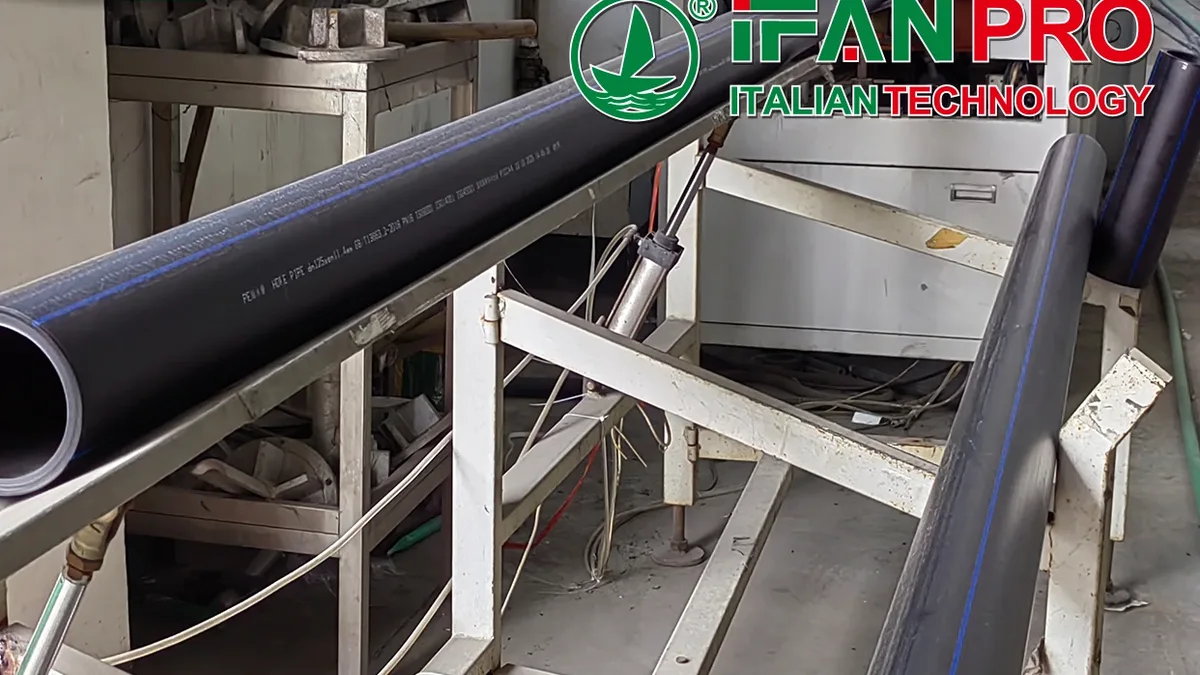
An HDPE water pipe is a candidate for qualified squeeze-off planning only when the exact pipe, tool and procedure are supported together, the proposed location passes inspection, and the water operator accepts the method. A PE100 label or a tool that fits around the pipe does not establish eligibility. If identification is missing, hold the plan; if an exclusion is known, choose another isolation method.
This is a pre-job selection guide for utility engineers, maintenance planners and purchasers. It helps decide which records must reach a qualified reviewer before a crew is arranged. It gives no squeeze force, stop gap, compression speed or release instructions.
Key Takeaways
- Assess a one-time isolation task separately from repeated flow control.
- Match exact pipe identification, tool configuration and qualified procedure.
- Uncertain pipe history or unclear markings creates a hold point.
- Damage, prior squeezing and nearby connections can exclude a location.
- PPI water guidance does not extend a gas standard to a water pipe.
- A candidate decision still requires operator acceptance and trained personnel.
Start with the repair task: isolation or repeated flow control?
Write the intended task before requesting a tool. Is the operator considering temporary isolation for one repair, or does the site need routine modulation of flow? Those requests lead to different equipment decisions. A permanent or repeatedly used control point calls for review of a valve or another designed isolation arrangement.
PPI TN-54, revised in 2025, addresses polyethylene squeeze-off in water, oil and gas applications. Its restrictions on repeated squeezing and throttling explain why temporary eligibility should not become a standing flow-control plan. The note also places the work with personnel trained by an authorized instructor.
State what the isolated section serves and how the operator will maintain the required service. A hospital connection, a distribution branch and an empty replacement section can have different outage consequences. The article cannot decide those project conditions. The operator must identify them before accepting any isolation approach.
Include the required isolation result in the review request. A crew planning an intervention needs an approved method for confirming the condition it requires; selecting a squeeze tool alone does not demonstrate that condition. Caldertech’s public FAQ includes a question about complete closure, reinforcing the need to resolve the requirement with the operator and tool supplier instead of assuming a generic outcome.
The qualified combination is pipe + tool + procedure
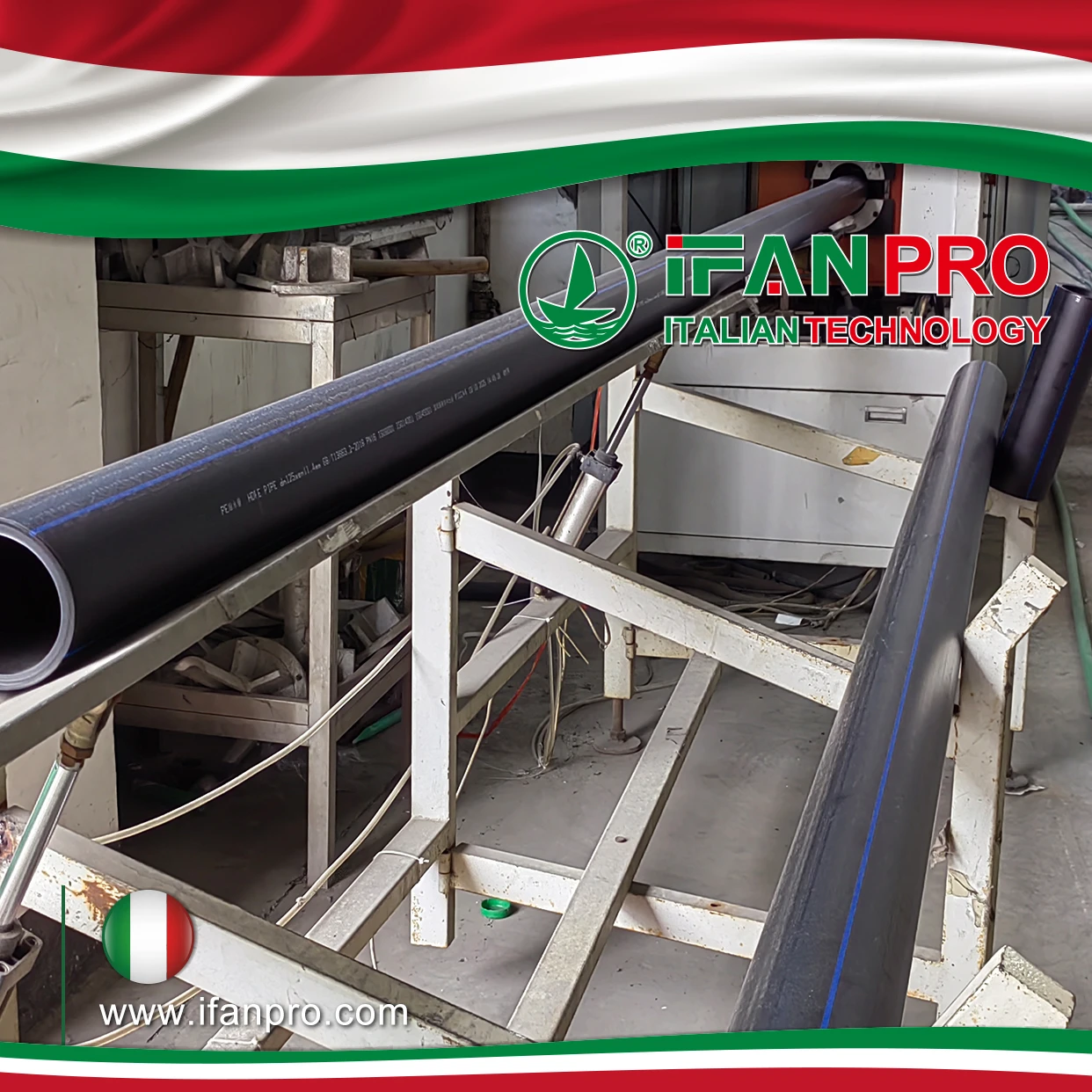
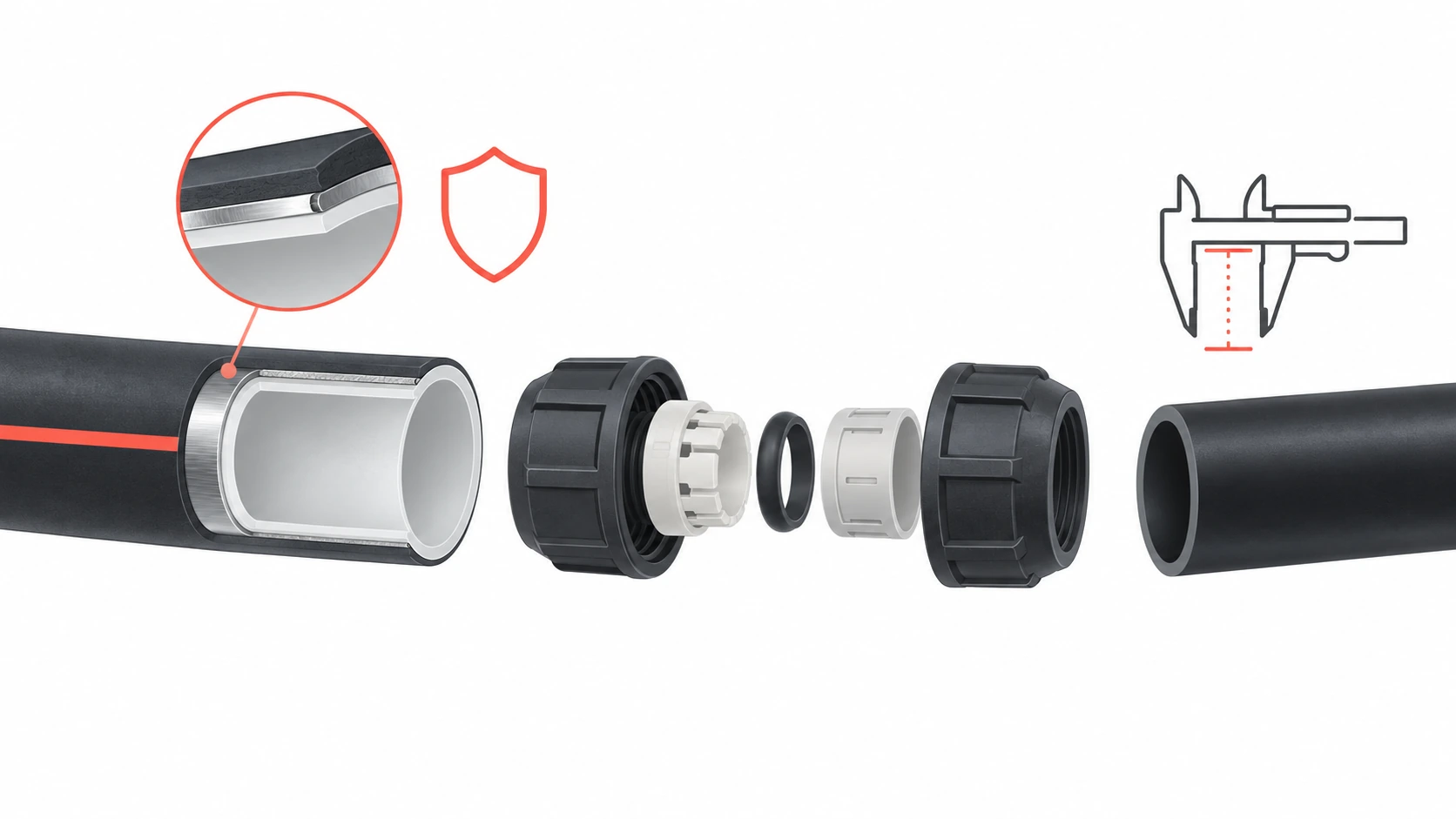
Collect a readable pipe-marking photograph and the associated product records. Identify the manufacturer, product designation, relevant pipe specification, outside diameter and dimension ratio or wall designation. Where markings are illegible, the project records must establish the identity. Guessing from colour, nominal size or an adjacent pipe leaves the proposed segment unidentified.
A material designation answers only part of the question. Two polyethylene products can share a resin classification while differing in dimensions, construction, documented application or manufacturer instructions. The exact product’s squeeze-off eligibility must be supported. Do not transfer an approval from a different diameter, wall series or manufacturer’s pipe.
Next, identify the tool by manufacturer and model, including its documented capacity and the configuration proposed for that pipe. The tool’s stop settings or plates belong in the qualified evidence package. A purchaser should obtain the matching documentation rather than infer a setting from a catalogue range. Caldertech’s equipment FAQ asks whether all PE pipe is suitable and advises consulting the pipe manufacturer when suitability is uncertain.
| Evidence | What it must establish | If absent |
|---|---|---|
| Exact pipe record | Product, service, OD and wall designation | Hold: establish segment identity |
| Pipe manufacturer’s guidance | Suitability and restrictions for this product | Hold: request product-specific response |
| Tool model and configuration | Documented match to the identified pipe | Hold: supplier confirms matching configuration |
| Qualified operator procedure | Applicable combination, inspection and disposition requirements | Hold: obtain accepted procedure |
| Site and history record | Suitable location and known previous interventions | Hold or alternate location review |
Keep the documents linked by a single proposed location. A valid tool instruction and a valid pipe sheet can still describe different combinations. Ask the reviewer to confirm that the pipe dimensions, tool configuration and procedure all refer to the same job. A substitution after approval returns that changed combination to review.
Condition and clear space can rule a segment out
The pipe’s general suitability does not clear every position along it. The proposed segment needs an inspection record and a location sketch showing joints, fittings, previous squeeze points and any other relevant obstruction. The reviewer must also know whether the crew can access and inspect the location under the accepted procedure.
Prior squeezing matters even when the pipe has regained a round appearance. Records and permanent identification prevent a later crew from selecting the same position again. If history is unknown, mark that uncertainty in the package. An unmarked segment cannot be treated as demonstrably untouched merely because no record was found.
PPI TN-54 identifies damage and proximity restrictions. For this screening article, the useful action is to flag visible gouges, scratches or other damage and submit their assessment under the applicable procedure. It would be misleading to turn a general guidance limit into a field pass for a particular installed pipe. Where damage already excludes the proposed point under the accepted procedure, select another eligible point or another isolation method.
Draw the nearest fusion and mechanical connections, fittings and previous squeeze positions on the sketch. Have the qualified reviewer assess the required separation and working clearance. Do not measure from an undefined reference point or copy spacing from a different application. A location that lacks the required clearance remains unsuitable even if the tool can physically be placed there.
These screens can change the purchasing request. If the only accessible segment is excluded, a larger tool will not solve the location problem. The operator may need a valve arrangement, a different isolation point or an outage plan. The correct alternative depends on the system; this page does not approve one.
Water guidance and a gas standard have different scopes
The document title and edition are part of the evidence. ASTM F1041-26 describes squeeze-off of polyethylene gas pressure pipe and tubing manufactured to D2513. Its published scope directs users to governing codes and project specifications. A water-line review cannot treat that gas scope as an automatic water approval.
PPI TN-54 includes water, oil and gas in its title. It supplies general guidance, while the exact pipe manufacturer, tool supplier, project requirements and water operator determine the applicable qualified plan. The distinction resolves an apparent contradiction: a general note can discuss water without changing the application covered by the current ASTM gas guide.
Check citations in older supplier literature. A reference to “F1041” without an edition or an explanation of service scope does not establish what the supplier has qualified for this water pipe. Request the actual applicable recommendation. Also separate a pipe’s general pressure or water-service compliance from its eligibility for this particular temporary intervention.
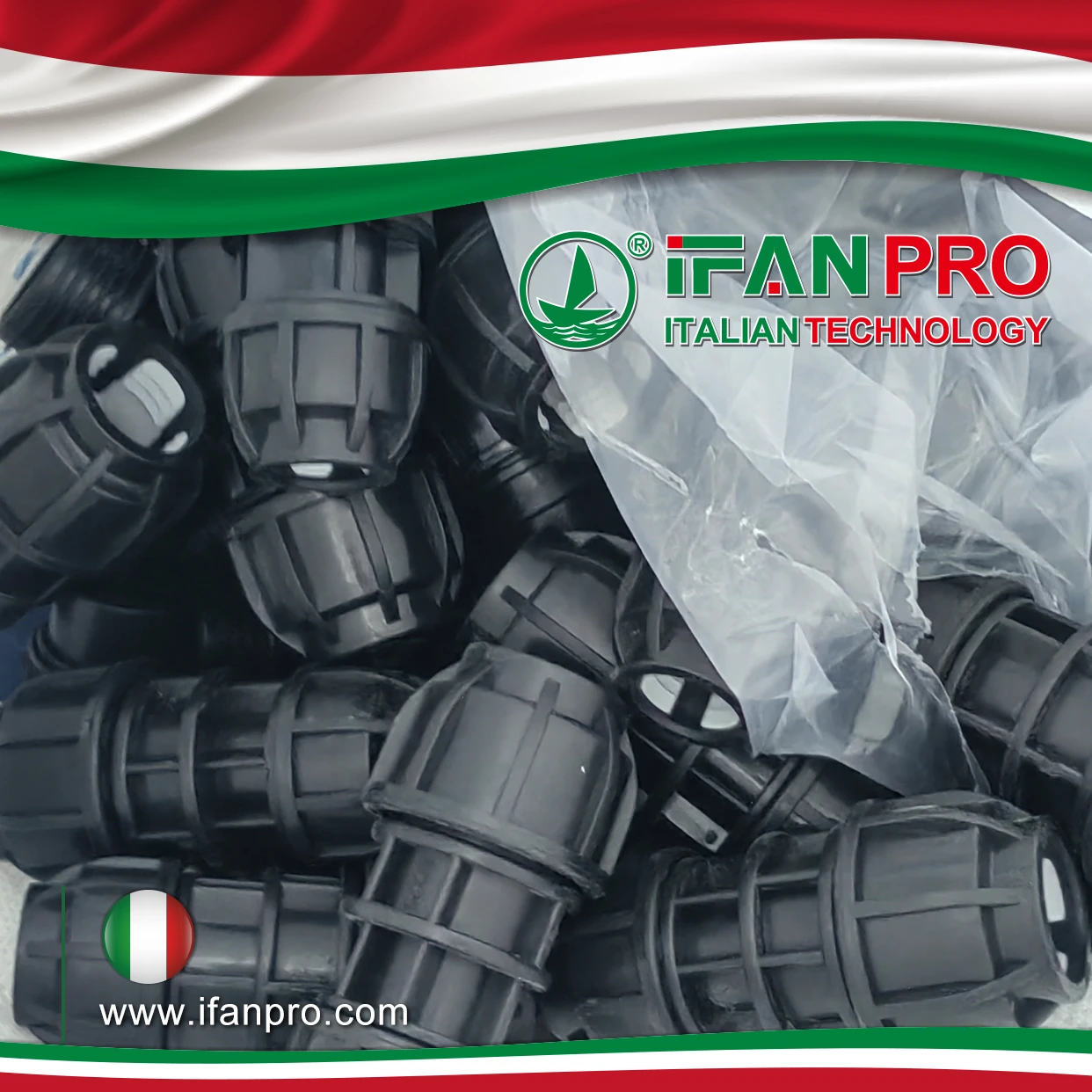
No product-specific IFAN squeeze-off authorization was established for this article. The HDPE pipe and fittings category can help identify the proposed product family, but its existence supplies no approval for the method. An enquiry must name the exact pipe and service and ask for the relevant technical documentation.
Make one of three planning decisions
Use the following decision order on the proposed job. First classify the task. Then establish the matched evidence set. Next assess condition, history and location. Finally confirm that the sources and procedure apply to the actual water service. Each stage can stop the proposal before equipment is selected.
| Finding | Disposition | Next action |
|---|---|---|
| Matched evidence; acceptable location; one-time task | Candidate for qualified review | Operator reviews complete package and personnel requirements |
| Identity, history or applicable documents missing | Hold | Resolve the named missing record |
| Known exclusion or repeated-control requirement | Alternate isolation | Operator assesses another location or designed method |
Consider an illustrative maintenance request with readable pipe markings and an available tool, but no product-specific recommendation. The disposition is hold. The missing input is the manufacturer’s applicable suitability response and its relationship to the operator’s qualified procedure. A tool catalogue alone cannot close that hold. Once the response is obtained, review its scope and restrictions before revisiting the location and candidate decision.
Change one condition: the operator now needs repeated throttling at the same point. Collecting more pipe paperwork does not resolve that task mismatch. The disposition becomes alternate flow-control design. This countercheck helps distinguish an incomplete evidence package from a known unsuitable use.
A third proposal has all required matched records and an acceptable location. It may enter the operator’s qualified planning process as a candidate. The article’s screening outcome still leaves the responsible operator to accept the plan, assign trained personnel and establish the job-specific controls. It is not a crew instruction.
Inspection and records belong in the plan before the job
The package should name the inspection, marking and disposition requirements that apply after the intervention. Those requirements come from the qualified procedure and relevant manufacturers. Planning them in advance prevents an incomplete handover when the immediate repair is finished.
Record the actual location and intervention history so future crews can identify the previously squeezed section. Capture the inspection result and any required disposition. The pipe’s recovered shape alone does not establish an acceptable condition or erase the need to preserve the event in the records.
If an inspection identifies a condition outside the accepted requirements, follow the operator’s disposition process. Do not reinterpret the screening table as authority to return that section to service. Equally, a generic rerounding statement should not be used to dismiss damage or substitute for the required inspection.
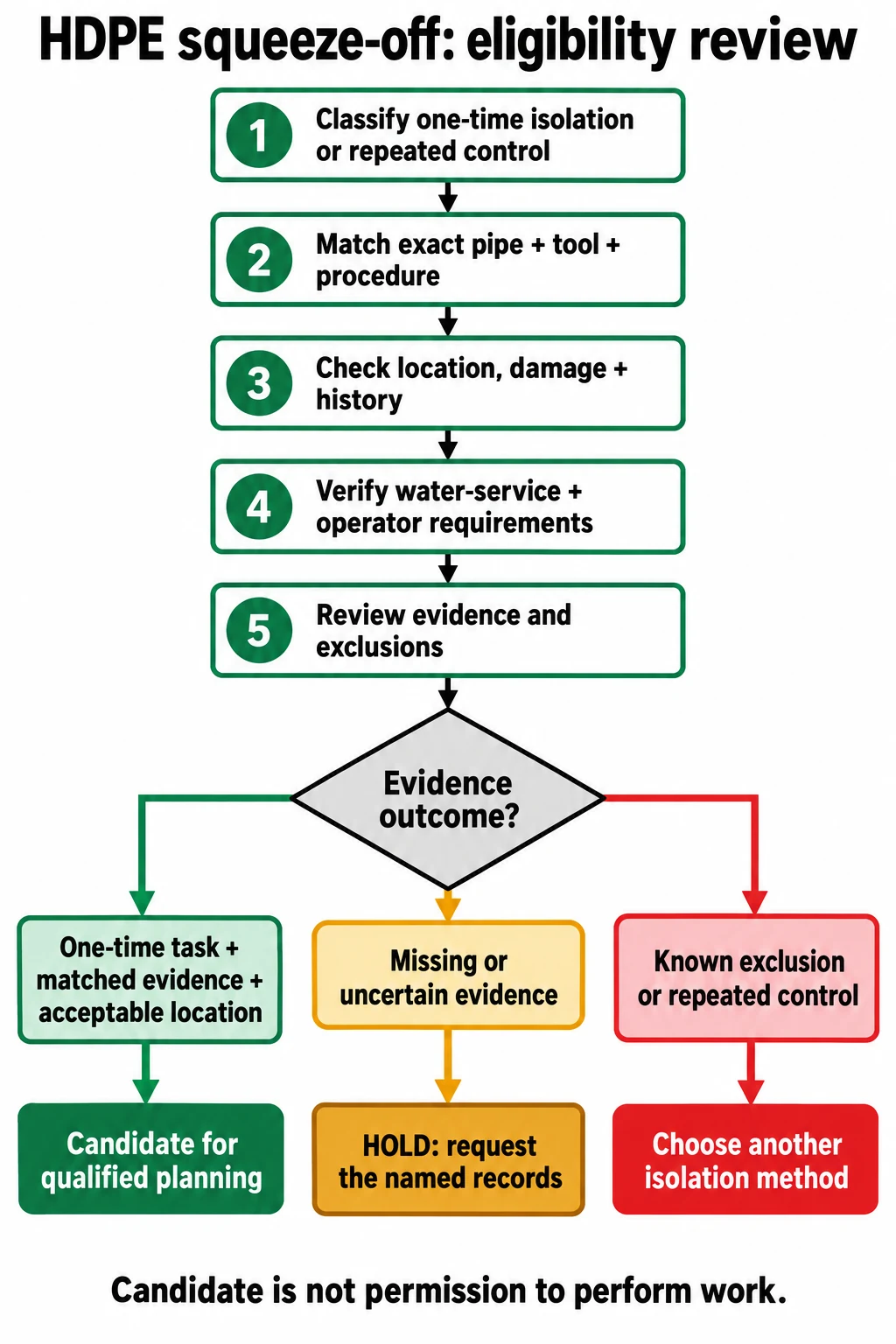
- Identify isolation task
- Match exact pipe + tool + procedure
- Check location, damage + history
- Verify water-service + operator requirements
- Review evidence and exclusions
Conclusión
Temporary squeeze-off may avoid a wider intervention where the exact combination and location are accepted. It also demands a supported pipe identity, a matched tool and procedure, and reliable condition records. Missing evidence creates a hold; an established exclusion sends the operator toward another isolation plan.
For product identification and document availability, Send the pipe identification and water-service details for technical review. Include the proposed pipe designation and dimensions, location sketch, tool model and operator procedure reference. Request an explicit applicable response before treating any product as eligible.
PREGUNTAS FRECUENTES
Is PE100 enough to approve squeeze-off?
No. It identifies a material classification. Eligibility needs the exact pipe dimensions and product guidance, matched tool configuration, qualified procedure and acceptable location.
Can a water pipe use ASTM F1041-26 as its approval?
No automatic approval follows. F1041-26 covers gas pressure pipe and tubing to D2513. Water-service planning requires applicable operator, project and manufacturer evidence.
What if the pipe’s squeeze history is unknown?
Hold the proposed location for investigation. The reviewer must resolve history under the applicable procedure or assess another location or isolation method.
No. It means the proposal has enough matched evidence to enter qualified operator review. Accepted procedures, trained personnel and job-specific requirements still control the work.











 Español
  English
  Français
  Русский
Comentarios recientes