
Search for a PEX brass manifold and the results will offer you a 36-port unit and a 4-loop unit on the same screen, at prices an order of magnitude apart, with nothing on either listing explaining which one your job needs. That is not a bad search result. It is an accurate picture of a category where two genuinely different products share one name, and where almost every buying guide describes what a manifold is instead of telling you how many ports to buy.
This page does the arithmetic instead. You will finish it with a loop count, a flow rate per loop, the flow-meter range that has to cover that flow, and a short list of numbers to demand on the submittal before you release a PO. Where a figure is a published standard, it is quoted with the standard named. Where a figure is one supplier’s product limit, it is attributed to that supplier. And where IFAN does not publish something, this page says so rather than borrowing a competitor’s number.
Key takeaways
- Two products, one name. A home-run potable manifold runs a ladder of 12 to 36 ports off a 1 in NPSM trunk inlet; a radiant loop manifold typically runs 2 to 12 loops. Ordering from the wrong family is the most expensive mistake in this category.
- Port count comes from tubing length, not room count. Total tubing divided by the circuit-length ceiling for your tubing size, rounded up.
- Flow follows heat load, not loop count. Size the flow meter so your calculated working flow sits in the middle of its range, not at the top of it.
- The joining standards share one envelope. ASTM F877, F1807, F1960, F2080, F2098, F2159 and F2434 are all written to 100 psi at 180°F (82°C). What differs is the size range each one covers.
- IFAN does not currently publish manifold port counts, flow-meter ranges, Kv values or outlet thread designations. That gap is stated plainly below, with the submittal questions that close it.
On this page
- Two Different Products Share One Name
- Step 1: Turn Floor Area Into a Loop Count
- Step 2: Turn the Loop Count Into a Flow Rate Per Loop
- Step 3: Match the Joining Standard to the Size You Need
- Step 4: Check the Brass Itself
- What to Demand on the Submittal Before You Order
- Where We Stop, and What You Check on Arrival
- The Risk You Are Actually Managing
- Frequently Asked Questions
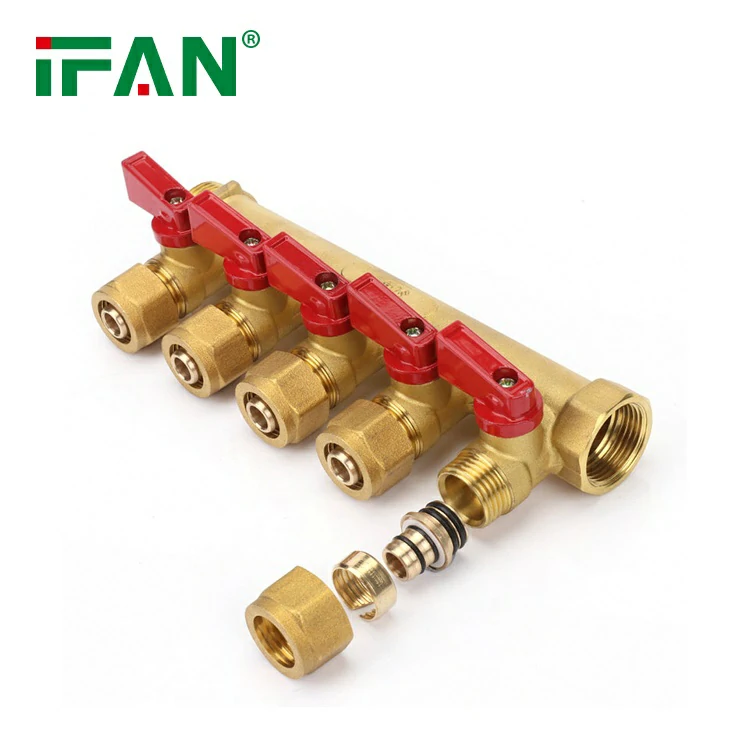
The confusion is structural, not careless. Both products are a brass bar with outlets drilled along it, both are called a PEX brass manifold, and both are sold by the same retailers. They do different jobs and they are sized by completely different logic.
A home-run potable distribution manifold feeds fixtures. One line leaves the manifold for each tap, toilet and appliance, so the port count tracks the number of fixtures in the building. Apollo publishes its brass PEX manifolds with ball valves in a ladder of 12, 16, 20, 24, 28, 32 and 36 ports, with 1/2 in male-threaded outlets. Those counts are high because a house has a lot of fixtures.
The trunk connection on that family is worth reading carefully, because it is a place submittals go wrong. The body inlet is a 1 in NPSM thread; the 3/4 in PEX connection usually quoted alongside it is the adapter that screws on, sold as Apollo part APXMBA and specified as a 3/4 in PEX barb by 1 in NPSM. Order a 3/4 in PEX trunk fitting expecting it to thread straight into the bar and it will not.
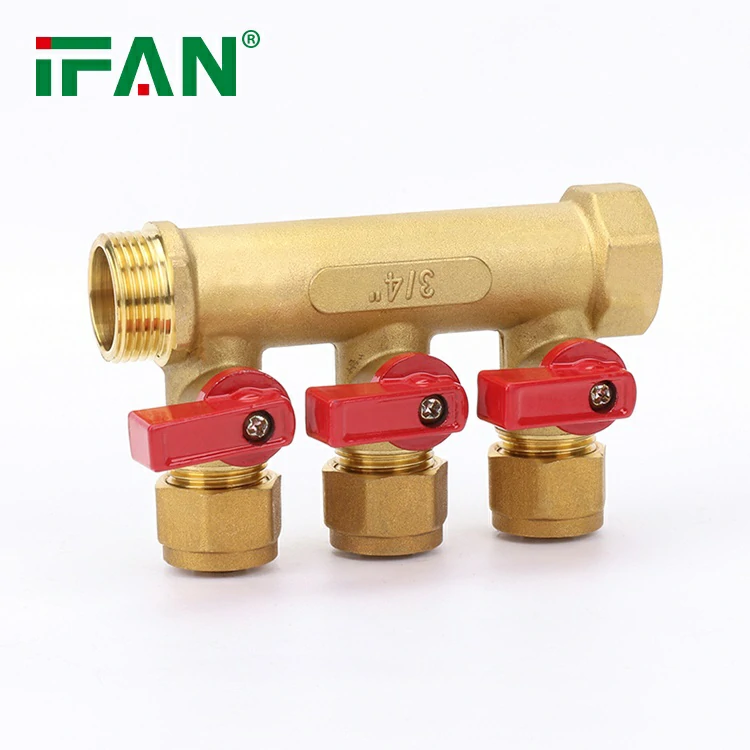
A radiant loop manifold feeds heating circuits. Each port is one continuous loop of tubing buried in a floor, and the count tracks floor area divided by how long a loop can usefully run. That number is small — typically two to twelve. A radiant set also carries hardware a potable manifold has no reason to have: flow meters on the supply bar, balancing valves on the return bar, an air vent, and fill and drain valves.
One physical consequence is worth planning for early. Outlets on a typical radiant manifold set sit at 2 in on centre, so a ten-loop manifold is roughly twenty inches of bar before you add the end fittings, the ball valves and the mounting brackets. Specify the cabinet after you know the port count, not before.
| Home-run potable manifold | Radiant loop manifold | |
|---|---|---|
| What a port feeds | One fixture | One heating loop |
| Typical port count | 12–36 (Apollo’s published ladder) | 2–12 |
| Sized by | Fixture count | Floor area ÷ circuit-length ceiling |
| Flow meters | No | Yes, on the supply bar |
| Balancing valves | Shut-off only | Yes, on the return bar |
Best for: if you are distributing cold and hot water to fixtures, you want the potable family and your question is fixture count. Not for: if you are heating a floor, everything below applies and the potable ladder is irrelevant to you.
Step 1: Turn Floor Area Into a Loop Count
Port count is an output, not a preference. It falls out of two numbers: how much tubing the floor needs, and how long one loop is allowed to run.
Tubing quantity comes from area and spacing. At 9 in on centre you need roughly 1.33 ft of tube per square foot of heated floor, so a 900 sq ft area takes approximately 1,200 ft of tubing. Tighter spacing raises that figure and looser spacing lowers it, which is why spacing is decided before the manifold is sized rather than after.
The second number is the ceiling on a single circuit, and it exists because of friction. Push a loop too long and the circulator cannot maintain flow to the far end, so the tail of the loop runs cool regardless of how hot the supply water is. PexUniverse publishes the following planning ranges for radiant heating circuits:
| Tubing size | Recommended circuit length | Application |
|---|---|---|
| 3/8 in PEX | 200–250 ft | Radiant heating |
| 1/2 in PEX | 300–350 ft | Radiant heating |
| 5/8 in PEX | 400–500 ft | Radiant heating |
| 5/8 in PEX | 250 ft | Snowmelt |
| 3/4 in PEX | 300 ft | Snowmelt |
Treat the 1/2 in figure as the upper end of a planning band rather than a hard permission. Our own guide to PEX underfloor heating puts the practical ceiling at roughly 250 to 300 ft for 1/2 in tube, and the widely cited Radiant Panel Association guideline is 300 ft maximum on 1/2 in. Where sources disagree at the margin, size to the conservative end: a loop that is slightly short costs you one extra port, while a loop that is too long costs you a cold room you cannot fix from the manifold.
The worked example, started
PexUniverse works this example and it is worth carrying forward, because it is the point where most guidance stops. Take that 900 sq ft area with 1/2 in PEX at 9 in on centre, needing approximately 1,200 ft of tubing. Divide the tubing by the recommended circuit length: 1,200 ÷ 300 = 4. Any decimal rounds up. So this floor needs a 4-branch manifold, and dividing back gives 1,200 ÷ 4 = 300 ft as the average circuit.
Two practical notes the arithmetic does not show. Keep the loops within about 5 percent of each other in length, because a manifold delivers similar flow to equal-resistance circuits and a 180 ft loop sitting beside a 300 ft loop will steal flow from it. And when the division lands just under a whole number, buy the next port up anyway — an unused port capped at the manifold costs very little now and is the difference between adding a bathroom loop later and replacing the whole assembly.
Step 2: Turn the Loop Count Into a Flow Rate Per Loop
Here is where most buying guides stop and where the actual specification decision starts. You now know you need four ports. You do not yet know whether the flow meters on the manifold you are about to buy can read the flow those four loops will run at.
Flow follows heat load, not loop count. Two identical 4-loop manifolds in two identical-sized rooms can need very different flows if one room is a glazed extension losing heat fast and the other is an interior hallway. The heat a loop must deliver sets the water it must carry, and the loop count only tells you how that total is divided up.
The number to check against is the manifold’s own per-branch limit. PexUniverse publishes a maximum flow per branch of 1.4 GPM on the radiant manifold sets it supplies, with a maximum operating temperature of 180°F. That is one supplier’s published product limit rather than an industry maximum, so read the figure off the datasheet for the manifold you are actually buying — but it is representative of the order of magnitude, and it tells you something useful immediately: a design that wants 2 GPM through a single loop is not a manifold problem, it is a loop-splitting problem.
Resist the urge to reach for a single per-loop number as a substitute. Figures in the region of half a gallon per minute circulate widely in installer discussion, but they are aggregations of other people’s finished designs, not a published design rule, and they are the wrong thing to specify a manifold against. Two constraints are real and checkable: the per-branch ceiling on the datasheet for the manifold you are buying, and the heat-loss calculation for your actual building. Everything between those two is arithmetic, not a rule of thumb.
Reading a flow-meter range properly
A flow meter is not a pass or fail device, it is a scale, and a scale is only useful across the part of it you actually operate in. This is the detail that separates a manifold that can be balanced from one that cannot.
- Working point in the middle. If your calculated flow is 0.6 GPM per loop, a meter reading 0 to 1.0 GPM puts you at 60 percent of scale, where a small adjustment is visible. A meter reading 0 to 4 GPM puts the same loop at 15 percent of scale, crowded into the bottom of the sight tube where you cannot resolve the difference between 0.5 and 0.7.
- Check the top, not just the bottom. The meter must also cover the highest-flow loop on the bar, which is usually the longest one or the one serving the coldest room.
- Ask for the units on the submittal. Meters are supplied in GPM or in l/min depending on the market. A drawing marked 0–5 without units is a change order waiting to happen.
- Confirm the meter sits on the supply bar and the balancing valves on the return bar, which is the conventional arrangement for a set of this type.
Carrying the worked example through: the four 300 ft loops sit well under the 1.4 GPM per-branch ceiling PexUniverse publishes, so the ceiling is not what governs the meter choice — the working point is. Run the heat-loss figure for each zone and the design flow will land in the lower half of that branch range, and that is the number the meter has to resolve. A meter scaled 0 to 1.0 or 0 to 1.5 GPM resolves it comfortably; a meter scaled to 4 GPM technically covers it and practically cannot be balanced with it. Nothing about the port count told you that, which is precisely why port count alone is not a specification.
Step 3: Match the Joining Standard to the Size You Need
The connection is where a manifold specification most often fails an inspection, and the useful fact is that the American standards governing PEX joining are unusually consistent about the pressure and temperature envelope while differing sharply on the sizes they cover.
Every one of the fitting standards below is written to the same duty: 100 psi (690 kPa) cold and hot water, at temperatures up to and including 180°F (82°C). ASTM F877, which covers the system as a whole rather than an individual fitting, states the same 100 psi (0.69 MPa) service and the same 180°F (82°C) maximum working temperature.
The scope wording quoted throughout this section is reproduced with ASTM’s permission in the PPI and PPFA Design Guide: Residential PEX Water Supply Plumbing Systems (2nd edition), which is where these figures are drawn from. So a supplier telling you a manifold is “rated for high pressure” has told you nothing — the envelope is common to the entire category, and the differentiator is size coverage and material.
| Standard | What it covers | Rating | Size range |
|---|---|---|---|
| ASTM F877 | PEX hot- and cold-water distribution systems | 100 psi (0.69 MPa) at 180°F (82°C) | System-level |
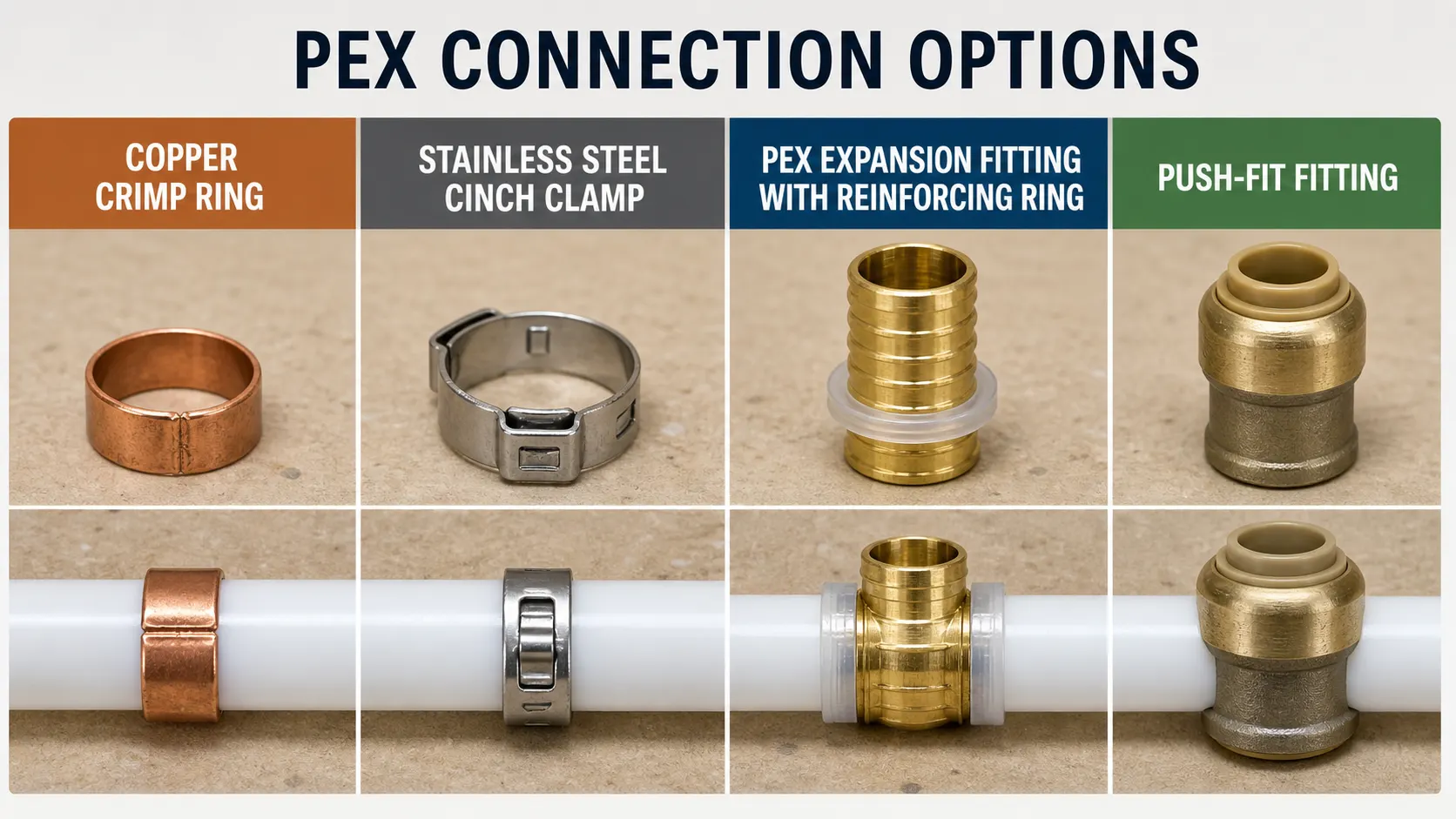
| ASTM F1807 | Metal insert fittings, copper crimp ring | 100 psi (690 kPa) at 180°F (82°C) | 3/8 to 2 in |
| ASTM F1960 | Cold expansion, PEX reinforcing rings | 100 psi (690 kPa) at 180°F (82°C) | 3/8 to 2 in |
| ASTM F2080 | Cold expansion, metal compression sleeves | 100 psi (690 kPa) at 180°F (82°C), continuous | 3/8 to 2 in |
| ASTM F2098 | Stainless steel clamps securing PEX to inserts | 100 psi (689.5 kPa) at 180°F (82°C) | Four insert sizes |
| ASTM F2159 | Plastic insert fittings, copper crimp ring | 100 psi (690 kPa) at 180°F (82°C) | 3/8 to 1 in |
| ASTM F2434 | Metal insert fittings for PEX and PEX-AL-PEX | 100 psi (689.5 kPa) at 180°F (82°C) | 1/2 to 1 1/4 in |
| ASSE 1061 | Push-fit fittings (PEX, copper, CPVC, PE-RT) | Sets minimum temperature and pressure ratings | Up to 2 in |
Read the last column again, because it carries the decision. ASTM F2159 — the plastic insert route — stops at 1 in, while the metal F1807 route continues to 2 in. If your manifold trunk is 1 1/4 in, the plastic insert standard does not reach it and the choice has been made for you by the standard rather than by preference. F2434 is the standard to name when PEX-AL-PEX is in the system, and its range is narrower again at 1/2 to 1 1/4 in.
ASSE 1061 is worth knowing by name because it is the standard that lets one push-fit body serve PEX to ASTM F876, Type K, L and M copper to ASTM B88, CPVC to ASTM D2846 and PE-RT to ASTM F2769. On a retrofit where a brass manifold has to meet an existing copper riser, that multi-material scope is the clause that makes the transition legitimate rather than improvised. For the thread side of the same problem, our note on BSP versus NPT threads covers where those two families are and are not interchangeable.
Insider warning. The pressure and temperature figures above come from the standards’ scope statements, which describe the duty the fitting is qualified for. They are not a licence to run a system at 180°F continuously, and they say nothing about the derating that applies as temperature rises in a specific manufacturer’s product. Ask for the manufacturer’s own pressure-temperature curve; a supplier who can only repeat the standard number has not tested to it.
Step 4: Check the Brass Itself
Two properties of the alloy matter on a manifold specifically, and both are checkable on paper before anything ships.
The first is lead content. For potable applications, “lead free” is not a marketing adjective, it is a numerical limit: no more than 0.25 percent lead as a weighted average of the wetted surfaces, the threshold used by NSF/ANSI 61 and NSF/ANSI 372. Ask which certification body issued the listing and for which product family — a company-level certificate is not the same as a listing that names the manifold. Our overview of lead-free brass fittings sets out what the declarations cover.
The second is dezincification, the selective leaching of zinc out of the brass that leaves a porous copper skeleton behind. It is driven by water chemistry, and a manifold is a bad place to discover it because the failure appears at the threaded outlets. Where the destination market has aggressive water, specify a dezincification-resistant alloy explicitly and ask for the test evidence rather than assuming the grade — we cover the mechanism in dezincification of brass.
On IFAN’s side, the published position on the manifold product is specific and limited: the brass manifold is declared to GB/T 28799, and IFAN states it also offers a range of other standards including ASTM F2623, BS EN ISO 22391, DIN 16833 and ISO 22391.
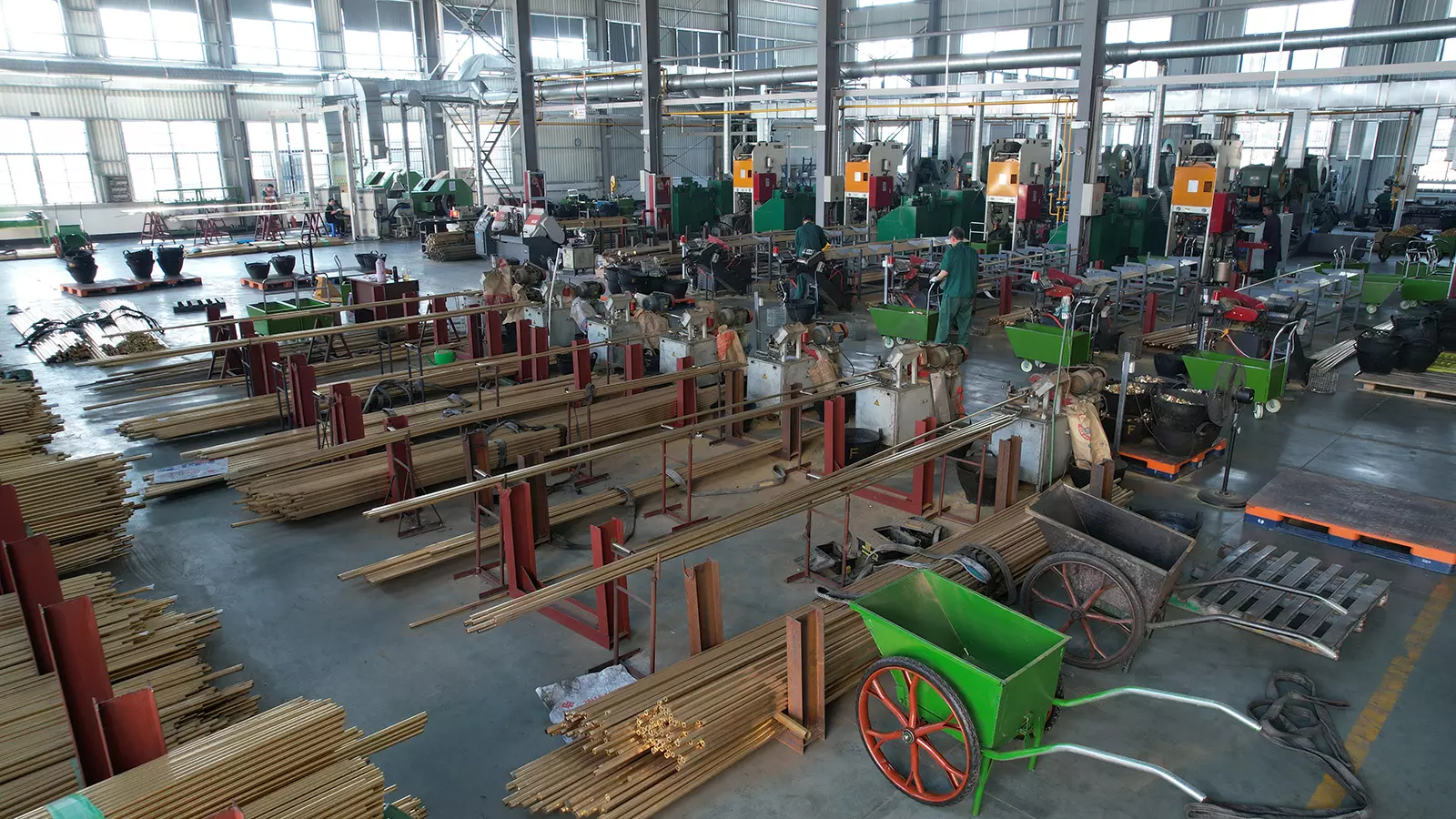
At company level IFANPRO holds ISO 9001, ISO 14001, CE, WRAS, NSF/IAPMO, Intertek, EAC, Watermark and SAI Global, from a 120,000 m² plant running 200+ production and testing machines. Those are company and material certifications; treat them as evidence of capability, and still ask for the product-level listing that names the manifold for your market. The full brass fittings and valves range shows the bodies and valve types the factory produces, though the manifold SKU detail discussed below is not published there.
Watch how a manifold is balanced before you specify one
If you have never balanced a manifold by flow meter, the mechanics explain why the range question above matters more than the port count. This trade-show session walks through auto-balancing an underfloor system.

Source: InstallerSHOW, “How to auto-balance Underfloor Heating Systems”. Third-party educational video, not IFAN content.
What to Demand on the Submittal Before You Order
You now have a port count and a flow-meter range. The remaining risk is that the manifold you receive is not the manifold you calculated for, and that risk is closed on the submittal rather than at the loading dock.
Six items belong on the datasheet. Ask for all of them in the first email, because a supplier’s willingness to answer is itself information.
- Port count and outlet spacing. The loop count you calculated, and the on-centre dimension so the cabinet fits. Two inches on centre is common on radiant sets.
- Flow-meter range with units. Stated as a span and a unit — 0–1.5 GPM or 0–6 l/min — not a bare number. Confirm your working flow lands mid-scale.
- Kv, the flow coefficient. This is the number that tells you the pressure drop across the manifold at your design flow, and it is the one specifiers most often forget to ask for. A manufacturer who cannot produce a Kv figure for the body has not characterised the product hydraulically, and that is worth knowing before you commit a pump selection to it.
- Thread designation, not thread size. “3/4 inch” is not a specification. G3/4 eurocone, M24×1.5, R3/4 tapered and NPT are different things that will not seal against each other. Get the designation in writing on the drawing.
- The joining standard by name and size. F1807, F1960, F2080 or F2434, with the size range confirmed against the table above — particularly if you are near the 1 in boundary where the plastic insert standard stops.
- The product-level compliance listing. The certificate that names this manifold for your destination market, plus the lead-content declaration against the 0.25 percent weighted-average limit where the application is potable.
Where IFAN’s published data currently stops — stated plainly.
Of the six items above, IFAN’s public product information covers the standards declaration (GB/T 28799, with ASTM F2623, BS EN ISO 22391, DIN 16833 and ISO 22391 also offered) and nothing else. IFAN does not currently publish a manifold port ladder, a flow-meter measurement range, a Kv value, or the outlet thread designation.
We would rather write that sentence than fill the gap with another manufacturer’s figures, which is what a spec sheet assembled from search results usually contains. Request those four items directly for the configuration you need, and apply the same six questions to every supplier you are comparing — the answers, not the catalogue photography, are what make two quotes comparable.
Where We Stop, and What You Check on Arrival
Worth being exact about where IFAN’s published information stops: the standards declaration above is what is public, and per-SKU hydraulic data is not, so the two checks below are the buyer’s own and are not a substitute for the datasheet requested in the list. Both take a few minutes on the bench and they catch the failures that become expensive once the assembly is mounted and filled. Neither needs equipment beyond what is already in a van.
- Gauge the thread, do not eyeball it. Offer up the actual tail pieces or adaptors you intend to use to one outlet before you commit the whole bar. A G3/4 parallel thread and an R3/4 tapered thread look nearly identical and will start to engage before they bind. This is the check that catches a designation error while the goods are still returnable.
- Pressure test before anything is buried, and record the result. The joining standards are qualified at 100 psi (690 kPa), so a test at working pressure with the loops connected and the manifold still accessible tells you whether every port sealed. Once a slab is poured, a weeping outlet stops being a fitting problem and becomes a concrete problem.
On the commercial side, three things are worth settling in the same message. Minimum order quantity on brass manifolds is set per project against your size and port mix rather than as a single published figure, so state your mix and ask for it explicitly.
Price structure on brass manifolds is quoted per unit against your port count and configuration, not as a published list price, because the metal content dominates the cost: pricing moves with the copper and zinc content, which is why a quote carries a validity window. Ask what that window is rather than treating the number as fixed, and ask whether the quote is per unit or per set, since a radiant manifold is normally sold as a supply-and-return pair.
And lead time splits into production and shipping; ask for the two separately, because the production half is the part a factory controls.
The Risk You Are Actually Managing
It is worth being clear about what goes wrong when this is done by eye, because the failure is quiet and it is expensive.
An undersized port count does not announce itself at commissioning. The system fills, the boiler fires, the floor warms, and the installer signs off. The symptom arrives in the first genuinely cold week, when the longest loop cannot carry its share and one room sits three degrees below the rest of the house. By then the tubing is under a slab. Nothing at the manifold will fix a loop that is too long, and the options are a higher supply temperature that costs efficiency across the whole building, or taking up a floor.
A mis-scaled flow meter fails even more quietly, because the manifold looks correct and balances to what appears to be the right reading. The loop that cannot be resolved at the bottom of the sight tube is simply set wrong, and the imbalance is attributed to the pump, the boiler or the floor construction for years.
Both failures are prevented by arithmetic that takes ten minutes and a submittal that asks six questions. The manifold is the cheapest component in a radiant system and the only one that is genuinely difficult to change afterwards. Size it from the numbers, and get the numbers in writing before the PO.
Frequently Asked Questions
How many ports does my PEX brass manifold need?
Divide your total tubing length by the recommended circuit length for your tubing size — 300–350 ft for 1/2 in PEX — and round up. A 900 sq ft floor needing 1,200 ft of 1/2 in tube gives 1,200 ÷ 300 = 4 ports. Buy one spare port if the division lands close to a whole number.
What flow rate should each loop carry?
Flow is set by the heat load of the area a loop serves, not by the loop count. Check it against the manifold’s per-branch limit — PexUniverse publishes 1.4 GPM maximum per branch on its radiant sets. If a design wants more than the branch limit, split the loop rather than upsizing the manifold.
What pressure and temperature is a PEX brass manifold rated for?
The ASTM fitting standards — F1807, F1960, F2080, F2098, F2159 and F2434 — are all written to 100 psi (690 kPa) at temperatures up to and including 180°F (82°C), and ASTM F877 states the same envelope at system level. Ask the manufacturer for their own pressure-temperature curve as well.
Can I use plastic insert fittings instead of brass on a larger manifold?
Only up to 1 in. ASTM F2159, which covers plastic insert fittings with a copper crimp ring, has a size range of 3/8 to 1 inch, while the metal insert standard ASTM F1807 runs 3/8 to 2 inches. Above 1 in the standard makes the decision for you.
What does “lead free” mean on a brass manifold?
It means no more than 0.25 percent lead as a weighted average of the wetted surfaces, the limit applied under NSF/ANSI 61 and NSF/ANSI 372. Ask for the listing that names the product family rather than a company-level certificate.
Why does the thread designation matter more than the thread size?
Because “3/4 inch” describes several incompatible threads. G3/4 eurocone, M24×1.5, R3/4 tapered and NPT will not seal against each other despite sharing a nominal size. Put the designation on the drawing, not the size.











 English
  Français
  Русский
  Español
Recent Comments