
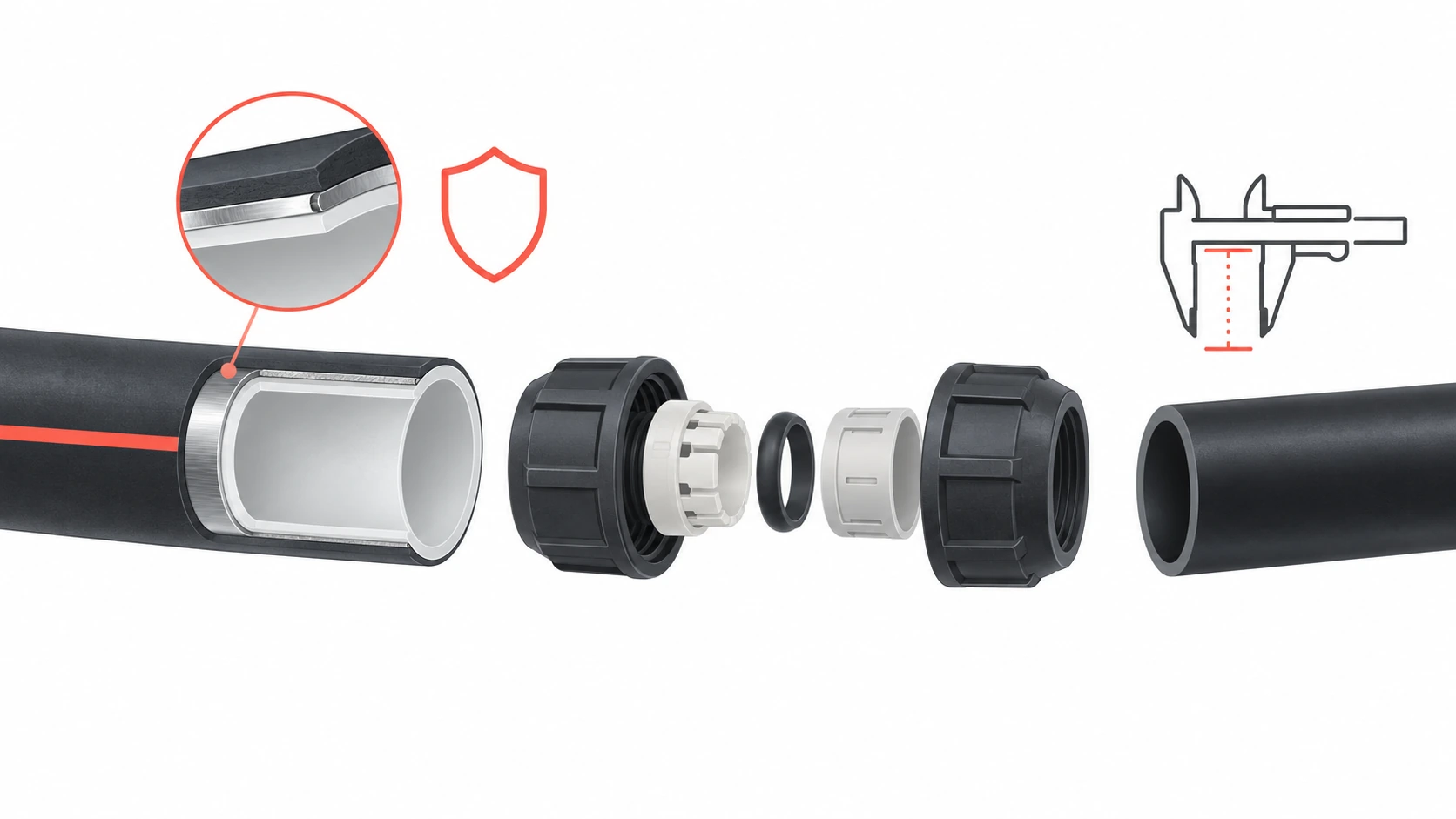
A standard PE reducer is not automatically suitable for barrier water pipe. Barrier pipe can have a larger outside diameter than its nominal size, and the fitting must protect the pipe end and maintain the specified contamination barrier. Use a documented barrier-compatible fitting or the exact approved conversion kit, and confirm that the route permits a transition to ordinary PE; a watertight connection alone does not settle either question.
- Select from the pipe’s actual outside diameter and documented system compatibility, not the nominal number alone.
- Barrier-to-barrier reduction and barrier-to-ordinary-PE transition solve different connection problems.
- A manufacturer conversion kit belongs to the exact fitting assembly it documents; it is not a universal insert.
- A pressure-tight connection does not establish protection against contaminant permeation.
- The accepted soil route decides where a contamination barrier may end; a transition fitting does not establish a safe boundary.
- A 32-to-25 mm elbow proposal needs evidence for both pipe ends, the complete assembly and its route position.
The nominal size does not tell you whether the fitting fits
The number printed on a barrier pipe is a size designation, not a reliable instruction to buy the same-number ordinary PE fitting. A barrier construction adds layers around the carrier pipe. The resulting outside diameter can exceed the nominal designation; the connector must accommodate that actual pipe surface and its permitted dimensional range.
PLASSON’s July 2026 catalog publishes the following mean outside-diameter ranges for the barrier sizes covered by its fitting range. These are the catalog’s stated barrier-pipe ranges, not a dimensional specification for every multilayer pipe sold worldwide.
| Nominal barrier size | Minimum mean OD | Maximum mean OD |
|---|---|---|
| 25 mm | 26.2 mm | 27.78 mm |
| 32 mm | 33.3 mm | 34.78 mm |
| 63 mm | 64.3 mm | 67.75 mm |
For a nominal 32 mm barrier pipe in that published range, choosing a plain connector solely because its label says 32 mm leaves a real mismatch unresolved. The useful comparison is the exact pipe brand, construction and outside diameter against the connector’s documented acceptance. Do not remove the protective outer construction to make the pipe resemble an ordinary PE size unless the selected system’s manufacturer expressly specifies that preparation.
A legacy example shows why the distinction matters. Wavin’s older Trigon product and installation guide lists a nominal 32 mm pipe with a 34 mm outside diameter and fittings designed for that system. This is historical product information, not evidence that current Trigon supply, approval or every other barrier brand has the same dimensions.
Source and scope
Measure to identify a candidate, then verify the system
Outside diameter is a useful screening measurement, but matching a number is not the whole approval. The catalog’s mean-OD ranges describe the barrier sizes its documented range covers. A field measurement that appears within one of those ranges can identify which manufacturer instruction to examine; it does not independently prove the pipe brand, layer construction, pressure class or connector compatibility. Record the pipe marking with the measured surface so the two cannot become separated in a purchasing request.
If the marking and measured outside diameter do not point to the same documented system, resolve that discrepancy before ordering. One possible error is treating the nominal carrier designation as the outside surface the fitting must seal and grip. Another is borrowing the OD of the historical Trigon example for a different current brand. Both can produce a plausible-looking nominal match while leaving the actual assembly outside the cited evidence. The condition that changes the decision is an explicit match between the identified pipe and the selected assembly’s instructions, not measurement alone.
A leak-tight joint is only half the acceptance question
A pressure-tight connection stops water escaping under the test conditions. Contamination protection asks a different question: can chemicals outside the buried system reach the drinking water through the pipe wall or a component of the joint? A successful pressure test does not measure that chemical transport mechanism.
The Plastics Pipe Institute’s Statement N, reaffirmed in 2021 describes permeation through buried pipe walls and components such as gaskets. It also explains that contamination outcome depends on the contaminant, exposure conditions, soil, pipe dimensions and water flow. The practical implication is neither “all plastic is unsafe” nor “a dry-looking joint is protected.” The specification must address the actual exposure and the complete piping system.
Source and scope
At a cut end, the fitting has more work to do than gripping an enlarged diameter. In the current PLASSON catalog, the barrier design keeps the protective aluminium layer from contacting drinking water, and the manufacturer reports permeation-test certification for named barrier-pipe brands. Treat this as evidence for that documented fitting and compatible system, not proof that any brass or polypropylene connector provides the same protection.
The acceptance questions therefore remain separate: does the assembly fit and restrain the pipe, does it meet the pressure duty, and does its documented construction preserve the required contamination protection? A generic seal, pipe insert or reducer might answer one of these while leaving the others open.
Source and scope
Keep mechanical, pressure and barrier acceptance separate
A joint can pass one acceptance question while leaving another unanswered. For example, documentation that a connector accepts the pipe’s actual OD answers a dimensional question. Documentation of its pressure duty answers a containment question. The manufacturer’s barrier-system evidence answers how the cut end and assembly maintain the required protection. These pieces should name the same pipe and assembly; joining three documents about different products does not make a combined approval.
| Acceptance question | Evidence to use | Unresolved substitution |
|---|---|---|
| Will it fit and restrain? | Exact pipe and complete assembly instructions | Nominal label alone |
| Will it contain the specified duty? | Rating for the documented pipe/joint system | A visual dry-joint observation |
| Will it maintain required protection? | Barrier-compatible assembly and permitted route | Pressure-tightness alone |
This distinction follows the permeation mechanism described by PPI. External contaminants can involve the wall or components such as gaskets; no visible leak is needed to leave that question unresolved. Do not turn that caution into a claim that any particular unassessed fitting has already contaminated drinking water. The usable result is narrower: acceptance must cover the mechanism the barrier system is required to address.
Three connection types that must not be confused
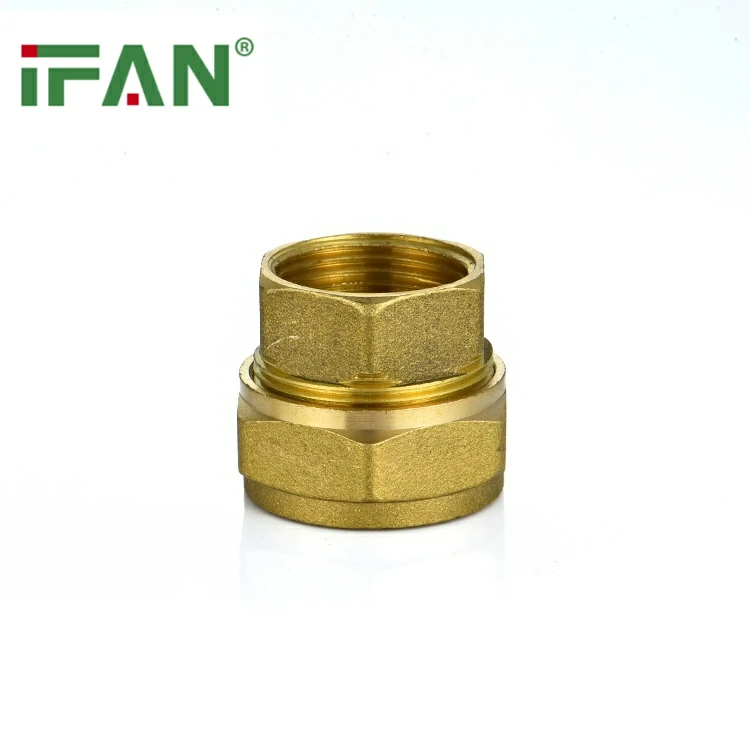
Three catalog entries can sound like interchangeable answers to a reduction enquiry. They serve different connections. Keeping them separate prevents a product photograph or a nominal size from doing the work of a compatibility statement.
| Connection type | What the documentation establishes | What it does not establish |
|---|---|---|
| Barrier-to-barrier reducing coupler | PLASSON lists a dedicated 32 × 25 mm reduction between stated barrier sizes. | Permission to put ordinary 25 mm PE on the barrier end. |
| Barrier-to-metric-PE coupler | Barrier-to-metric PE connector; published PLASSON entries include equal nominal sizes. | Approval for every reducing elbow, different-brand kit or contaminated route. |
| Manufacturer conversion kit | PLASSON-specific kit for its metric fittings; replacement components and assembly instructions govern compatibility. | A generic insert that can be fitted to any manufacturer’s connector. |
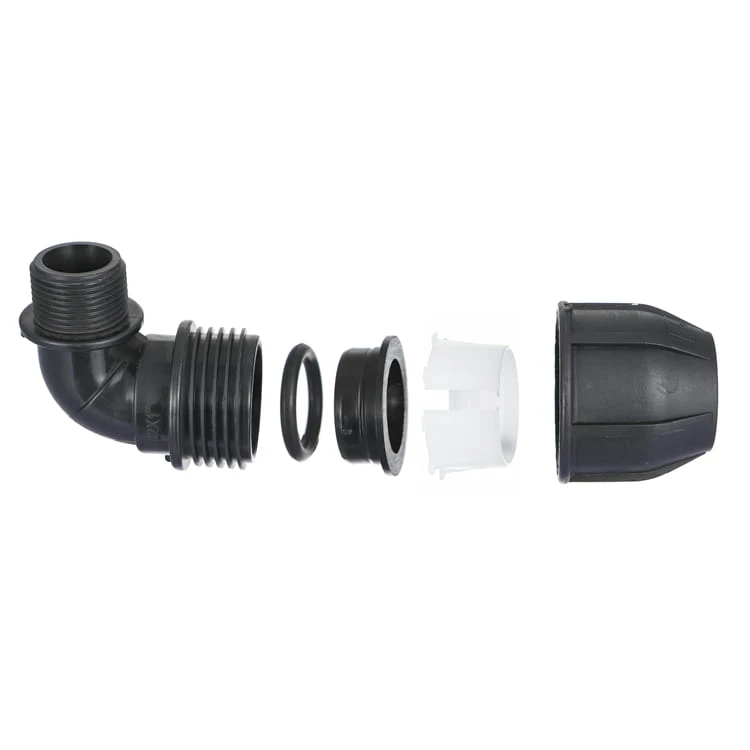
The kit route is a useful example of a conditional yes. A standard fitting body may form part of a barrier-compatible assembly when the manufacturer documents the exact conversion. That is different from claiming that an unmodified ordinary fitting is already suitable. The body, nut, grip, adaptor and pipe end form an assembly; substituting one piece can change what the evidence covers.
Likewise, a barrier-to-metric transition is a legitimate product category. Its existence establishes that a transition can be engineered. It does not decide where the barrier requirement ends along a particular service route.
Source and scope
Source and scope
Read both ends of the proposed connector
Write the connection as two end descriptions before searching a catalogue: identified barrier pipe on one side, identified ordinary metric PE on the other, with any reduction and change of direction stated separately. This prevents the shared “32-to-25” label from hiding the difference between two barrier ends and one barrier/one ordinary end. A barrier reducer entry cannot settle the ordinary-end question merely because its small number is 25.
The conversion-kit option also needs the entire parts relationship. If the maker documents a conversion of one of its metric fittings, use the named fitting and kit together with the current preparation instructions. A kit with a similar photograph or an insert that appears to fit does not establish cross-brand compatibility. Conversely, the presence of an ordinary fitting body in a documented converted assembly is not evidence that ordinary fittings are categorically excluded. The conditional distinction is whether the manufacturer covers the complete configuration you intend to use.
The 32-to-25 mm elbow question: which unknown changes the answer?
Source and scope
An explicitly supported reducing-elbow assembly or a manufacturer-approved conversion of the relevant connector could answer the connection problem. The information saved for this article does not approve a particular combination for the forum installation. The unresolved inputs are the barrier pipe’s exact brand and OD, the fitting and kit codes, the manufacturer’s compatibility instructions, and the authority’s accepted transition location. Once those are available, accept only a configuration documented for both pipe ends and the protected route; otherwise revise the assembly or retain barrier pipe through the relevant segment.
This is a selection decision, not a substitute installation procedure. Cutting, preparation, insertion and tightening requirements belong to the selected assembly’s current instructions. Instructions from an older barrier system must not be copied onto a different fitting just because the sizes appear similar.
When fewer buried joints does not decide the winner
The forum question seeks a compact reduction at an elbow. Treat that as an installation constraint to be solved, rather than as evidence for a specific connector. First establish whether a single component actually covers the two pipe-end duties and the bend. If the saved catalogue only establishes separate reduction and transition categories, it does not establish their combination in one reducing elbow. A supported multi-component arrangement may be a candidate, but the evidence must cover each interface and the route; this article does not select one for the forum installation.
A useful countercheck reverses the priority: suppose the most compact proposed fitting has no documented barrier-end protection, while a less compact candidate is covered by the correct system instructions. Reducing joint count does not make the undocumented end acceptable. The outcome can flip only when a manufacturer-supported compact assembly covers both ends and the required protection. There is no need to invent a failure-rate saving or declare that more joints are inherently safer to explain this tradeoff.
Where the barrier is allowed to end
A mechanically correct transition can still put the wrong pipe into the ground. If the downstream ordinary-PE segment remains exposed to a contamination condition that requires a barrier system, changing connector type has not removed that requirement. The transition point needs a route/material decision as well as a fitting decision.
PE100+ Association’s soil-permeation guidance recommends soil analysis before laying pipe through known contaminated ground and notes that water companies apply their own classification and pipe-selection practices. It also recommends avoiding heavily contaminated routes for drinking-water pipes of any material. Statement N similarly calls for case-specific analysis where contamination is known or suspected.
Source and scope
These sources do not supply a universal safe distance beyond which barrier pipe may become ordinary PE. Soil analysis, the planned route and the water undertaker’s applicable requirements establish the boundary. If the protected route continues, keep the specified protection continuous. If a clean downstream segment is accepted for ordinary PE, the transition can be evaluated there using its documented system connection. Unknown ground conditions are a missing design input, not an automatic approval to end the barrier.
A transition location is a material boundary
Mark the proposed change from barrier to ordinary PE on the same route drawing used for the ground assessment. Then follow the ordinary segment onward: the transition point is relevant because that downstream length still encounters its own environment. A connector that protects the barrier cut end cannot give ordinary pipe an unclaimed contamination barrier along the rest of the route.
The question to send for project review is therefore specific: is ordinary PE accepted for the identified downstream segment under the applicable assessment and water-company requirements? “The fitting is certified” answers a different question, even where the certification genuinely covers the selected product. If ground conditions or the accepted material boundary remain unknown, leave the location unresolved. If the downstream segment is accepted for ordinary PE, evaluate the documented transition there. If the requirement continues, maintain the specified protection through that segment.
A connection schedule the reviewer can accept or return
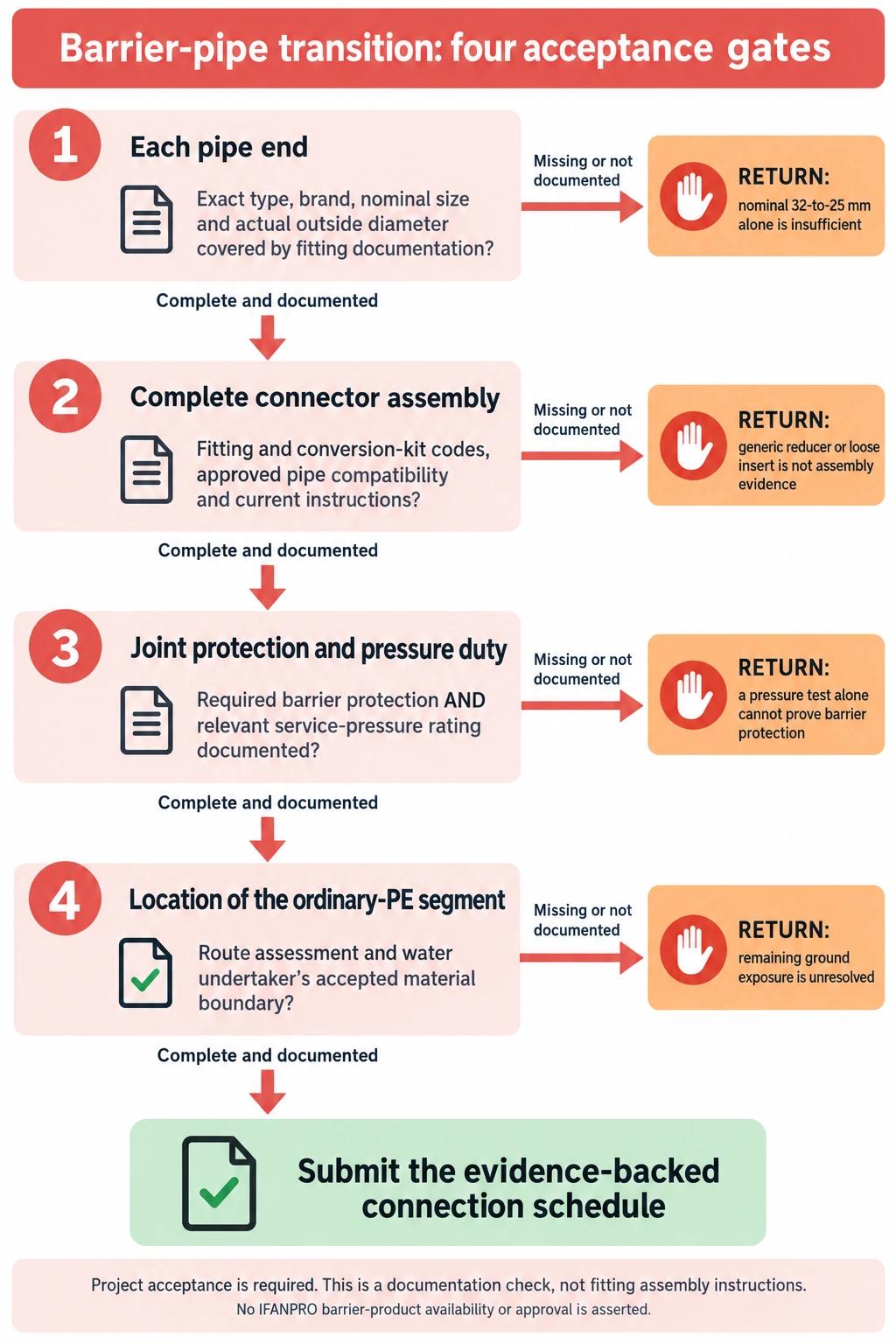
A useful connection schedule lets a reviewer distinguish a supported assembly from one that merely looks plausible. Record the evidence beside each decision rather than writing “suitable fitting” across the entire row.
| Schedule field | Evidence that supports acceptance | Return for clarification when… |
|---|---|---|
| Each pipe end | Exact pipe type, brand, nominal designation and actual OD covered by the fitting documentation. | Only “32 mm to 25 mm” is supplied. |
| Complete connector assembly | Fitting and any conversion-kit codes, approved pipe compatibility and current instructions. | A generic reducer or loose insert is named without assembly coverage. |
| Joint protection and pressure duty | Documentation for required barrier protection and the relevant service-pressure rating. | Only a pressure test or a claim of watertightness is supplied. |
| Location of the ordinary-PE segment | Route assessment and the water undertaker’s accepted material boundary. | The connector is suitable but the remaining ground exposure is unresolved. |
Source and scope
- Each pipe end
- Complete connector assembly
- Joint protection and pressure duty
- Location of the ordinary-PE segment
For broader material selection, the HDPE versus PVC water-main guide covers different project variables. The standard HDPE product category is a separate starting point for ordinary PE enquiries; it does not establish availability of a contamination-barrier system.
IFANPRO barrier-pipe supply, compatible barrier fittings and project approvals are not verified here. The named manufacturers’ examples must not be read as IFAN specifications, certificates or stocked products.
Browse the standard HDPE range
Source and scope
Conclusion
Choose a connection for the exact pipe surfaces, the complete documented assembly and the required contamination protection. A reducer, transition and conversion kit are separate answers until their pipe-end duties are explicitly matched.
Put the transition on the accepted route drawing. If either assembly coverage or the ordinary-PE boundary is unresolved, return that specific input for review; a leak-tight joint or a compact elbow cannot close the gap.
Frequently Asked Questions
Can I strip the outer layers to make the pipe fit?
Only if the selected system’s current preparation instructions expressly require it; do not strip the protective construction just to fit an ordinary connector.
Is there a fixed distance where barrier pipe can change to ordinary PE?
No universal distance is established here. The route assessment and water-company requirements must accept the ordinary-PE segment.
Are the fittings shown available from IFAN PRO?
Availability is not verified here. The named manufacturers’ examples explain compatibility; ask IFAN PRO to confirm the exact offered system and documentation.










 English
 Français
 Русский
 Español
Recent Comments