
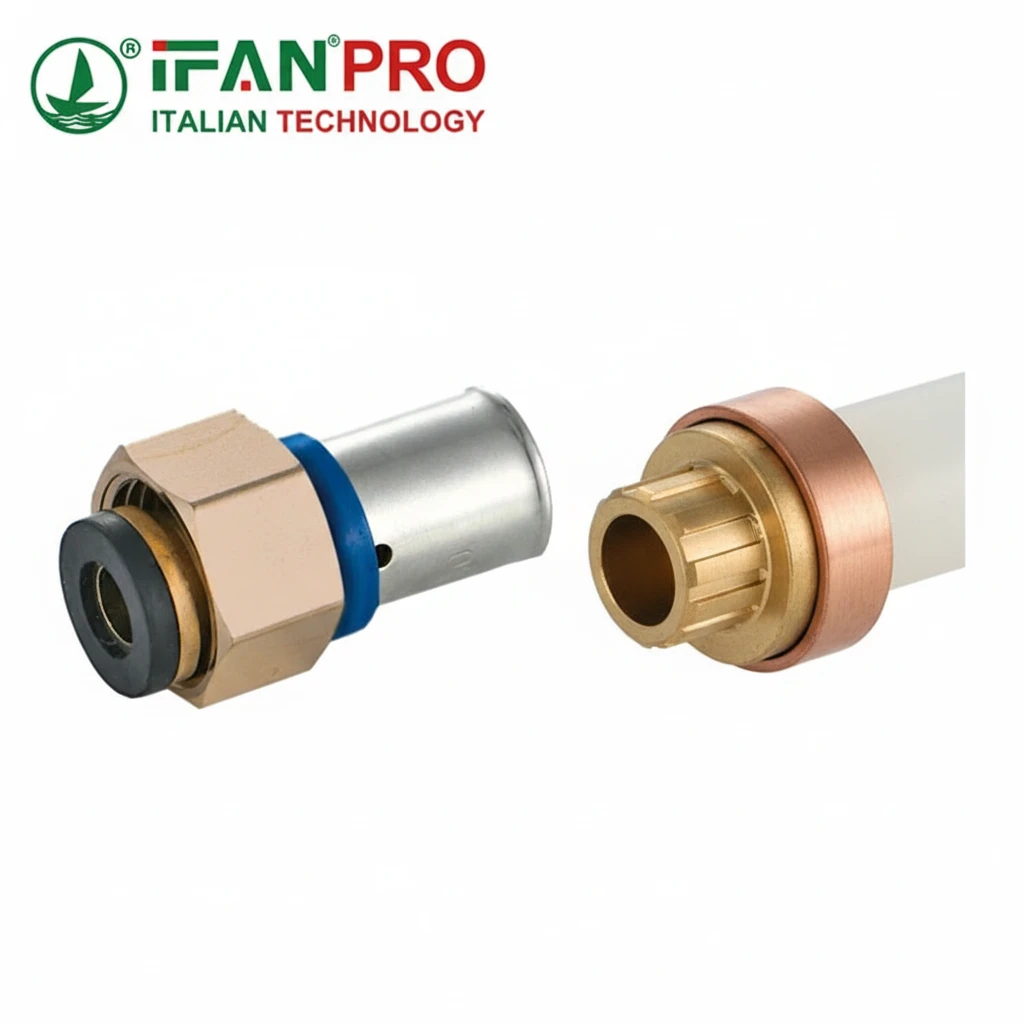
I once watched a plumber struggle for hours trying to reposition a misaligned PEX crimp fitting. That wasted time and ruined fitting taught me the value of a truly versatile connection system.
The IFANPRO 121UC offers clear advantages over standard PEX crimp fittings for professionals who value flexibility, reusability, and installation precision. While standard crimp fittings are permanent and require exact placement, the 121UC’s union design allows for adjustments, easy disconnections, and direct fixture attachment without extra adapters.
However, the best choice depends on your specific project needs. Let’s examine the key differences.
Union Connections vs. Permanent Crimp Fittings
I’ve seen contractors make a single alignment mistake and have to cut out an entire section of pipe. Permanent fittings leave zero room for error.
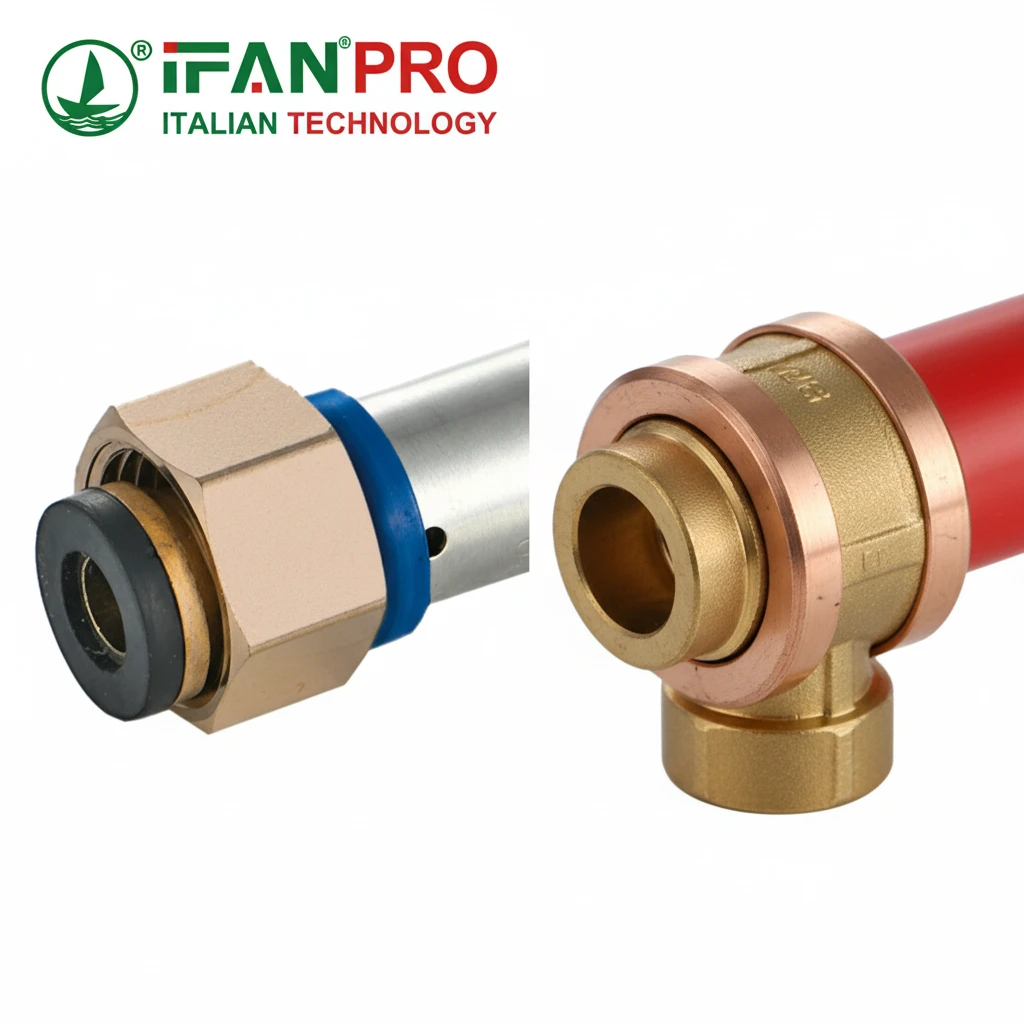
Union connections use a mechanical compression mechanism—typically a threaded nut that compresses a ferrule or O-ring onto the pipe—creating a secure, leak-proof seal that remains fully removable and adjustable. In contrast, permanent crimp fittings use a copper or stainless steel ring that is permanently deformed onto the pipe with a crimping tool, creating a connection that cannot be undone without cutting.
How Each Connection Works
Standard Crimp Fittings: These rely on a simple but permanent process. The installer slides a crimp ring onto the PEX pipe, pushes the pipe onto the fitting barb, and positions the ring over the barbed section. Then, they use a calibrated crimp tool to compress the ring, deforming it and the pipe tightly against the fitting barbs. The result is a permanent mechanical lock.
The main limitation here is obvious: you must get everything right the first time. If you push the pipe too far or not far enough, or if you realize the fitting angle is wrong after crimping, your only solution involves cutting the pipe and starting over. This wastes materials and time.
IFANPRO 121UC Union Connections: This design takes a different approach. It uses a threaded union nut that slides onto the PEX pipe first. Then, you insert a split ring or compression ferrule. When you push the pipe onto the fitting’s tailpiece and tighten the union nut, it compresses the ferrule evenly around the pipe circumference. This creates a strong, watertight seal through compression rather than permanent deformation.
Because the connection relies on threaded compression rather than crushing a ring permanently, you can loosen the nut later. This means you can disconnect the pipe for repairs, reconfigure the system, or replace a fixture without cutting anything.
Installation Comparison Table
| Feature | IFANPRO 121UC Union | Standard Crimp Fitting |
|---|---|---|
| Tools Required | Basic wrenches, no calibration needed | Specialized crimp tool + go/no-go gauge |
| Installation Time | Slightly longer but more forgiving | Fast but requires precision on first try |
| Removability | Fully removable and reusable | Permanent; must cut pipe to remove |
| Skill Level Required | Moderate; threading requires feel | Moderate; proper crimp requires tool calibration |
| Идеальное применение | Fixture connections, areas needing future access | Long buried runs, areas with no access needs |
The Practical Impact
For a contractor, this difference matters most when things go wrong. With standard crimp fittings, one alignment mistake means wasted materials. With the IFANPRO 121UC, you simply loosen the nut, adjust the angle, and retighten. This flexibility saves money and frustration on every job.
The Versatility of Direct Fixture Attachment
Standard approaches often require extra parts. I’ve seen jobs where plumbers needed three fittings just to connect a single faucet correctly.
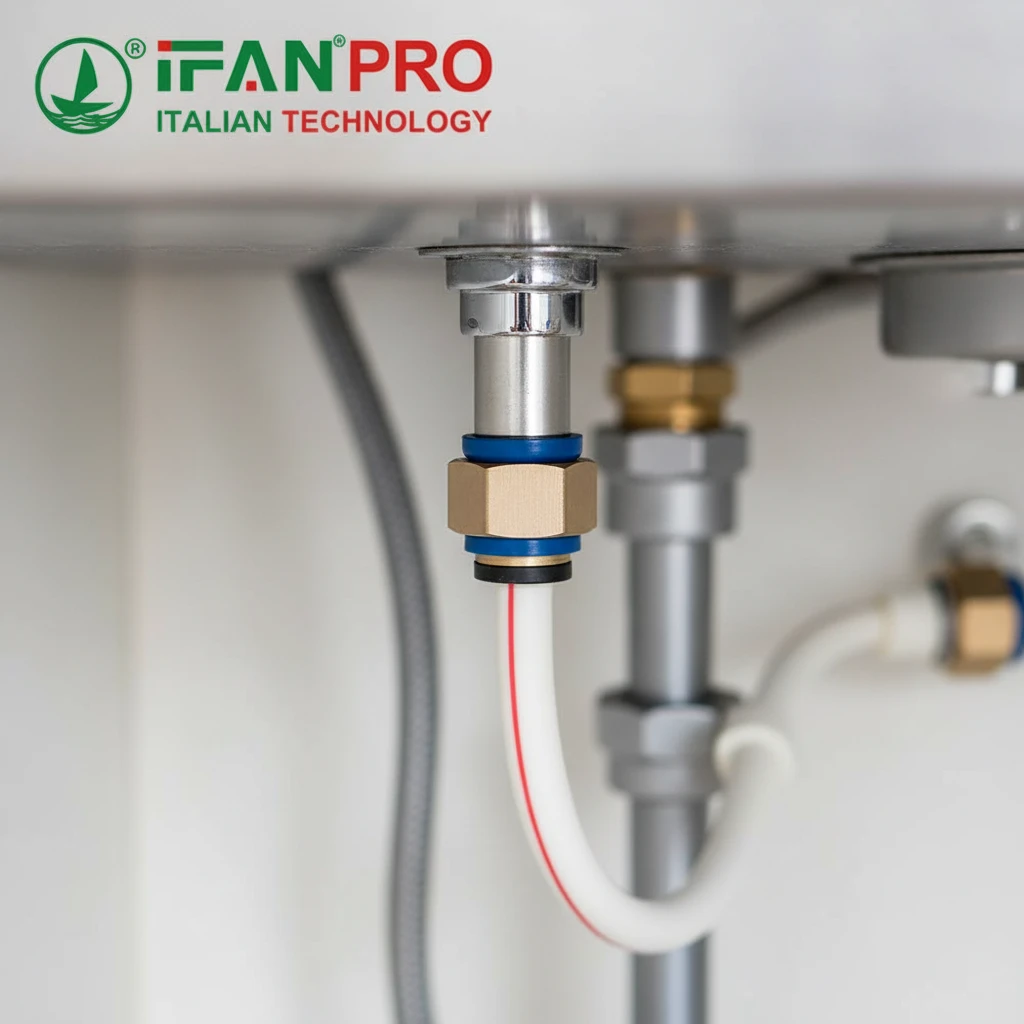
The IFANPRO 121UC excels at direct fixture attachment because its union design allows the fitting to be installed after the fixture is in place. You can thread the union nut onto the faucet shank or valve first, then connect the PEX pipe and tighten the compression. Standard crimp fittings require the fitting to be attached to the pipe first, often making final fixture connection awkward and requiring additional adapters.
The Challenge of Standard PEX at Fixtures
Connecting PEX directly to fixtures like faucets, toilets, or water heaters presents a common problem. Standard PEX crimp fittings create a rigid connection at a fixed length. If your measurements are slightly off, or if the fixture doesn’t line up perfectly with your stub-out, you face a difficult situation.
Typically, installers solve this by adding extra fittings:
- A PEX crimp adapter to male or female threads
- A short stub of pipe
- Sometimes an additional elbow to adjust angle
Each extra fitting adds cost, increases potential leak points, and takes more installation time.
How the Union Design Simplifies Things
The IFANPRO 121UC handles this scenario much more gracefully. Its design includes a union nut that can be removed completely from the fitting body. Here’s how it simplifies fixture installation:
- Install the fixture first: Mount the faucet or valve in its final position.
- Attach the union nut: Slide the union nut (and compression ring) onto your PEX pipe.
- Make the connection: Push the pipe onto the fitting tailpiece, then tighten the union nut onto the threaded fixture shank.
Because the union nut threads onto the fixture independently, you don’t need perfect alignment or exact measurements. The connection happens at the fixture itself, not somewhere behind the wall.
Application Comparison
| Fixture Type | Standard PEX Approach | IFANPRO 121UC Approach |
|---|---|---|
| Faucet Connection | PEX stub-out + adapter + supply line | Direct PEX to faucet shank with union |
| Toilet Supply | Angled stop valve + braided hose | Direct PEX to valve with union |
| Water Heater | Dielectric union + PEX adapters | Direct PEX to heater with union |
| Potential Leak Points | 3-4 connections | 1-2 connections |
This versatility means fewer parts to buy, fewer joints that could potentially leak, and a cleaner final installation.
Comparing Material Quality and Corrosion Resistance
Materials determine longevity. I’ve pulled out enough corroded metal fittings to know that material choice directly impacts system lifespan.
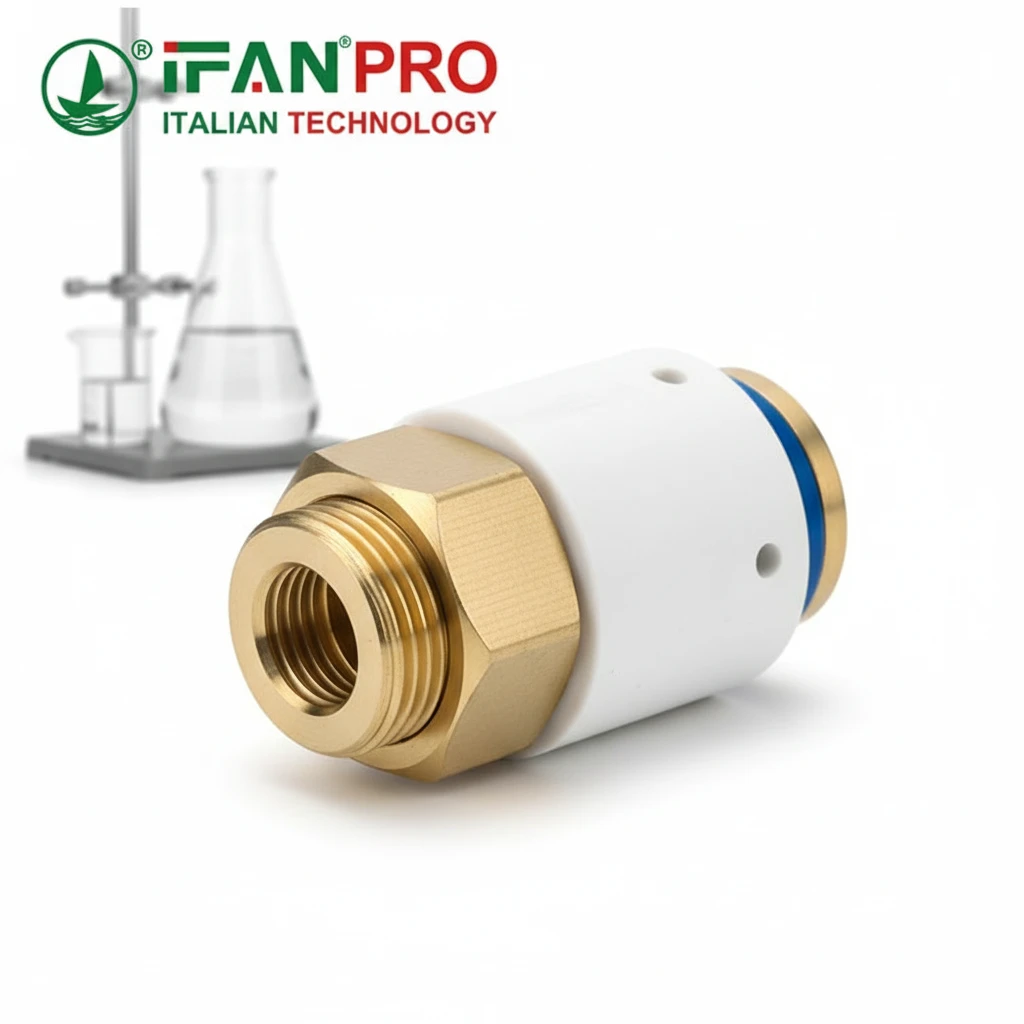
The IFANPRO 121UC typically uses high-grade engineering polymers and corrosion-proof materials like lead-free brass or stainless steel for its threaded components. This eliminates the galvanic corrosion risks associated with mixing different metals in a plumbing system. Standard PEX crimp rings, usually copper or stainless steel, can sometimes react with other metals in the system, leading to corrosion over time.
Understanding Corrosion Mechanisms
Corrosion in plumbing doesn’t just happen randomly. It follows predictable patterns based on the materials involved and the water chemistry.
Galvanic Corrosion: This occurs when two different metals connect in the presence of an electrolyte (water). The more active metal corrodes faster. In a standard PEX system, you might have:
- Copper crimp rings
- Brass fittings
- Copper pipe elsewhere
- Steel clamps or supports
Each metal combination creates a potential galvanic cell. Over time, this can cause pitting, weakening, and eventually leaks.
IFANPRO 121UC Advantage: By using polymer bodies and carefully selected, compatible metals only where necessary (like threaded inserts), the 121UC minimizes galvanic potential. The materials that contact water are chosen specifically to resist corrosion and avoid reactions.
Material Comparison Table
| Component | IFANPRO 121UC | Standard PEX Fitting |
|---|---|---|
| Fitting Body | High-strength polymer | Usually brass or sometimes polymer |
| Crimp/Compression Ring | Split ring, often stainless or polymer | Copper or stainless steel crimp ring |
| Threaded Components | Lead-free brass or stainless steel | Integral to brass body |
| Corrosion Risk | Minimal; dissimilar metals isolated | Moderate; brass + copper combination |
| Химическая стойкость | Excellent; inert polymer | Good for brass; fair for copper |
The Water Chemistry Factor
Different water supplies affect materials differently. Acidic water (low pH) can corrode brass and copper more quickly. High chlorine levels can accelerate stress corrosion cracking in some brass alloys. Hard water causes scale buildup on metal surfaces.
Polymer-based fittings like the IFANPRO 121UC largely ignore these water chemistry variations. The material doesn’t react with pH extremes, doesn’t provide a surface for scale to grip, and won’t leach metal ions into the water. For homeowners concerned about water quality, this represents a significant advantage.
Evaluating the Total Cost of Ownership and Maintenance
Upfront price catches attention, but long-term cost determines value. I’ve seen too many projects where cheap fittings led to expensive callbacks.
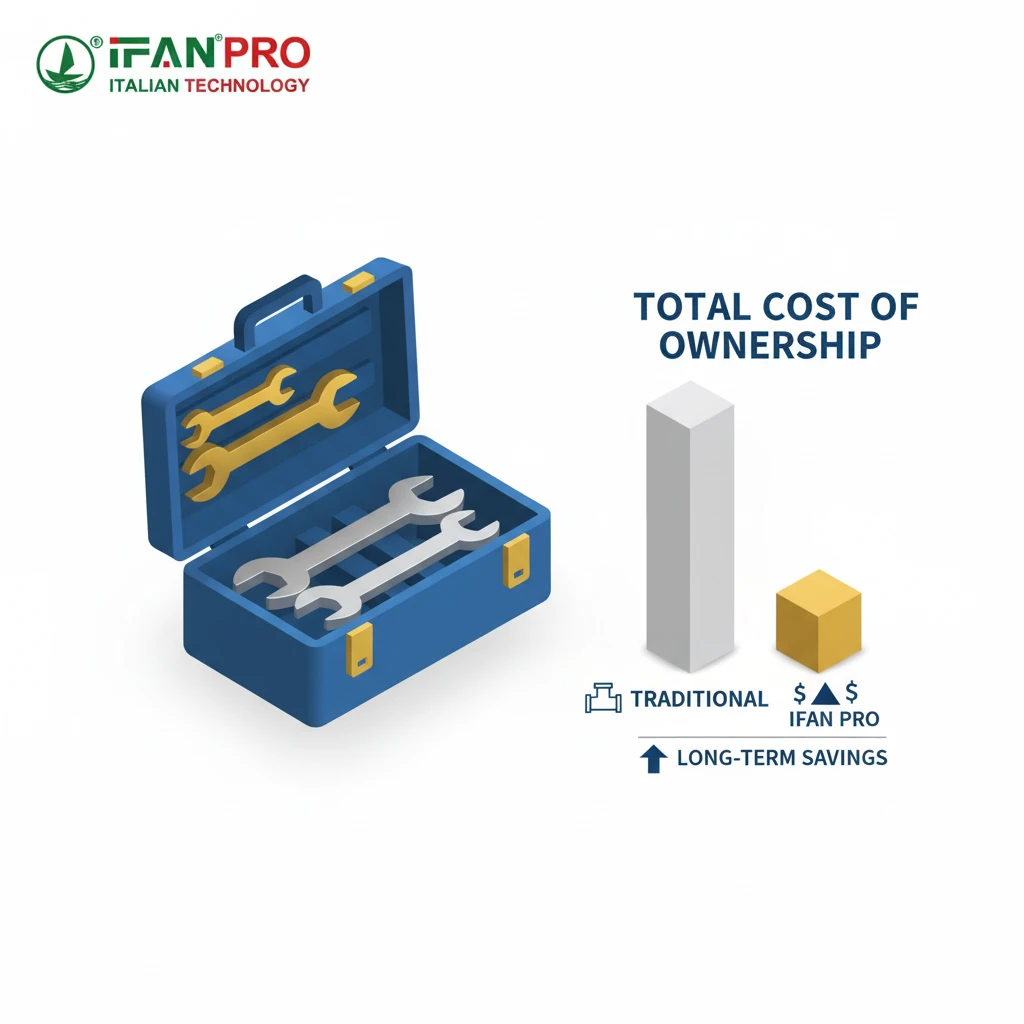
While standard crimp fittings often have a lower upfront cost per unit, the IFANPRO 121UC frequently delivers lower total cost of ownership when you factor in installation errors, rework, future modifications, and maintenance access. Its reusability means you don’t buy new fittings for every change, and its accessibility simplifies future repairs.
Breaking Down the Real Costs
To understand total cost, we need to look beyond the price tag on the fitting itself. Consider these factors:
Initial Installation:
- Standard crimp: Lower fitting cost, but requires specialized tool investment
- IFANPRO 121UC: Higher fitting cost, but uses basic tools most plumbers already own
Error and Rework:
- Standard crimp: One wrong crimp means cutting pipe and replacing fitting
- IFANPRO 121UC: Mistake means loosening nut and readjusting
Future Modifications:
- Standard crimp: Any change requires cutting and new fittings
- IFANPRO 121UC: Disconnect, reconfigure, reconnect with same fittings
Maintenance Access:
- Standard crimp: Must cut to access behind fittings
- IFANPRO 121UC: Union design allows removal without damage
Cost Comparison Over 10 Years
Let’s model a typical residential system with 20 PEX connections, accounting for normal modifications and potential issues:
| Cost Factor | Standard Crimp System | IFANPRO 121UC System |
|---|---|---|
| Initial Fitting Cost (20 units) | $40 – $60 | $80 – $120 |
| Tool Investment | $100 – $300 for crimper + gauge | $0 (uses existing wrenches) |
| Estimated Rework Materials (Year 1-3) | 3-5 fittings replaced ($8-15) | $0 (adjust existing fittings) |
| Future Modification Cost (Year 4-10) | 8-10 new fittings ($16-30) | $0 (reuse originals) |
| Potential Leak Repair Cost | Higher if crimp fails | Lower due to accessible joints |
| Total 10-Year Estimated Cost | $164 – $405 | $80 – $120 |
The Serviceability Advantage
Beyond pure dollars, consider the convenience factor. When a homeowner needs to replace a faucet or water heater years later, the IFANPRO 121UC system allows simple disconnection. The plumber loosens the union nuts, swaps the fixture, and retightens. The job takes minutes.
With standard crimp fittings, that same plumber might need to cut pipe, install new adapters, and add transition fittings. What could have been a 30-minute job stretches to two hours, with additional parts and higher labor costs.
For property owners, this means lower maintenance bills over the life of the building. For contractors, it means fewer callbacks and happier customers.
Заключение
The IFANPRO 121UC outperforms standard PEX fittings where flexibility, material quality, and long-term value matter most. For your next project requiring reliable, reusable connections, choose IFAN’s IFANPRO 121UC series and experience the difference.








 Русский
  English
  Français
  Español
Последние комментарии