
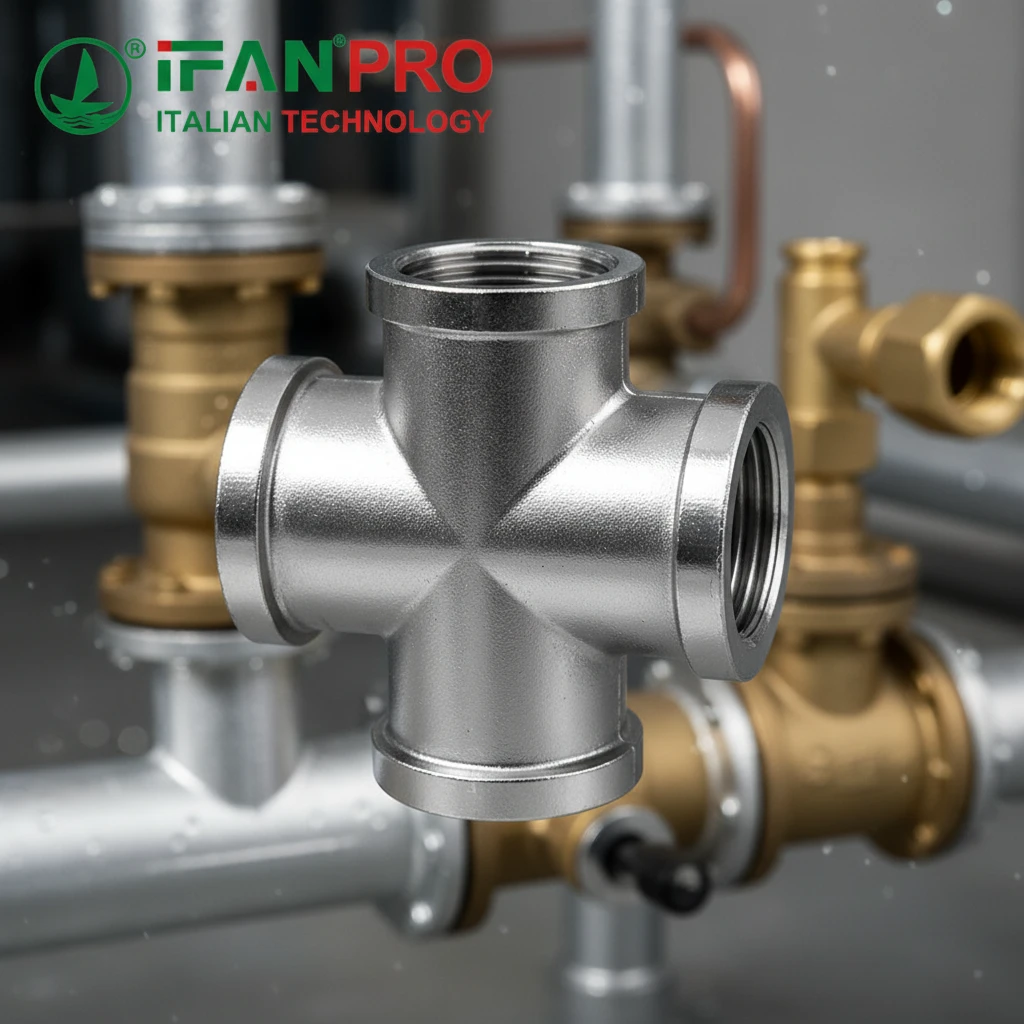
Early in my career, I watched a standard cast iron tee crack under pressure, flooding a client’s mechanical room. That day taught me the true value of superior materials and smart design in every component.
The 407 Series Stainless Steel Cross Tee is a four-way pipe fitting designed to distribute flow efficiently in tight spaces. Made from premium rust-proof stainless steel, it offers exceptional durability, leak-proof female threaded connections, and versatile use across residential, commercial, and industrial applications.
Let’s explore why this fitting stands out and how it can solve common plumbing challenges.
Superior Material: Advantages of Rust-Proof Stainless Steel
Rust is the silent killer of plumbing systems. I’ve seen countless failures start with a single spot of corrosion on ordinary steel fittings.
Stainless steel offers complete resistance to rust and corrosion because it contains chromium, which forms a protective oxide layer on the surface. This material does not react with water, chemicals, or moisture, ensuring the fitting maintains its structural integrity and appearance for decades, even in harsh environments.

Why Material Choice Matters
The material of a pipe fitting determines everything: lifespan, maintenance needs, and safety. Many standard fittings use galvanized steel or cast iron. These materials work initially, but they have hidden weaknesses.
Galvanized steel has a thin zinc coating. Over time, water and minerals wear this coating away. Once the zinc disappears, the underlying steel begins to rust. Rust reduces the wall thickness, weakens the fitting, and contaminates the water with brown particles.
Cast iron performs well in some applications, but it is brittle and prone to rust, especially in damp environments like basements or crawl spaces. A small impact or freezing condition can crack a cast iron fitting.
Stainless steel eliminates these problems entirely.
The Science Behind Rust Resistance
Stainless steel contains at least 10.5% chromium. When oxygen touches the surface, the chromium reacts to form a thin, invisible layer of chromium oxide. This layer is incredibly stable and adheres tightly to the metal. If you scratch the surface, the chromium immediately reacts with oxygen to repair the layer. This self-healing property makes stainless steel truly rust-proof in normal conditions.
The 407 Series typically uses grades like SS304 or SS316:
- SS304: The standard grade for general plumbing, food processing, and indoor applications. It offers excellent resistance to water and mild chemicals.
- SS316: Contains molybdenum for enhanced resistance against chlorides and industrial chemicals. This is the choice for coastal areas, chemical plants, and marine applications.
Long-Term Benefits for Users
Choosing stainless steel means choosing peace of mind. You don’t need to paint it or apply protective coatings. It doesn’t stain surrounding materials with rust streaks. It maintains its clean, professional appearance forever.
The table below compares stainless steel with other common materials:
| Материал | Rust Resistance | Lifespan | Maintenance Needs | Typical Applications |
|---|---|---|---|---|
| Stainless Steel (407 Series) | Excellent | 50+ years | None | All plumbing, industrial, marine |
| Galvanized Steel | Poor (coating fails) | 20-40 years | Regular inspection | Older homes, temporary structures |
| Cast Iron | Poor | 25-50 years | Painting, sealing | Drainage, underground (coated) |
| Brass | Good | 40-50 years | Occasional cleaning | Valves, fittings, decorative |
For the end user, this means no unexpected failures, no water damage from corroded fittings, and no costly replacements.
Core Function: Optimizing Pipe Space with Four-Way Flow
Space is always at a premium in mechanical rooms and industrial settings. I’ve often struggled to fit multiple tees and elbows into a cramped space.
A cross tee connects four pipes at a single point, creating two straight-through flow paths that intersect perpendicularly. This design optimizes space by replacing multiple standard tees and elbows, reducing the number of joints, and simplifying the piping layout while maintaining efficient flow distribution.

Understanding the Geometry
A standard tee connects three pipes in a T-shape. To create four connections, you traditionally need at least two tees and additional pipe sections. This consumes space and creates extra joints, each a potential leak point.
The cross tee solves this with a single fitting. It has four openings: two on the main run (inlet and outlet) and two on the branch run (opposite sides). This allows fluid to flow straight through in one direction while also diverting flow left and right simultaneously.
Think of it as a central hub. Water or other media enters from one direction and can exit through any combination of the other three ports. This is invaluable for:
- Manifold systems: Distributing supply to multiple points from a single source.
- Return lines: Combining flows from multiple branches back into a main line.
- Complex machinery: Connecting multiple components in a compact footprint.
Reducing Joints, Reducing Risk
Every joint in a plumbing system is a potential failure point. Threads can loosen, seals can degrade, and installation errors can occur. By using a cross tee, you eliminate at least two joints compared to a traditional assembly.
Consider a typical scenario where you need to supply two separate fixtures from a main line while also continuing the main line forward. With standard fittings, you would install one tee for the first branch, then a second tee downstream for the second branch. This requires two fittings, two sets of threads, and additional pipe nipples.
With a 407 Series cross tee, you install one fitting. The main line runs straight through, and both branches connect directly to the cross. The result is cleaner, more compact, and more reliable.
Flow Dynamics and Pressure Drop
Some engineers worry about turbulence and pressure loss in cross tees. Quality designs address this with smooth internal contours and gradual transitions.
The 407 Series features:
- Radiused interior corners: Reduce turbulence where flows merge or split.
- Full-port design: Maintains the full pipe diameter through the fitting, minimizing flow restriction.
- Consistent wall thickness: Ensures strength without internal obstructions.
The table below shows typical pressure drop comparisons:
| Configuration | Number of Fittings | Relative Pressure Drop | Installation Time |
|---|---|---|---|
| 407 Series Cross Tee | 1 | Low (baseline) | 1x |
| Two Standard Tees + Nipples | 4+ | Medium (15-20% higher) | 2-3x |
| Four Elbows + Manifold | 5+ | High (30-40% higher) | 3-4x |
By simplifying the layout, the cross tee maintains better flow characteristics while saving space and installation effort.
Versatile Applications: From Home Plumbing to Industrial Use
One question I hear often is, “Where can I actually use this fitting?” The answer covers more ground than most people expect.
The 407 Series Stainless Steel Cross Tee serves a wide range of applications including residential water distribution, commercial HVAC systems, industrial process piping, fire sprinkler networks, and marine plumbing. Its corrosion resistance and four-way design make it adaptable to virtually any situation requiring efficient fluid distribution.

Residential Applications
In homes, space and reliability matter most. The 407 Series fits perfectly in several residential scenarios:
- Water heater manifolds: Connect hot water supply to multiple fixtures from a central point.
- Basement plumbing: Organize supply lines in tight utility areas.
- Radiant heating systems: Distribute heated water to multiple floor loops.
- Water filtration setups: Connect filter banks with inlet, outlet, and bypass lines.
Homeowners benefit from the compact size and leak-free reliability. No more worrying about rusty fittings in finished basements or crawl spaces.
Commercial and HVAC Applications
Commercial buildings demand durability and code compliance. The 407 Series meets both:
- Chilled water systems: Distribute cooling water to multiple air handlers.
- Boiler rooms: Connect supply and return lines with branch takeoffs.
- Cooling towers: Manage water flow to multiple cells or components.
- Process cooling: Supply machinery with consistent coolant flow.
The stainless steel construction handles the temperature cycling and chemical treatments common in commercial systems without degradation.
Industrial and Specialized Applications
Industrial environments push materials to their limits. Here, the 407 Series truly shines:
- Chemical processing: SS316 versions resist aggressive chemicals.
- Food and beverage: Sanitary designs meet hygiene requirements.
- Marine and offshore: Saltwater exposure demands stainless steel.
- Fire protection: Reliable connections for sprinkler systems.
- Pharmaceutical: Clean, non-reactive surfaces for pure water systems.
The table below matches applications with recommended stainless steel grades:
| Application Area | Recommended Grade | Key Requirements |
|---|---|---|
| Сантехника для жилых помещений | SS304 | Cost-effective, rust-proof, potable water safe |
| Commercial HVAC | SS304 | Temperature cycling, moderate pressure |
| Food Processing | SS304/SS316 | Sanitary surfaces, easy cleaning |
| Chemical Plants | SS316 | Corrosion resistance to acids and chlorides |
| Marine/Coastal | SS316 | Saltwater resistance, long-term durability |
| High-Purity Systems | SS316L | Low carbon, smooth finish, no contamination |
No matter the industry, the core benefits remain: no rust, fewer joints, and reliable performance.
Easy Installation: Leak-Free Experience with Female Threads
Installation mistakes cause most plumbing failures. I’ve seen good fittings ruined by poor threading practices.
Female threaded connections on the 407 Series simplify installation by allowing direct attachment of male-threaded pipes without additional adapters. When properly sealed with thread tape or pipe dope and tightened to the correct torque, these threads create a robust, leak-free seal that withstands pressure and vibration.

Understanding Female Threads
Female threads are internal threads cut into the fitting’s ports. They accept pipes or nipples with matching male threads. This design offers several advantages:
- Direct connection: No need for couplings or adapters.
- Compact assembly: Threads are integral to the fitting, not added length.
- Field flexibility: Easy to connect in any orientation.
- Standard compatibility: Works with NPT (National Pipe Taper) threads common worldwide.
The 407 Series uses precision-cut threads that meet strict standards. This ensures consistent engagement and proper sealing.
Step-by-Step Installation Guide
Follow these steps for a reliable installation:
1. Prepare the Pipe: Cut the pipe square and remove burrs. Clean the male threads thoroughly. Any debris can prevent proper sealing.
2. Apply Sealant: Wrap PTFE tape clockwise around the male threads, covering all threads but leaving the first thread exposed to prevent tape from entering the system. Alternatively, apply pipe thread sealant (pipe dope) evenly.
3. Start by Hand: Thread the pipe into the fitting by hand until snug. This ensures you don’t cross-thread, which damages both parts.
4. Tighten with Tools: Use wrenches on both the pipe and the fitting’s hex flats. Never grip the fitting body, which can distort it. Tighten to the recommended torque, typically 2-3 full turns past hand-tight for NPT threads.
5. Align Before Final Torque: Position the assembly as needed during the final turns. Once fully tightened, don’t back off, as this breaks the seal.
Common Installation Mistakes to Avoid
I’ve seen these errors repeatedly:
- Over-tightening: This stresses the fitting and can crack the female threads. Stainless steel can gall (seize) when overtightened.
- Under-tightening: Leaves gaps where leaks can occur.
- Wrong sealant: Some sealants aren’t rated for potable water or specific temperatures.
- Dirty threads: Oil, dirt, or metal chips prevent proper sealing.
- Cross-threading: Starting at an angle damages threads permanently.
The table below summarizes sealing methods:
| Sealant Type | Best For | Application Tips |
|---|---|---|
| PTFE Tape | General plumbing, potable water | Wrap 3-5 turns clockwise; stretch slightly for tight wrap |
| Pipe Dope (Paste) | High-pressure, industrial | Brush evenly on male threads; follows all surfaces |
| Anaerobic Sealants | Metal threads, vibration-prone | Cures in absence of air; requires clean threads |
| Combination | Maximum security | Tape first, then dope over tape for extra lubrication and seal |
Testing the Installation
After installation, always pressure test the system. For threaded connections, this is especially important because small leaks may not appear until the system is under full pressure.
The 407 Series design includes reinforced thread bosses that withstand the stress of tightening and pressure cycling. This ensures the fitting maintains its integrity over decades of service.
Заключение
The 407 Series Stainless Steel Cross Tee combines rust-proof durability, space-saving four-way flow, versatile application, and easy installation. For your next project, choose IFAN’s 407 Series for reliable, leak-free performance across all your piping needs.










 Русский
  English
  Français
  Español
Последние комментарии