
HDPE pipe fusion is how you turn separate lengths of polyethylene pipe into one continuous, leak-free line. Done right, a fused joint is as strong as the pipe wall itself, with no gasket, no thread, and no mechanical seal that can back off or weep years later. That single property is why municipal water, gas distribution, and mining crews bury HDPE with confidence.
The catch is that “fusion” is not one process. There are three heat-fusion methods and one no-fusion alternative, and each wins in a different situation. This guide compares butt fusion, electrofusion, socket fusion, and mechanical/compression joining side by side, tells you when to pick each, and lists the defects that cause underground joints to fail. Before you size anything, it helps to understand HDPE pipe sizes and SDR, because wall thickness drives which method is even practical.
Key Takeaways
- A correctly fused HDPE joint is monolithic. It has no mechanical seal, so there is no discrete leak point to fail underground.
- Butt fusion heats pipe ends on a plate at roughly 200–230°C, then joins under set pressure. It wins on long, straight runs of larger diameter (typically 90 mm and up).
- Electrofusion energizes a wired coupler at low voltage (about 8–48 V). It wins in trenches, tie-ins, and repairs where a butt machine will not fit.
- Socket fusion suits smaller diameters (often under 110 mm) with simpler, lower-cost tooling.
- Mechanical and compression fittings need no fusion gear, but they reintroduce a mechanical seal and a potential leak point.
- Most fusion failures trace to four causes: under-heating (cold joint), contamination, misalignment, and wrong pressure. Every one is preventable at the bench.
The Four Ways to Join HDPE
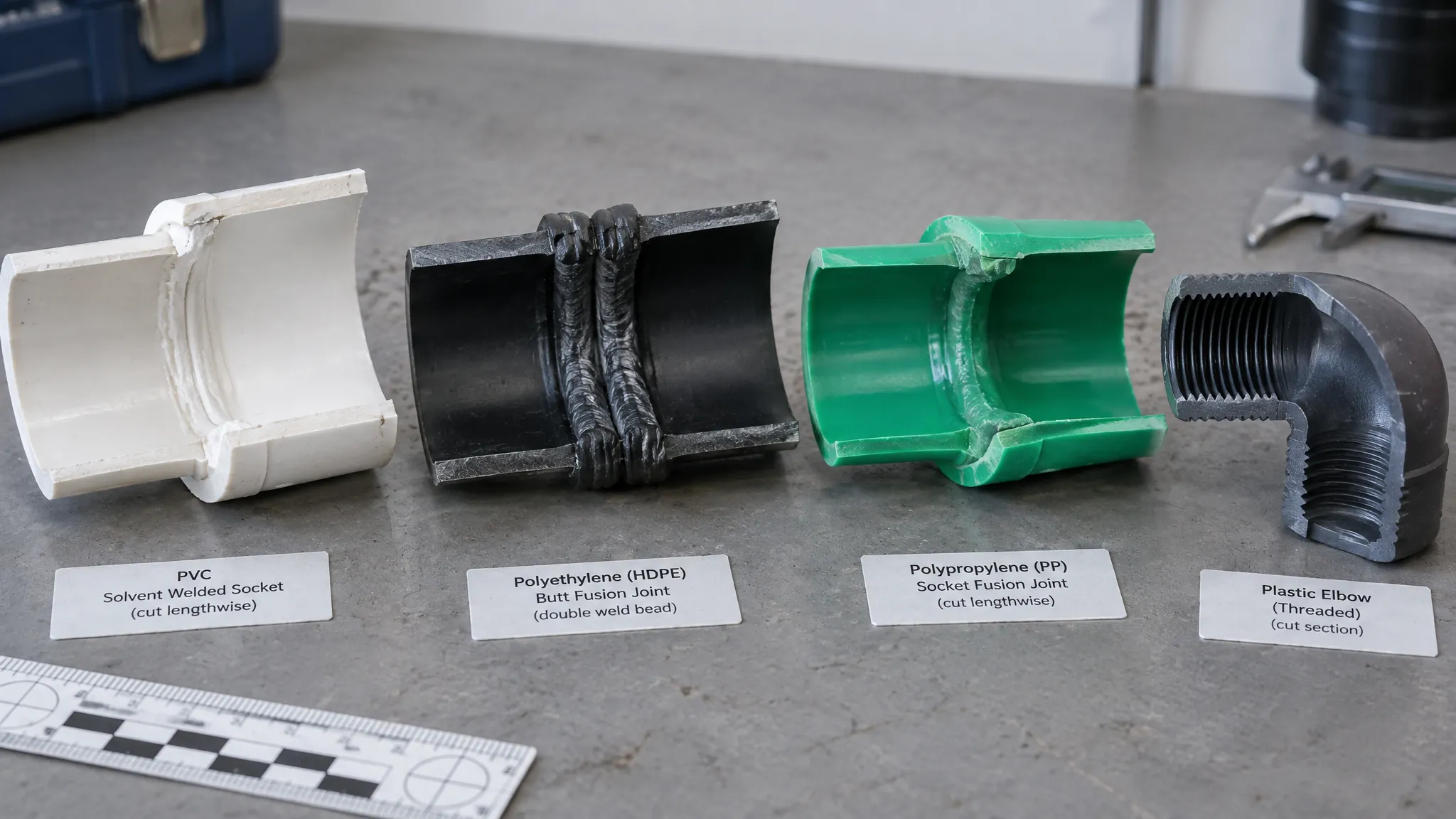
HDPE does not accept solvent cement the way PVC does, so joining relies on either heat or a mechanical grip. Four methods cover almost every field situation, and the first three are true fusion.
- Butt fusion — two pipe ends are heated flat against a hot plate, then pressed together end to end. The joint becomes one continuous piece of pipe.
- Electrofusion — a factory fitting with embedded heating wire is slid over the joint and energized. The wire melts the plastic from inside the coupler outward.
- Socket fusion — the pipe outside and a fitting socket are heated on a bushing, then pushed together so the pipe seats inside the fitting.
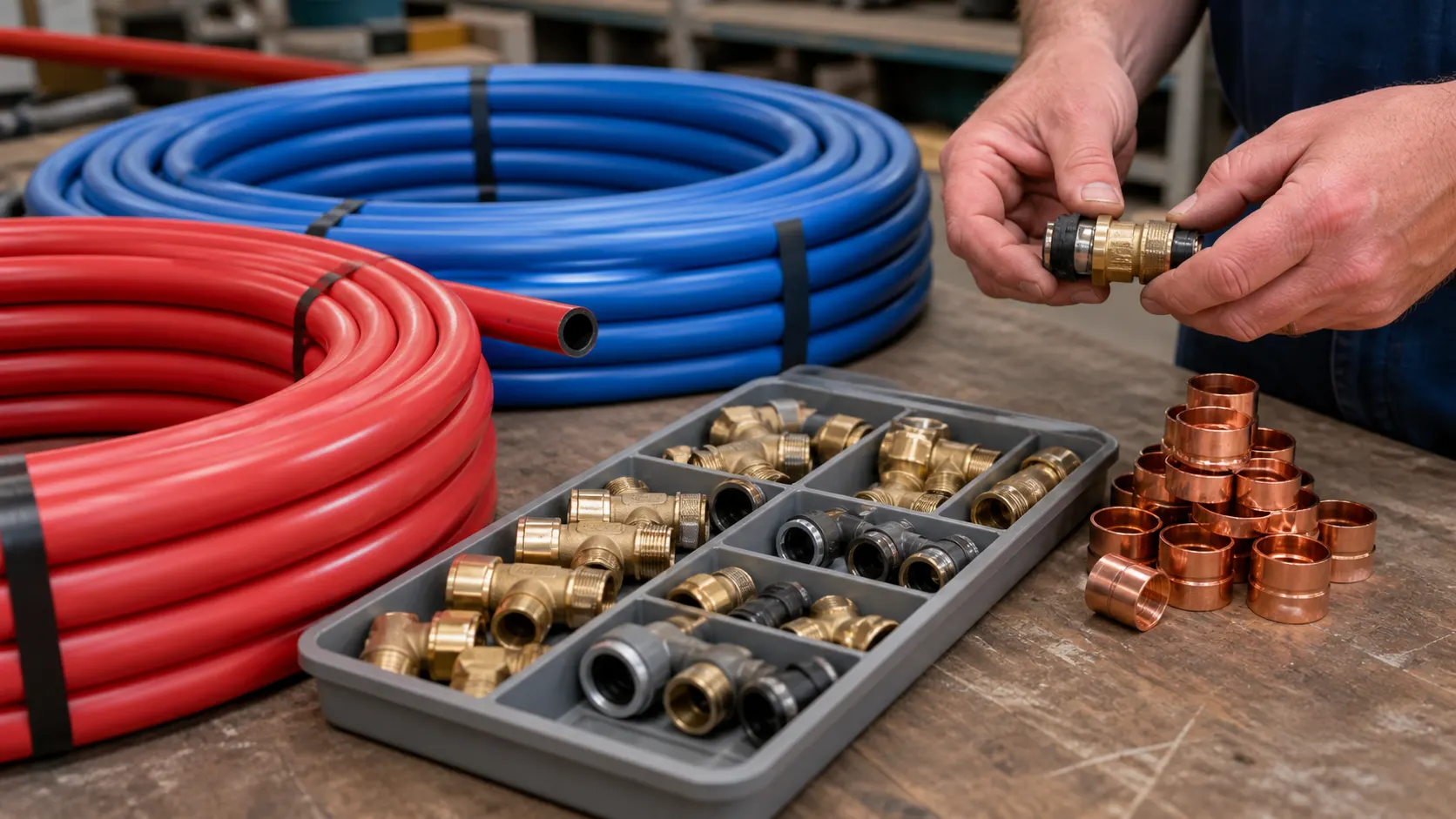
- Mechanical / compression — a gasketed or grip-ring fitting clamps onto the pipe. No heat, no fusion, and a mechanical seal that fusion avoids.
The distinction matters underground. A fused joint has the same long-term strength as the pipe, verified by decades of pressure-rating data from the Plastics Pipe Institute. A mechanical joint is only as reliable as its gasket and the installer who torqued it. When a repair means excavating a road, that difference is the whole decision.
Butt Fusion
Butt fusion is the workhorse for large-diameter mains. Both pipe ends are clamped square in a hydraulic machine, faced flat with a rotating cutter, checked for alignment, then heated on a hot plate held at roughly 200–230°C until a uniform melt bead forms around each end. The plate is pulled, the ends are joined under a set fusion pressure, and the joint cools under that same pressure before the clamps release.
Where butt fusion wins
Pick butt fusion for long, straight runs of larger pipe, typically 90 mm and above, where a machine can sit on grade and index down the line. It is the fastest cost-per-joint method once the machine is set, and the finished bead is visible for inspection. It is the wrong choice inside a cramped trench or against a wall, because the machine needs clearance to open and clamp around the full pipe. Fusion parameters for butt joints follow published procedures such as ASTM F2620; confirm the standard and any local code that applies to your project.
Field warning: The most common butt-fusion mistake is releasing pressure before the joint has cooled. HDPE stays soft well after the bead looks set. Pull a joint off the machine early and you get a weak interface that can pass a visual check but split under pressure. Follow the machine’s cooling timer, not the clock in your head.
Electrofusion
Electrofusion swaps the hot plate for heat generated inside the fitting itself. An electrofusion coupler or saddle has resistance wire molded into its bore. You prep the pipe, insert it into the fitting, connect a control box, and energize at low voltage — commonly in the 8–48 V range — for a time the fitting’s barcode specifies. The wire heats, the plastic melts at the interface, and coupler and pipe fuse into one body. The electrofusion process is self-timed by the control box, which reduces operator guesswork.
Where electrofusion wins
Electrofusion is the answer whenever space is tight: a repair coupling in a narrow trench, a tie-in against an existing line, or a saddle branch on a live main. It needs almost no clearance, since nothing has to swing open around the pipe. The trade-off is fitting cost. An electrofusion coupler costs far more than a butt joint, which has no fitting at all, so on a long straight run the numbers favor butt fusion. Two prep steps are non-negotiable: scrape the full oxide layer off the pipe surface, and keep the joint clamped still during the entire fuse and cool cycle.
Socket Fusion
Socket fusion heats two surfaces at once on a shaped bushing: the pipe outside diameter goes on the male face, the fitting socket goes over the female face, both reach melt temperature, and then the pipe is pushed into the fitting. The overlap of pipe inside socket forms the fused zone. Tooling is a heater with interchangeable bushings sized to the pipe, far simpler and cheaper than a butt machine.
Where socket fusion wins
Socket fusion is common on smaller diameters, often under 110 mm, where lightweight tooling and quick cycle times matter more than raw throughput. It shines for above-ground plumbing and service lines with lots of fittings. The limits are diameter and depth control: you must push the pipe to the full socket depth without over-inserting, or the melt bead can restrict the bore. For large mains, butt fusion remains the standard, and for tight in-ground repairs electrofusion is safer.
Mechanical & Compression (No-Fusion)
Sometimes fusion is not on the table. A mechanical or compression fitting grips the pipe with a nut, ferrule, or grip ring and seals against an elastomer gasket. It needs no heater, no power, and no trained fusion operator, which is exactly why crews reach for it on small service lines, temporary connections, and transitions from HDPE to metal or another plastic.
The honest trade-off: a mechanical joint reintroduces the one thing fusion eliminates, a mechanical seal that can loosen, creep, or age. For a buried main under a road, that is a real liability. For a small-diameter connection you can reach, or a material transition where fusion is impossible, it is the practical choice. When you are joining dissimilar materials, the rules change again — see our guide on the best methods for joining pipes of different materials. HDPE itself is a high-density polyethylene (ПНД) whose creep behavior is exactly why buried mains favor a fused, gasket-free joint.
Head-to-Head: Which HDPE Joining Method to Use
The right method is a function of diameter, access, and how many joints you are making. This table lays the four options side by side.
| Method | Tooling | Best diameter / use | Speed | Relative cost |
|---|---|---|---|---|
| Butt fusion | Hydraulic fusion machine + hot plate | 90 mm and up; long straight mains | Fast per joint once set up | Low per joint (no fitting) |
| Electrofusion | Control box + wired fitting | Tight trenches, tie-ins, repairs, saddles | Moderate; self-timed cycle | Higher (costly fitting) |
| Socket fusion | Heater + sized bushings | Under ~110 mm; service lines, plumbing | Fast on small pipe | Low tooling cost |
| Mechanical / compression | Hand tools only | Small diameter, transitions, temporary | Very fast | Higher fitting; no machine |
Reading it as decisions: laying a 250 mm trunk main across open ground, use butt fusion. Repairing that same main in a 600 mm-wide trench, switch to electrofusion. Plumbing a 63 mm building service with many bends, socket fusion moves fastest. Connecting HDPE to a brass valve, a compression or flange adapter is the only real option. If you are still choosing the pipe material itself, our comparison of PEX vs copper vs PPR sets HDPE in context against the alternatives.
Fusion Defects and Their Causes
A fused HDPE joint that fails almost never fails from bad material. It fails from a controllable error at the joint. Learn to recognize these five before you backfill, because a bad joint underground is the expensive kind.
| Defect | Cause | Prevention |
|---|---|---|
| Cold joint (weak fuse) | Under-heating or too little heat time; cold ambient | Hold plate temperature; follow full heat timer; tent in cold weather |
| Excessive / rolled-over bead | Over-heating or too much drag pressure | Use rated temperature and correct fusion pressure for the pipe size |
| Contaminated interface | Dirt, moisture, or oil on the melt face; un-scraped oxide (electrofusion) | Face and wipe clean; scrape full oxide layer; keep water off the plate |
| Misalignment / high-low | Pipe ends offset or out of round in the clamps | Re-round with clamps; check alignment before heating; use round pipe stock |
| Movement during cooling | Pressure released or pipe disturbed before full cool | Leave clamped under pressure for the full cooling time |
Two of these deserve a warning in bold. Contamination is silent — a joint contaminated by a fingerprint of oil can look perfect and still delaminate. And out-of-round pipe forces the clamps to fight the fusion, so ovality is a joint problem before it is a fitting problem. Both push the responsibility upstream, onto the pipe you started with.
What We Check on HDPE Before It Ships
A fusion joint is only as good as the two pipe ends going into it, so at IFANPRO we treat dimensional consistency as a joint-integrity issue, not a cosmetic one. Here is what we verify on HDPE before it leaves the factory.
- Outside diameter and ovality — we hold OD to tolerance and check roundness, so two ends mate square in the clamps without the operator forcing them round.
- Wall thickness — consistent wall by SDR keeps the melt zone uniform across the full circumference, so the bead forms evenly.
- Material certification — we run to PE100-grade resin with documented properties, backed by our ISO 9001 quality system, CE, WRAS, and NSF/IAPMO certifications.
- Pressure testing — sample lengths are hydrostatically tested against their pressure rating before a batch is released.
Since 1993 we have manufactured PEX, PPR, HDPE, and PVC pipe with brass fittings from a 120,000 m² plant, shipping to more than 200 countries. When your butt-fusion and electrofusion joints have to hold underground, the pipe dimensions are where reliability starts. For related plastic-pipe connections, our overview of PEX fitting connection types covers the wider system.
Заключение
HDPE pipe fusion gives you a joint with no mechanical seal to fail, which is why buried mains rely on it. Match the method to the job — butt fusion for long large-diameter runs, electrofusion for tight repairs, socket fusion for small lines, and mechanical fittings only where fusion is not possible. Get the pipe dimensions and the joint procedure right, and the line outlasts the crew that laid it.
Ready to spec pipe and fittings that fuse cleanly the first time? Talk to our team about your project diameters and volumes.
Frequently Asked Questions
Is a fused HDPE joint as strong as the pipe?
Yes. A correctly made butt-fusion or electrofusion joint reaches the strength of the pipe wall itself, with no gasket or thread. That is the core reason municipal water and gas systems bury HDPE with fused joints rather than mechanical ones.
Butt fusion vs electrofusion — which should I use?
Use butt fusion for long, straight runs of larger pipe (roughly 90 mm and up) where the machine has room to work; it is cheaper per joint because there is no fitting. Use electrofusion in tight trenches, tie-ins, and repairs where a butt machine will not fit, accepting the higher fitting cost.
At what temperature does HDPE butt fusion happen?
The hot plate is typically held around 200–230°C, and the ends are heated until a uniform melt bead forms before joining under set pressure. Always follow the machine and standard procedure for your pipe size and grade, and confirm any code that applies locally.
Why do HDPE fusion joints fail?
Most failures come from a controllable error: under-heating (a cold joint), a contaminated melt face, misalignment or out-of-round pipe, wrong fusion pressure, or releasing pressure before the joint has cooled. None of these are material faults — they are process faults at the bench.
Can I join HDPE without any fusion equipment?
Yes, with mechanical or compression fittings, which need only hand tools. They suit small diameters, transitions to other materials, and temporary connections, but they reintroduce a mechanical seal that is a potential leak point fusion avoids. For a buried main, fusion is the safer call.
IFANPRO has manufactured PEX, PPR, HDPE, and PVC pipe and brass fittings since 1993, from a 120,000 m² factory with 600+ staff. Our products carry ISO 9001/14001, CE, WRAS, NSF/IAPMO, and WaterMark certifications and ship to more than 200 countries. We write from the plant floor to help contractors and buyers spec plastic piping that performs.









 Русский
  English
  Français
  Español
Последние комментарии