
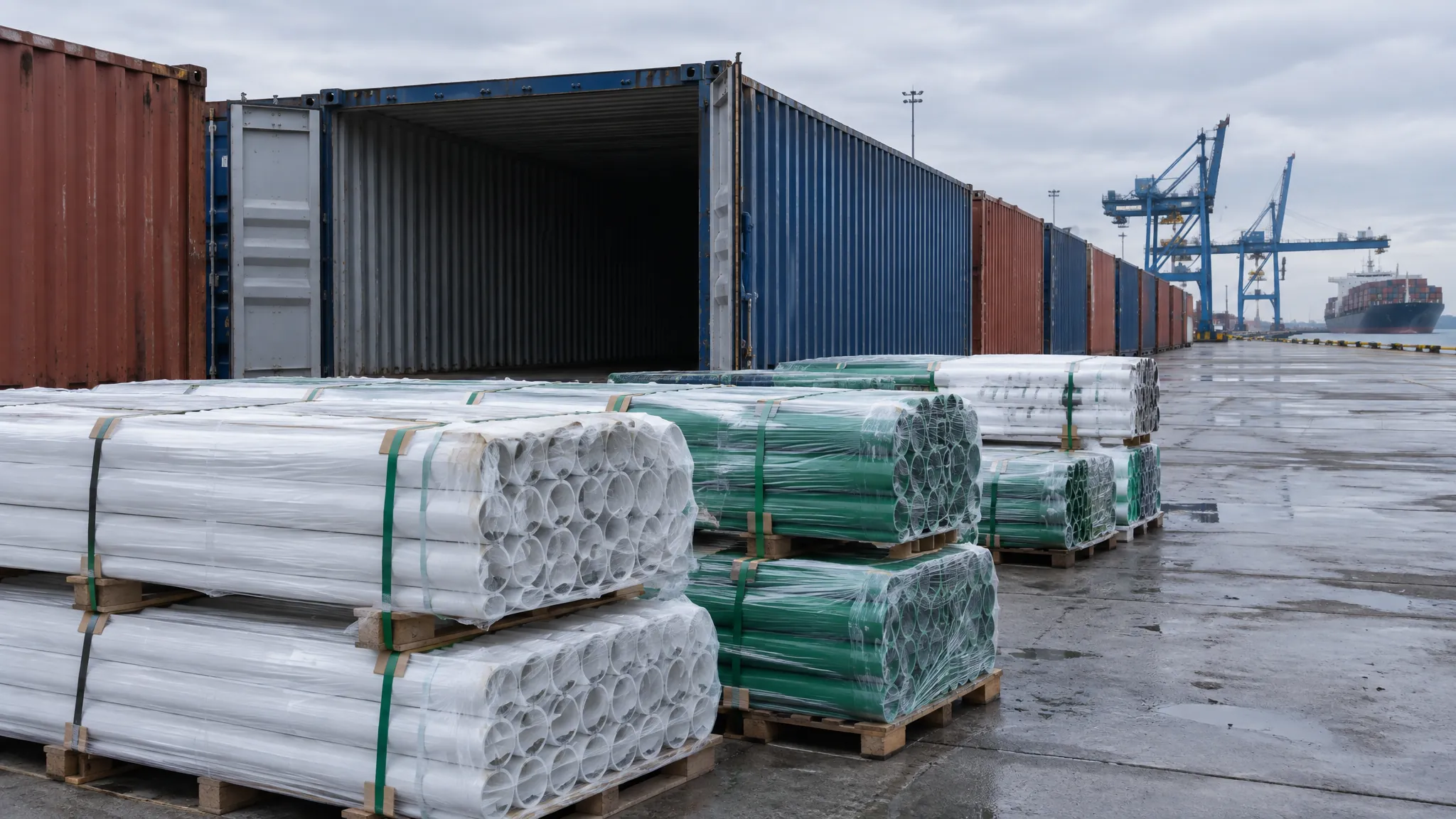
A bank paying under a letter of credit never sees your pipe. Under UCP 600 (the 2007 revision, ICC Publication No. 600), the ICC rules that govern a credit stating it is subject to them, banks deal with documents and not with goods, and each examining bank has a maximum of five banking days following the day of presentation to decide whether the papers comply. For a first container of pipe and fittings, a workable set is five papers: the commercial invoice, the packing list, a full set of clean on-board bills of lading, a certificate of origin, and an inspection certificate or test report. An insurance document joins them only if you buy CIF or CIP.
So the importer’s real control sits in the application form, before the credit is issued, and in the wording that follows.
Key Takeaways
- The bank checks paper, not pipe: a maximum of five banking days following the day of presentation.
- Only the commercial invoice must match the credit’s goods description. Keep field 45A short and exact.
- Pipe ordered in metres gets a 5% quantity tolerance. Fittings ordered in pieces get none.
- A quality condition with no document behind it is disregarded. Tie PN, standard and marking to a named certificate and issuer.
- The 21-day presentation rule needs an original transport document and never runs past expiry.
- What the Bank Checks: The Document Set for a Pipe Container
- Goods Description and Quantity: Where Pipe and Fittings Credits Differ
- Quality Terms the Bank Ignores Unless a Document Carries Them
- Dates That Fail First: Latest Shipment, Presentation Period and Expiry
- When a Discrepancy Is Found: Refusal, Waiver and the Arriving Container
- Agree These With the Supplier Before You Apply
- Conclusion
- Frequently Asked Questions
For the basic flow of a credit between buyer, banks and seller, the U.S. International Trade Administration has a short explainer:

What the Bank Checks: The Document Set for a Pipe Container
Every document is read against three things: the credit, the rules, and international standard banking practice, which ICC now publishes as the 2023 edition of ISBP (Publication 821E). Data in one document need not be identical to data in another, but must not conflict with it.
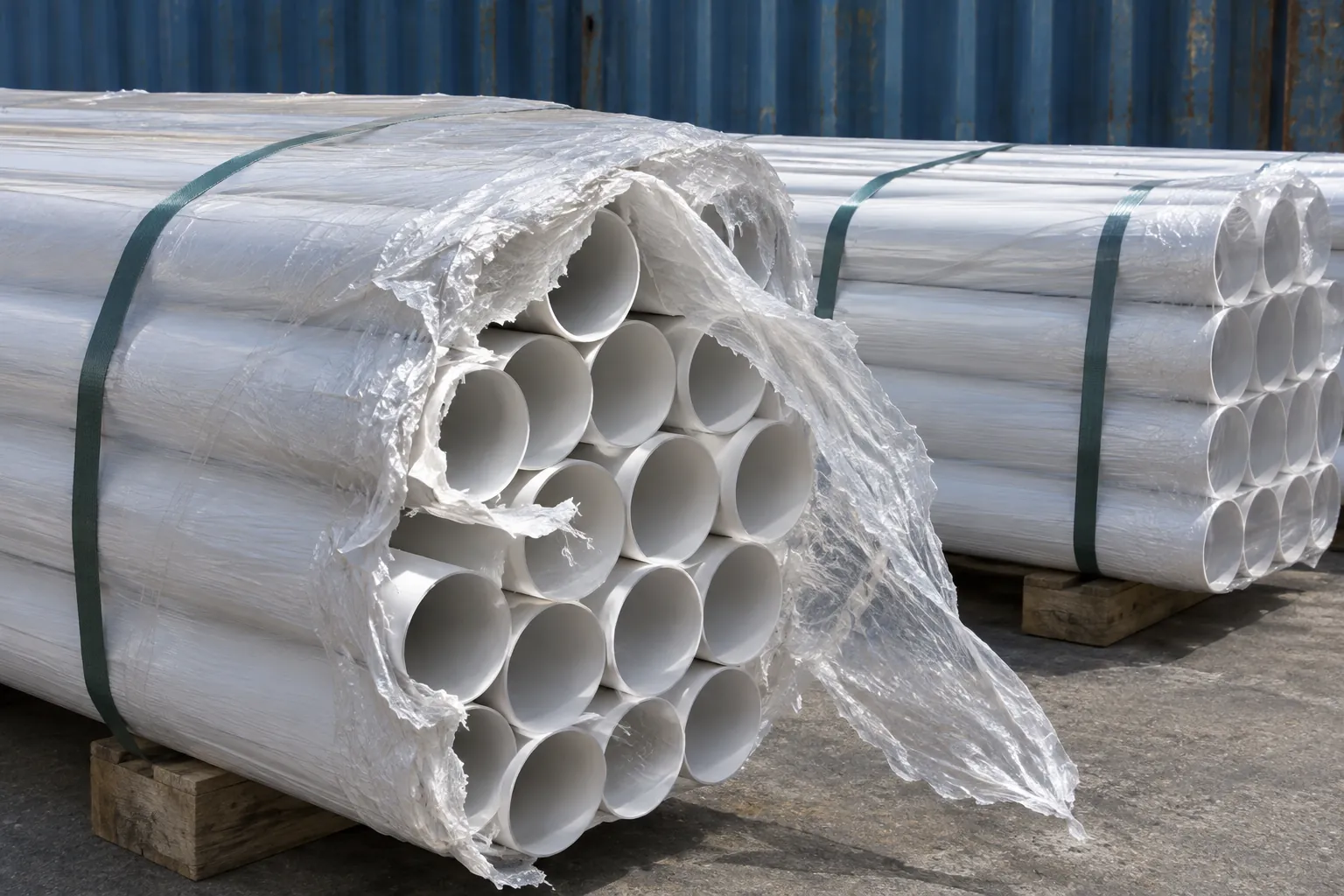
The commercial invoice carries the most risk. It is the one document whose goods description must correspond with the credit, and it must appear to be issued by the seller, be made out in the buyer’s name, and use the credit’s currency. The bill of lading carries the next most: a bank will only accept a clean transport document, so a carrier’s notation that bundle wrapping arrived torn can stop payment on a 40 ft container of sound pipe.
| Document | Issued by | What the examiner checks | UCP 600 rule |
|---|---|---|---|
| Commercial invoice | The seller (beneficiary) | Description corresponds with the credit; buyer’s name; credit currency | Art. 18 |
| Packing list | The seller | Quantities and marks do not conflict with the invoice | Art. 14(d) |
| Bill of lading, full set | Carrier, master or named agent | Clean; on-board date; ports as stated in the credit | Arts. 20, 27 |
| Certificate of origin | The issuer the credit names | Content fulfils its function; no conflicting data | Art. 14(f) |
| Inspection certificate or test report | The issuer the credit names | Issuer and content exactly as stipulated | Arts. 3, 14(f) |
| Insurance document (CIF or CIP only) | Insurer, underwriter or their agent | At least 110% of the CIF or CIP value if the credit is silent | Art. 28 |
Under Incoterms 2020, a CIF seller insures at Institute Cargo Clauses (C) by default, while CIP requires cover compliant with Clauses (A). If the credit states no percentage, cover must be at least 110% of the CIF or CIP value. For wider cover on a CIF container, write it into the credit, or buy FOB and insure it yourself. Our guide to Incoterms and packaging for pipe cargo covers who carries transit damage under each term.
Goods Description and Quantity: Where Pipe and Fittings Credits Differ
Keep the credit’s goods description short. The invoice description must correspond with it, while every other document may describe the goods in general terms. A workable field 45A names material, product standard, size range and pressure class, for example “PPR pipe, 20 to 63 mm, PN20, 4 m lengths, to the standard stated in the contract”. Put the size-by-size breakdown on the packing list, not in 45A, where the invoice must repeat every word. Check how each item is named in the IFAN product range before you copy wording into the application.
Quantity is where pipe and fittings split. UCP 600 art. 30(b) allows a tolerance not to exceed 5% more or 5% less than the quantity, provided the credit does not state the quantity as a stipulated number of packing units or individual items. Total drawings must also stay within the credit amount. Pipe ordered as, say, 12,000 metres can ship a bundle short or a bundle over. Fittings ordered as a count of pieces cannot: one carton short and the invoice no longer matches. Where a fittings count may move, put “about” before both quantity and amount, which UCP 600 reads as 10% more or 10% less.
| How the credit states the quantity | Art. 30(b) (± %) | "About" 30(a) (± %) |
|---|---|---|
| Pipe, stated in metres | 5 | 10 |
| Fittings, stated in pieces | 0 | 10 |
Quality Terms the Bank Ignores Unless a Document Carries Them
A clause such as “goods to be PN20, virgin material” does nothing on its own. If a credit contains a condition without stipulating the document to indicate compliance with it, banks will deem such condition as not stated and will disregard it. An examiner cannot measure a wall, so the requirement has to live inside a document.
Three drafting moves make it enforceable. First, name the document: an inspection certificate stating that pressure class, dimensions and marking were checked against the standard in the contract. Second, the issuer: the word “independent” alone lets any issuer except the seller sign, including an agency you never vetted. Third, the content: if the credit is silent on issuer and data, banks accept the document as presented if its content appears to fulfil the function of the required document, which is a low bar for a one-line certificate.
Then decide what the certificate rests on. A pre-shipment inspection of your packed lot says something about your container; a type test report already on file says something about the product line.

Dates That Fail First: Latest Shipment, Presentation Period and Expiry
First credits are often drafted backwards from the date the buyer wants the goods. Draft forwards from the supplier’s production lead time instead. Get it in writing and ask what starts the clock: receipt of the advised credit, a deposit, or artwork approval for printed marking. Then add the inland haul to the port of loading.
Three MT700 fields follow in order. Field 44C, Latest Date of Shipment, is the confirmed lead time plus a buffer you choose. Next, field 48, Period for Presentation in days, sets how long the seller has after shipment. Last, 31D, Date and Place of Expiry, should sit at least that many days after 44C.
If field 48 is blank, UCP 600 art. 14(c) supplies a default, but read its scope. It covers a presentation that includes one or more original transport documents, requires it not later than 21 calendar days after the date of shipment, and never runs past the expiry date. A credit expiring 10 days after the latest shipment date gives the seller 10 days, not 21. The date of shipment is the on-board notation date on the bill of lading where there is one. Avoid “on or about” for shipment too: UCP 600 reads it as five calendar days either side, an eleven-day window counting both ends.
| MT700 field | Choose this wording for pipe | Risk if left vague |
|---|---|---|
| 40E Applicable Rules | Name UCP 600 | The rules apply only when the credit says so |
| 45A Description of Goods | Material, standard, size range, pressure class | Invoice wording drifts from the credit |
| 46A Documents Required | Each document with its issuer and content | A quality check with no document is disregarded |
| 44C Latest Date of Shipment | Written lead time plus inland haul plus buffer | A production slip makes the B/L date late |
| 48 Period for Presentation | An explicit number of days | Default 21 days, cut short by expiry |
| 31D Date and Place of Expiry | 44C plus the presentation period | Documents reach the counter after expiry |
| 47A Additional Conditions | Only conditions a document can evidence | Non-documentary clauses are ignored |
When a Discrepancy Is Found: Refusal, Waiver and the Arriving Container
Take a first presentation that fails twice: the on-board date falls 1 day after field 44C, and the inspection certificate comes from an agency the credit did not name. A refusing bank must send a single notice listing each discrepancy, no later than the close of the fifth banking day following the day of presentation. The issuing bank may then ask you, the applicant, to waive, and that request does not extend its five days. Trade.gov puts the other route plainly: discrepancies must be amended and resubmitted, which only works while the credit is still live.
The waiver is the buyer’s decision and the buyer’s risk. The container may already be at the discharge port while the original bills of lading sit with the bank, pending instructions. Waive a late shipment date if the goods are what you ordered. Do not waive a missing or wrongly issued inspection certificate, because that paper was your only quality check.

Agree These With the Supplier Before You Apply
Send the supplier the draft application text before the bank issues anything, and ask for written confirmation that every document in field 46A can be produced by the named issuer. Correcting a draft costs an email; correcting an issued credit means an amendment through both banks. Settle these five points first:
- Minimum order. Ask the supplier’s minimum order per size and colour, and ask your bank for its issuance and amendment charges. That comparison decides between one credit per container and one larger credit; UCP 600 allows partial shipments unless the credit says otherwise.
- Price structure. Fix the Incoterm on the invoice. FOB keeps insurance out of the document set; CIF puts it in at the percentage you state, or at least 110% of the CIF value.
- Lead time. The written production lead time, what starts it, and the inland haul. Together they set 44C.
- Certificates. Which certificates and test reports the factory holds per line, so the credit never demands a paper nobody can issue, and who issues the pre-shipment inspection certificate.
- Deposit. Whether any part of the price is paid by transfer outside the credit, which puts that part outside the document check.
IFANPRO has not yet published an L/C acceptance policy, a minimum order table or production lead times for this page, so treat each point as a written question for any supplier, us included. The rules are the same on the Chinese side: as a member of the International Chamber of Commerce since 1995, China is subject to UCP 600. For how payment terms sit beside price and order size, see B2B terms for pipe wholesale.
Conclusion
Before you sign the application, check five lines:
- UCP 600 named in field 40E.
- A 45A the invoice can repeat word for word.
- Pipe quantity in metres, where a 5% tolerance applies, and “about” on any fittings count.
- Every quality term tied to a document with a named issuer.
- 44C, 48 and 31D built forward from a written lead time.
If any line is still a guess, settle it with the supplier before the bank issues the credit.
Frequently Asked Questions
What documents are required for an import letter of credit?
Whatever field 46A of the credit lists. For a pipe container that is usually the commercial invoice, packing list, a full set of clean on-board bills of lading, a certificate of origin and an inspection certificate or test report, plus an insurance document under CIF or CIP.
How long does the bank have to check L/C documents?
Under UCP 600 art. 14(b), a maximum of five banking days following the day of presentation. A refusal must be notified no later than the close of the fifth banking day following the day of presentation, in a single notice listing each discrepancy.
Does the 21-day presentation period always apply?
No. UCP 600 art. 14(c) covers only a presentation that includes an original transport document, sets it not later than 21 calendar days after the date of shipment, and never past the expiry date. A presentation period stated in the credit replaces it.
Can the supplier ship 5% more pipe than the credit states?
On quantity, yes, if the credit does not state it as a number of packing units or individual items: UCP 600 art. 30(b) allows 5% more or 5% less. The total drawn still cannot exceed the credit amount.









 English
  Français
  Русский
  Español
Recent Comments