
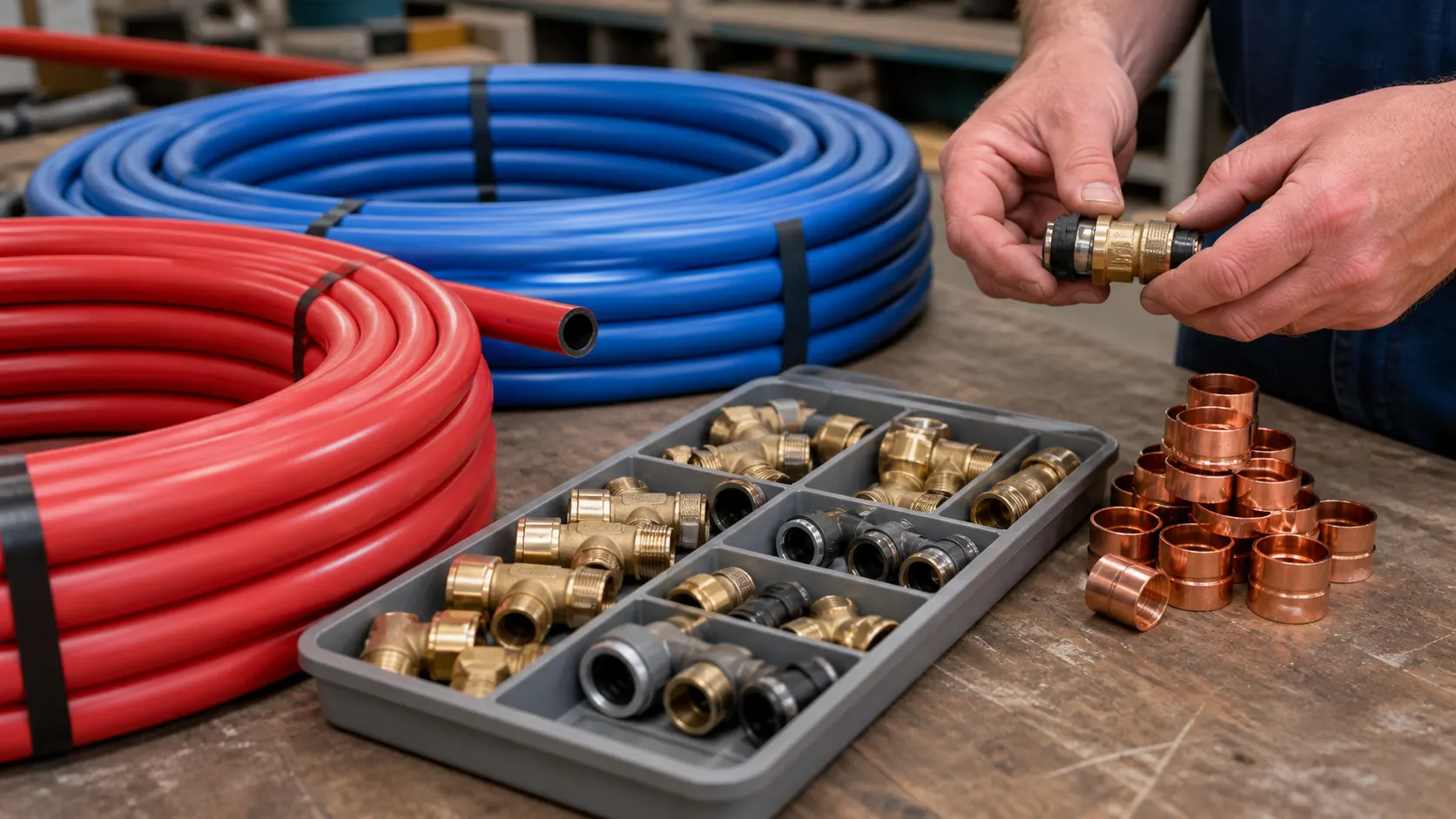
Match the replacement connector to both the existing manifold’s loop port and the actual pipe. Identify the manifold model and its documented port and sealing seat, then match the pipe construction, outside diameter and wall thickness to a connector listed for that combination. Release the order when the supplier confirms the current kit code and what it includes.
This guide is for a service job where the technician has cleared the manifold and the exposed end of the floor-heating loop for reuse. The part you’re buying is the removable connector between them. Make the selection from labels, drawings and service records. Leave any inspection that requires opening the system to the technician.
Key Takeaways
- Use the manifold drawing to identify the individual loop outlet and the surface where the connector seals.
- Record the pipe construction as well as its outside diameter and wall thickness. A size stamped on the old nut is a clue to verify against the pipe.
- Warmup lists different connector codes for supported 16 × 2.0 mm and 12 × 1.6 mm pipe on the same S3 manifold.
- On the Emmeti Topway Plus Type 2 example, the loop outlet is M 24×19. Within that connector range, multilayer composite pipe has its own listings.
- Use a dated part code to trace the part. Get the current code, documented pairing and package contents in writing before releasing the order.
Find the loop outlet on the manifold drawing
Start at the rail where the individual floor loop connects. Record the manifold maker, model and revision from the label or service paperwork. Mark the affected circuit and whether the part is on the flow or return rail. This gives the person checking the drawing a location to work from when photos show several connection types on the same assembly.

Bring the loop-port designation and its mating seat into the same record. Use the manufacturer’s parts drawing or an explicit pairing in its fitting list. In a seated connector assembly, a nut that takes up the thread can still draw the wrong sealing surface against the outlet. A quote that names only the thread leaves that part of the fit open. If you can verify the maker but can’t identify the model or confirm the seat from the records, ask for the drawing or a written match to the exact port.
If a technician finds the manifold’s seat is damaged, return the order to them for a scope decision. For a job that expands to the full assembly, see IFANPRO’s brass manifold selection guide.
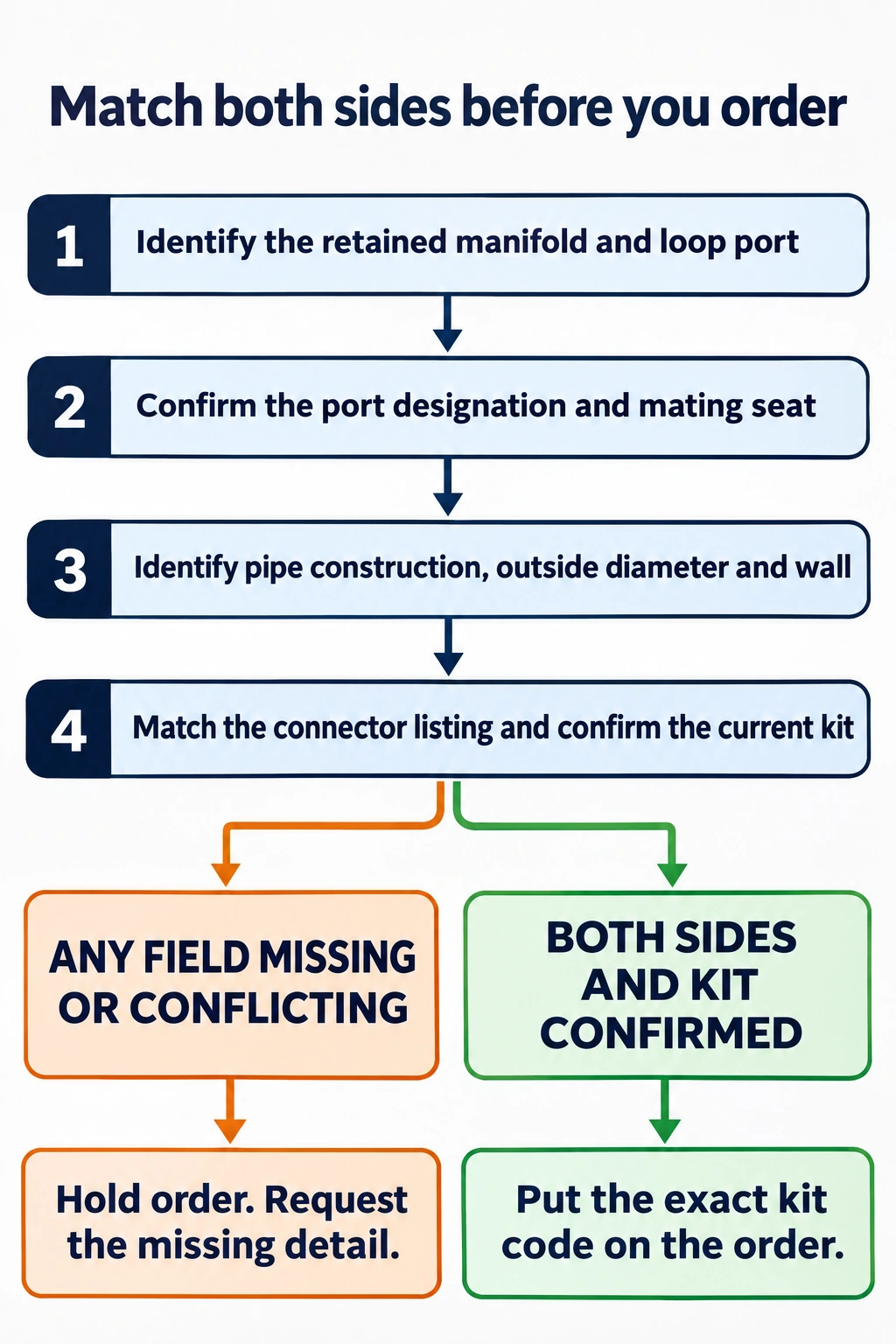
- Identify the manifold model, loop port and sealing seat.
- Record the exact pipe construction and outside diameter × wall thickness.
- Match both sides to a documented connector and check the current kit code and contents against the quote.
- Release the order when all fields agree. Otherwise, hold it and request the missing or conflicting detail.
Open the full-size decision flowchart
Read the pipe before choosing the connector
Photograph the writing on the actual loop tail. Record the pipe maker and series if visible, the construction and the full dimension pair. If the print is incomplete, use a commissioning record or a pipe datasheet that can be traced to that circuit. Photos of a similar loop in the same cabinet can help identify a label, but leave the purchase on hold if the records don’t tie that pipe to your circuit.

In a metric pipe marking such as 16 × 2 mm, the first number is the outside diameter and the second is the wall thickness. Two tubes can have the same outside diameter and different bores. Where the fitting has an insert, the bore affects which insert the manufacturer lists. Pipe construction is a separate input. Emmeti’s current Monoblocco 24×19 product page, for example, groups multilayer composite separately from the PEX, PE-RT and PB listing. With only “16” or an untraceable nut marking, ask for the exact pipe specification before picking a row.
Use the maker’s parts table to find the match
Suppose the records show a Warmup S3 manifold and pipe confirmed for that system at 16 × 2.0 mm. The S3 parts table gives you WHS-P-CONNECT. If the identified pipe instead belongs to the supported 12 × 1.6 mm combination, the manifold-side designation stays ¾-inch Eurocone and the code changes to ACC-CONNECT12x1.6. Warmup’s separate WHS-P-CONNECT sheet shows a spigot, connecting nut and split olive and specifies two O-rings. Use that component list to query a quote that shows just the nut.
| Existing manifold and loop port | Verified pipe | Part to confirm |
|---|---|---|
| Warmup S3, ¾-inch Eurocone | Supported 16 × 2.0 mm | WHS-P-CONNECT |
| Warmup S3, ¾-inch Eurocone | Supported 12 × 1.6 mm | ACC-CONNECT12x1.6 |
| Emmeti Topway Plus Type 2, M 24×19 | Compatible 16 × 2 mm multilayer composite | Confirm the current 24×19 multilayer kit. The 2021 guide lists 28100358 for identification. |
Sources: Warmup S3 Manifold technical sheet v1.5 and 16 mm Pipe connector technical sheet v1.0. Emmeti Topway Plus Type 2 Manifold Installation and Commissioning Instructions, Monoblocco 24×19 Connectors and Buyer’s Guide 2021, page 44.
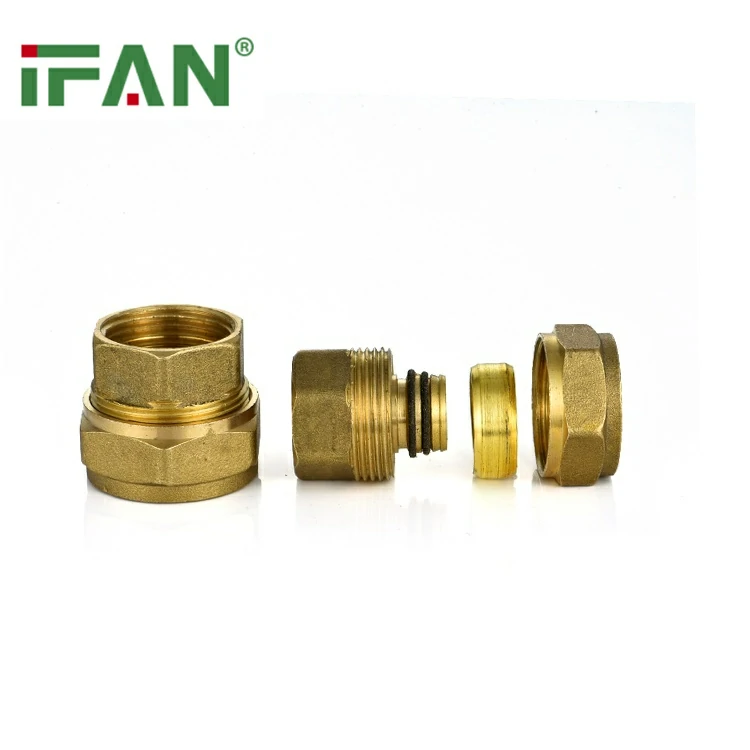
Now keep the 16 × 2 mm pipe dimensions and change the manifold to the Emmeti example. The Type 2 manual identifies the loop connection as M 24×19. That changes the manifold side of your search. With confirmed multilayer composite pipe, use the multilayer Monoblocco line. If the pipe record instead says PEX, recheck the product group and the exact row for that PEX. Send the older reference as a lookup aid and ask which current kit is documented for the installation.
Write the purchase-order line or put it on hold
Ask the supplier to quote the connector as an assembly and reconcile the reply with the drawing and pipe record. A product name can be shortened on the invoice, so carry the model, port and exact tube designation in the purchase-order line or attach the confirmed parts sheet.
Copyable purchase-order description
[Quantity and pack count] complete connector kit, [current maker and part code], for [manifold maker/model/revision and circuit/rail], [loop port and seat or mating drawing reference], for [pipe maker/series, construction, outside diameter × wall, units]. Include [sealing and retention components from the kit sheet]. Any change of code or assembly requires written confirmation before dispatch.
| Quote or record shows | Verdict | What resolves it |
|---|---|---|
| Correct model, documented port and matching pipe; current kit and package contents confirmed | Release | Copy the exact code and quantity to the order. |
| Same thread or same outside diameter only | Hold | Request the model-specific mating seat and full pipe match. |
| Right dimensions, unknown pipe construction | Hold | Find the pipe datasheet for that loop and select the matching material row. |
| Old part number, substitute or incomplete kit description | Hold | Request written supersession or compatibility and the current parts list. |
Basis: purchase decision checks derived from the manufacturer parts and compatibility examples above.
For an IFAN enquiry, the public IFANPro Brass PEX Manifold and the IFAN Manifold Eurocone Adapter appear in separate catalogue listings. If you’re checking an IFAN part, send the manifold and pipe details to IFANPRO and request the mating drawing, current connector code, package contents and availability for your combination.
Conclusion
Give the supplier one record that ties the retained port to the actual tubing. If the reply confirms both sides and identifies the complete kit, put the confirmed code on the order. If a field is still open, name it on the hold so the technician or supplier knows exactly what to resolve.
FAQ
Will any ¾-inch Eurocone connector fit my manifold?
Confirm the documented mating seat for the exact manifold and the part’s approved pipe specification. The Eurocone description alone leaves those checks open.
Can I order from “16 × 2” on the old connector?
Use the marking to help identify the part, then confirm the actual pipe construction and dimensions and the manifold-side interface.
What if I have only the old connector code?
Ask the maker or supplier to trace it to a current complete kit and confirm the pairing against your manifold and pipe before ordering.
Should I mix the old nut or seals with the new kit?
Order the documented assembly. Use separately supplied components only if the manufacturer specifically lists them for that connection.










 Français
 English
 Русский
 Español
Commentaires récents