
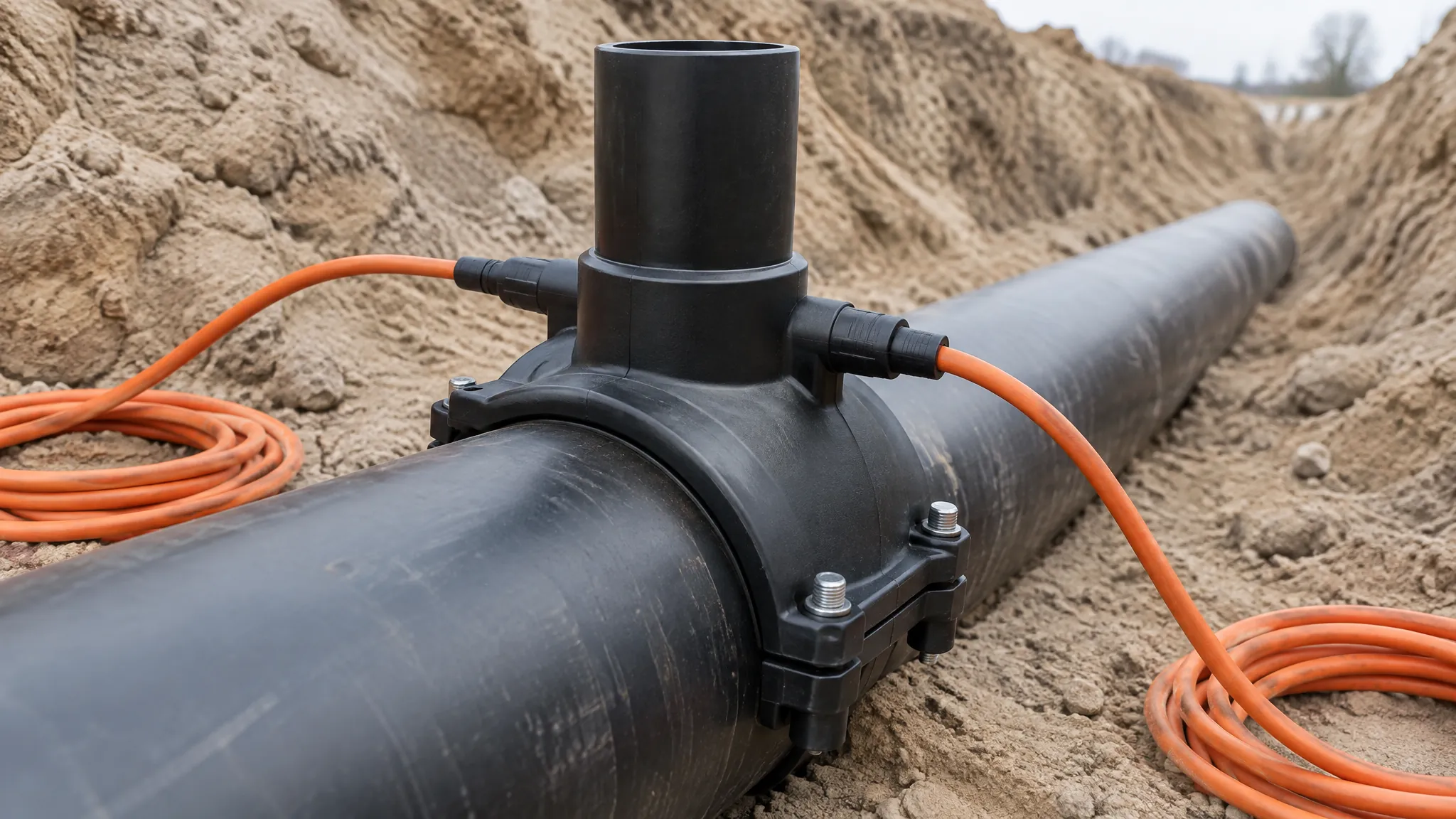
A 250 mm PE100 main runs live under a service road, and the drawing calls for a 32 mm domestic service off it. The schedule says HDPE saddle clamp, which is where the job starts to go wrong, because the phrase covers three products with three different consequences. An electrofusion tapping tee carries its own cutter and keeps the coupon inside the fitting body. A branch saddle has no cutter, so the hole is drilled in a separate operation with a separate tool. A mechanical clamp saddle does not fuse at all. Pick the wrong one and either the main comes down or the coupon goes into the network.
These are not catalogue distinctions: ISO 4427-3:2019 writes the cutter into the definition. And the melt indicator pins that crews read as proof of a sound joint prove nothing of the kind.
Key Takeaways
- A tapping tee cuts its own hole and keeps the coupon inside the fitting. A branch saddle needs a separate tool.
- That difference decides whether the main must be depressurised, which is the real constraint on a live network.
- Risen melt indicator pins are not acceptance. The industry guideline says they confirm only that melt pressure developed.
- ISO 11413 is a laboratory specimen-preparation standard. It sets no site acceptance criteria.
- What evidences a saddle joint: the peeled surface, the clamp held through cooling, and a six-field weld record.
- A listing citing ISO 8085-3 quotes a gas standard withdrawn in 2014.
- Tapping Tee, Branch Saddle or Clamp Saddle: The Difference Is Who Cuts the Hole
- Can the Main Be Shut Down? That One Answer Picks the Fitting
- Matching the Saddle to the Main: OD, SDR and Pressure
- The Indicator Pin Is Not an Acceptance Criterion
- What Actually Evidences the Joint: Prep, Clamping and the Weld Record
- What to Ask Before the Order Goes Out
- Conclusion
- Frequently Asked Questions
If you have never watched one go on, the Alliance for PE Pipe — an industry education alliance rather than a fittings supplier — films a small-diameter electrofusion saddle installation from start to finish.

Tapping Tee, Branch Saddle or Clamp Saddle: The Difference Is Who Cuts the Hole
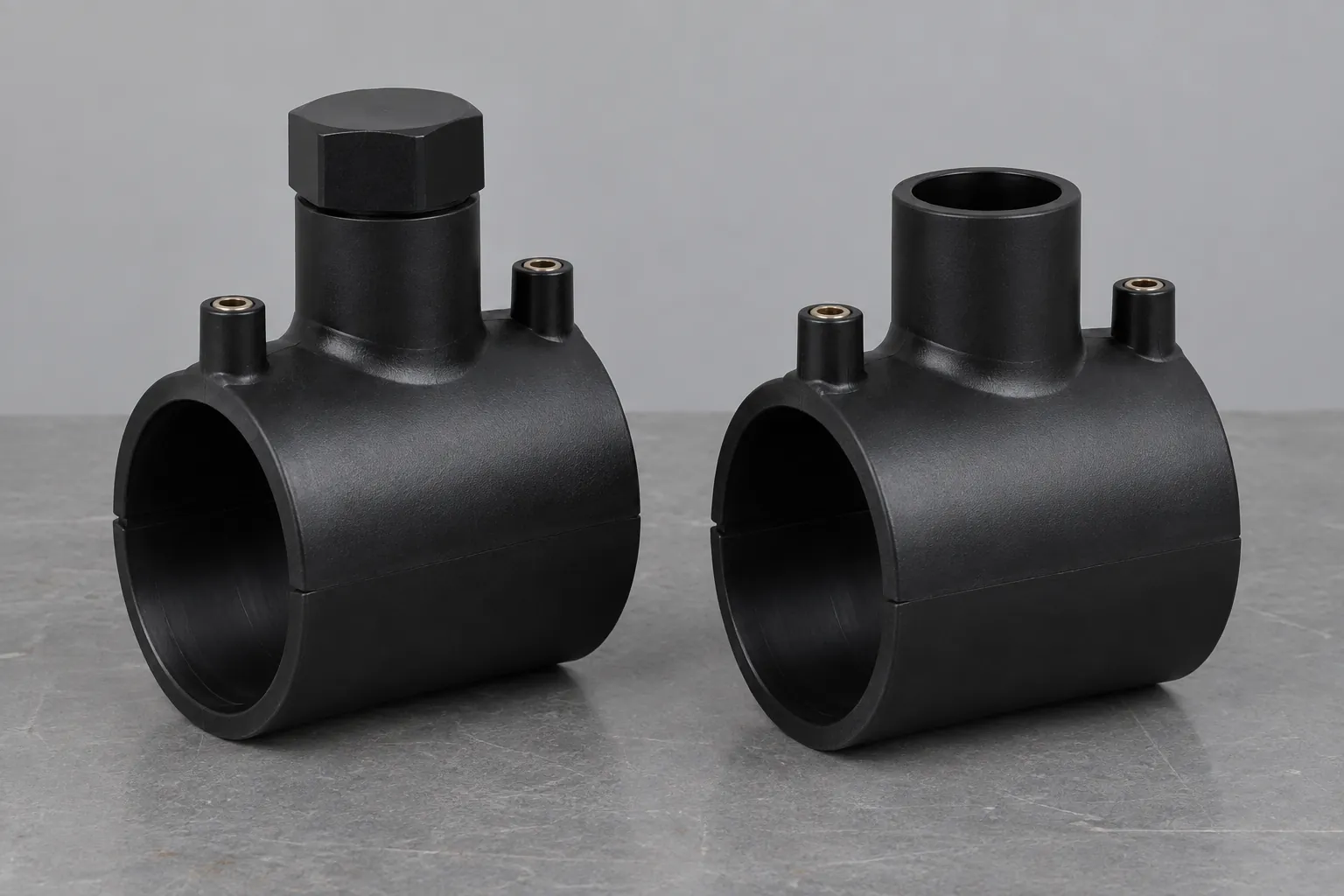
ISO 4427-3:2019 defines an electrofusion saddle fitting as a polyethylene fitting with heating elements built in, turning electrical energy into heat to fuse onto a pipe. Both fusion families sit inside that definition, and the standard scopes them to service up to 25 bar at 20 °C. The split between them is one clause lower, and it is about tooling rather than shape.
Clause 3.2.1 defines a tapping tee as a saddle fitting, top-loading or wraparound, carrying a cutter built into it “for cutting through the wall of the main pipe, which remains in the body of the tapping tee after installation”. Clause 3.2.2 defines a branch saddle as one “which requires an ancillary cutting tool for drilling the hole in the adjoining main pipe”. Read those against each other and the selection question resolves: the tapping tee brings the cutter and swallows the coupon, the branch saddle brings neither.
A mechanical clamp saddle keeps appearing under the same search term. It grips the main rather than fusing to it, the practical option where fusion equipment or a trained operator is unavailable. Our guide to HDPE pipe fusion methods sets out where a fused joint earns its cost over a gasketed one.
| Family | Who cuts the hole | Where the coupon ends up | Cut with main live? | Best for |
|---|---|---|---|---|
| Electrofusion tapping tee | Cutter built into the fitting | Retained inside the tapping tee body | Yes, where the fitting is rated for it | A service off a main that cannot be shut down |
| Electrofusion branch saddle | A separate ancillary cutting tool | Comes out with the tool | No, the drilling is its own operation | Planned tie-ins while the main is already down |
| Mechanical clamp saddle | A separate drill or tapping machine | Comes out with the tool | Depends on the tapping machine used | Transitions where fusion is not available |
Can the Main Be Shut Down? That One Answer Picks the Fitting
On a live network the shutdown is the expensive part: valves found and exercised, customers notified, the main drained, recharged and flushed. So the sequence runs opposite to the catalogue: establish whether the main can come down, and the family follows.
If it cannot, the connection is made and then cut, in that order, which is what the built-in cutter is for. The fitting fuses to a pressurised main, and only once the joint has cooled does the cutter go through the wall, the coupon captured where it cannot travel downstream. If the main can be taken out of service, a branch saddle becomes available and usually cheaper. On the 250 mm main above, that means one dig and a 32 mm outlet fused at leisure.
Two cautions. PIPA POP001 (Plastics Industry Pipe Association of Australia) describes under clamp-type saddle fittings that encircle the pipe on a built-in clamp and are often used with live tapping saddles, but publishes no under-pressure tapping procedure. Treat any generic live-tapping sequence with suspicion. Second, the cut waits until the joint has cooled for the period the fitting maker specifies, a manufacturer figure rather than an industry constant.
Matching the Saddle to the Main: OD, SDR and Pressure
A saddle body is moulded to one outside diameter: a 250 mm body does not sit on a 225 mm main, and a wraparound body changes how clamping load is applied rather than widening the fit. So OD is the first question, and it concerns the pipe in the ground, not the order.
Wall thickness is the question people skip. POP001 notes that electrofusion fittings can weld a range of SDRs, which describes capability rather than blanket permission: the range is the one the fitting maker declares, and no wall-thickness floor for saddle fusion is set. Obtain SDR compatibility in writing. A pressure rating quoted without its reference temperature is likewise incomplete.
| Parameter to confirm | Unit or form of answer | Why it decides the fitting | Governing document |
|---|---|---|---|
| Main outside diameter | mm (or in) | A saddle body is cut to one OD; near enough does not fuse | ISO 4427-3:2019 |
| Main SDR and wall thickness | SDR, dimensionless | A fitting covers several SDRs, but only those stated | PIPA POP001 cl. 3.2 |
| Maximum operating pressure | bar at 20 °C | The standard’s own ceiling is 25 bar at that temperature | ISO 4427-3:2019 |
| Outlet size and end type | mm, plus thread or spigot | Sets the service leg and the transition after it | ISO 4427-3:2019 |
| Service-side pipe standard | Standard designation | Governs the branch leg, 3/4 in to 3 in | ANSI/AWWA C901-2020 (North America) |
| Main-side pipe standard | Standard designation | Governs the main, 4 in to 65 in | ANSI/AWWA C906-2021 (North America) |
Procurement teams buying at container volume can see the range on the HDPE pipe and fittings catalogue, then take the six lines above to the supplier as written questions. One further check costs nothing: a listing citing ISO 8085-3 quotes a standard withdrawn on 13 January 2014 and revised by ISO 4437-3:2014, and ISO 8085 covered gas fittings. On a potable-water enquiry it is wrong twice.
The Indicator Pin Is Not an Acceptance Criterion
Here is the belief that costs projects money. The joint on the 250 mm main is fused, the pins rise, the crew signs it off, and the trench is backfilled.
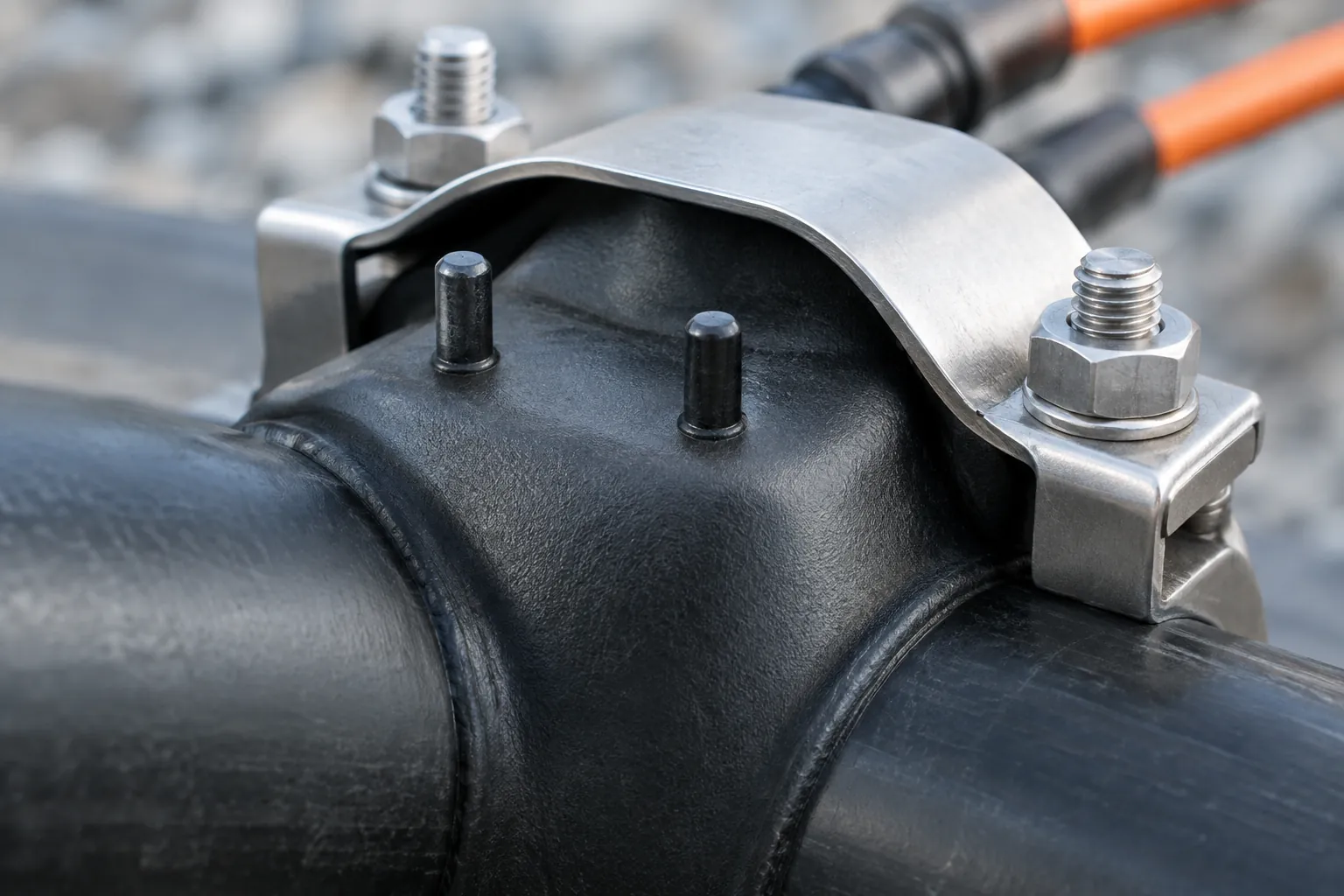
The guideline says otherwise in one sentence. PIPA POP001, Issue 9: “The melt indicator pins confirm that some melt pressure has developed in the weld. They are not a confirmation of a successful weld.” A pin is a pressure telltale: it reports that material expanded far enough to push it up, which happens over a surface that was never properly prepared.
The pin check remains a legitimate step, which is why the confusion persists. The GF Piping Systems checklist lists checking that the pins have fully risen as a post-weld action, alongside the instruction not to remove alignment clamps until cooling time elapses. A process step and an acceptance criterion are different objects.
A standard gets misquoted here too. ISO 11413:2019 appears in specifications as though it sets site acceptance criteria. Its title is “Preparation of test piece assemblies between a polyethylene (PE) pipe and an electrofusion fitting”: it covers how laboratory specimens are assembled so destructive tests run reproducibly. It carries no field acceptance criteria, so a specification leaning on it leans on nothing. The field-practice document that does exist is ASTM F1290-19, “Standard Practice for Electrofusion Joining Polyolefin Pipe and Fittings” — a practice for making the joint, not a criterion for accepting one.
What Actually Evidences the Joint: Prep, Clamping and the Weld Record
Three things carry the evidence, and none is visible after backfill. The first is surface preparation. POP001 is explicit that hand scrapers must not be used for peeling, though they stay acceptable for deburring pipe ends. A hand scraper removes an unverifiable amount of the oxidised skin. The peeled length is set from the fitting: GF Piping Systems has its operators measure half the fitting length plus 20 mm, over at least two passes.
The second is restraint. Clamps stay in place throughout the fusion and cooling periods, and the joint cools in ambient conditions rather than being hurried with cool water. Many disputed saddle joints were disturbed while still soft rather than welded wrongly.
The third is paperwork, the only one that survives to arbitration. Fusion parameters are not typed in: the fitting’s barcode is read automatically by the scanner into the welding machine, so the cycle that ran is recoverable. POP001 clause 8 and Appendix A set a minimum weld record covering project, welder, equipment, pipe and fitting, with anything further left to the asset owner.
| Record field | What the entry identifies | Why it matters when a joint is disputed |
|---|---|---|
| Project | Site, main reference and joint location | Ties the record to one connection, not a day’s work |
| Welder | Operator identity and qualification | A joint is only as traceable as the person who made it |
| Equipment | Control box serial number and calibration status | An uncalibrated box invalidates every cycle it ran |
| Pipe | Manufacturer, batch and SDR of the main | Proves the fitting matched the pipe actually there |
| Fitting | Manufacturer, type and barcode or batch | The barcode carries the cycle the machine ran |
| Asset owner additions | Whatever the client specification names | POP001 defers the remainder to the asset owner |
What to Ask Before the Order Goes Out
IFANPRO’s own saddle listings, like most in this category, carry a standard designation and a photograph rather than an outlet range, an SDR window or a cooling time. So the specification gets built from questions, not lifted from a page.
Ask for four things in writing. The declared main OD and SDR range for the exact saddle, not the family. The maximum operating pressure with its reference temperature. The cooling time before the joint may be tapped, pressurised and backfilled, a manufacturer figure for that fitting and size. And the weld-record fields the fittings support, since a barcode the control box cannot read is a traceability gap found on site. For the service leg in North America, ANSI/AWWA C901-2020 covers 3/4 in to 3 in; outside that market the equivalent national pipe standard governs instead.
Lead time is driven less by moulding than by which outlet sizes are held as stock. A main-OD-and-outlet pairing inside the standard range usually ships from inventory, while an unusual pairing, a wraparound body, or market-specific marking moves the order onto a production run. So the useful question is not how long, but which pairings are stocked today, what quantity moves one onto a run, and the run length.
| Size limit stated in the standard’s own title | C901-2020 (in) | C906-2021 (in) |
|---|---|---|
| Smallest covered | 0.75 | 4 |
| Largest covered | 3 | 65 |
Conclusion
The family is decided by who cuts the hole, and that decides whether the main stays up. Acceptance rests on the peeled surface, the clamp held through cooling and a weld record with named fields, never on a pin that only reports melt pressure. Specify main OD, SDR window and pressure rating with its temperature.
If you are matching saddles to an existing main, send the main’s OD, SDR and operating pressure with the outlet size you need, and our technical team will confirm what fits before anything is quoted.
Frequently Asked Questions
What is the difference between a tapping tee and a branch saddle?
A tapping tee has an integral cutter and the cut coupon stays inside the fitting body after installation. A branch saddle has no cutter and needs an ancillary tool to drill the main. ISO 4427-3:2019 uses that difference as the definition of each fitting.
Can you tap an HDPE main while it is under pressure?
Yes, with a fitting rated for it: the saddle is fused first, then the integral cutter goes through the wall once the joint has cooled. PIPA POP001 names fully encircling clamp-type saddles as the type used for live tapping but publishes no procedure, so work to the fitting manufacturer’s instructions.
Do raised melt indicator pins mean the weld is good?
No. PIPA POP001 Issue 9 states that the pins confirm only that some melt pressure has developed in the weld and are not a confirmation of a successful weld. Treat the pin as a process step and rely on surface preparation, clamping through cooling, and the weld record.
Does ISO 11413 set acceptance criteria for electrofusion joints on site?
No. ISO 11413:2019 covers the preparation of test piece assemblies between a PE pipe and an electrofusion fitting, for laboratory testing. It defines no field acceptance criteria, so a site specification cannot rely on it for joint sign-off.






 Français
  English
  Русский
  Español
Commentaires récents