
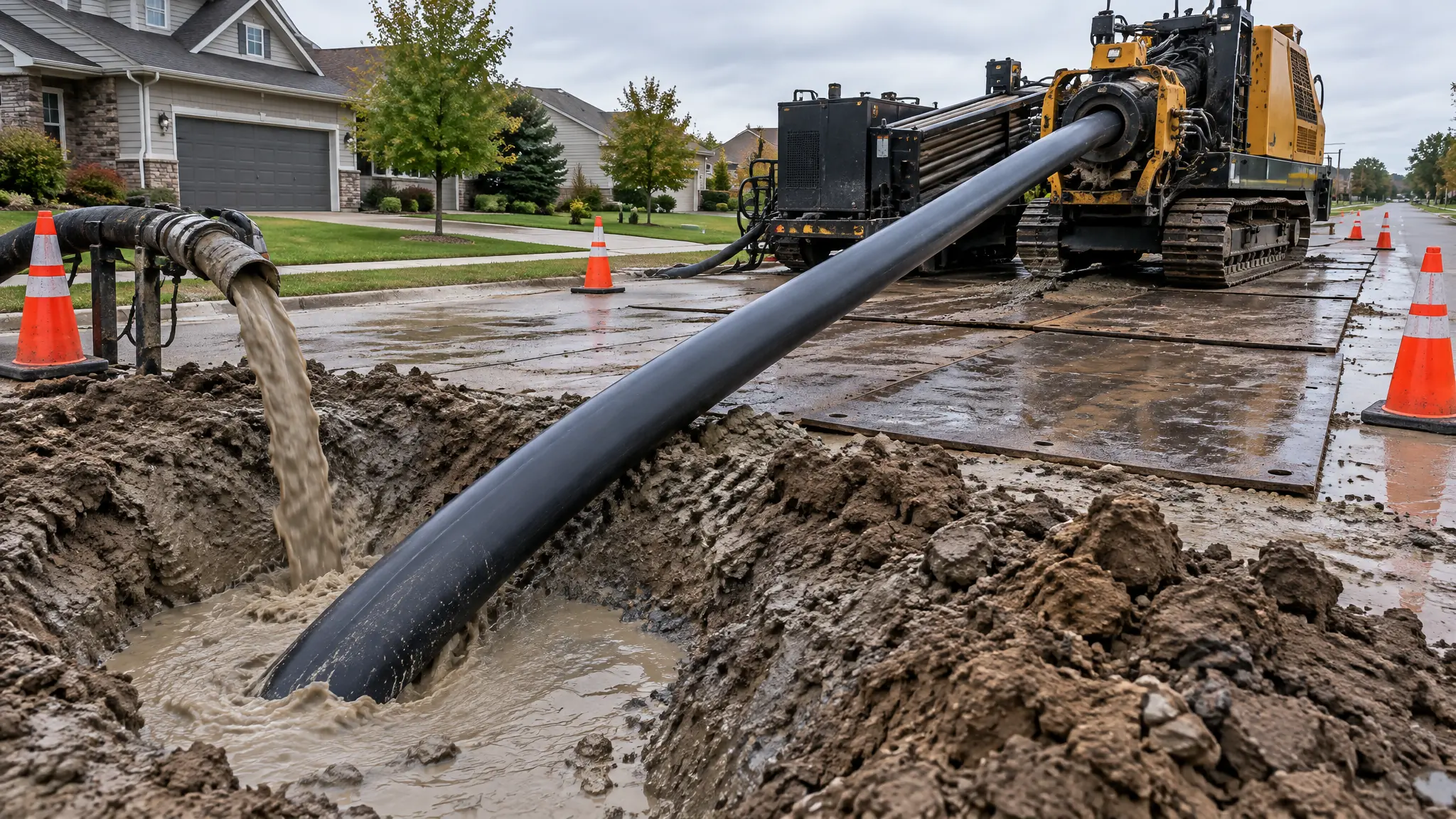
You priced HDPE for a job, the contractor changed the installation method, and nobody re-checked the pipe. That is the order that goes wrong. HDPE pipe for trenchless installation is specified against the pulling load, not the buried service pressure, and the three common methods load it in three different ways.
The short answer: for directional drilling, size the wall so predicted pullback tension stays under the pipe’s safe pull tension, which the Plastics Pipe Institute bases on a safe tensile stress of 1,350 psi held for one hour. For pipe bursting there is no accepted pull-force formula, so the specification — resin grade and a surface-damage limit — carries the risk. For sliplining the pull is low and predictable, and clearance binds.
Key Takeaways
- Safe pull tension comes from a stress limit, not from the pipe’s tensile strength: 1,350 psi on the pipe cross-section for a one-hour pull, per PPI TR-46. PE4710 gets about 1.05× that; MDPE about 0.80×.
- Moving 4 in pipe from DR 17 to DR 11 raises the allowable pull from 5,040 lb to 7,524 lb. The ratio is 1.49× at every size in the table.
- Route curvature beats route length: predicted tension carries a 1.6 factor for every 90° of cumulative bend, planned or not.
- ASTM F1962 is titled for maxi-HDD. PPI TR-46 covers mini-HDD and is deliberately more conservative. Neither one governs pipe bursting.
- PPI states in writing that no generally accepted pull-force procedure exists for pipe bursting. The enforceable clause there is scratch depth: under 10% of wall thickness, checked at the exit pit.
- The “radius of curvature 100× the diameter” rule quoted all over this topic is a steel rule. For PE in HDD the drill string, not the pipe, sets the bend limit.
The operation this arithmetic governs, filmed by the Plastics Pipe Institute:
The Method Decides the Load, and the Load Decides the Pipe
In a directional drill the pipe is pulled through a fluid-filled bore, and tension is drag multiplied by every bend in the path. In pipe bursting the same pipe is dragged through the shattered remains of a clay or cast iron main, in contact with fragments throughout. In sliplining it slides down an intact host pipe. Three loads, one purchase order naming none of them.
PPI’s Municipal Advisory Board puts it directly: in most trenchless applications the pipe that withstands the pulling stresses will also withstand vertical overburden and traffic pressures. Installation governs. On a 4 in line wall thickness fixes the allowable pull long before soil load matters; the exceptions PPI names, very deep or very shallow runs, need their own check.
| Method | What loads the pipe | What sets the wall thickness | Verdict: grade to specify | Governing document |
|---|---|---|---|---|
| Maxi-HDD (river and obstacle crossings) | Frictional drag plus bore curvature, amplified by each bend | Predicted pullback tension against safe pull tension | PE100 / PE4710; PE100-RC where contact risk is high | ASTM F1962 |
| Mini-HDD (distribution, short shallow bores) | Same, at shorter length and shallower depth | Same test, on a deliberately more conservative basis | PE100 / PE3608 / PE4710 | PPI TR-46 (2009) |
| Pipe bursting and splitting | Drag plus continuous contact with host pipe fragments | No accepted formula; set by surface-damage limits and experience | PE100-RC or PE4710 — the named case for RC grade | PPI MAB-5; AWWA C622; PE Handbook Ch. 16 |
| Sliplining | Low, predictable pull inside an intact host pipe | Ring stiffness as an independent liner, not the pull | PE100 is normally sufficient | Liner designed as fully structural |
Source: Load and governing-document columns from PPI TR-46 (2009) clauses 1.3, 1.4 and 2, and from the PPI Municipal Advisory Board pipe bursting design guidelines (Maximum Allowable Tensile Load, Selection of Pipe SDR). Verdict column from TEPPFA RP-EX-202410-21, which names HDD, pipe bursting and close-fit relining among the methods behind the PE100-RC designation; it is this article’s reading of that list applied to each method.
How to Size HDPE for an HDD Pullback, Step by Step
- Get the bore length and the bends. Count planned direction changes plus unplanned undulations; two 45° corrections make one 90° bend.
- Work out buoyant weight. Roughly half the square of the outside diameter in inches, minus the pipe’s own weight per foot.
- Predict the peak tension. Bore length × buoyant weight × one third, multiplied by 1.6 raised to the number of 90° bends.
- Read the allowable off Table 2 for size and DR, then correct: ×1.05 for PE4710, ×0.80 for MDPE.
- Compare. Predicted tension must sit at or below safe pull tension. If not: drop a DR step, shorten the run, or take bends out.
| Nominal size (in) | DR 11 (lb / kN) | DR 13.5 (lb / kN) | DR 17 (lb / kN) | DR 21 (lb / kN) |
|---|---|---|---|---|
| 4 | 7,524 / 33.5 | 6,244 / 27.8 | 5,040 / 22.4 | 3,895 / 17.3 |
| 6 | 16,307 / 72.5 | 13,533 / 60.2 | 10,924 / 48.6 | 8,442 / 37.6 |
| 8 | 26,844 / 119.4 | 22,278 / 99.1 | 17,982 / 80.0 | 13,897 / 61.8 |
| 12 | 60,398 / 268.7 | 50,125 / 223.0 | 40,461 / 180.0 | 31,268 / 139.1 |
Source: PPI TR-46 (2009) Table 2, based on a safe tensile stress of 1,350 psi applied to the pipe cross-section for a cumulative load duration of one hour. DR 21 carries an explicit footnote against typical mini-HDD use. Multiply by about 1.05 for PE4710 and 0.80 for MDPE.
| Dimension ratio (DR) | 4 in nominal (lbf) | 6 in nominal (lbf) |
|---|---|---|
| DR 11 | 7524 | 16307 |
| DR 17 | 5040 | 10924 |
| DR 21 | 3895 | 8442 |
A worked case, and why thin wall fails first
Take 4 in DR 17 PE3608, a straight 400 ft bore, buoyant weight around 2 lb/ft. Predicted tension is 400 × 2 ÷ 3, about 267 lb against an allowable of 5,040 lb. Stretch the run to 900 ft and add two 45° corrections: the length term triples, the 1.6 factor applies once, and the prediction lands near 960 lb — still inside. On pull load alone PPI shows DR 11 clearing 1,050 ft of straight bore, past the 600 ft nominal limit of mini-HDD equipment.
| Bore length (ft) | n = 0, straight (lbf) | n = 1 bend (lbf) | DR 17 allowable (lbf) | DR 11 allowable (lbf) |
|---|---|---|---|---|
| 200 | 133 | 213 | 5040 | 7524 |
| 400 | 267 | 427 | 5040 | 7524 |
| 600 | 400 | 640 | 5040 | 7524 |
| 800 | 533 | 853 | 5040 | 7524 |
| 1000 | 667 | 1067 | 5040 | 7524 |
| 1200 | 800 | 1280 | 5040 | 7524 |
The trap is elsewhere. Thin wall fails first, which is why TR-46 advises against anything thinner than DR 17 for typical mini-HDD and footnotes DR 21 as not recommended: the collapse case, not the tension case. Moving DR 17 to DR 11 also moves PE100 from PN10 to PN16 — a different pressure class and price, asked for or not. Our HDPE pipe sizing and pressure rating reference has the SDR-to-PN ladder.
Pipe Bursting: No Pull-Force Formula, So the Specification Carries the Risk
One sentence should change how this is bought. PPI’s Municipal Advisory Board states that estimating the pulling force for a bursting run is very difficult and that no generally accepted procedure exists — too many interacting variables: host pipe strength, backfill, upsize, bursting system, overcut. A designer can borrow the HDD arithmetic as a sanity check. A buyer cannot treat it as the spec.
The controls move to the pipe and to acceptance criteria. Three belong in the spec.
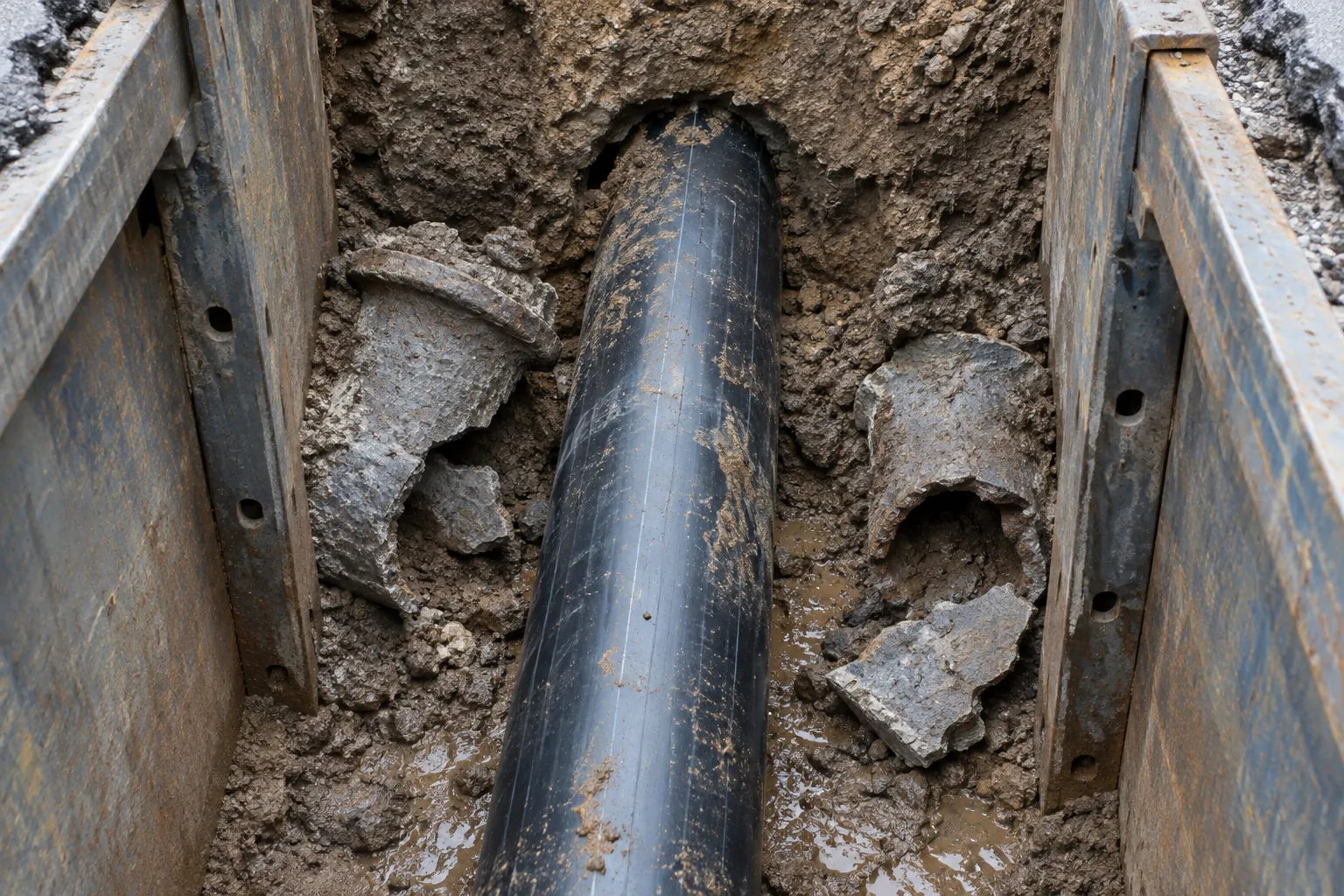
- Scratch depth. Visible scratches must be under 10% of wall thickness, inspected on the pipe’s leading end at the exit pit. Upsizing more than one size needs extra care, especially over ductile iron.
- Resin grade. That damage tolerance is the argument for PE100-RC, the grade the EN and ISO framework names for HDD, bursting, close-fit relining and sand-free trenching. It shares PE100’s MRS of 10.0 MPa, so dimensions and pressure class do not change.
- Overcut and lubrication. The contractor’s levers when loads run high: a head about an inch larger, leaving roughly half an inch of overcut, with bentonite or polymer injected behind it.
One dimension comes back to the pipe. The insertion shaft must be long enough for the pipe to bend into it, and PE cold-bends to 25 to 30 times its OD depending on SDR. PPI’s example: an 18 in SDR 17 pipe needs a flat section of 12 diameters, 18 ft, plus a sloped section 2.5 times the shaft depth. A tight site limits diameter, better found at quotation than the pit. On grade, PE80 vs PE100 vs PE100-RC sets out what each is certified to do.
Sliplining: The Pull Is the Easy Part, the Clearance Is Not
A common claim about sliplining is that it puts no tension in the pipe. It does: the liner is pulled through the host, as PE100+ describes. What changes is that the pull happens inside an intact, round pipe rather than a drilled bore, so the load is lower and more predictable.
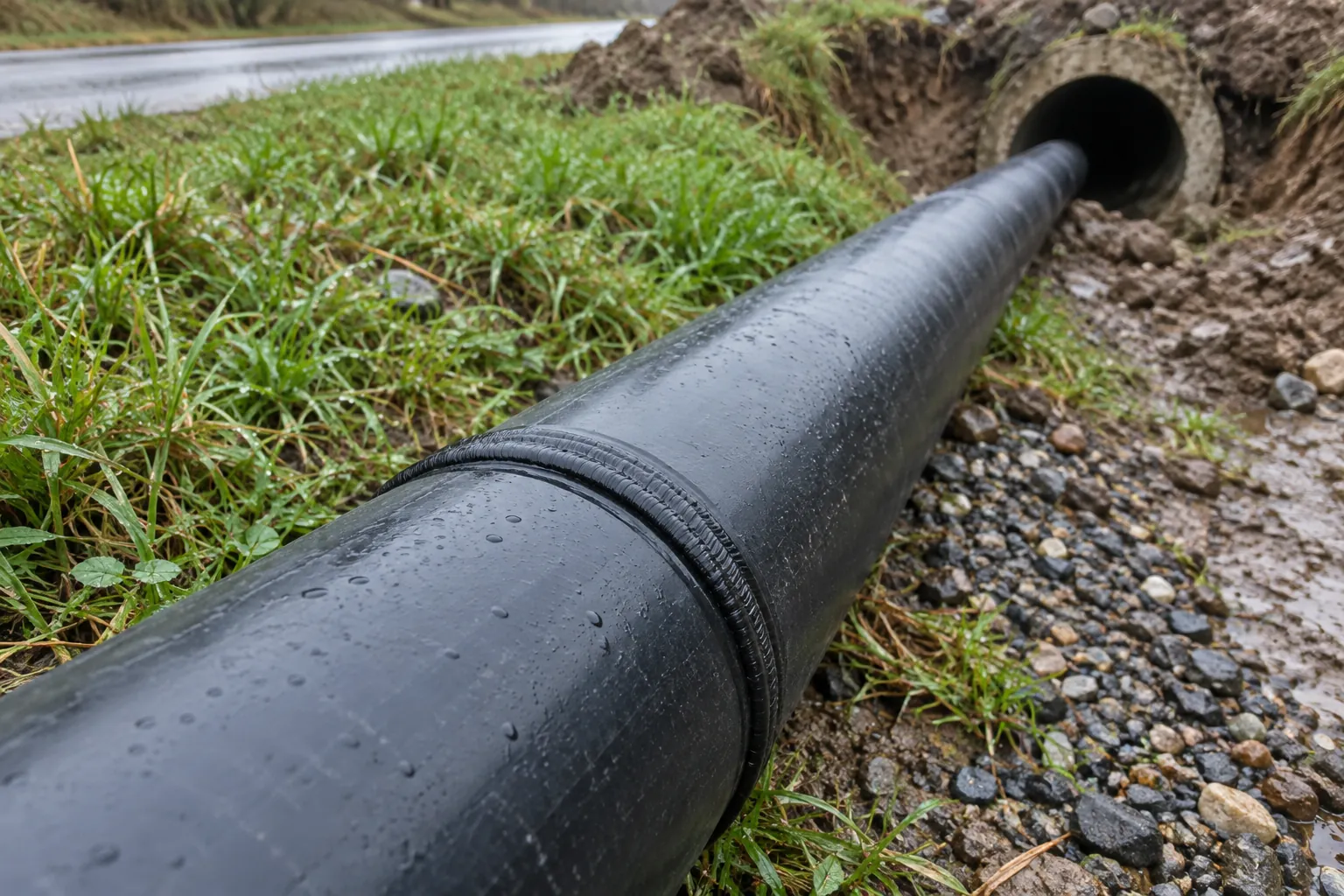
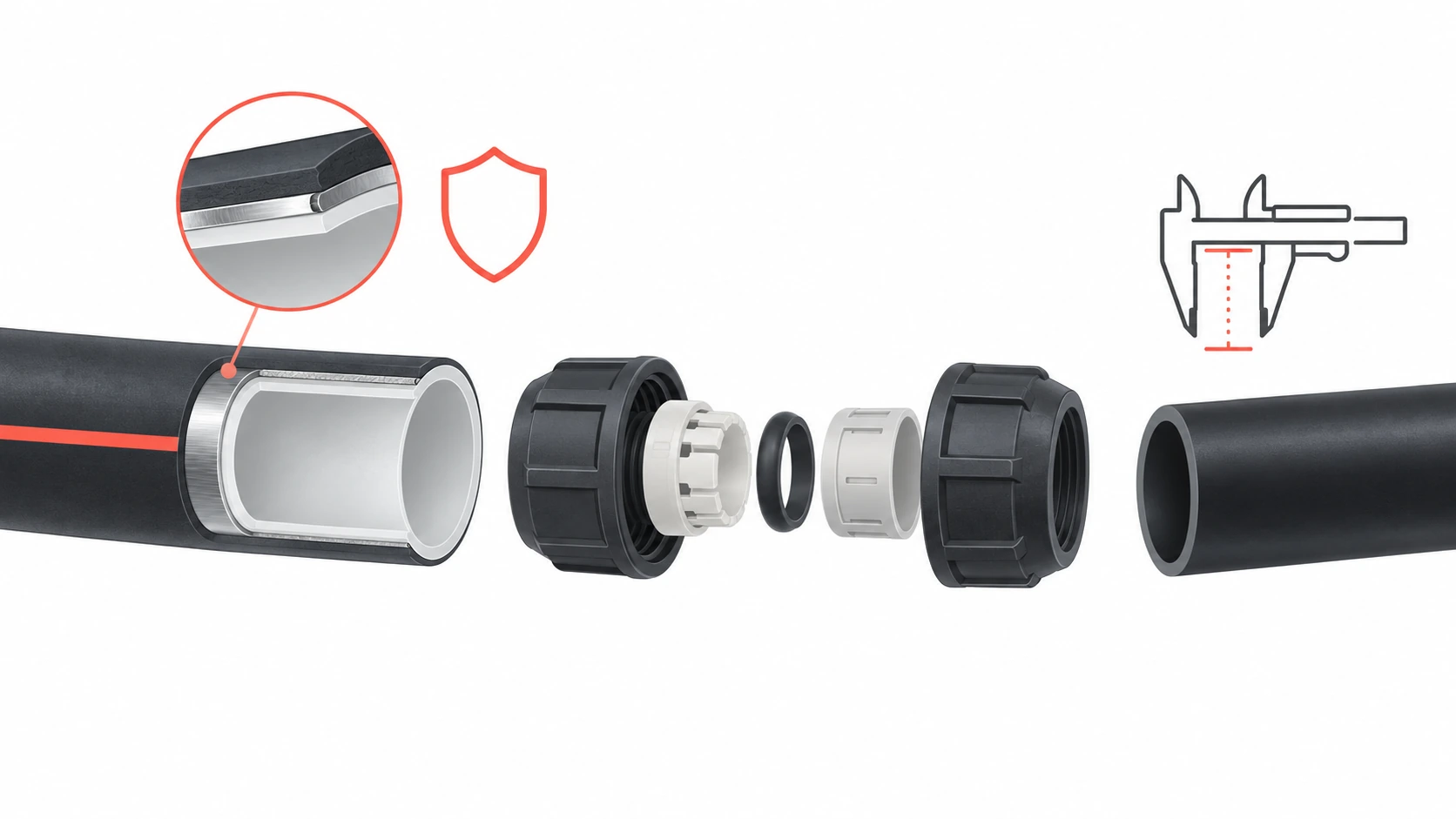
Diameter is what bites. The liner has to fit, and so does everything on it: a butt-fused joint carries an external bead, so the controlling dimension is the OD at the weld, not the catalogue OD. Check the fused OD against the host’s real bore, scale included, before the fusion method is agreed — our guide to HDPE fitting connection methods covers what each joint adds.
The second trade-off is hydraulic: a loose liner costs capacity, which is why it is normally designed as a fully structural independent pipe rather than a skin leaning on the host. Ring stiffness, not pull load, sets the wall — and whatever SDR that lands on fixes the pressure class, 10 bar at SDR 17 in PE100.
Failure Modes, and What We Check Before the Container Loads
Four things go wrong, and all four are specification gaps, not site accidents. A pipe sized on service pressure meets a curved bore and yields. Thin-wall DR chosen for economy collapses under drilling fluid long before the tension limit. Standard PE100 pulled through burst cast iron arrives with gouges over the 10% limit and is rejected at the exit pit. Last, a fusion bead that will not pass the host bore, found after the string is fused.
All four are avoidable at enquiry stage, and none is answerable from a catalogue page. Ours included: a live check of our HDPE pipe and fittings catalogue on 19 September 2026 found twelve products and no mention of SDR, PE100 or ISO 4427 — the only pressure designation on it is PN10, on a saddle clamp. Category pages sell shapes; trenchless jobs buy numbers.
What we check, and where we stop
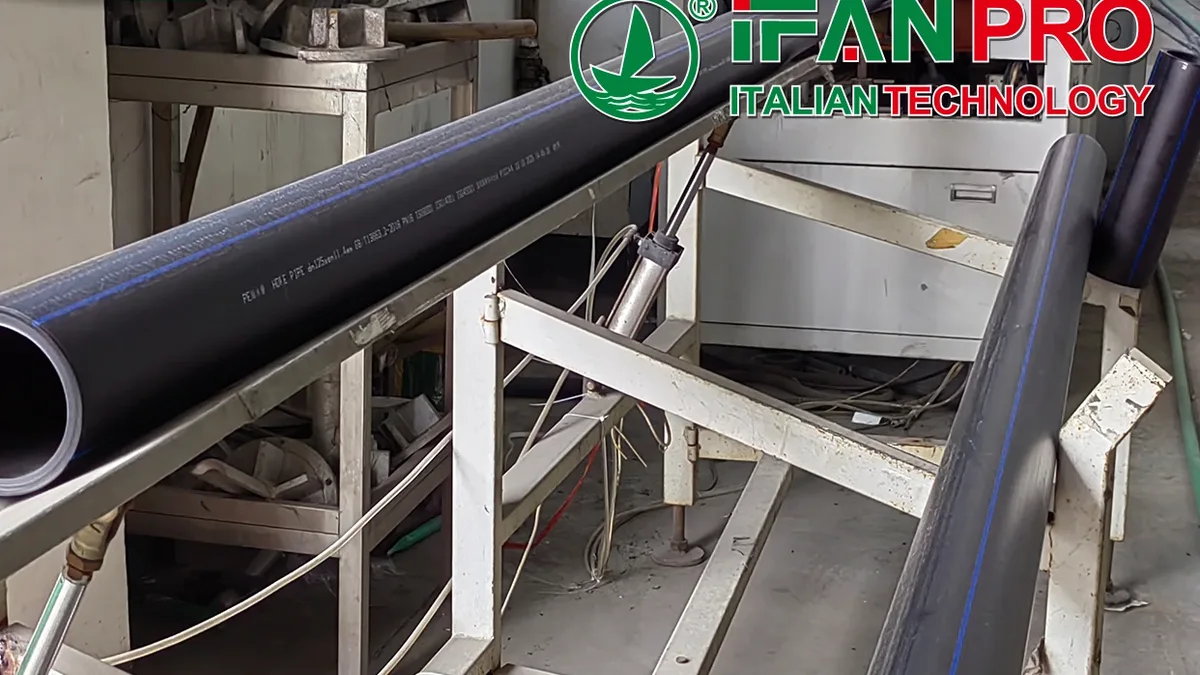
What IFANPRO will put in writing is the print: OD and wall against the DR you called, plus the standard, grade and production code on the barrel, photographed before loading. What nobody can hand you is a pull-test record for your bore — that calculation is the project engineer’s.
Put these on the enquiry: method and bore length; number and angle of bends; cover depth; host pipe material and bore, where there is one. Then the pipe: required DR and the standard it is called to, ISO 4427 or ASTM F714; resin grade, including whether PE100-RC is required; the marking you will inspect. Photographed before shipment, that list is what catches a substituted SDR while the container is still in the yard.
Frequently Asked Questions
Does ASTM F1962 apply to pipe bursting?
No. Its title scopes it to maxi-horizontal directional drilling for placing polyethylene pipe under obstacles, including river crossings. PPI TR-46 covers mini-HDD on a deliberately more conservative basis. For pipe bursting, PPI states that no generally accepted pull-force procedure exists, and points to MAB-5, AWWA C622 and Chapter 16 of the PE Handbook instead.
What is the minimum bend radius of HDPE pipe for directional drilling?
Not the figure usually quoted. The rule that radius of curvature in feet should be at least 100 times the diameter in inches is an ASTM F1962 rule of thumb for steel pipe or drill rod. PPI TR-46 says the product pipe’s allowable radius comes from the manufacturer, and that PE is flexible enough that the drill string’s bend limit governs the path, not the pipe’s.
What SDR should I use for HDD?
The one that passes the tension check for your bore. Predicted pullback tension must stay at or below the safe pull tension for that size and DR: for 4 in PE3608 that is 5,040 lb at DR 17 and 7,524 lb at DR 11. PPI advises against anything thinner than DR 17 for typical mini-HDD work, with DR 21 explicitly footnoted as not recommended.
Do I need PE100-RC for trenchless installation?
It depends on contact risk. PE100-RC is the grade the EN and ISO framework names for HDD, pipe bursting, close-fit relining and sand-free trenching, because those methods put the pipe against fragments and stones. It carries the same MRS of 10.0 MPa as PE100, so it does not raise the pressure class or change the dimensions for a given SDR.
Conclusion
The expensive version of this mistake is a 900 ft string of fused HDPE beside an open pit while somebody works out that the DR on the delivery note was chosen for a service pressure nobody will see for decades. Tension governs the drill, damage tolerance governs the burst, clearance governs the liner, and none of the three is on a product page. Decide the method before the pipe, run the tension check, and write the DR, resin grade and standard onto the order.
On the material decision that comes first, HDPE vs PVC for underground water mains. To have the DR and grade checked against a bore before you commit to a container, talk to our technical team.






 Français
  English
  Русский
  Español
Commentaires récents