
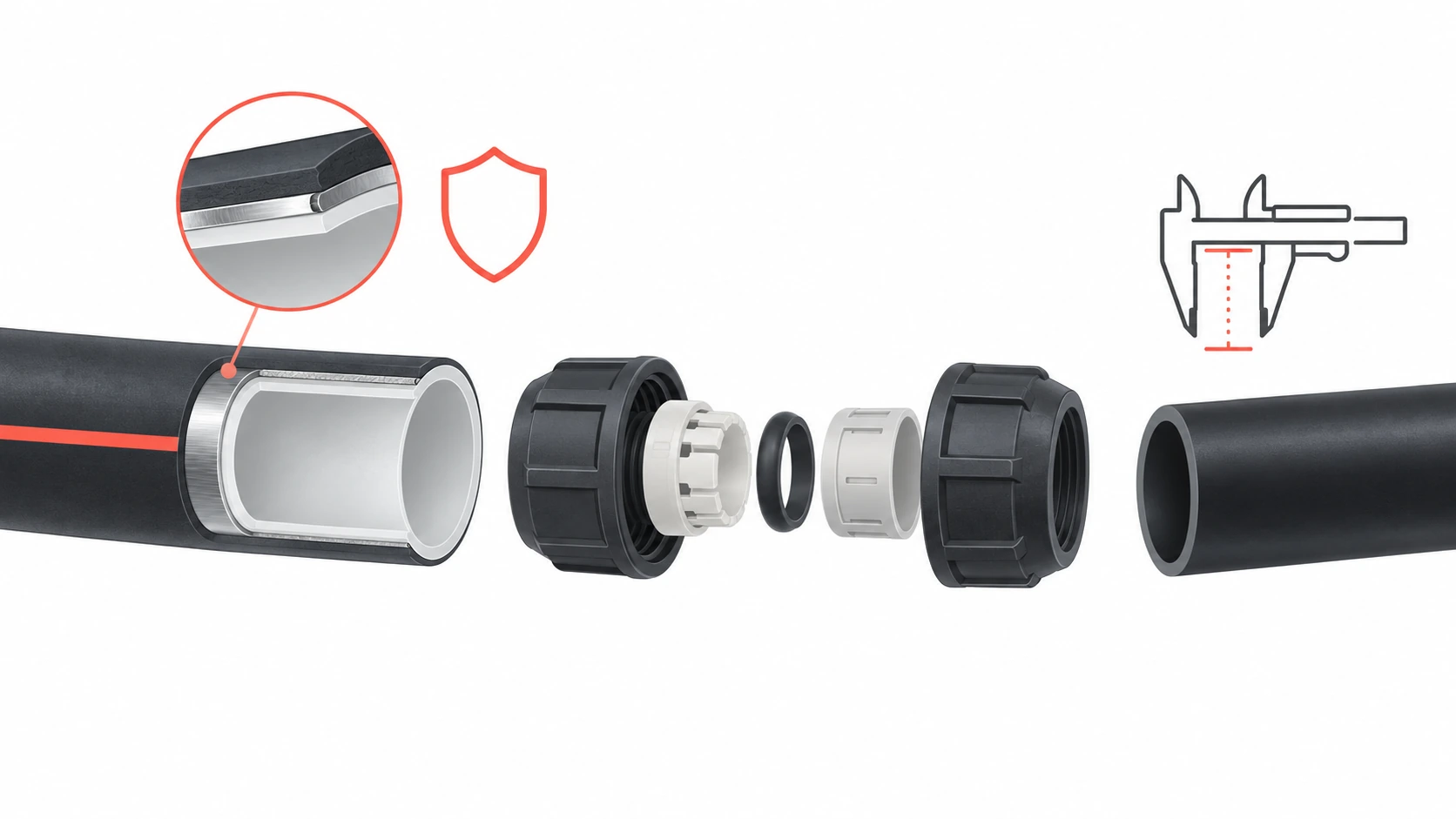
A standard PE reducer is not automatically suitable for barrier water pipe. Barrier pipe can have a larger outside diameter than its nominal size, and the fitting must protect the pipe end and maintain the specified contamination barrier. Use a documented barrier-compatible fitting or the exact approved conversion kit, and confirm that the route permits a transition to ordinary PE; a watertight connection alone does not settle either question.
The nominal size does not tell you whether the fitting fits
The number printed on a barrier pipe is a size designation, not a reliable instruction to buy the same-number ordinary PE fitting. A barrier construction adds layers around the carrier pipe. The resulting outside diameter can exceed the nominal designation; the connector must accommodate that actual pipe surface and its permitted dimensional range.
PLASSON’s July 2026 catalog publishes the following mean outside-diameter ranges for the barrier sizes covered by its fitting range. These are the catalog’s stated barrier-pipe ranges, not a dimensional specification for every multilayer pipe sold worldwide.
| Nominal barrier size | Minimum mean OD | Maximum mean OD |
|---|---|---|
| 25 mm | 26.2 mm | 27.78 mm |
| 32 mm | 33.3 mm | 34.78 mm |
| 63 mm | 64.3 mm | 67.75 mm |
For a nominal 32 mm barrier pipe in that published range, choosing a plain connector solely because its label says 32 mm leaves a real mismatch unresolved. The useful comparison is the exact pipe brand, construction and outside diameter against the connector’s documented acceptance. Do not remove the protective outer construction to make the pipe resemble an ordinary PE size unless the selected system’s manufacturer expressly specifies that preparation.
A legacy example shows why the distinction matters. Wavin’s older Trigon product and installation guide lists a nominal 32 mm pipe with a 34 mm outside diameter and fittings designed for that system. This is historical product information, not evidence that current Trigon supply, approval or every other barrier brand has the same dimensions.
A leak-tight joint is only half the acceptance question
A pressure-tight connection stops water escaping under the test conditions. Contamination protection asks a different question: can chemicals outside the buried system reach the drinking water through the pipe wall or a component of the joint? A successful pressure test does not measure that chemical transport mechanism.
The Plastics Pipe Institute’s Statement N, reaffirmed in 2021 describes permeation through buried pipe walls and components such as gaskets. It also explains that contamination outcome depends on the contaminant, exposure conditions, soil, pipe dimensions and water flow. The practical implication is neither “all plastic is unsafe” nor “a dry-looking joint is protected.” The specification must address the actual exposure and the complete piping system.
At a cut end, the fitting has more work to do than gripping an enlarged diameter. In the current PLASSON catalog, the barrier design keeps the protective aluminium layer from contacting drinking water, and the manufacturer reports permeation-test certification for named barrier-pipe brands. Treat this as evidence for that documented fitting and compatible system, not proof that any brass or polypropylene connector provides the same protection.
The acceptance questions therefore remain separate: does the assembly fit and restrain the pipe, does it meet the pressure duty, and does its documented construction preserve the required contamination protection? A generic seal, pipe insert or reducer might answer one of these while leaving the others open.
Three connection types that must not be confused
Three catalog entries can sound like interchangeable answers to a reduction enquiry. They serve different connections. Keeping them separate prevents a product photograph or a nominal size from doing the work of a compatibility statement.
| Connection type | What the documentation establishes | What it does not establish |
|---|---|---|
| Barrier-to-barrier reducing coupler | PLASSON lists a dedicated 32 × 25 mm reduction between stated barrier sizes. | Permission to put ordinary 25 mm PE on the barrier end. |
| Barrier-to-metric-PE coupler | Barrier-to-metric PE connector; published PLASSON entries include equal nominal sizes. | Approval for every reducing elbow, different-brand kit or contaminated route. |
| Manufacturer conversion kit | PLASSON-specific kit for its metric fittings; replacement components and assembly instructions govern compatibility. | A generic insert that can be fitted to any manufacturer’s connector. |
The kit route is a useful example of a conditional yes. A standard fitting body may form part of a barrier-compatible assembly when the manufacturer documents the exact conversion. That is different from claiming that an unmodified ordinary fitting is already suitable. The body, nut, grip, adaptor and pipe end form an assembly; substituting one piece can change what the evidence covers.
Likewise, a barrier-to-metric transition is a legitimate product category. Its existence establishes that a transition can be engineered. It does not decide where the barrier requirement ends along a particular service route.
The 32-to-25 mm elbow question: which unknown changes the answer?
The issue appears in a real public enquiry posted in January 2026: the installer wanted to connect nominal 32 mm MDPE barrier pipe to 25 mm non-barrier pipe at an elbow, reducing the number of buried joints. The attraction is clear: a compact connection can be easier to fit into the existing route. Fewer joints, however, do not resolve compatibility at the remaining joint.
For that enquiry, a plain 32-to-25 reducing set is insufficient evidence by itself. The barrier side still needs a fitting configuration that accepts its actual OD and protects its cut end; the ordinary side must be documented for ordinary metric PE. A catalog’s 32-to-25 barrier reducer instead describes barrier pipe on both sides. An equal-size barrier-to-metric coupler establishes a transition, but not the requested reduction and change of direction in one component.
An explicitly supported reducing-elbow assembly or a manufacturer-approved conversion of the relevant connector could answer the connection problem. The information saved for this article does not approve a particular combination for the forum installation. The unresolved inputs are the barrier pipe’s exact brand and OD, the fitting and kit codes, the manufacturer’s compatibility instructions, and the authority’s accepted transition location. Once those are available, accept only a configuration documented for both pipe ends and the protected route; otherwise revise the assembly or retain barrier pipe through the relevant segment.
This is a selection decision, not a substitute installation procedure. Cutting, preparation, insertion and tightening requirements belong to the selected assembly’s current instructions. Instructions from an older barrier system must not be copied onto a different fitting just because the sizes appear similar.
Where the barrier is allowed to end
A mechanically correct transition can still put the wrong pipe into the ground. If the downstream ordinary-PE segment remains exposed to a contamination condition that requires a barrier system, changing connector type has not removed that requirement. The transition point needs a route/material decision as well as a fitting decision.
PE100+ Association’s soil-permeation guidance recommends soil analysis before laying pipe through known contaminated ground and notes that water companies apply their own classification and pipe-selection practices. It also recommends avoiding heavily contaminated routes for drinking-water pipes of any material. Statement N similarly calls for case-specific analysis where contamination is known or suspected.
These sources do not supply a universal safe distance beyond which barrier pipe may become ordinary PE. Soil analysis, the planned route and the water undertaker’s applicable requirements establish the boundary. If the protected route continues, keep the specified protection continuous. If a clean downstream segment is accepted for ordinary PE, the transition can be evaluated there using its documented system connection. Unknown ground conditions are a missing design input, not an automatic approval to end the barrier.
A connection schedule the reviewer can accept or return
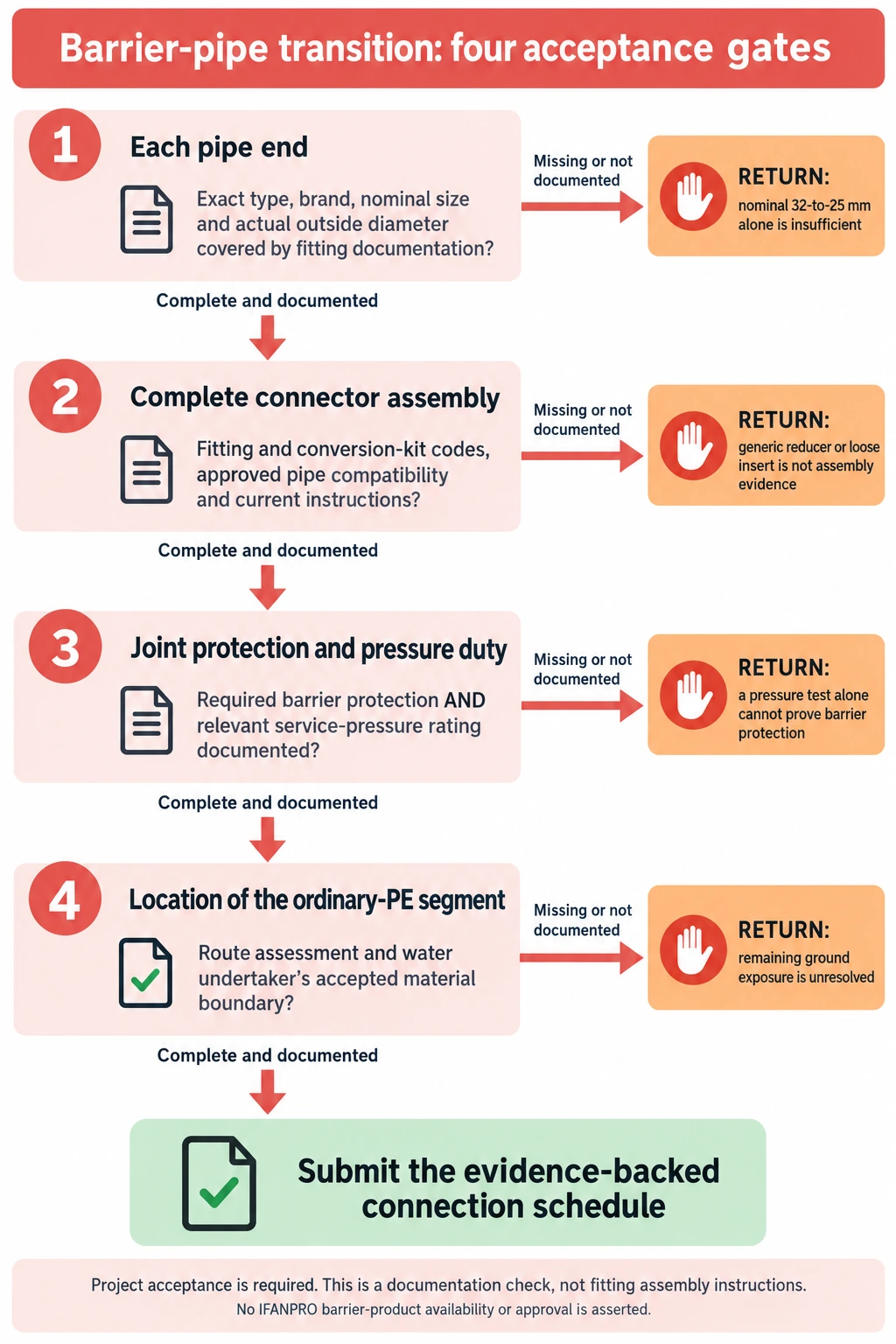
A useful connection schedule lets a reviewer distinguish a supported assembly from one that merely looks plausible. Record the evidence beside each decision rather than writing “suitable fitting” across the entire row.
| Schedule field | Evidence that supports acceptance | Return for clarification when… |
|---|---|---|
| Each pipe end | Exact pipe type, brand, nominal designation and actual OD covered by the fitting documentation. | Only “32 mm to 25 mm” is supplied. |
| Complete connector assembly | Fitting and any conversion-kit codes, approved pipe compatibility and current instructions. | A generic reducer or loose insert is named without assembly coverage. |
| Joint protection and pressure duty | Documentation for required barrier protection and the relevant service-pressure rating. | Only a pressure test or a claim of watertightness is supplied. |
| Location of the ordinary-PE segment | Route assessment and the water undertaker’s accepted material boundary. | The connector is suitable but the remaining ground exposure is unresolved. |
For broader material selection, the HDPE versus PVC water-main guide covers different project variables. The standard HDPE product category is a separate starting point for ordinary PE enquiries; it does not establish availability of a contamination-barrier system.
IFANPRO barrier-pipe supply, compatible barrier fittings and project approvals are not verified here. The named manufacturers’ examples must not be read as IFAN specifications, certificates or stocked products.












 Français
  English
  Русский
  Español
Commentaires récents