

PIPA guidance says properly stored electrofusion fittings may achieve more than ten years of shelf life. That is conditional, not an expiry rule. Before issuing older stock, match the fitting to its maker’s instructions, establish its storage history and inspect its condition. Hold fittings with unknown or questionable history for the manufacturer-directed evaluation; do not release them just because they look unused. GF Central Plastics specifically calls for destructive evaluation of sample fusions in that situation.
This guide helps a buyer or stores supervisor prepare a documented disposition: advance identified stock to normal installation checks, keep a defined group on HOLD, or reject affected fittings under the applicable procedure. It does not approve a particular lot or substitute for the project’s acceptance authority.
Key Takeaways
- A manufacture date tells you age; it does not establish storage conditions or permission to install.
- Use the instructions for the actual manufacturer and product family. A shelf-life statement from another brand cannot release your stock.
- Keep documented indoor stock separate from material with missing history, open packaging or suspected exposure.
- A clean appearance cannot resolve an unknown-history requirement for destructive sample-fusion evaluation.
- Cleaning removes permitted contamination; it is not evidence that an oxidised fitting fusion surface has been restored.
- Record which fittings an evaluation covers, who accepts the result and what remains outstanding before issue.
TWI’s lecture introduces assessment of welds in PE pipes. It is background for the evaluation discussion; it does not approve stored fittings or replace the applicable maker’s procedure.
Identify the stock and the rule that governs it
Start with the fitting, not the date on the delivery note. Record its manufacturer, family, size, product identification and available batch or traceability markings. Retain the labels and packaging with the corresponding pieces. If identification is uncertain, put that stock on HOLD before considering a shelf-life allowance. Otherwise, there is no reliable way to decide which storage statement applies.
The distinction matters because published statements have different scopes. PIPA POP005, Issue 7, pages 4–5, describes the possibility of more than ten years from manufacture under appropriate storage and directs users to the fitting manufacturer. It is Australian industry guidance, not a universal ten-year certificate. It neither expires every fitting at year ten nor grants every younger fitting unconditional acceptance.
Meanwhile, the GF Central Plastics manual, “Fitting Storage and Handling”, describes virtually unlimited shelf life for its fittings stored indoors in original packaging. That statement belongs to the specified products and conditions. Do not transfer it to a different maker, an unidentified bag or stock whose prior exposure is unknown.
Check the project requirement separately. Even when a fitting meets the maker’s storage conditions, a purchase specification may require a particular manufacture window or documented approval. A technical storage allowance cannot silently amend that requirement. Conversely, a recent purchase date cannot prove that a returned carton was stored correctly before you received it.
Record the document revision, too. The revision history in INNOGAZ K-1412 notes a change to its storage section from a ten-year period. That is a reason to identify the applicable instruction, not permission to choose whichever copy gives the longest allowance. A saved old leaflet and a current manual can describe different editions, product scopes or conditions. Ask the actual maker to resolve a conflict for the identified fitting and retain that clarification with the record.
If two manuals appear to disagree, compare their subjects before comparing their numbers. Is each one for the same maker, product family and application? Does the stated period assume intact original packaging and protection from ultraviolet exposure? Is the project explicitly tied to a named edition? Until those questions are resolved, record the conflicting requirement and keep the disputed release on HOLD. Do not average storage periods, pick the more generous statement, or infer that a later document retroactively approves every older piece. The useful result is an identified governing instruction or an explicit unresolved conflict, rather than a guessed expiry date.
Separate known history from a reassuring label
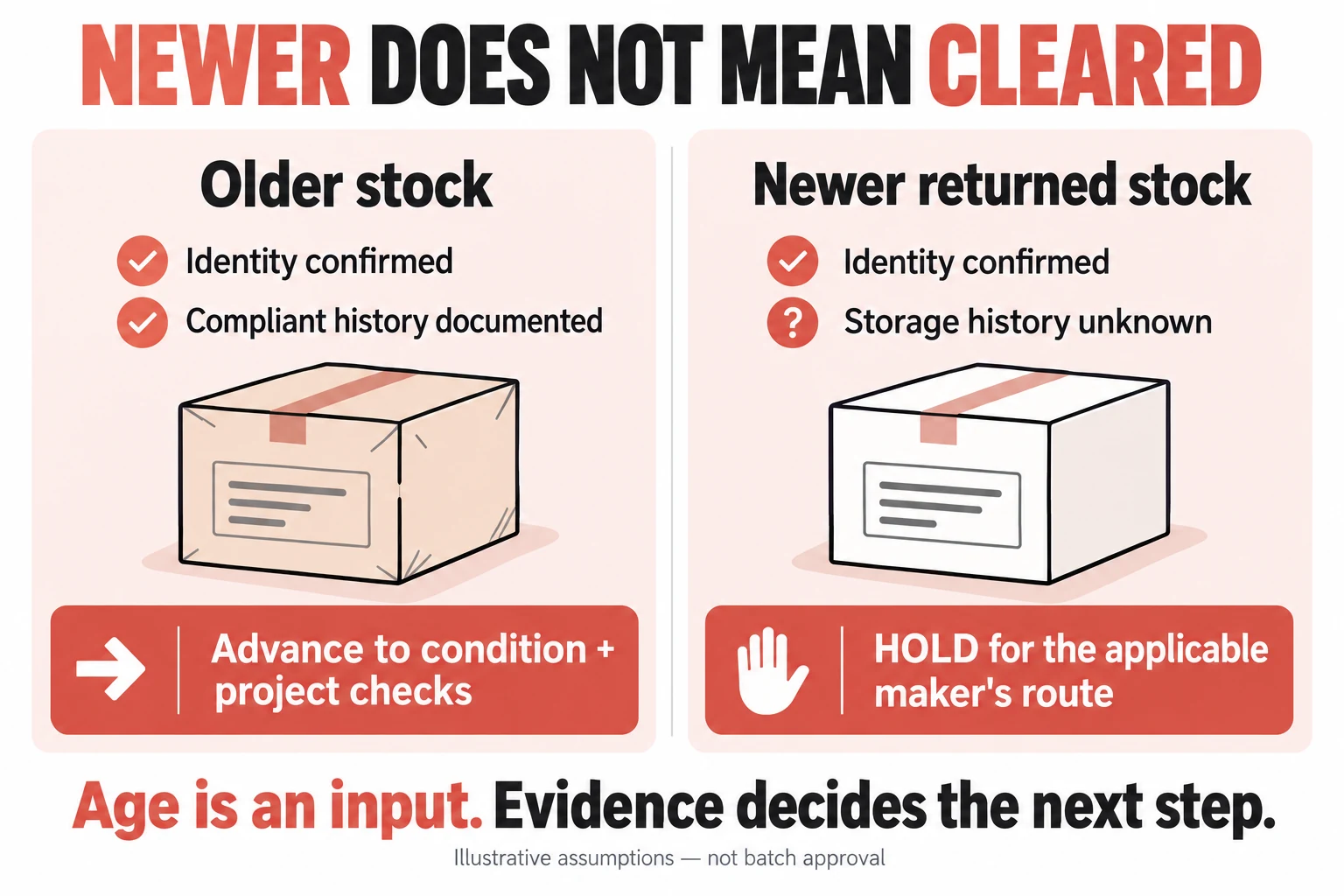
“New old stock” describes a sales condition, not a complete exposure record. A sealed-looking bag and an unused fitting can arrive without evidence of where the carton stood. Treat the missing history as the missing input it is. Do not convert it into either “definitely damaged” or “safe because unused.” The appropriate next action is to identify the applicable evaluation route.
Build the history around evidence you actually have: manufacture identification, receipt and transfer records, storage locations, packaging condition and any reported sun, heat, moisture or chemical exposure. Do not backfill missing dates from memory as though they were recorded facts. A warehouse photograph may support one location at one time; it does not prove the entire interval.
Keep groups separate when their histories differ. This is an administrative recommendation for making the disposition traceable, not a published sampling formula. If a protected carton and a returned open pack share a product code, that code alone does not make their exposure histories identical. Mixing them removes information that the evaluator needs.
| What you can establish | Immediate disposition | What closes the branch |
|---|---|---|
| Positive identity; documented storage within the exact maker’s conditions | Advance to condition and project checks; no automatic installation approval | Acceptable inspection, applicable instructions and required project acceptance |
| Identity known; prior storage unknown or questionable | HOLD the affected group | Maker-directed evaluation and a documented disposition covering that group |
| Identity or applicable instructions unresolved | HOLD identification | Reliable identification and the correct instruction set; otherwise reject the proposed use |
| Known defect or adverse evaluation | Do not issue affected fittings for installation | Disposition under the applicable manufacturer and project procedure; no cosmetic release |
The table is a decision aid assembled from the cited guidance. It is deliberately not an acceptance certificate. “Advance” means the storage question no longer blocks the next check; “HOLD” means a named uncertainty still blocks issue. Neither term replaces the person authorised to release materials on the project.
Inspect condition without turning cleaning into requalification
History and condition answer different questions. Inspect the actual pieces without removing protection earlier than necessary. The GF manual identifies terminal damage, visible damage to fusion surfaces or heating wires, and foreign material as inspection concerns. Record what was found and which pieces are affected. A good-looking example from the top of a carton cannot describe unseen pieces below it.
The packaging has a technical purpose. PLASSON Australia’s public electrofusion FAQ advises keeping fittings in the plastic bag out of the sun and using the bag to handle them during insertion. Protection is therefore part of maintaining a usable joining surface, rather than just preserving resale appearance. Once a bag is damaged, establish what was exposed instead of treating every tear as equivalent.
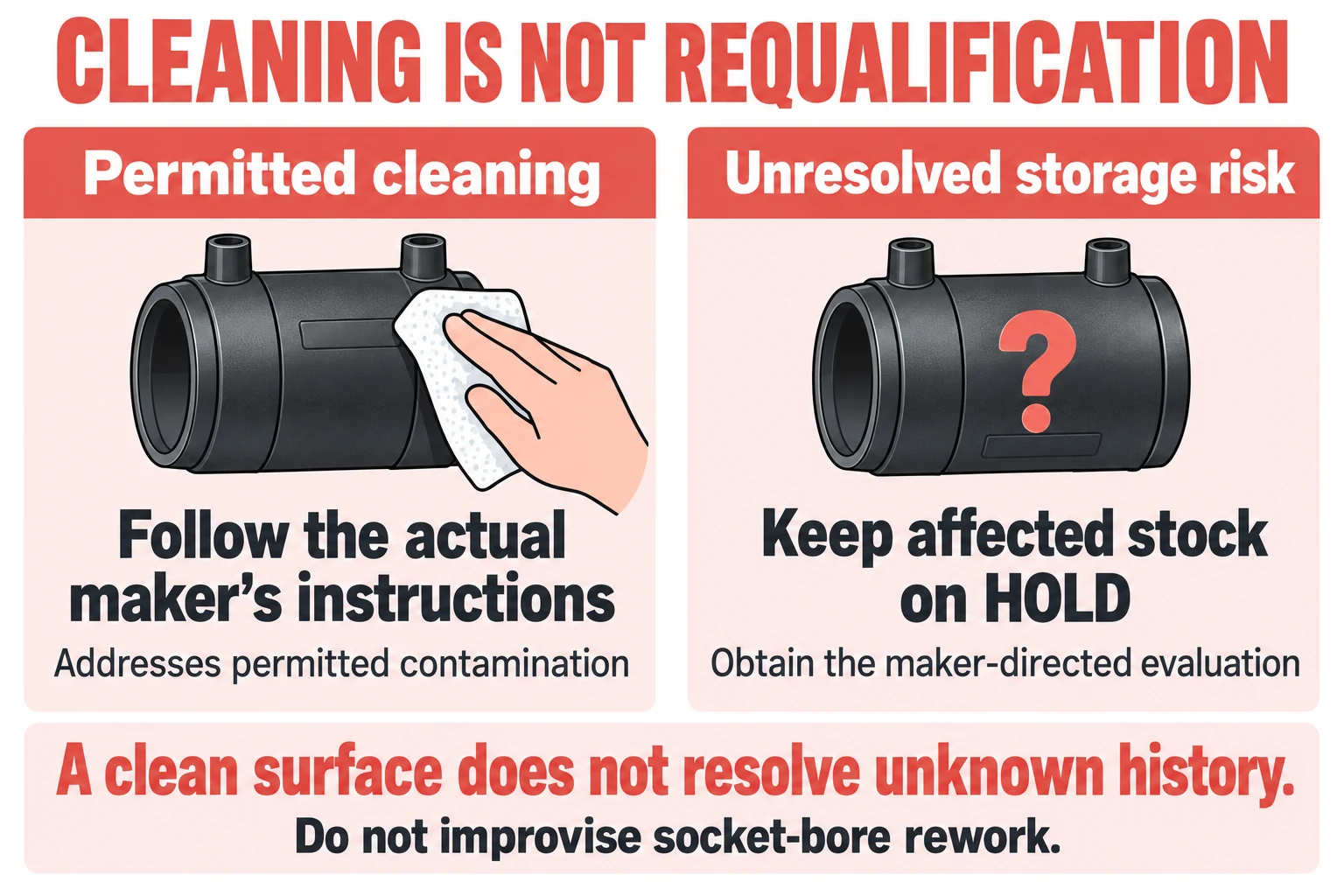
There is an important boundary between contamination and surface degradation. Integrity Fusion’s L1/L2 training manual, “Fitting Storage/Handling”, calls for destructive evaluation of fittings stored outdoors in direct sunlight and weather. It also states that cleaning cannot remove oxidation that prevents proper bonding. A wipe is therefore not a substitute for the evaluation required by that manufacturer.
Follow the actual fitting instructions for permitted cleaning and preparation. Do not scrape an electrofusion socket bore as an improvised way to renew old stock, or borrow a pipe-peeling instruction and apply it to the fitting. This article supplies no bore-rework procedure. If the proposed remedy is absent from the applicable instructions, stop and obtain the maker’s decision instead of altering the fusion geometry.
Difficulty assembling an older fitting also deserves its own record. Do not assume that extra force, improvised heating or a modified bore is acceptable because a package label remains readable. A storage review should expose an unresolved fit problem, not hide it inside the installer’s work. Preserve the fitting’s condition for the competent reviewer.
Close the unknown-history branch properly
The INNOGAZ procedure K-1412, revision 22, section 7, explicitly connects uncertain storage history with a test fusion evaluated destructively. Poor fusion quality means the affected fittings must not enter the network and should be discarded. The document is an INNOGAZ gas-system procedure; its product and application scope must travel with its recommendation.
This gives the buyer a concrete action. Identify the questionable group, send its identity and exposure information to the actual manufacturer or responsible technical authority, and request the applicable evaluation and disposition. Specify that the unresolved question concerns stored stock. A general certificate for newly manufactured products does not describe the condition of the pieces now under review.
Agree the evaluation scope before taking reassurance from a result. Which stock does the sample represent? Who selects it, conducts the work and judges acceptance? What procedure and criteria apply? These questions are a proposed control record, not an invented test standard. None of the cited storage passages supplies a universal number of samples or a rule allowing one successful specimen to clear every carton in a warehouse.
Keep the distinction visible after the test. A satisfactory result is evidence within its agreed scope. It does not recreate missing history for unrelated stock. If the evaluator accepts one defined group, record that group and the remaining installation conditions. If the result is adverse, segregate the affected material and follow the maker’s rejection instruction; do not blend it back into an apparently sound batch.
A routine pressure test on a completed line is a different event from destructive assessment of sample fusions. Where the applicable storage instruction requires the latter, the former does not silently replace it. Resolve the storage release before consuming questionable fittings in the permanent works. Any actual test work still requires the applicable trained personnel, procedure and project authority.
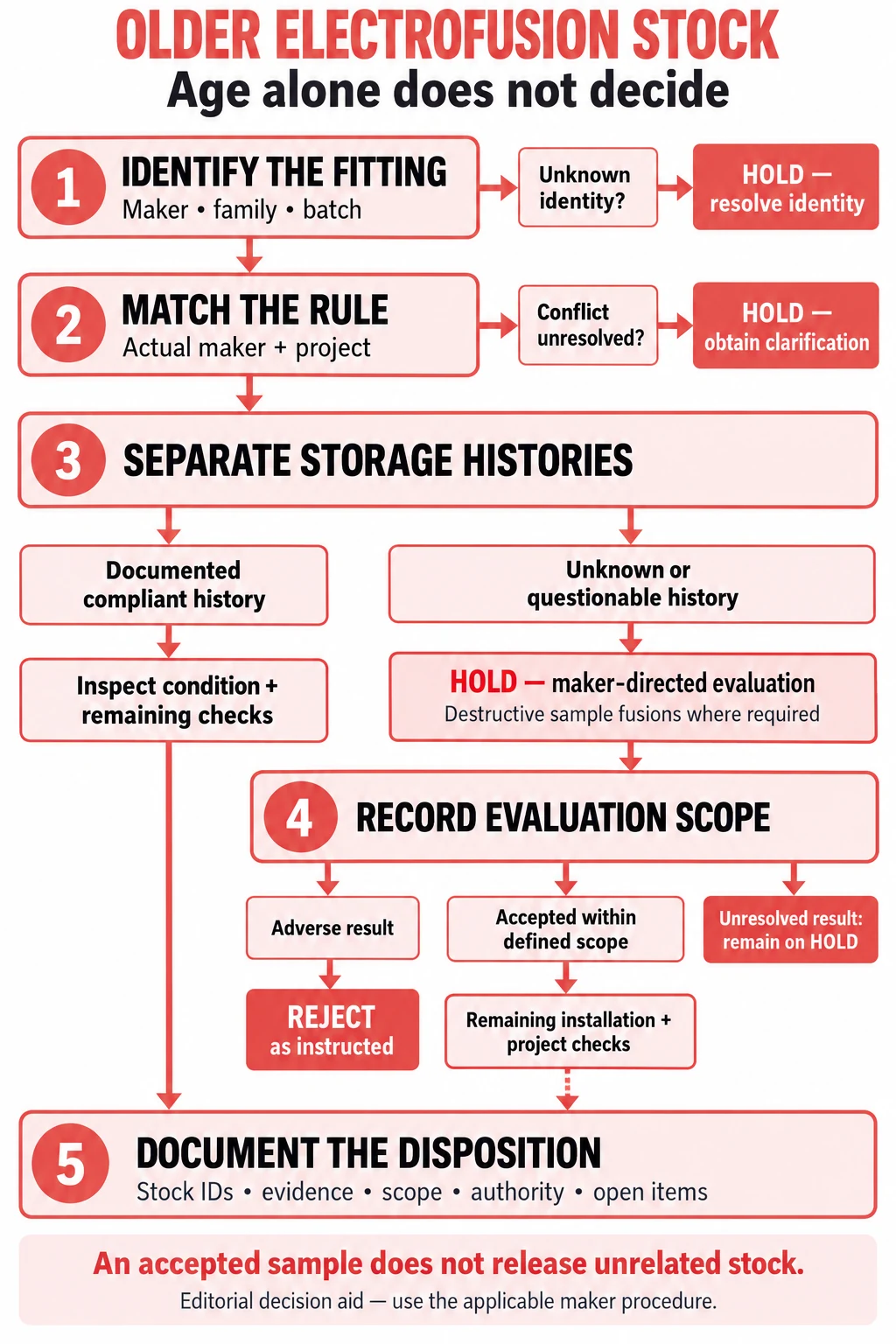
- Identify the maker, family and affected stock. Unknown identity stays on HOLD.
- Match the actual maker and project rules; unresolved conflicts stay on HOLD.
- Separate storage histories and inspect condition. Unknown or questionable history stays on HOLD for maker-directed evaluation, including destructive sample fusions where required.
- Record evaluation scope and authority. Reject affected stock as instructed after an adverse result; unresolved results remain on HOLD. Accepted evidence applies only within its defined scope.
- Retain remaining installation and project checks and document stock IDs, evidence, scope, authority and open items.
Three stock-room decisions with different outcomes
The following cases are illustrative assumptions, not IFANPRO customer records or tested batches. They show how changing the evidence changes the decision while the product description stays similar.
Case A: older stock with a documented protected history
Assume the fitting is positively identified, its applicable maker instructions allow the recorded duration and conditions, and the records cover the storage interval. Inspection finds no listed defect and the project has no unresolved manufacture-window restriction. The age alone is not a reason to reject it. Advance that identified stock to the normal installation and project checks, keeping the evidence with the issue record. This is not permission to skip those remaining checks.
Case B: a newer carton returned from an unknown location
Assume the maker and family are known but the return record cannot establish storage conditions. The pieces look unused. Under an applicable instruction such as GF’s unknown-history warning, the correct result is HOLD for destructive sample-fusion evaluation before use. The newer manufacture date does not close the missing-history branch. If reliable records later establish compliant protected storage, the reviewer can reassess that branch using those records; appearance alone cannot do so.
Case C: one acceptable sample, two different histories
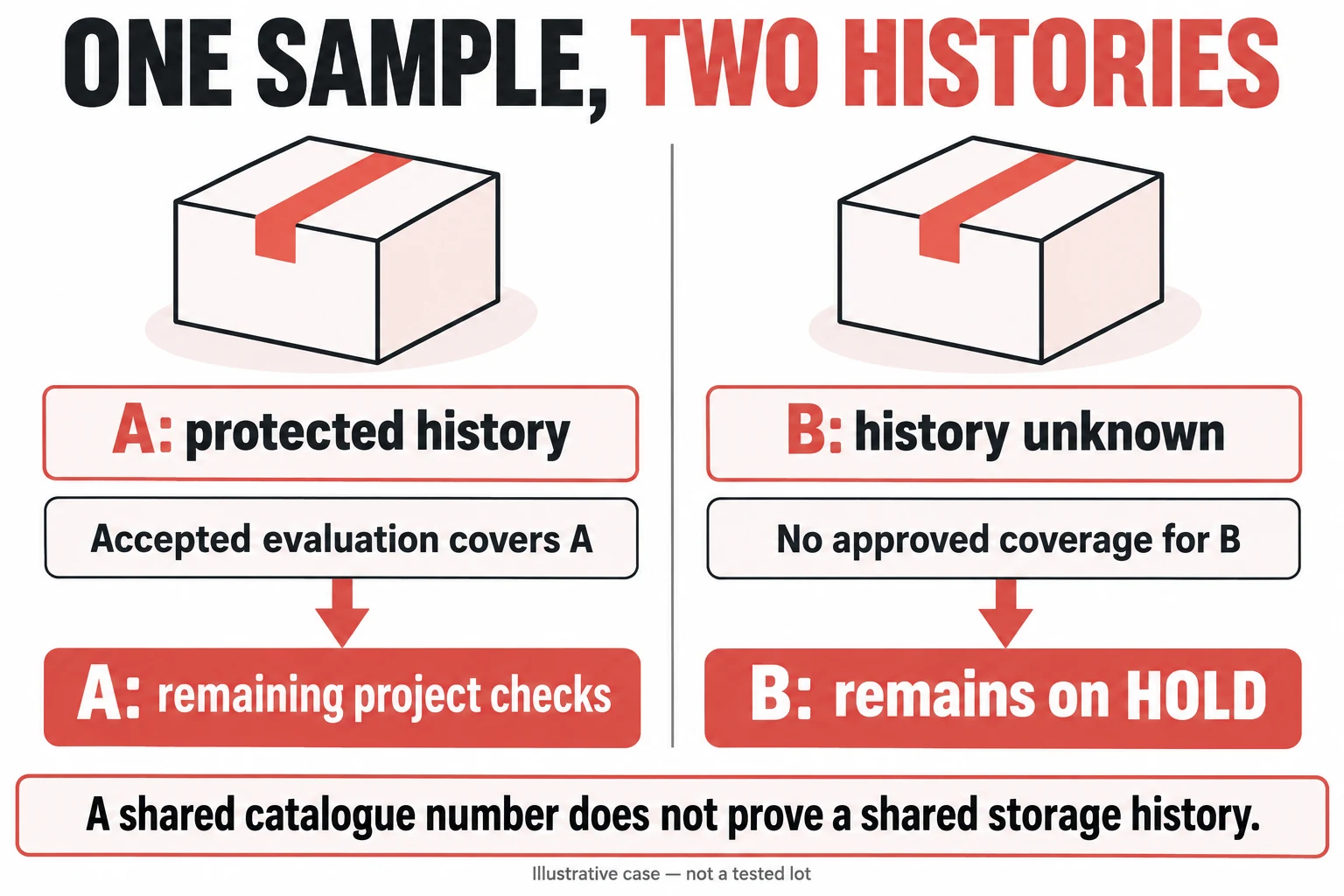
Assume a competent evaluator accepts a sample from protected carton A, but carton B was separately exposed or has an unknown history. Unless the approved evaluation expressly covers B, retain B on HOLD. A shared catalogue number does not demonstrate shared storage conditions. The usable result is two dispositions, not a warehouse-wide pass. If a documented evaluation later covers B, apply that result within its stated scope.
Write the disposition so it survives a shift change
A useful record lets the next person tell what may move and why. Avoid “old fittings checked, OK”: it leaves the evidence, scope and authority invisible. Record identity, the storage question, evidence reviewed, condition findings, the evaluation route if required, and the resulting disposition. Give each open item an owner and a closure condition so HOLD does not become an unstructured reminder.
| Record field | Illustrative entry | Why it changes the decision |
|---|---|---|
| Affected stock | Returned carton B; maker/family and piece identifiers attached | Keeps this decision separate from protected carton A |
| Unresolved input | Storage location and exposure before return not established | The applicable unknown-history instruction remains triggered |
| Action and authority | HOLD; obtain actual maker-directed evaluation and responsible reviewer’s disposition | Appearance or an unrelated certificate cannot close the issue |
| Closure | Retain accepted evaluation scope, result, affected identifiers and remaining installation conditions; reject affected stock if instructed | Prevents an unscoped sample result becoming blanket release |
For a replenishment enquiry, send the intended country and service, pipe dimensions and SDR, fitting type and quantity, required standards, and any manufacture-date or traceability condition. Keep that enquiry separate from approval of the old lot. If you contact IFANPRO, ask IFANPRO to confirm availability and terms before ordering. Matching electrofusion products, qualification, stock, pricing and delivery have not been confirmed by this guide; IFANPRO is not presented as the acceptance authority for another maker’s stored fittings. Agree any sample charges, shipping, delivery and other commercial terms directly before proceeding.
Conclusion
The expensive mistake is treating missing history as positive evidence. It can send an apparently unused fitting into service without resolving the storage condition its maker requires. The opposite mistake is discarding identified, correctly stored stock solely because it is old. Keep the decision attached to the actual fitting, applicable instruction, exposure record and evaluation scope. An age, clean surface or successful sample detached from that scope cannot carry the release.
Frequently Asked Questions
Does “more than ten years” mean fittings expire at ten years?
No. PIPA describes a possible shelf life under appropriate storage and directs users to the manufacturer. The exact product instructions and project conditions still govern the disposition.
Can unused fittings have an unknown storage history?
Yes. Unused describes prior installation, not prior exposure. If the applicable maker instruction requires evaluation for unknown history, unused appearance does not remove that requirement.
Does a manufacture date prove project approval?
No. It helps establish age and identity. Product suitability, storage evidence, condition and any project acceptance requirements remain separate checks.
Can I apply another brand’s unlimited shelf-life statement?
No. Use the storage statement for the identified manufacturer and product family. Another maker’s manual can explain a principle but cannot release your stock.
Editorial responsibility: IFAN editorial team. Prepared from the cited public manufacturer and industry guidance. No firsthand storage trial, laboratory evaluation, independent engineering sign-off or confirmed electrofusion supply is claimed.











 Français
 English
 Русский
 Español
Commentaires récents