
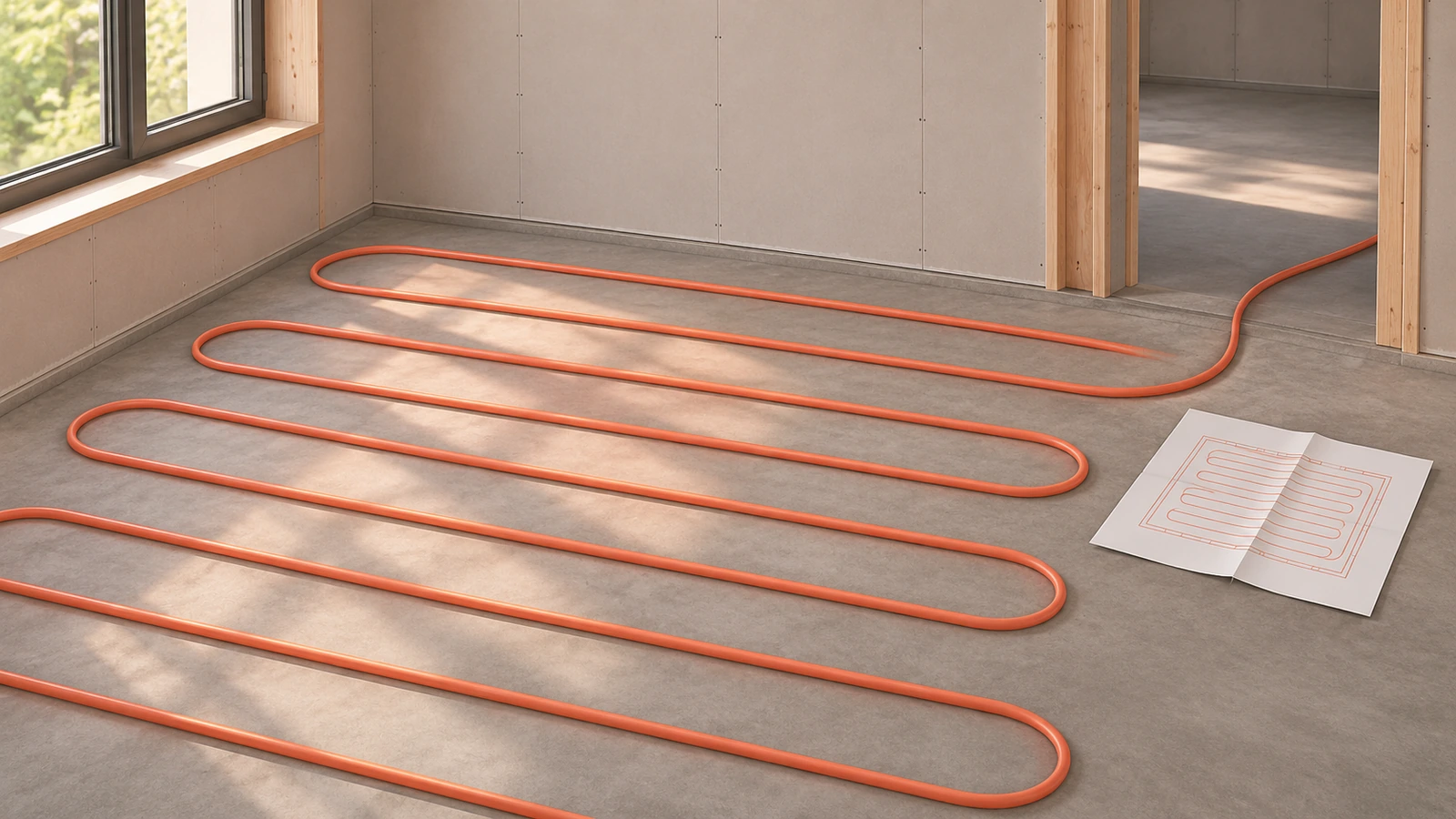
The screed crew is due and the installer spots a gouge on one exposed underfloor heating loop. Hold the affected pour area. If you are the homeowner and the circuit is already pressurized, is leaking or is losing pressure, stop work in the affected area and notify the heating installer. Leave isolation, repair and testing to that installer.
If the route is still accessible and the specified pipe is available, replace the whole circuit with one continuous run from manifold supply to return. Consider a local repair only when the damage is clearly bounded, the system documentation covers the exact pipe and repair assembly at that location, and the project accepts the detail. Record a fresh pressure test against the circuit before releasing the area for screed.
Mark the affected circuit while the floor is open
Trace the pipe back to its manifold and record the manifold, port and circuit ID. Mark the damage on the floor plan and take a wide photo that places it against a fixed feature such as a doorway. Add a close-up with a scale and a separate photo of the pipe print. Record the product, construction, outside diameter and wall thickness from the print and approved schedule. If the two disagree, ask the project reviewer to resolve the identity before buying tubing or a connector.
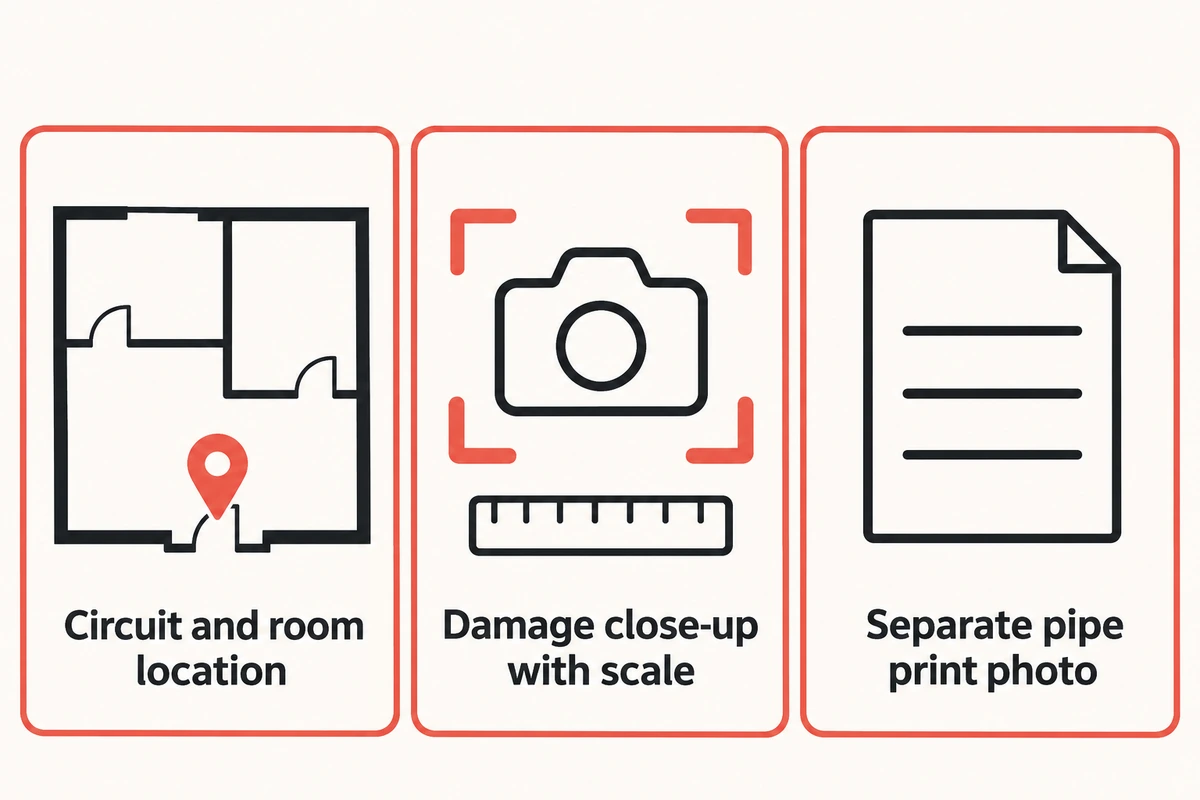

Inspect the accessible run around the incident and mark where each defect begins and ends. A single puncture with sound pipe visible on both sides presents a different proposal from a long scrape, several gouges or damage that runs beneath a fixed threshold. Where the installer cannot establish where sound pipe starts, keep the area on hold and plan for a continuous replacement. Send any potentially superficial mark to the system supplier with its photos and pipe identification. If the project accepts it as cosmetic, keep that decision and the current test with the circuit record.
Check the pipe, assembly and location before selecting a repair
Ask the installer to identify the exact fitting and any pipe-specific inserts or sleeves from the applicable documentation. Check the construction as well as the diameter. Grant UK’s Uflex example shows why both fields matter. Its UFLEX51 coupling goes with the named 10 mm PE-RT pipe. The UFLEX50X listing covers both 16 mm constructions shown below. For a different system or construction, obtain its own written match. Grant UK Uflex manual, section 8.1.3.
| Pipe named in §8.1.3 | Grant repair connector |
|---|---|
| 10 mm PE-RT | UFLEX51 |
| 16 mm PE-RT | UFLEX50X |
| 16 mm PEX-AL-PEX | UFLEX50X |
Then check where the assembly would sit. Can the installer fit it between sound ends without pulling the pipe out of its approved route? Is there room for the specified protection and access at that point in the floor build-up? If the proposal adds a short section and two fittings, submit both joint locations and the whole repair assembly for review. Ask the reviewer to check the proposed span, each joint and each location against the system detail.
Grant prefers an inspection chamber for future access. Where that is impractical, its manual describes a protected fitting buried in screed and directs the installer to seek the building inspector’s approval before doing so. Apply that detail only to the system it covers. If the project requires access and the proposed position cannot provide it, obtain approval for a revised location or replace the run. If permission for concealment is unresolved, keep the screed hold in place. Grant UK Uflex manual, section 8.1.3.
Price the whole route if replacement is the decision
Confirm the full uninterrupted length with the installer, including both manifold tails along the approved route. Put that usable length, the approved pipe construction and barrier, outside diameter and wall thickness, and the project item reference on the request. Ask the supplier to confirm that the selected coil yields the entire run as one piece. If route access or supply is unresolved, give the site coordinator the affected area and the missing decision before rescheduling screed.
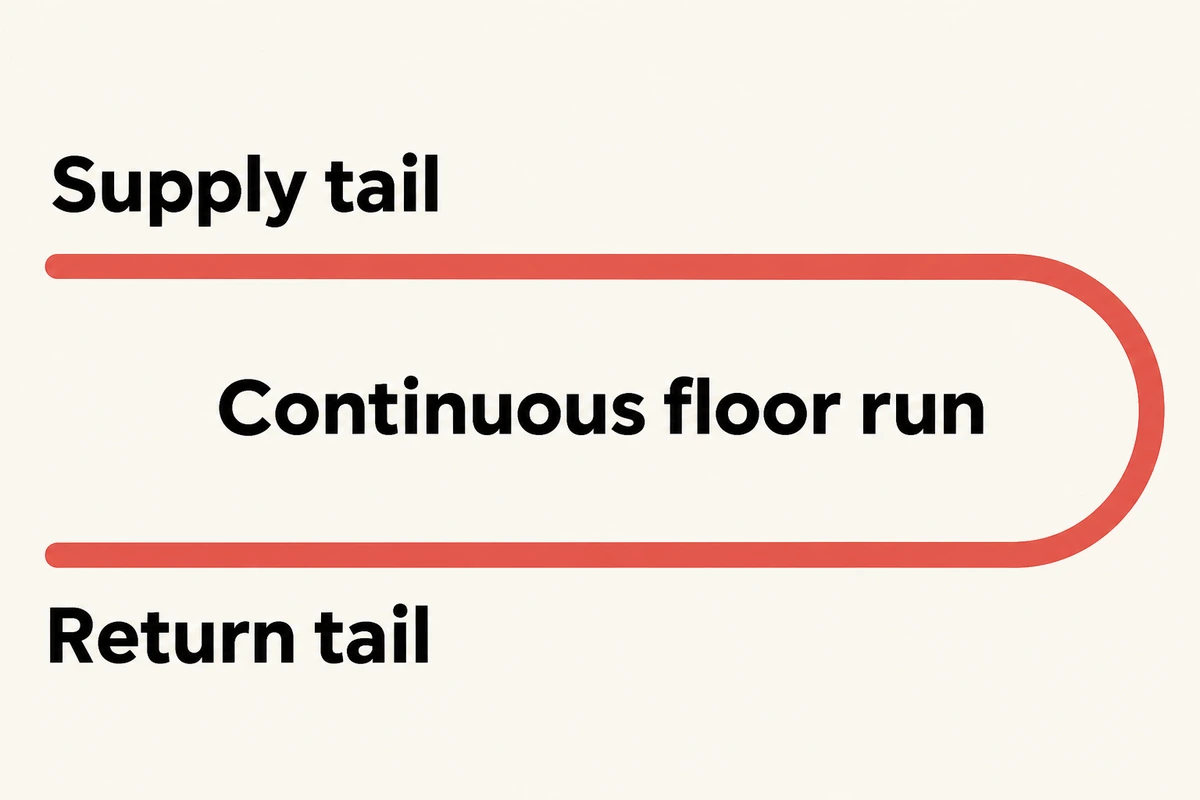
Where the schedule calls for oxygen-barrier PEX or PEX-AL-PEX, check the IFANPRO catalogue for a specified replacement coil and compare the listed tubing with the approved pipe specification.
Put the decision and test on the same circuit record
Say the installer finds a single gouge beside a doorway, with matching pipe markings and visibly sound pipe on both sides. The submitted connector matches the pipe, but the project reviewer has yet to accept its position under screed. Log a hold while the installer obtains the location detail or measures the route for replacement. If a second scrape continues beneath the threshold and its end cannot be inspected, quote the continuous run and have the reviewer resolve the access to replace it.
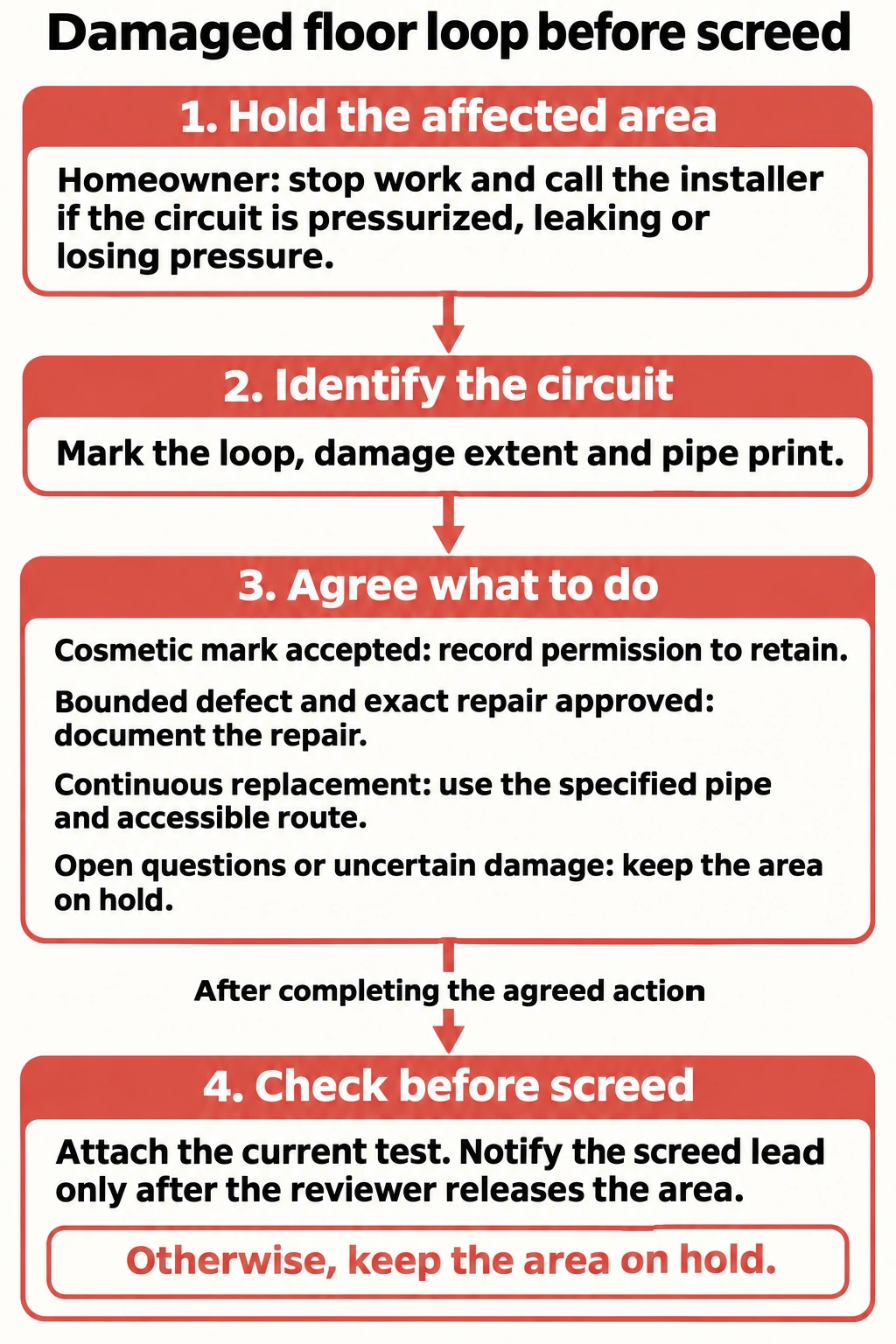
Open the full-size decision flowchart
| Record field | What to enter |
|---|---|
| Circuit and evidence | Manifold/port and circuit ID, plan revision, damage location and extent, photos and pipe print. |
| Hold | Missing evidence, responsible person and due time. |
| Retain | Documented acceptance of the mark as cosmetic. |
| Repair | Accepted assembly and each joint’s marked position. |
| Replace | Approved pipe and confirmed continuous length. |
| Closeout | Completed work, installer inspection, current test reference and reviewer’s release. |
Grant calls for a repeat pressure test after repair before the floor covering is laid. Use the approved test method for the work actually completed, including a replacement run if selected. A pass recorded before the gouge belongs to the earlier condition. Once the installer has attached the current test and the reviewer has recorded release, notify the screed lead which area can proceed. Grant UK Uflex manual, section 8.1.3.
Summary
Give the screed lead a marked plan and the current status for the affected circuit. Leave the area on hold until the evidence supports the chosen action and the project reviewer records its release. If the crew needs a replacement, send the buyer the measured full route and the approved item reference together.
Frequently asked questions
Can the loop stay as laid if the mark is dry?
Keep the area on hold until the mark has a documented disposition. A dry surface does not establish whether the mark is superficial or affects a layer the project specifies.
Does a repair connector of the same diameter fit?
Check the listed pipe construction, actual dimensions and complete fitting assembly before selection. Then check that the system and project allow the assembly at the proposed location.
What if the exact replacement coil is unavailable?
Keep the area on hold. Take any proposed substitution back through project review, with its product identification, dimensions, construction and usable length, before ordering.











 English
 Français
 Русский
 Español
Recent Comments