
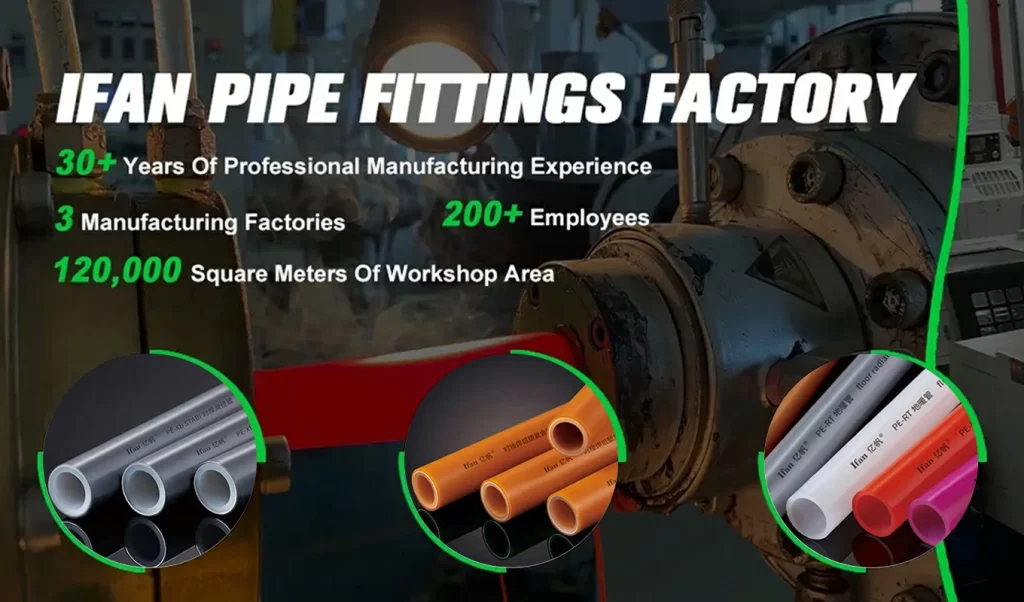
1/2 pex pipe fittings sit at the center of most residential fitting orders, and the size trips up more buyers than any other. The tube measures 0.625 inches outside diameter, or 5/8 inch, because PEX is CTS-sized, named for copper tube size, not for its own wall. That one number explains half the confusion in this market.

Key Takeaways
- 1/2-inch PEX is CTS-sized. Outside diameter 0.625 in (5/8 in), wall 0.070 in, nominal inside diameter 0.485 in.
- This guide covers four common North American 1/2-inch PEX connection families. ASTM F1807 crimp covers 3/8-2 in, F2159 plastic insert covers 3/8-1 in, F1960 expansion covers 3/8-3 in, F2854 push-fit covers 1/2-1-1/4 in.
- All four fitting standards share one service condition. 100 psi up to 180 F (82 C).
- The 1/2-inch crimp bore is smaller than you expect. A 1/2-inch F1807 brass insert has a 0.350 in minimum bore, per one manufacturer’s bore table. That matches 3/8-inch tubing and costs roughly 46% of the tube flow area at the joint.
- US adapters use 1/2 NPT. Major diameter 0.840 in, 14 threads per inch; NPT and BSP threads are not interchangeable, so verify the thread standard for your market.
- Potable brass needs a lead-free cert. The US limit is 0.25% weighted-average lead under NSF/ANSI 372.
The other half of the confusion sits inside the fitting. A 1/2-inch brass crimp insert has a published minimum bore of 0.350 inch, per one manufacturer’s bore table. That matches the inside diameter of 3/8-inch tubing, so the joint, not the pipe, sets the flow limit. This guide walks a wholesale buyer through the dimensions, the standards, the bore math, and the RFQ line items so a container matches the spec on paper.
Why 1/2 Inch PEX Fittings Matter Most
In US residential plumbing, 1/2-inch is the standard branch size that feeds one fixture, typically a lavatory, a toilet, or a faucet. A 3/4-inch trunk carries water to the room, and 1/2-inch branches split off to each point of use. That makes 1/2-inch fittings the highest-turn SKUs in most fitting orders, which is exactly why the spec matters before you buy in bulk.
The size also creates a classic import trap. A buyer asks for 1/2-inch PEX fittings and the supplier quotes 16 mm, because in metric markets the near-equivalent is 16 mm outside diameter, not 0.625 inch. The two are close and they are not interchangeable. A 1/2-inch CTS fitting does not grip 16 mm tube correctly, and the reverse is equally true.
There is a second trap one size down. 3/8-inch PEX and 1/2-inch PEX share the same wall thickness of 0.070 inch, and a rushed pick list can blur them. The OD difference is 0.125 inch, small enough to slip past a glance and large enough to fail a pressure test. IFANPRO, a China pipe and fittings manufacturer operating since 1993, publishes the dimension set below from its 120,000 m2 factory. The point is simple: a buying decision starts from numbers, not a photo.

PEX tubing is OD-controlled. The 1/2-inch name refers to copper tube size, not the pipe wall.
1/2 Inch PEX Dimensions and CTS Sizing
The Outside Diameter That Names the Size
PEX follows copper tube sizing, or CTS. A 1/2-inch PEX tube has an outside diameter of 0.625 inch, the same OD as 1/2-inch copper. The name tells you the copper it matches, not its own measurement. ASTM F876, the tubing specification, states this directly: PEX is outside-diameter-controlled, made in nominal SDR9 wall ratios, and pressure-rated for water at three temperatures.
Wall, Bore, and Bend Radius at 1/2 Inch
A 1/2-inch tube carries a nominal wall of 0.070 inch and a nominal inside diameter of 0.485 inch. Manufacturer TDS tolerances put the wall at 0.070 inch plus or minus 0.010, so the true ID can sit near 0.475 inch. The minimum bend radius is 8 times the OD, which gives 5 inches for 1/2-inch PEX; tighter than that and the wall can kink or stress.
| Nominal Size | CTS OD | Wall Thickness | Nominal ID |
|---|---|---|---|
| 3/8 in | 0.500 in (12.70 mm) | 0.070 in | 0.350 in |
| 1/2 in | 0.625 in (15.88 mm) | 0.070 in | 0.485 in |
| 3/4 in | 0.875 in (22.23 mm) | 0.097 in | 0.677 in |
| 1 in | 1.125 in (28.58 mm) | 0.125 in | 0.863 in |
The OD column is what makes CTS work: 1/2-inch PEX meets 1/2-inch copper and most 1/2-inch valves at the same outside dimension. The site’s bore and thread spec chart carries the full size ladder with flow areas if you are comparing more than one size.
Every Fitting Family That Fits 1/2 Inch PEX
This guide covers four common North American 1/2-inch PEX connection families, each governed by its own ASTM standard. The standards are the contract: they define the fitting, the ring, the size range, and the service condition. Read the size range carefully, because the four do not cover the same ground, and other connection systems exist beyond them.
Crimp Rings and Clamp Systems
ASTM F1807 covers metal insert fittings with a copper crimp ring or an alternative stainless steel clamp, for PEX tubing in sizes 3/8 through 2 inch. The 1/2-inch size is squarely inside that range. The alternative ring is a stainless steel clamp per ASTM F2098, cinched with a clamp tool instead of a crimp tool. Both systems use the same barbed insert; the ring is what differs.
ASTM F2159 covers plastic insert fittings, and here the size story changes. The current scope lists only four sizes: 3/8, 1/2, 3/4, and 1 inch. That means 1/2-inch is the second-smallest size in the plastic insert family. Any buyer who assumes F2159 runs as deep as F1807 will be wrong at 1-1/4 inch and above.
Expansion and Push-Fit Fittings
ASTM F1960 covers cold-expansion fittings with a PEX reinforcing ring, from 3/8 through 3 inch. The 1/2-inch fitting is expanded with a tool, the tube is slipped over the barb, and the ring shrinks back to lock it. Because the ring sits outside the expanded wall, the bore at the joint stays close to the tube bore, which matters for the flow math in the next section.
ASTM F2854 covers push-fit mechanical fittings, and 1/2-inch is the smallest size the standard lists, running to 1-1/4 inch. Push-fit performance requirements also sit under ASSE 1061. If you want the mechanics of each joint rather than the standard numbers, our guide to PEX connection systems walks through how each joint is actually made.
Press-sleeve systems extend the picture. ASTM F3347 covers metal press insert fittings and ASTM F3348 covers plastic press insert fittings. Both use a factory-assembled stainless steel press sleeve for SDR9 PEX and PE-RT tubing, and both list 1/2 inch among their nominal sizes. The four families above are the ones this guide details; an RFQ that names only PEX fittings leaves the family unnamed, so specify the standard.
| Standard | Connection Family | Size Range | 1/2 In Covered? |
|---|---|---|---|
| ASTM F1807 | Metal insert crimp or clamp | 3/8 to 2 in | Yes |
| ASTM F2159 | Plastic insert crimp or clamp | 3/8, 1/2, 3/4, 1 in | Yes |
| ASTM F1960 | Cold expansion with ring | 3/8 to 3 in | Yes |
| ASTM F2854 | Push-fit mechanical | 1/2 to 1-1/4 in | Yes, smallest size |
Every row above carries the same intended service condition: 100 psi (689 kPa) in cold- and hot-water systems up to 180 F (82 C). The scope texts for ASTM F1807, ASTM F2159, ASTM F1960, and ASTM F2854 state it directly. They also list PE-RT tubing beside PEX, so the 1/2-inch dimension set you verify applies to the PE-RT lines that share the same fittings.
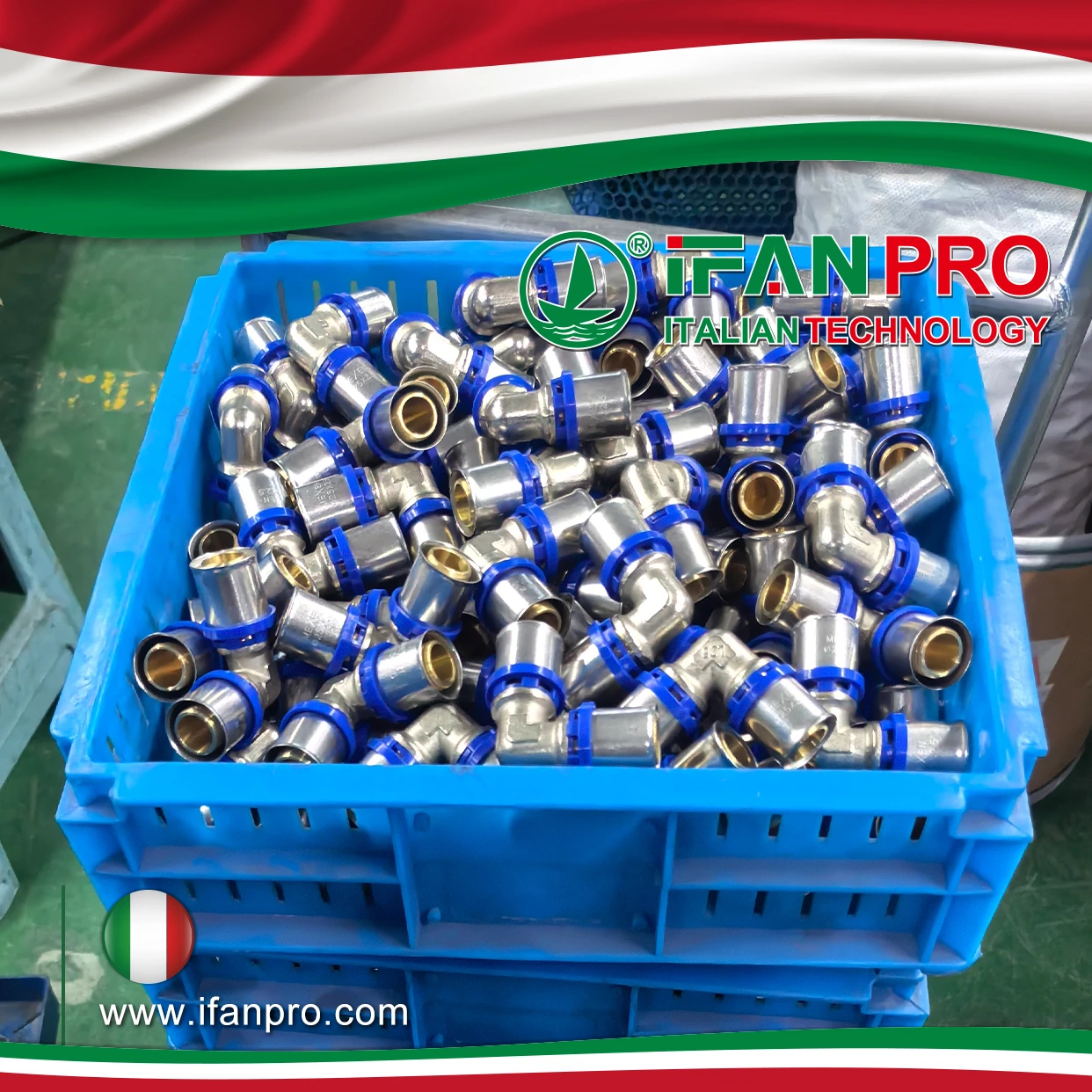
The barb and ring seat are the parts that decide whether a 1/2-inch joint holds its rated 100 psi.
The Real Bore of a 1/2 Inch Fitting
Ask installers why they prefer expansion fittings and the answer is often flow. The numbers justify it. A 1/2-inch brass insert under F1807 has a published minimum inside diameter of 0.350 inch, per one manufacturer’s bore table, which is exactly the inside diameter of 3/8-inch tubing. The fitting, not the pipe, becomes the choke point.
What the Numbers Do to Flow
At the nominal tube ID of 0.485 inch, the flow area is about 0.185 square inch. At a 0.350-inch bore, the area drops to about 0.096 square inch. That is a loss of roughly 46% of the tube’s cross-sectional area at the joint, calculated from the published bore figures. The drop does not halve the flow rate, because pressure recovers past the joint, but it does raise velocity and friction in every transition.
Velocity puts a practical frame on it. US codes cap water velocity in supply piping around 8 ft/s to control noise and erosion. At that limit, a 1/2-inch tube with a 0.485-inch ID carries about 4.6 gallons per minute, while the same velocity through a 0.350-inch fitting bore allows about 2.4 GPM. Both figures are arithmetic from the code limit and the published bores, not manufacturer ratings. Friction loss has its own numbers. The manufacturer TDS cited earlier lists 1/2-inch PEX at 5.3 psi per 100 ft at 2 GPM and 18.4 psi per 100 ft at 4 GPM. Those are tubing figures before any fitting transition.
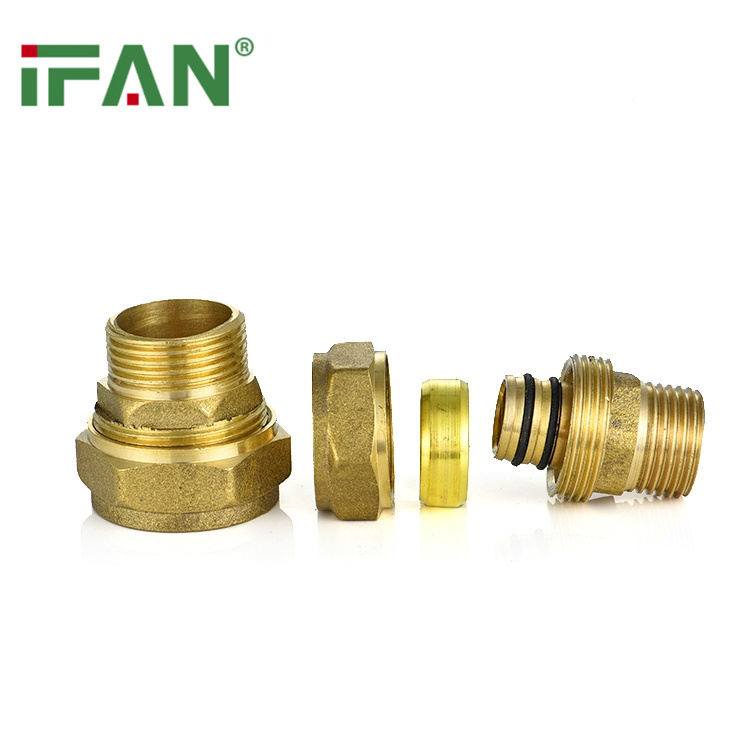
The visible bore at the center of a 1/2-inch fitting is the flow limit a distributor should quote, not the tube size.
This is why the fitting family choice is a spec decision, not a tool preference. For a 1/2-inch branch feeding a single fixture, the bore difference rarely matters. For a 1/2-inch line that has to satisfy a demanding flow schedule, expansion fittings hold more of the tube bore because the reinforcing ring sits outside the expanded wall. For every size in between, our size and thread chart carries the same comparison at 3/4 inch and 1 inch.
Pressure Ratings for 1/2 Inch Systems
Two rating sets get mixed up in every fitting conversation, and the distinction decides what you can safely specify. The tubing has one set of numbers; the fittings have another.
Tubing Ratings Versus Fitting Ratings
Standard residential PEX tubing is rated 160 psi at 73 F, 100 psi at 180 F, and 80 psi at 200 F, per manufacturer TDS tables that follow ASTM F876. The fitting standards carry their own contract: 100 psi in cold- and hot-water service up to 180 F. Pressure ratings follow the fitting standard, not the tubing’s 160 psi cold rating. ASTM F1807, F2159, F1960, and F2854 all rate fittings to 100 psi at 180 F. So a 160 psi hydrotest exceeds the rated service condition of the fittings.
| Component | 73 F | 180 F | 200 F |
|---|---|---|---|
| PEX tubing (F876-rated) | 160 psi | 100 psi | 80 psi |
| Fittings (F1807/F2159/F1960/F2854) | 100 psi | 100 psi | Not rated |
The compliance story runs alongside the ratings. Brass 1/2-inch fittings sold for potable water in the US must meet the 0.25% weighted-average lead limit under NSF/ANSI 372, as summarized on the EPA lead-free page. Confirm the certification on the fitting or its documentation before you commit an order, because a missing cert may cause market-access, project-approval, or acceptance failure.
Threads and Adapters at the 1/2 Inch Size
PEX does not thread. To reach a valve, a faucet, or a manifold, a 1/2-inch PEX line needs an adapter with a pipe thread on one end. That thread is a market decision as much as a size decision.
The 1/2 Inch NPT Transition
In US markets the adapter thread is 1/2-inch NPT, National Pipe Taper. The nominal major diameter is 0.840 inch at 14 threads per inch, which is why a 1/2-inch NPT fitting visibly swallows a 1/2-inch PEX tube that measures 0.625 inch. The female-thread side of the adapter is what meets brass valves and fixture supplies.
Reading a 1/2 Inch Adapter Number
A typical part reads 1/2 PEX x 1/2 NPT, male or female. The first number is the tubing size, the second is the thread, and the gender tells you which side is the thread. That simple grammar catches most ordering errors, because buyers who only quote 1/2 inch leave the thread unspecified and let the supplier guess.
NPT and BSP are not interchangeable. NPT uses a 60-degree thread form, BSP uses 55 degrees, and the pitches do not match, so a 1/2 BSP adapter forced onto a 1/2 NPT valve leaks or strips. In UK, Middle East, and Asia markets, PEX adapters and compression fittings are built to BS 7291 or DIN 16892. On the metric side, 16 mm is the near-equivalent of 1/2-inch CTS. IFANPRO builds PEX compression fittings to both metric standards alongside the ASTM line, which is the practical answer for a distributor serving both markets.
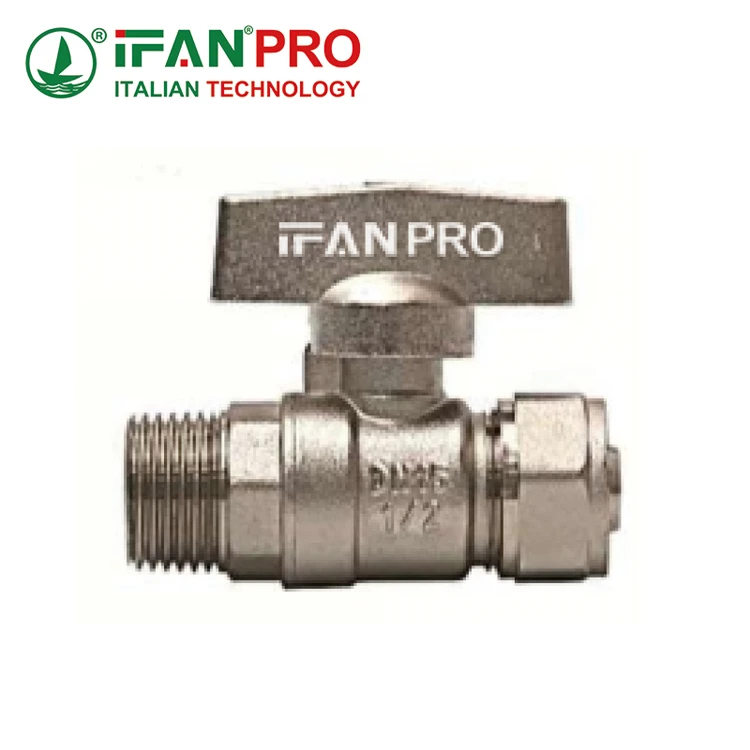
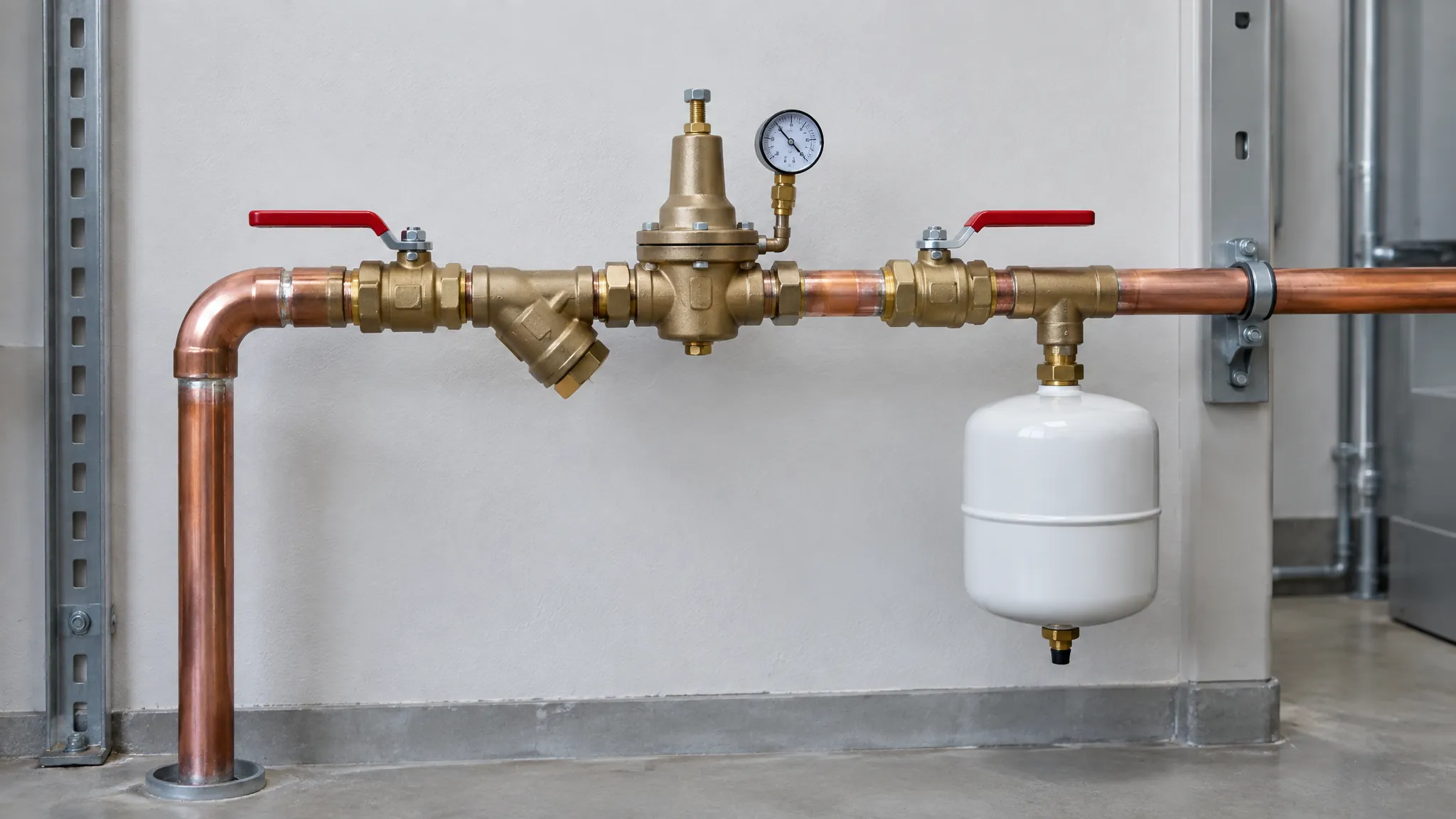
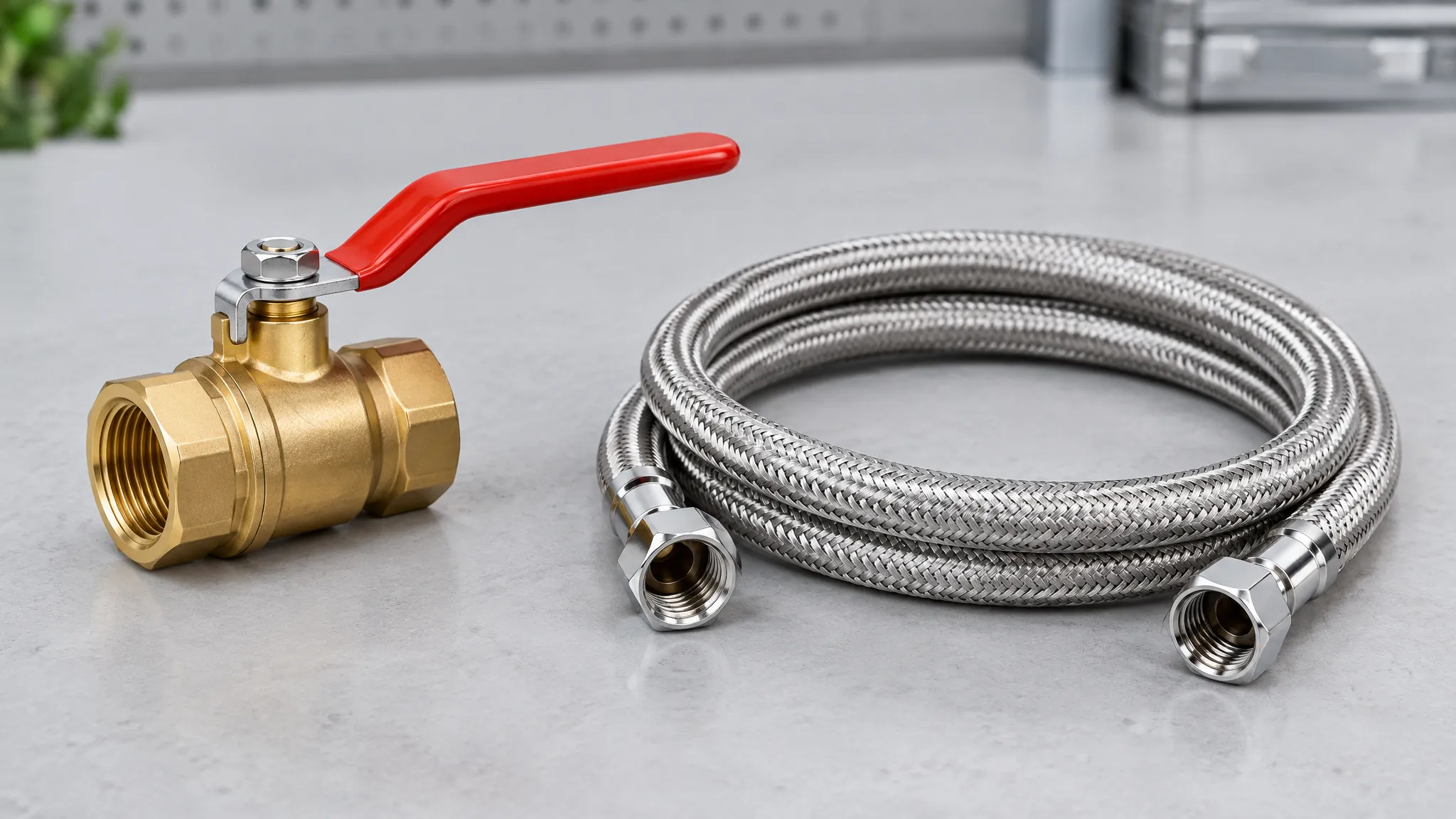
The threaded end of a 1/2-inch brass valve is NPT in US catalogs and BSP or metric in UK and Asia catalogs.
What to Specify When Sourcing 1/2 Inch Fittings
A fitting order fails when the RFQ was written in one vocabulary and the factory quoted in another. The fix is a written spec that names the size basis, the standard, and the compliance target before price enters the conversation.
The Seven-Line RFQ for 1/2 Inch Fittings
Put these seven lines in the first email and the quote comes back comparable:
- Size basis: 1/2-inch CTS PEX, OD 0.625 in, or 16 mm metric if the market is UK/EU/Asia.
- Fitting standard: ASTM F1807, F2159, F1960, or F2854, and whether the ring is copper crimp or stainless clamp (F2098).
- Material: brass alloy with the lead-free designation, or the plastic family for F2159.
- Thread: 1/2 NPT male or female, or BSP/metric per market; state the gender explicitly.
- Certification: product standard (BS 7291, DIN 16892), drinking-water approval (WRAS, NSF/ANSI 61), and lead-content compliance (NSF/ANSI 372), specified by destination market.
- Packaging: boxed by SKU or mixed, labeling language, and any private-label requirement.
- Documentation: dimensional report, material certificate, and batch test records per lot.
What a factory should prove is specific, not cosmetic. A dimensional report shows the bore and barb match the standard. A material certificate confirms the alloy and lead content. Batch test records tie the delivered lot to the qualified design. Any supplier that hesitates on these three is asking you to trust a photo.

A dimensional report and batch test records are the paper proof behind a 1/2-inch fitting order.
Certificates to Demand Per Market
Sort the paperwork into five buckets so the RFQ asks for the right document instead of a mixed list:
- Product standard: BS 7291 and DIN 16892 are product standards used in UK/EU projects; they define construction and performance, not drinking-water approval.
- Drinking-water approval: NSF/ANSI 61 covers health effects for US potable systems; WRAS is a UK drinking-water approval.
- Lead-content compliance: NSF/ANSI 372 confirms the 0.25% weighted-average lead limit for US potable brass.
- Third-party certification: certification bodies verify a product against a listed standard or approval. ISO 9001, ISO 14001, CE, Intertek, EAC, Watermark, and SAI Global are factory or product certifications, not drinking-water approvals.
- Destination-market requirement: WRAS is a UK drinking-water approval; BS 7291 and DIN 16892 are product standards used in UK/EU projects — verify the exact requirement for your destination market.
IFANPRO holds ISO 9001, ISO 14001, CE, WRAS, NSF/IAPMO, Intertek, EAC, Watermark, and SAI Global certifications across its lines. The wholesale PEX sourcing guide covers how to verify certificates on a real order rather than a brochure.
MOQ, lead time, and FOB pricing for 1/2-inch fittings depend on the SKU mix and the container; reputable suppliers typically do not quote a single flat number. Start the check with the 1/2-inch families in the PEX pipe and fittings catalog, then send the seven-line spec to a factory with a stated mixed-container policy. The current numbers come back in writing, which is the difference between a quote and a placeholder.
If the fitting list is already written, skip the browse and go straight to the numbers. Send the 1/2-inch spec list for a current quote and have it checked against what is actually in production before you commit a container.
Frequently Asked Questions
Is 1/2-inch PEX the same as 16 mm PEX?
No. 1/2-inch PEX is CTS-sized with a 0.625 in (15.88 mm) outside diameter. 16 mm PEX is a metric size with a 16.0 mm OD. The dimensions are close but not identical, so fittings and tools are not interchangeable across the two systems.
What is the outside diameter of 1/2-inch PEX?
0.625 inch, which is 5/8 inch or 15.88 mm. PEX is CTS-sized, so 1/2-inch PEX matches the OD of 1/2-inch copper tubing.
Can I use crimp and expansion fittings on the same 1/2-inch line?
You can, but every fitting family must be rated to the same system pressure and temperature, and the local code may require one listing per system. Check the manufacturer compatibility statement before mixing.
How many fixtures can a 1/2-inch PEX line serve?
A 1/2-inch branch is typically sized for one fixture, such as a lavatory, toilet, or faucet. Trunk lines are usually 3/4 inch or larger, with 1/2-inch branches feeding each fixture.
Are 1/2-inch PEX fittings lead-free?
Brass fittings sold for potable water in the US must meet the 0.25% weighted-average lead limit of NSF/ANSI 372. Confirm the certification on the fitting or its documentation before ordering for drinking water.
Conclusion
1/2-inch PEX fittings are a size story first and a brand story second. The tube measures 0.625 inch OD. The fittings in the four families covered here are qualified to 100 psi at 180 F. The 1/2-inch crimp bore of 0.350 inch, per one manufacturer’s bore table, sets the real flow limit.
- Spec the size basis first. Specify one size basis (1/2-inch CTS at 0.625 in OD or 16 mm metric) per order.
- Name the standard. F1807, F2159, F1960, or F2854 decides the ring, the tool, and the bore.
- Check the thread and the cert. 1/2 NPT for US, BSP for UK/Asia; product standard (BS 7291, DIN 16892), drinking-water approval (WRAS), and lead-free proof per destination market.
- Put it in writing. The seven-line RFQ turns a vague inquiry into a quote that can be compared.
Start with the dimension set in this guide and confirm it against the manufacturer’s TDS before you commit. When the fitting list is ready, check the 1/2-inch families in the fitting catalog. The contact form carries your spec straight to a written quote.











 English
  Français
  Русский
  Español
Recent Comments