
I once visited a chemical plant where a failed cross fitting caused a complete shutdown. That costly experience taught me the critical importance of choosing the right component for high-pressure, high-temperature applications.
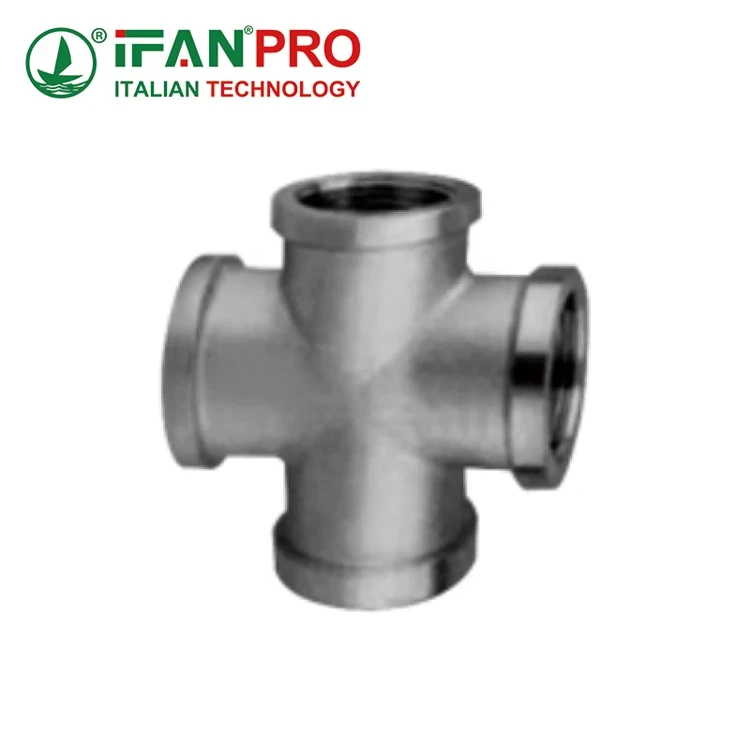
Stainless steel crosses perform exceptionally well under high pressure and extreme temperatures because of their material properties and precise manufacturing standards. They maintain structural integrity from freezing conditions up to 150°C while handling pressures up to 16 bar, making them ideal for demanding industrial applications where reliability is non-negotiable.
However, not all stainless steel crosses deliver the same performance. Let’s examine the engineering behind their capabilities and what you should look for when selecting these critical components.
Industrial-Grade Standards: The Real-World Engineering Value of a 16 Bar Pressure Rating
Numbers on a specification sheet mean little until you see a fitting survive years of abuse. I’ve learned that a 16 bar rating represents serious engineering commitment.
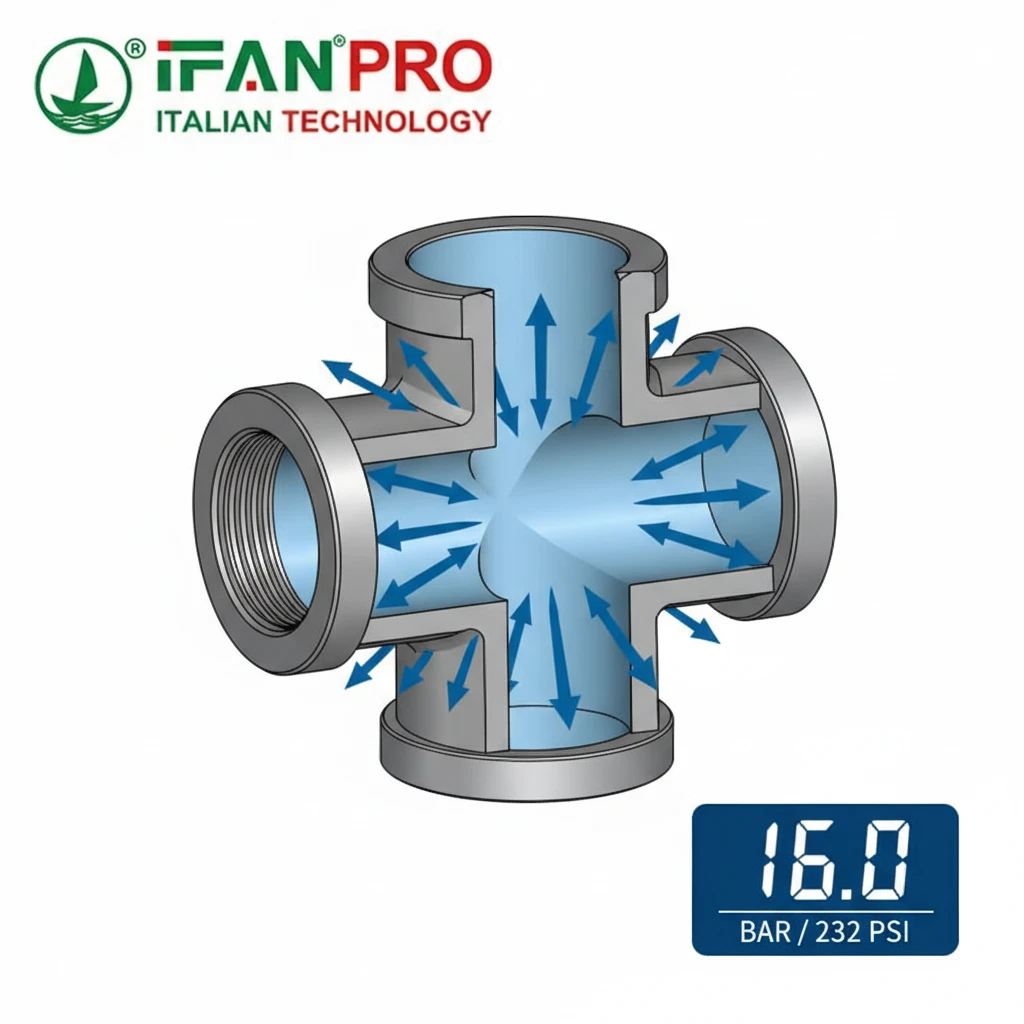
A 16 bar pressure rating means the fitting can safely handle water pressure 16 times greater than atmospheric pressure at the Earth’s surface. In practical terms, this translates to approximately 232 PSI, which is sufficient for most industrial applications including high-rise building supply lines, industrial cooling systems, and process piping where pressure surges are common.
Understanding What 16 Bar Actually Means
Many people see “16 bar” on a spec sheet and don’t grasp its real significance. Let’s break it down:
1 bar equals the average atmospheric pressure at sea level. Therefore, 16 bar means the fitting withstands pressure equivalent to being 160 meters underwater. For context, a standard home water system runs at about 3-4 bar. Commercial systems typically operate at 6-10 bar.
A 16 bar rating provides a substantial safety margin. Industrial systems experience pressure spikes from pump starts, valve closures, and temperature changes. A fitting rated exactly at operating pressure would fail during these events. The 16 bar rating ensures survival during these transients.
Material Thickness and Design Factors
Achieving a 16 bar rating requires specific engineering choices:
| Design Factor | Impact on Pressure Rating |
|---|---|
| Wall Thickness | Thicker walls resist hoop stress from internal pressure |
| Alloy Composition | Higher chromium and nickel content improves strength at temperature |
| Manufacturing Method | Forged crosses have better grain structure than cast ones |
| End Connection Design | Threaded, welded, or flanged ends affect overall system strength |
Real-World Applications
Where do you actually need a 16 bar rating? Consider these scenarios:
- High-Rise Buildings: Water pressure increases 1 bar for every 10 meters of height. A 40-story building needs fittings that handle pressure at the base.
- Industrial Boiler Feed Lines: Water injected into boilers requires high pressure to overcome boiler pressure.
- Hydronic Heating Systems: Large commercial systems use higher pressures to circulate water through extensive piping networks.
The Safety Margin Concept
Engineers design systems with safety factors. A 16 bar rated fitting doesn’t fail at 16.1 bar. Quality manufacturers design them to burst at significantly higher pressures, often 2-3 times the rated pressure. This provides protection against unexpected conditions.
IFAN manufactures stainless steel crosses with conservative safety margins. Our 16 bar rated fittings undergo burst testing to verify actual failure points exceed 48 bar. This gives our industrial clients confidence in their system designs.
From -20°C to 150°C: Thermal Stability Across Freezing and Boiling Extremes
Temperature changes cause materials to expand and contract. I’ve seen fittings crack when systems switched from freezing to operating conditions too quickly.
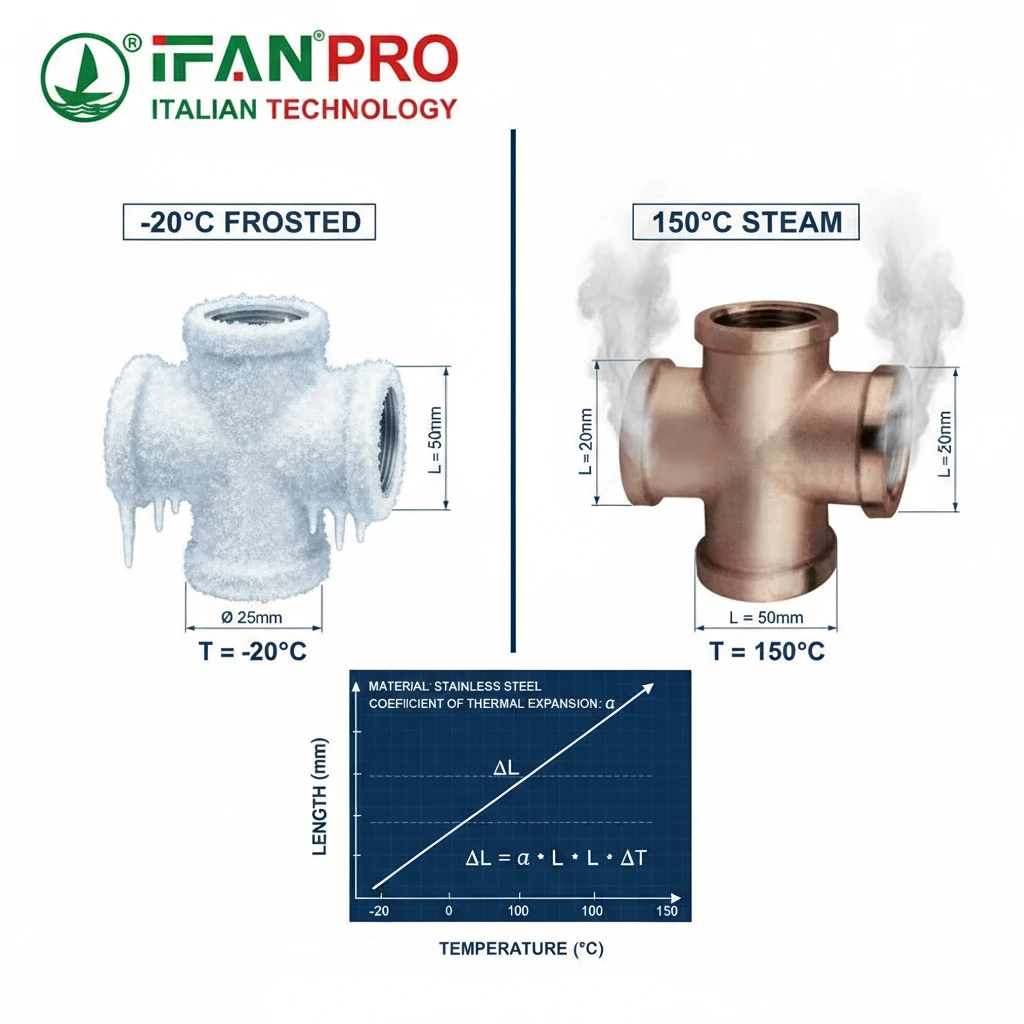
Stainless steel maintains its mechanical properties across an exceptionally wide temperature range because its crystalline structure remains stable from -20°C to 150°C. Unlike plastics that become brittle when cold or soften when hot, stainless steel’s coefficient of thermal expansion is predictable and manageable with proper system design.
Material Behavior at Low Temperatures
Many materials become brittle when cold. Carbon steel undergoes a ductile-to-brittle transition at low temperatures. Plastics can shatter like glass.
Stainless steel behaves differently. Its face-centered cubic crystal structure remains ductile even at -20°C. This means:
- The fitting won’t crack during winter installation
- Systems can safely start up after freezing overnight
- Thermal shock from sudden cold water won’t cause failure
Performance at High Temperatures
At the opposite extreme, 150°C presents different challenges:
- Oxidation Resistance: Stainless steel forms a protective chromium oxide layer that prevents scaling at these temperatures.
- Strength Retention: While some strength loss occurs at 150°C compared to room temperature, the reduction is minimal and predictable.
- Creep Resistance: Unlike plastics that slowly deform under load at high temperatures, stainless steel resists creep deformation.
Thermal Expansion Considerations
All materials expand when heated and contract when cooled. The key is managing this movement:
| Материал | Coefficient of Thermal Expansion (µm/m·°C) | Expansion Over 100°C Rise (per 10m pipe) |
|---|---|---|
| Stainless Steel 304 | 17.3 | 17.3 mm |
| Carbon Steel | 12.0 | 12.0 mm |
| Copper | 16.6 | 16.6 mm |
| PP-R Plastic | 150.0 | 150.0 mm |
Stainless steel’s expansion rate is moderate and predictable. System designers account for this with expansion loops and proper supports.
Real Thermal Cycling Challenges
Industrial systems rarely stay at constant temperature. Consider a typical day:
- Morning startup: System warms from 20°C to 120°C
- Daytime operation: Temperature fluctuates with demand
- Night shutdown: System cools back to ambient
Each cycle stresses every fitting. Stainless steel handles thousands of these cycles without fatigue failure, provided the system design accommodates the movement.
Material Selection for Temperature Extremes
Different stainless steel grades offer varying performance:
| Grade | Low Temp Limit | High Temp Limit | Best Application |
|---|---|---|---|
| 304/L | -200°C | 870°C | General industrial, food processing |
| 316/L | -200°C | 870°C | Chemical processing, marine environments |
| 321 | -200°C | 900°C | Frequent thermal cycling applications |
For the -20°C to 150°C range, 304 or 316 stainless steel works perfectly. The “L” grades (low carbon) resist sensitization during welding, maintaining corrosion resistance.
Durability and Pressure Resistance Tested in Harsh Environments
Laboratory conditions differ from real installations. I’ve tested fittings in chemical plants, offshore platforms, and desert installations to see how they truly perform.
Stainless steel crosses demonstrate exceptional durability in harsh environments because they resist corrosion from chemicals, maintain strength under mechanical stress, and withstand erosion from high-velocity flow. Combined with their pressure rating, this makes them suitable for applications where replacement access is difficult or impossible.
Corrosion Resistance Mechanisms
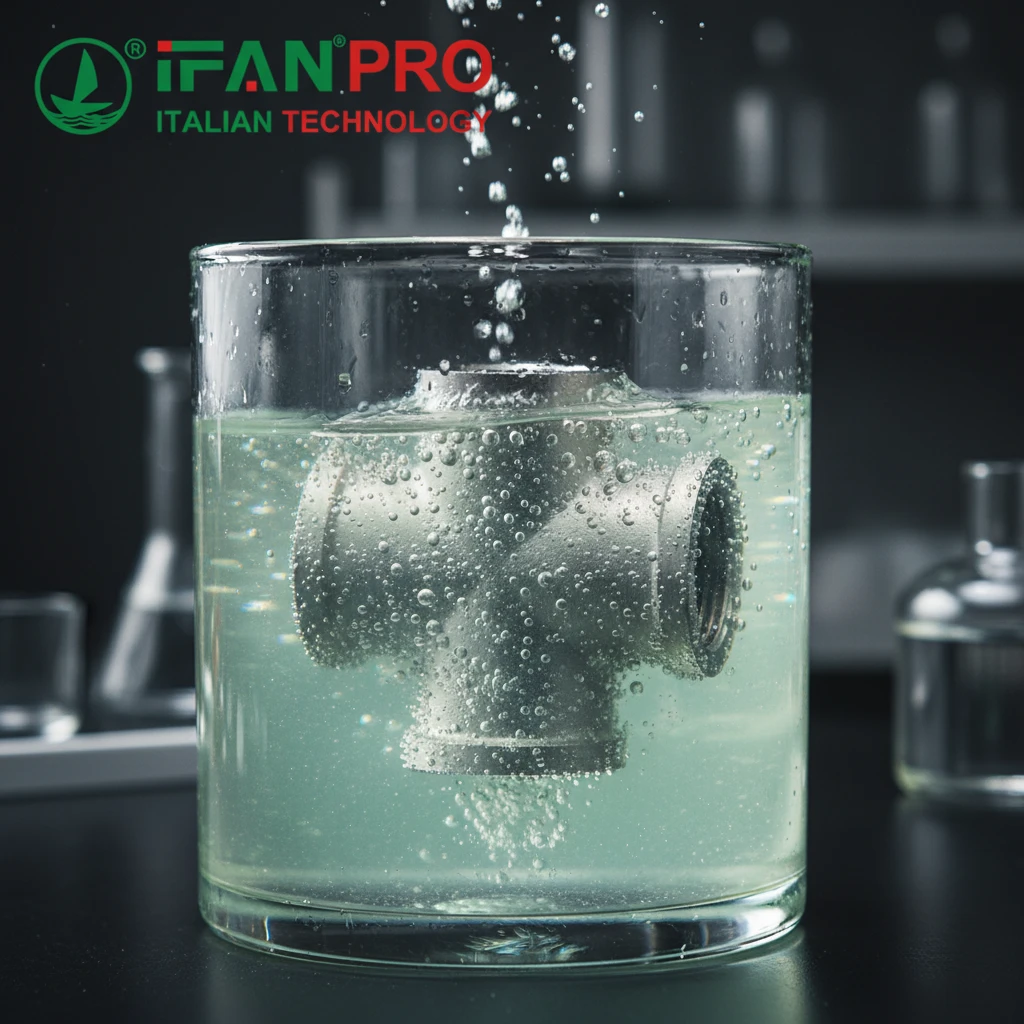
Stainless steel doesn’t rust like ordinary steel. Its corrosion resistance comes from:
The Passive Layer: Chromium in the alloy reacts with oxygen to form a microscopic chromium oxide film on the surface. This layer is:
- Extremely thin (only a few molecules thick)
- Self-healing if damaged (as long as oxygen is present)
- Transparent, maintaining the metal’s appearance
- Chemically stable in most environments
If you scratch stainless steel, the passive layer instantly reforms, continuing protection. This self-healing property makes stainless steel unique among metals.
Environmental Challenges and Responses
Different harsh environments test fittings in different ways:
| Окружающая среда | Вызов | Stainless Steel Response |
|---|---|---|
| Coastal/Offshore | Salt spray causes pitting | 316 grade with molybdenum resists chloride attack |
| Chemical Plants | Acidic or caustic exposure | Passive layer resists most chemicals |
| High Humidity | Constant moisture | No coating needed; passive layer sufficient |
| Abrasive Flow | Erosion from particles | Hard surface resists wear; smooth finish reduces turbulence |
| Thermal Cycling | Expansion/contraction stress | Ductile material accommodates movement |
Pressure Testing Under Real Conditions
Standard pressure testing happens in controlled labs. Real-world testing reveals more:
- Cyclic Pressure Testing: We pressurize fittings from 0 to 16 bar repeatedly, simulating years of operation. Quality stainless steel crosses survive over 100,000 cycles without failure.
- Burst Testing at Temperature: We heat fittings to 150°C and gradually increase pressure until failure. This reveals the true safety margin at operating temperature.
- Combined Stress Testing: We apply external mechanical loads while maintaining internal pressure, simulating pipe weight and thermal expansion forces.
Failure Modes to Watch For
Even stainless steel can fail under extreme conditions. Common failure modes include:
Pitting Corrosion: Localized attack in chloride environments. Proper grade selection (316 instead of 304) prevents this.
Stress Corrosion Cracking: Combination of tensile stress, temperature, and chlorides can cause cracking. Solution-annealed fittings resist this.
Erosion-Corrosion: High velocity flow removes the protective layer faster than it reforms. Proper sizing to keep velocities below recommended limits prevents this.
Galvanic Corrosion: Connecting stainless steel to dissimilar metals in conductive fluids can cause accelerated corrosion of the less noble metal. Dielectric unions prevent this.
Field Performance Data
Based on IFAN’s experience supplying industrial clients:
- Chemical plants: Stainless steel crosses typically last 20+ years in mildly corrosive service
- Food processing: Daily cleaning with aggressive sanitizers doesn’t affect properly passivated fittings
- Offshore platforms: 316 grade fittings survive 15+ years in salt spray with proper maintenance
- Power plants: Thermal cycling from daily startups doesn’t cause fatigue failures
Routine Maintenance Tips for Industrial Piping Systems for Long-Term Performance
Even the best fittings need attention. I’ve developed these maintenance practices through decades of field experience.
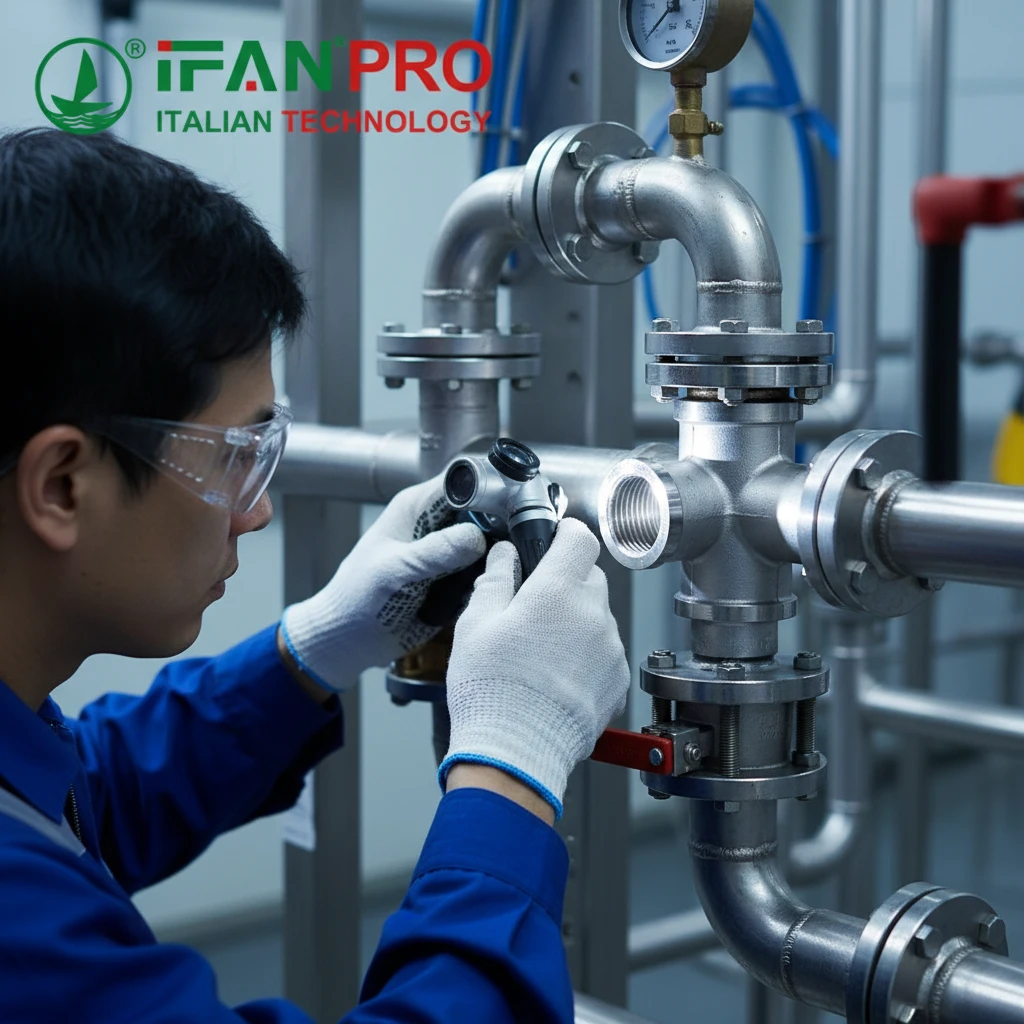
Regular inspection, proper cleaning, and timely intervention extend stainless steel piping system life significantly. Focus on visual checks for surface changes, monitoring for leaks at connections, and maintaining proper system operating conditions within design parameters.
Visual Inspection Protocols
Train maintenance staff to look for specific signs:
Surface Changes:
- Rust spots indicate contamination from carbon steel tools or particles
- Brown discoloration suggests overheating or chemical attack
- Pitting shows as small dark spots, often starting at scratches
Connection Points:
- Check threaded connections for signs of galling or seizure
- Inspect welded areas for discoloration or cracking
- Look for weeping at gasketed joints
Cleaning Procedures
Proper cleaning maintains the passive layer:
Routine Cleaning:
- Wash with mild soap and water
- Rinse thoroughly to remove all residues
- Dry with clean cloth to prevent water spots
For Stubborn Stains:
- Use non-abrasive cleaners specifically for stainless steel
- Always scrub in direction of grain or polish lines
- Never use steel wool; it leaves embedded particles that rust
Passivation Treatment:
- After welding or severe contamination, chemical passivation restores the protective layer
- Professional treatment recommended for critical systems
Mechanical Integrity Checks
Beyond visual inspection:
| Check Frequency | Activity | What to Look For |
|---|---|---|
| Monthly | Listen for unusual flow noises | Whistling indicates high velocity; banging suggests water hammer |
| Quarterly | Check support systems | Pipe hangers should allow thermal movement without binding |
| Annually | Verify pressure relief devices | Ensure relief valves operate at correct set points |
| Every 5 Years | Non-destructive testing | Ultrasonic wall thickness measurements verify no thinning |
Operating Practice Recommendations
How you run the system affects fitting life:
Avoid Rapid Temperature Changes:
- Gradual startup and shutdown reduces thermal stress
- Pre-heat or pre-cool systems when possible
- Steam-out procedures should follow controlled ramp rates
Maintain Proper Water Chemistry:
- Monitor pH, chloride content, and dissolved solids
- Treat water to prevent scaling or corrosive conditions
- Drain systems during extended shutdowns
Document Everything:
- Keep installation records with material grades and certifications
- Log inspection dates and findings
- Track replacement history to identify problem areas
Common Mistakes to Avoid
From our experience helping clients troubleshoot:
Mixing Metals: Using carbon steel tools on stainless steel leaves embedded particles that rust. Use stainless steel tools or thoroughly clean after contact.
Over-tightening Connections: Stainless steel threads can gall (seize) when over-tightened. Use anti-seize compound and follow torque specifications.
Ignoring Small Leaks: A weep today becomes a spray tomorrow. Address even minor leaks immediately.
Wrong Cleaning Chemicals: Chlorinated cleaners can attack stainless steel. Use products specifically formulated for stainless steel.
When to Replace
Even stainless steel eventually needs replacement. Signs include:
- Visible pitting or corrosion penetrating the wall
- Cracking at stress points
- Wall thinning below minimum required thickness
- Repeated failures in same area indicating systemic issue
Заключение
Stainless steel crosses deliver reliable performance under high pressure and extreme temperatures when properly selected and maintained. For your next industrial project, consider IFAN’s stainless steel crosses, manufactured to strict standards and available in multiple grades to match your specific application requirements.










 Русский
  English
  Français
  Español
Последние комментарии