
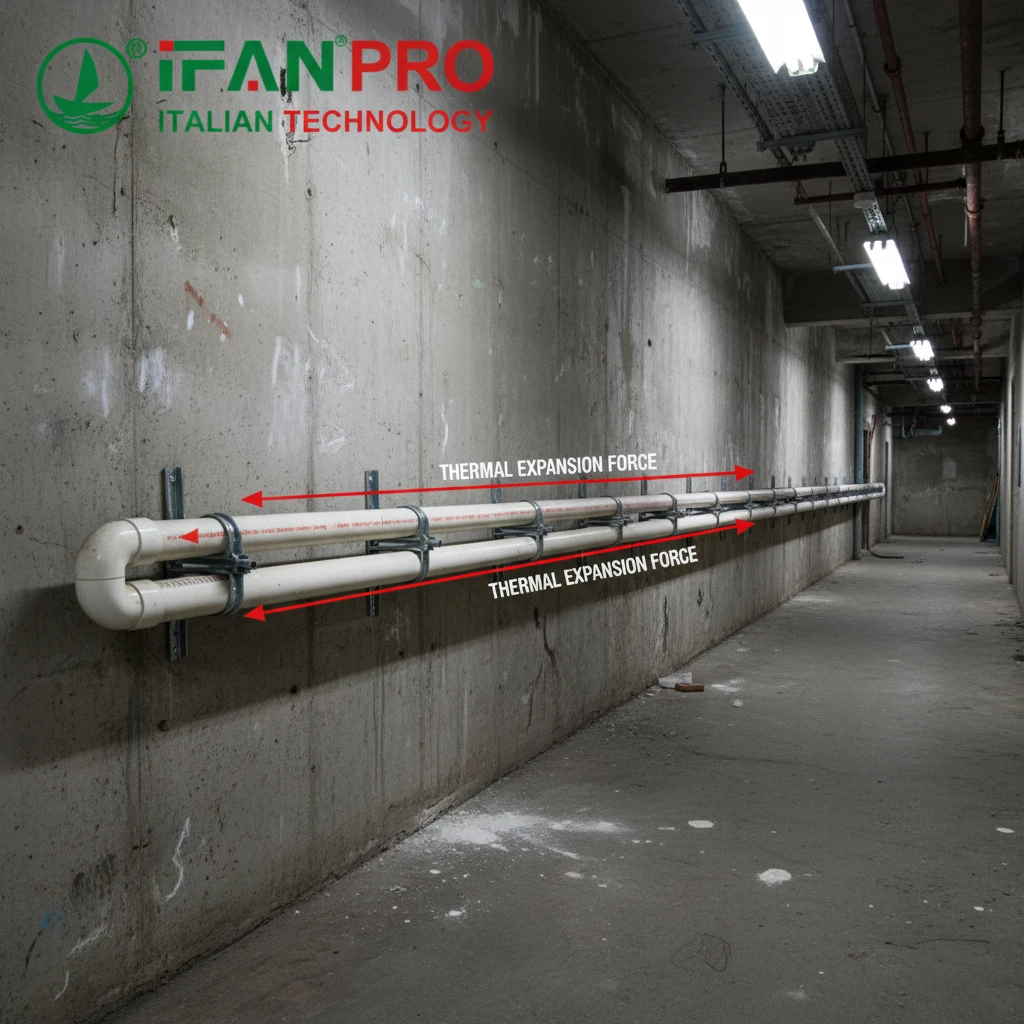
I once inspected a factory’s compressed air system where loud banging noises came from the PVC lines. The pipes were literally trying to jump out of their rigid clips because no one planned for thermal expansion.
Yes, properly selected PVC pipe clips do allow for thermal expansion. Not all clips are the same. You must use specially designed clips that let the pipe slide freely, and you must install them with the correct spacing. Using rigid, restrictive clips on a PVC system is a common mistake that leads to pipe damage, joint failures, and costly repairs.
Let’s explore why this simple detail is so critical for a reliable piping system.
Why is Thermal Expansion a Critical Consideration for PVC Piping Systems?
Many installers treat PVC like rigid steel, forgetting it’s a plastic that moves significantly with temperature changes. This oversight causes most field failures we see.
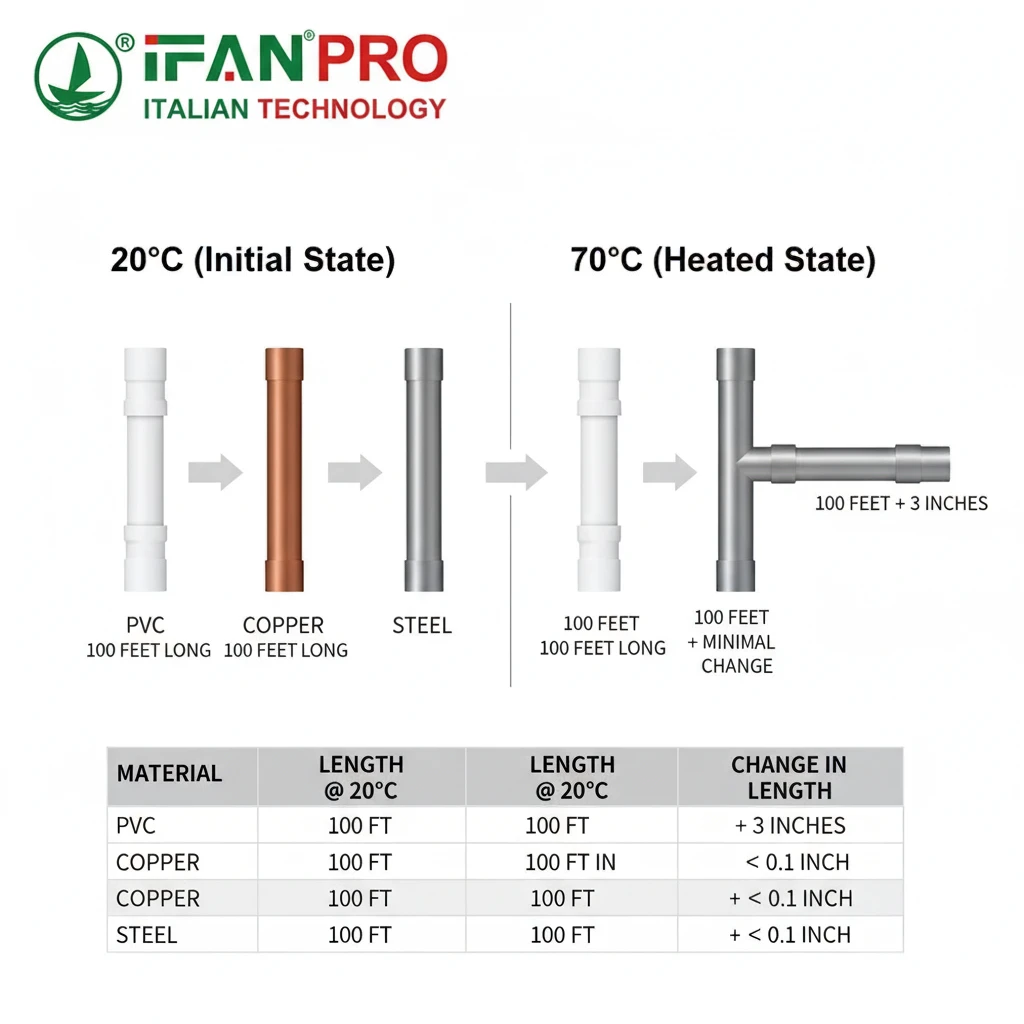
Thermal expansion is critical for PVC because it expands and contracts much more than metal pipes when temperature changes. PVC can expand over 3 inches per 100 feet for a 50°F temperature rise. If this movement is restricted, it creates immense stress, leading to pipe buckling, broken fittings, and joint leaks.
The Science Behind PVC Movement
First, you need to understand how much PVC moves. Unlike copper or steel, PVC plastic has a high coefficient of thermal expansion. This is a technical term that simply means it grows a lot when it gets warm and shrinks when it cools down.
For example, in an attic or an outdoor installation, the temperature can change drastically between night and day, or between summer and winter. The pipe length will change constantly. If the pipe is locked tightly in place by its supports, it has nowhere to go. The force has to go somewhere, so it pushes against the fittings and clips until something fails.
Consequences of Ignoring Expansion
The problems from restricted expansion are serious and expensive:
- Pipe Deformation: The pipe can bend, bow, or even buckle in the middle of a run.
- Joint Failure: The most common point of failure is at the glued joints (socket welds). The stress can crack the fitting or break the solvent cement bond, causing immediate leaks.
- Stress on Equipment: The pushing force transmits back to pumps, valves, or tanks connected to the pipe, potentially damaging this expensive equipment.
- Noise: As the pipe struggles against its clips, it can create loud creaking, ticking, or banging sounds.
Comparing Thermal Expansion of Common Pipes
This table shows why PVC needs special attention compared to other materials.
| Pipe Material | Coefficient of Expansion (in/in/°F x 10⁻⁵) | Expansion per 100 ft for a 50°F rise |
|---|---|---|
| PVC | 3.0 – 3.3 | ~3.1 inches |
| Carbon Steel | 0.65 | ~0.47 inches |
| Copper | 0.9 | ~0.65 inches |
| PP-R | 3.8 – 4.5 | ~4.2 inches |
As you can see, PVC expands about 5 times more than steel. You cannot support it the same way. Planning for this movement is not optional; it is a fundamental requirement for a durable PVC installation.
How Do Specific PVC Pipe Clip Designs Accommodate Pipe Movement?
The right clip makes all the difference. We stock two main types, and choosing the wrong one is a frequent error we help clients correct.
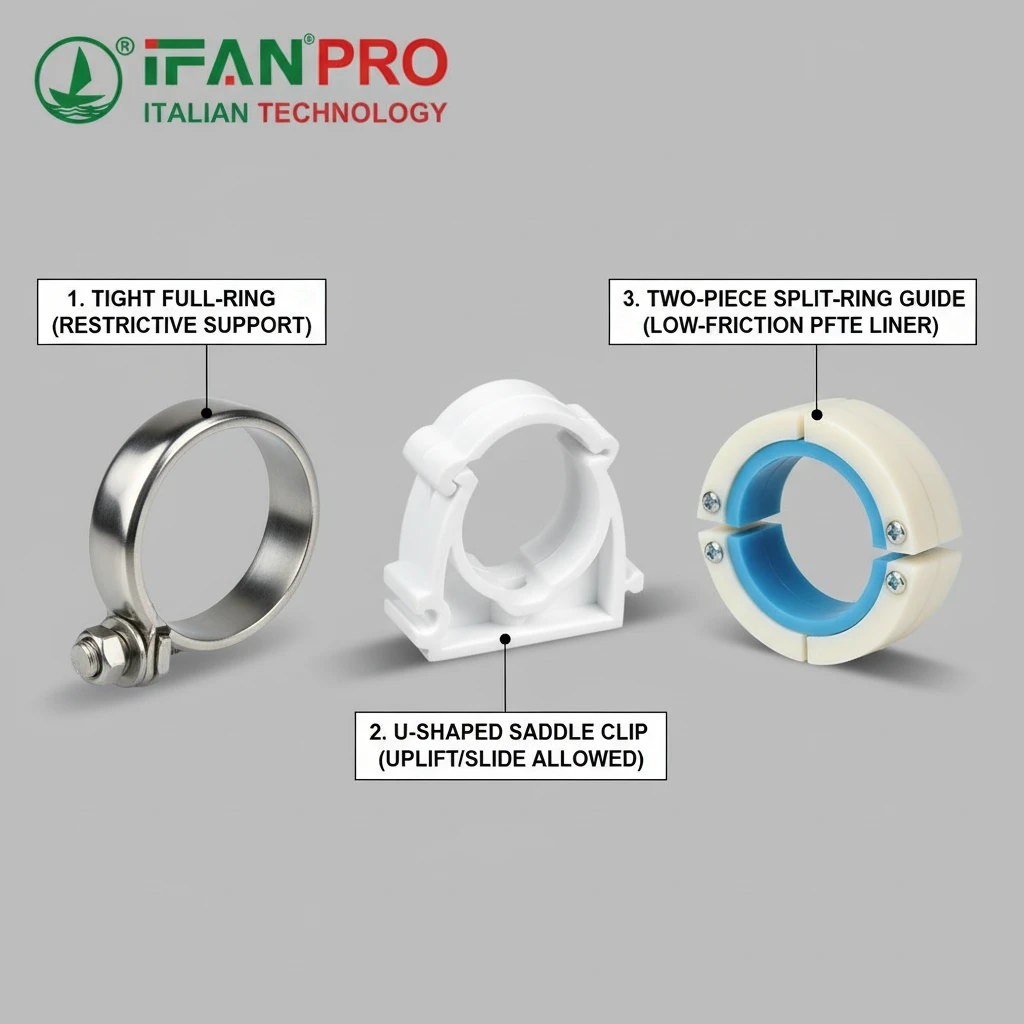
Specific PVC pipe clip designs accommodate movement by not fully encircling the pipe or by using low-friction materials. Common designs include “U-shaped” saddle clips that leave the top open, “split-ring” guides, and clips lined with smooth plastic or Teflon. These allow the pipe to slide longitudinally while still providing vertical support.
The Role of a Guide vs. an Anchor
This is the most important concept. In a system that expands, most pipe clips should act as guides, not anchors.
- A Guide supports the pipe’s weight and prevents sideways movement but allows the pipe to slide forward and backward through it.
- An Anchor fixes the pipe firmly in place and does not allow any movement. Anchors are only used at specific, calculated points (like near a pump or a branch connection) to control the direction of expansion.
Analysis of Common Clip Designs
Let’s look at how different clip designs function:
1. Standard Full-Ring Clips (Rigid):
These are usually metal or plastic rings that completely surround the pipe. They are often screwed tightly shut. These are generally BAD for long, straight runs of PVC. They act as unwanted anchors, locking the pipe in place. Use them only where you intentionally need an anchor point.
2. U-Shaped or Saddle Clips:
This is the most common and correct type for supporting PVC. The clip is shaped like a “U” or a saddle. It supports the bottom and sides of the pipe, but the top remains open. This allows the pipe to expand upward if needed, but more importantly, it creates less friction, allowing for easier longitudinal sliding. Always ensure the fasteners are not overtightened.
3. Split-Ring Guides:
These are two half-circle pieces that bolt together around the pipe, but they have a small intentional gap or are made of a slippery material like PTFE (Teflon). They provide good lateral stability while significantly reducing friction. These are excellent for critical or high-temperature applications.
4. Roller Supports or Spring Hangers:
For very long runs or large-diameter pipes, more advanced supports like small rollers or spring hangers may be used. These actively accommodate movement with minimal resistance.
The key takeaway is that the clip must not create a “stranglehold” on the pipe. Its job is to hold it up, not lock it in.
What is the Proper Spacing for PVC Pipe Clips to Allow for Expansion?
Spacing is just as important as clip design. Clips placed too far apart will let the pipe sag; clips placed too close together increase friction and cost.
The proper spacing for PVC pipe clips balances support and movement. General spacing is 3 to 4 feet for pipes under 1 inch in diameter, and 4 to 6 feet for pipes 1 to 2 inches in diameter. Crucially, clips near an anchor point or direction change must be placed closer together to guide the expansion force correctly and prevent pipe sag between supports.

Standard Support Spacing Guidelines
The primary rule for spacing is to prevent the pipe from sagging between supports, which puts stress on the joints. This spacing depends on the pipe size, the temperature of the fluid inside, and the type of clip used.
Here is a practical spacing table based on common practice for Schedule 40 PVC at moderate temperatures:
| Pipe Diameter (inches) | Maximum Recommended Support Spacing (feet) |
|---|---|
| 1/2″ | 3 ft |
| 3/4″ | 3.5 ft |
| 1″ | 4 ft |
| 1-1/4″ | 4.5 ft |
| 1-1/2″ | 5 ft |
| 2″ | 6 ft |
Important Note: If your pipe carries hot fluid (above 100°F) or is in a very hot environment, you should reduce these spacing distances by about 20-30%. A hotter, softer pipe is more prone to sagging.
Strategic Spacing for Expansion Loops and Anchors
Spacing becomes a strategic tool when managing expansion. You cannot just space clips evenly and forget about it.
- Near Anchors: The first clip on either side of a fixed anchor point should be placed much closer—often 12 to 24 inches away. This prevents the pipe from flexing right at the critical anchor connection, where stress is highest.
- Guiding the Run: In a long straight run, all clips between anchor points should be aligned perfectly straight. This ensures the pipe expands in a smooth, straight line along the path of least resistance.
- Before Direction Changes: Place a clip within 6 pipe diameters of any elbow or tee. This supports the fitting and helps direct the expansion force around the corner into the next leg of the run.
Remember, the goal of spacing is twofold: to provide adequate physical support to prevent sagging, and to create a smooth “pathway” that guides the pipe’s natural expansion and contraction without creating points of high stress.
What Problems Arise from Using Rigid Clips on Expanding PVC Pipes?
Using the wrong clip is the number one installation error we find. The damage is often slow and hidden until a sudden failure occurs.
Using rigid clips on expanding PVC pipes creates four main problems: 1) high stress at glued joints, leading to cracks and leaks; 2) pipe buckling or deformation in the middle of a run; 3) transfer of damaging forces to connected pumps and valves; and 4) loud, annoying noise from the pipe fighting against its restraints.
Direct Mechanical Failure
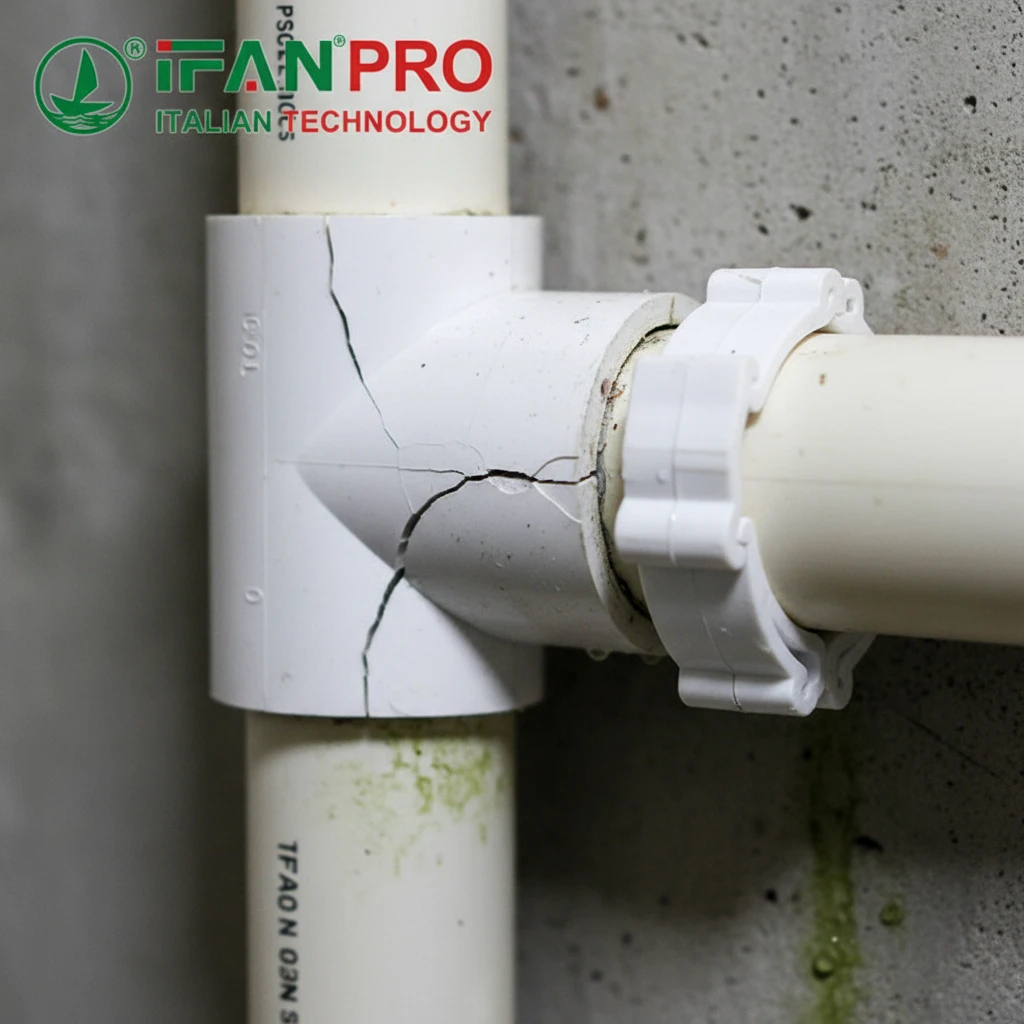
When a pipe expands but is held tightly, the force builds up like compressing a spring. Since PVC is rigid, it doesn’t compress—it fails. The weakest points fail first.
- Joint Failure: The solvent-cemented socket joint is strong but brittle. The bending stress concentrated at the entrance to a fitting can cause a circumferential crack. This crack starts small and is often invisible, leading to a slow leak that goes unnoticed for months, causing water damage or mold.
- Pipe Buckling: If the middle of a long, straight run is restricted, the pipe may relieve stress by buckling sideways. This creates a visible bend or kink that restricts flow and looks unprofessional.
System-Wide Damage
The problems extend beyond the pipe itself.
- Equipment Damage: The expansion force is transmitted along the pipe. If one end is fixed at a pump connection, that pump’s flange and casing absorb the repeated push-pull stress. This can crack housings, break bolts, or misalign shafts, leading to premature pump failure.
- Noise and Vibration: As the pipe moves against a tight metal clip, it produces noise. This can be a persistent ticking, creaking, or loud bang (water hammer). In residential or office settings, this is unacceptable and leads to complaint calls.
The Cost of Correction
Fixing a system with improperly installed rigid clips is expensive. It is not a simple clip replacement. Often, the pipe and fittings have already been stressed and micro-cracked. The only reliable fix is to:
- Cut out and replace damaged sections.
- Install proper guide clips at correct intervals.
- Re-evaluate and potentially add expansion loops or joints if the run is very long.
This retrofit costs 3-5 times more than doing it correctly during the initial installation.
Заключение
Allowing for thermal expansion with the right PVC clips and spacing is essential for a quiet, leak-free, and durable system. For reliable PVC pipes and the correct support clips and guides, trust ИФАН to supply the complete, compatible solution for your project.










 Русский
  English
  Français
  Español
Последние комментарии