
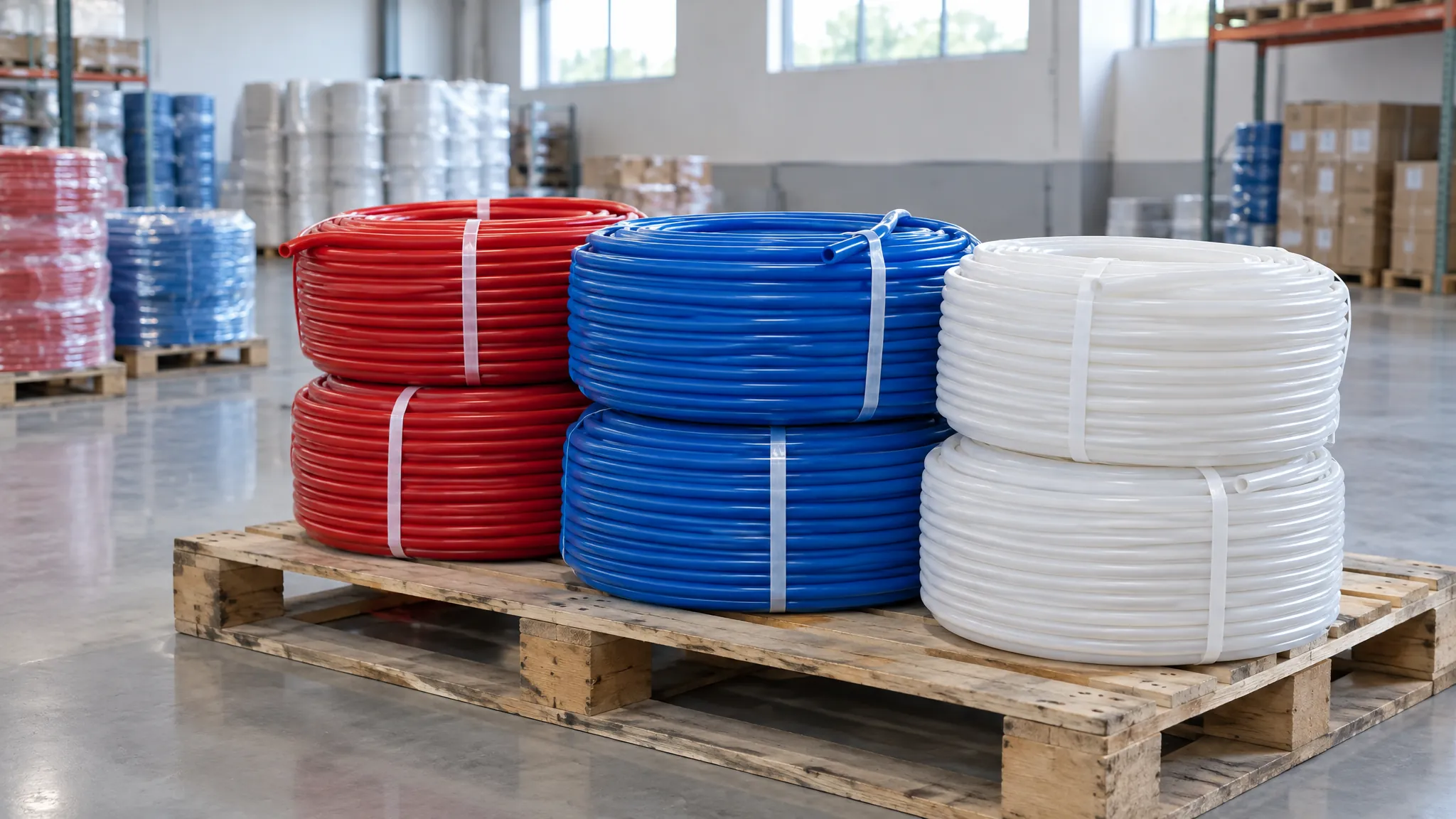
The quotation reads “PEX pipe to ASTM F876 / EN ISO 15875”, and that slash is the problem: the two documents describe different pipes. ASTM F876-26 is the North American rulebook for copper-tube-size tubing in one wall ratio, SDR 9, pressure rated at three fixed temperatures. EN ISO 15875-2:2025 is the metric rulebook, and it rates the same material by application class and design pressure. At 1/2 in, F876 tubing has an average outside diameter of 15.88 mm ±0.10 mm, so a 16 mm metric pipe cannot sit inside that band. One extrusion, one rulebook.
Which one matters is settled at the destination, not at the factory. US plumbing codes (IPC 2024 Table 605.4, UPC Table 604.1) list PEX by ASTM F876 and CSA B137.5, so an American inspector reads the F876 print line and a potable-water listing mark. Where the project specification or the national certification scheme runs on EN ISO 15875, the inspector checks the class and pressure claim and the scheme’s mark instead. Order to that standard, and put its current edition on the PO.
Key Takeaways
- Current editions: ASTM F876-26 (23 March 2026) and ISO 15875-1, -2, -3 and -5:2025 (10 October 2025).
- F876 rates SDR 9 tubing 160 / 100 / 80 psi at 73 / 180 / 200 °F; ISO 15875 pairs an application class with 4, 6, 8 or 10 bar.
- 1/2 in CTS tubing is 15.88 ±0.10 mm across; 16 mm metric pipe falls outside that band, so the standard is a SKU decision.
- PEX 5306 = chlorine class 5, UV class 3 (6 months), 630 psi design stress at 73 °F.
- The inspector quotes the local code or the project specification, not the supplier’s preference.
- F876’s 120 °C stabilizer test alone runs 3,000 h (125 days): only an already-certified SKU ships on a normal lead time.
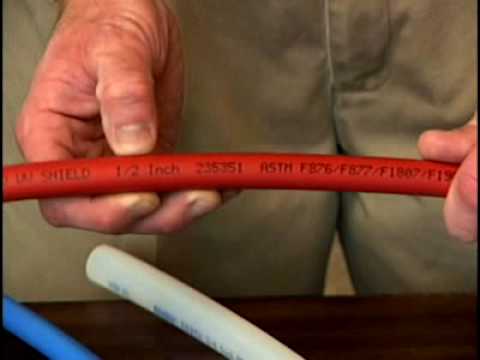
For a short neutral primer on how PEX tubing is sized and colour-coded, Home Innovation Research Labs, a third-party testing and certification lab, has a clip:
Which Editions Are Current in 2026
Search results still serve F876-23, F876-13 and even F876-02. The active edition is ASTM F876-26, updated on 23 March 2026. Its companion for fittings and manifolds is ASTM F877-26 (10 August 2026), written for 100 psi service up to 180 °F (82 °C).
On the ISO side, parts 1, 2, 3 and 5 of ISO 15875 were all republished on 10 October 2025 as second editions, replacing the 2003 texts and their amendments (ISO 15875-2:2025 is the pipe part). Europe has adopted it as EN ISO 15875-2:2025. A certificate citing “EN ISO 15875-2:2003 + A2:2020” quotes a withdrawn text.
The 2025 foreword lists real changes, and a 2003-era test report covers none of them:
- a fifth crosslinking route, PE-Xe (UV-light initiated);
- a diameter range extended to 250 mm;
- new pressure-test parameters of 20 °C for 22 h and 95 °C for 2,500 h;
- a rule fixing when the minimum degree of crosslinking has to be reached;
- thermal-stability rules for barrier and outer layers.
Head to Head: ASTM F876-26 Against EN ISO 15875-2:2025
Both govern crosslinked polyethylene for hot and cold water, and F876 has listed ISO 15875 among its references since 2020. There the overlap ends. The right-hand column of Table 1 is our reading of who each rulebook serves.
| Clause | ASTM F876-26 | EN ISO 15875-2:2025 | Verdict / best for |
|---|---|---|---|
| Size system | CTS tubing: OD is nominal plus 1/8 in, one ratio, SDR 9 | Metric OD × wall (dn × en), pipe series S, up to 250 mm | F876 for US fittings; ISO for metric systems |
| Pressure basis | 160 / 100 / 80 psi at 73 / 180 / 200 °F | Class 1, 2, 4 or 5, each paired with 4, 6, 8 or 10 bar | F876 for code plumbing; ISO for heating duty |
| Temperature logic | Continuous ratings at three fixed temperatures | A 50-year temperature-time profile per class | ISO where water temperature varies over the year |
| Crosslinking floor (%) | 65–89; 70 peroxide, 65 silane or e-beam (F876-10 text) | 70 PE-Xa, 65 PE-Xb, 60 PE-Xc (2003 text); PE-Xe added | Close; check method and edition on the report |
| Chlorine and UV | Coded on the pipe: chlorine to F2023-21, plus a UV class | Not part of the class system | F876 tells you more at goods-in |
| Fittings | System components to F877-26 | Fittings to ISO 15875-3:2025, joints to ISO 15875-5:2025 | Buy fittings under the pipe’s rulebook |
Source: ASTM store edition pages (read 25 September 2026); F876-22a´1 Tables 1–4 and F876-10 §6.8; ISO 15875-2:2025 foreword; PPI TN-52 (November 2024) Appendix A; crosslinking minima for ISO from two manufacturer documents quoting the 2003 text.
The second row decides most purchases. F876 gives every size the same three ratings: 160 psi (1.10 MPa) at 73 °F, 100 psi (0.69 MPa) at 180 °F, 80 psi (0.55 MPa) at 200 °F. ISO 15875 asks what the pipe will live through. Class 5, for high-temperature radiators, assumes 14 years at 20 °C, 25 years at 60 °C, 10 years at 80 °C and one year at 90 °C, then 100 hours at 100 °C. The Plastics Pipe Institute says it plainly in TN-52: ASTM F876, F3253, F2788 and CSA B137.5 do not use such temperature-profile assumptions.
| Water temperature | Pressure rating (psi) |
|---|---|
| 73 °F (23 °C) | 160 |
| 180 °F (82 °C) | 100 |
| 200 °F (93 °C) | 80 |
For the crosslinking rows, our PEX-a vs PEX-b vs PEX-c comparison covers the three methods.
Why One Extrusion Cannot Carry Both Labels
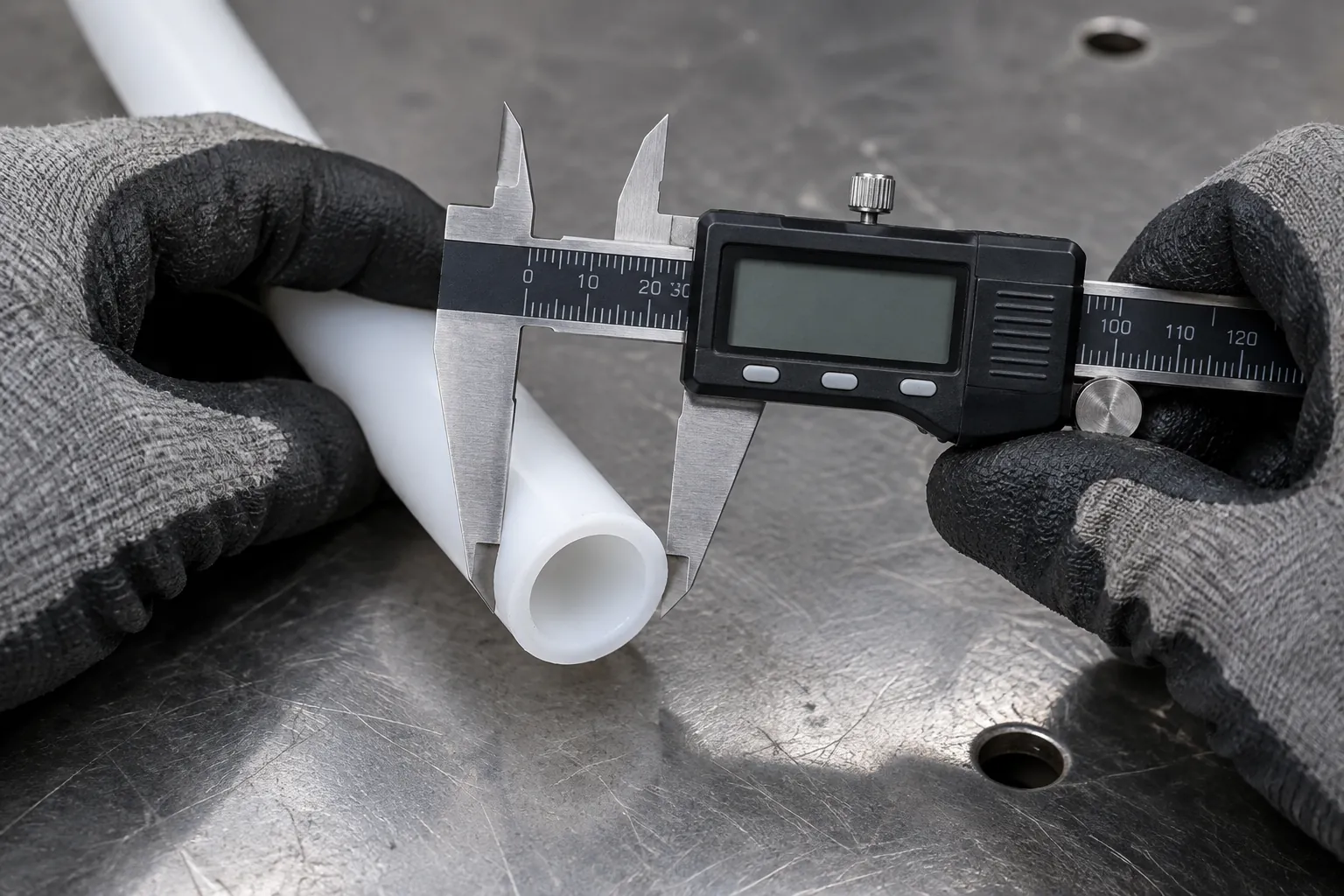
When a supplier offers “F876 and ISO 15875” on one line item, check the outside diameter. F876 puts 1/2 in tubing at an average OD of 0.625 in, which is 15.88 mm, with a tolerance of ±0.004 in (±0.10 mm), so the acceptable band runs from 15.78 to 15.98 mm. The metric nominal is 16.00 mm, 0.12 mm above the CTS figure and already outside the F876 band before any ISO tolerance is applied.
| Diameter | Distance from 15.88 mm (mm) |
|---|---|
| F876 1/2 in tolerance limit (15.78 / 15.98 mm) | 0.1 |
| 16 mm metric nominal (16.00 mm) | 0.12 |
The walls differ too. F876 sets a 0.070 in (1.78 mm) minimum at 1/2 in. ISO sizes pipe by series, Scalc = (dn − en) / 2en, so SDR 9 corresponds to S 4, while a European catalogue size such as 16 × 2.2 mm works out at S 3.2. Crimp rings, press sleeves and inserts are machined to one geometry; a fitting made for 15.88 mm tubing on 16 mm pipe is a leak installed in advance.
So the rulebook is a SKU choice. A distributor serving both markets carries two ranges, and ASTM itself routes metric PEX through a separate specification, F2788/F2788M-26. Our PEX pipe size chart lists both size systems, and the IFANPRO PEX pipe and fittings range is where to match a size to its fitting system.
Reading the Two Print Lines on the Pipe
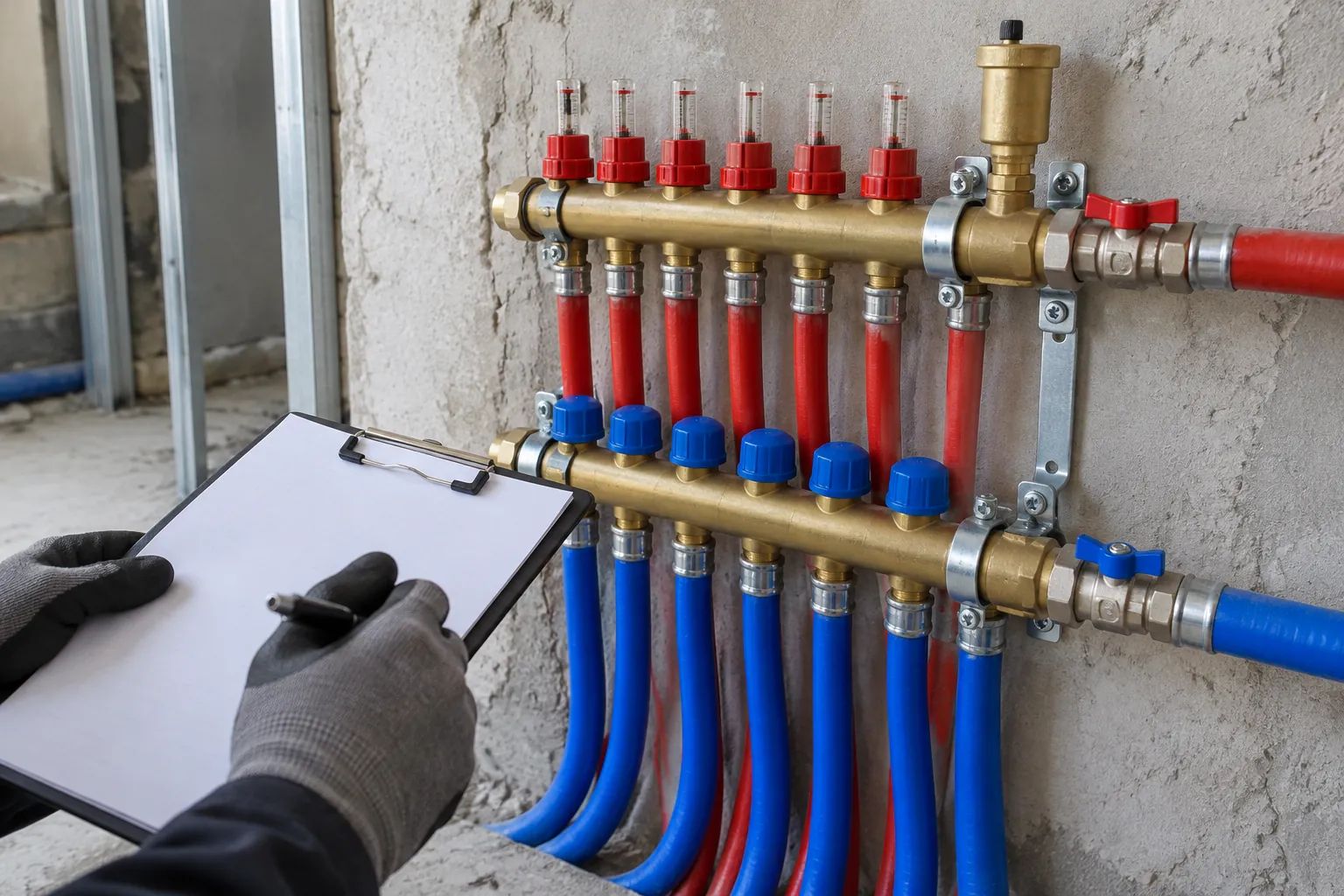
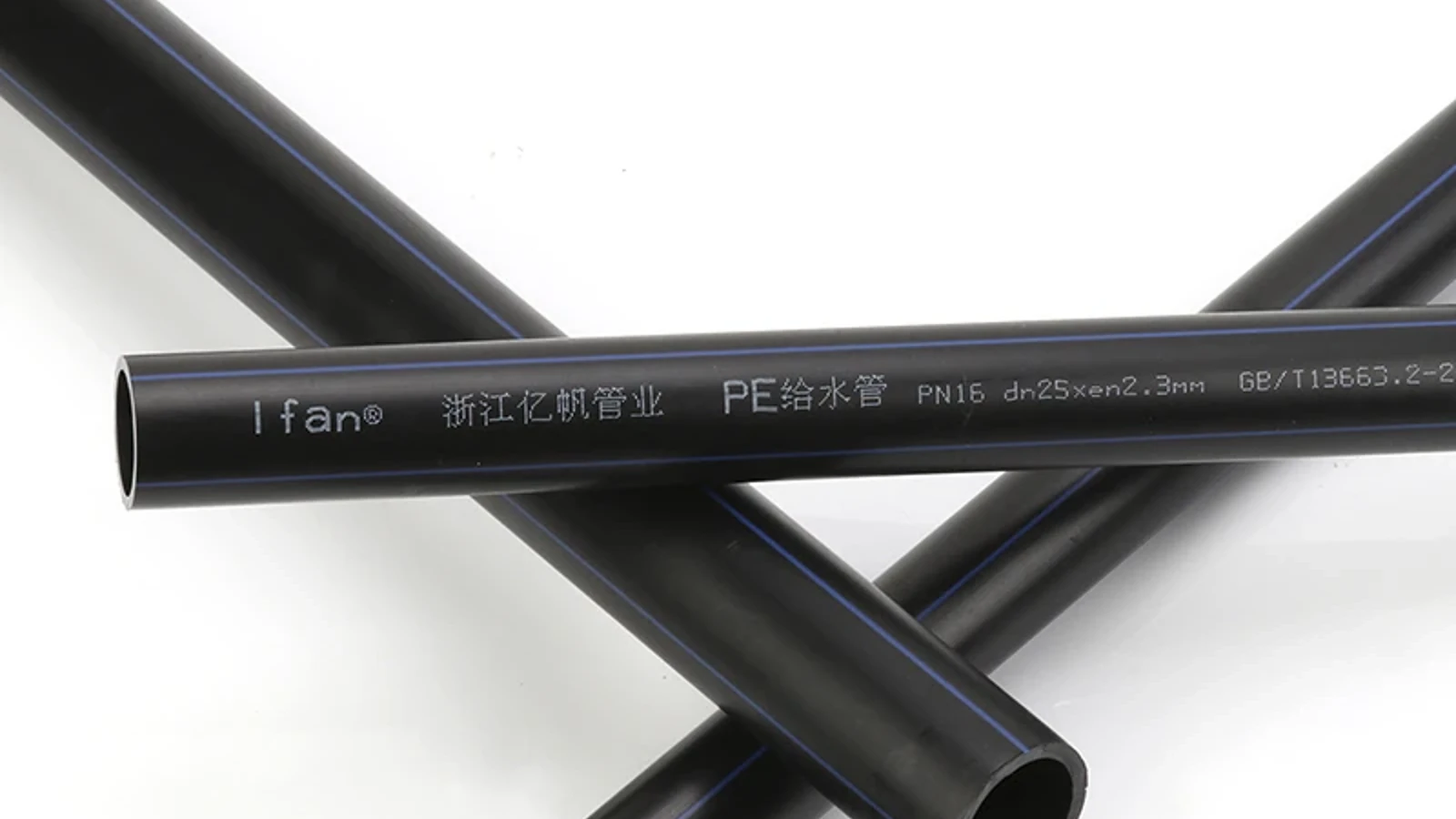
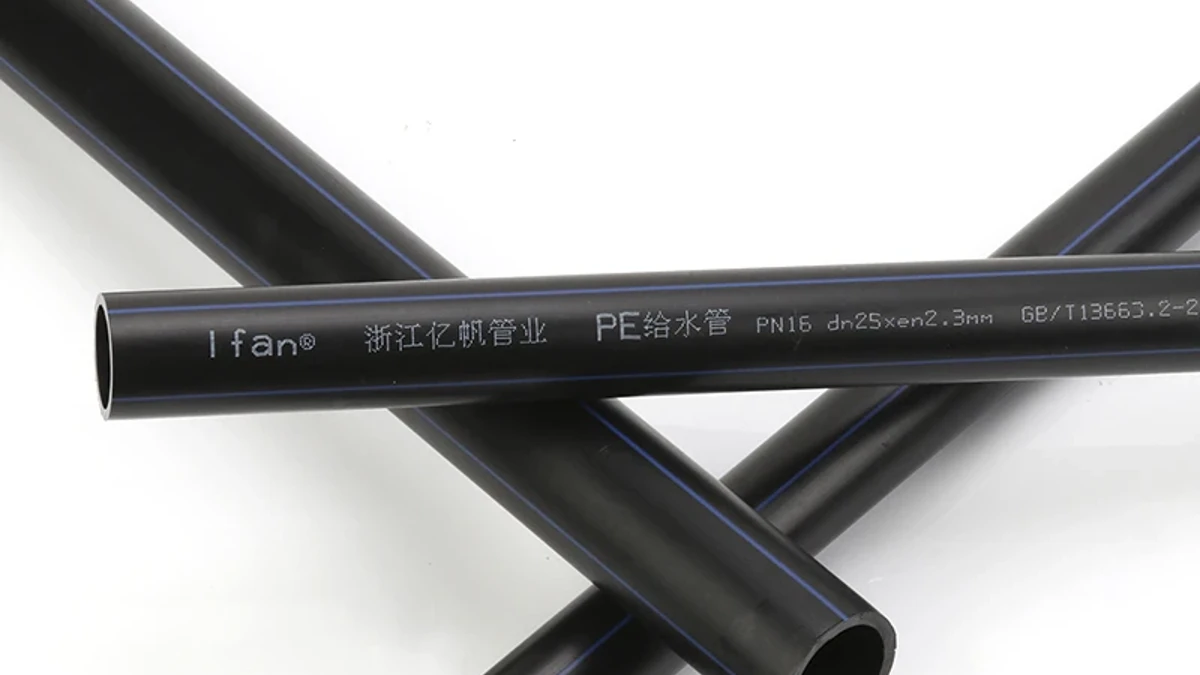
Goods-in inspection happens on the print line. One US PEX-b maker publishes this stream on its technical sheet: “CUPC CSA B137.5 NSF-PW ASTM F876/F877/F1807/F2159/F2080/F1960/F2023 SDR-9 PEX ½" CTS 5306 80PSI@200º/100PSI@180ºF/160PSI@73º”.
In F876’s designation code, the first digit after PEX is chlorine resistance tested to ASTM F2023-21: 5 means rated for 100 % of the time at 140 °F, against 1 for 25 % of the time. The second is UV resistance: 3 means 6 months. The last two are the hydrostatic design stress at 73 °F in hundreds of psi: 06 is 630 psi. Since F876-20, UV testing is mandatory for potable tubing; PPI puts the potable minimum at PEX 1106.
| Field | F876 tubing (US example) | EN ISO 15875 pipe | What to check |
|---|---|---|---|
| Standard | ASTM F876 plus fitting standards | EN ISO 15875 part and edition | Edition matches the PO and the certificate |
| Size | ½" CTS, SDR-9 | dn × en in mm, e.g. 16 × 2.2 | Size matches the fitting system you bought |
| Rating | 80 psi at 200 °F, 100 at 180, 160 at 73 | Class with design pressure, e.g. class 5 at 6 bar | Rating covers your real duty |
| Material code | PEX 5306: chlorine, UV, design stress | Crosslinked PE-X, as declared | Code or class is on the certificate too |
| Third-party mark | NSF-PW, cUPC, CSA listing marks | Certification scheme mark | Mark belongs to a live listing for this size |
Source: manufacturer print stream as published (not linked); ASTM F876-22a´1 Table 1; INSTA-CERT SBC EN ISO 15875 (January 2017), Table 2 class and pressure pairs; ISO 15875-2:2025 Clause 11 (Marking).
On the European side, argue over the class and pressure pair: in the Nordic INSTA-CERT scheme class 5 comes at 6 or 10 bar, and a class 5 / 6 bar pipe does not belong in a class 5 / 10 bar system.
Which Standard Your Buyer’s Inspector Will Quote
The code or the contract chooses, not the inspector. In US jurisdictions on the International Plumbing Code, 2024 Table 605.4 lists PEX water-distribution pipe by ASTM F876 and CSA B137.5 (now in the CSA B137:26 package). The UPC table names F877, written for 100 psi at 180 °F, plus the crimp, expansion and push-fit standards for fittings.
F876 then points the inspector at a second document. Tubing for drinking water has to be certified by a testing agency acceptable to the local health authority, to requirements no less restrictive than NSF’s; NSF/ANSI 14-2025 sets the physical, performance and health-effects rules for plastic piping. So the NSF-PW or similar mark gets read as closely as the F876 code.
Under EN ISO 15875, checking runs through a certification scheme. In INSTA-CERT’s rules each material is type-tested by an approved laboratory, audit testing follows normally twice a year, and the marking has to be approved by the certification body. Denmark and Finland add their own drinking-water marks on top. Where the project runs on WRAS or NSF approval, our WRAS vs NSF comparison covers the listing checks.
| Destination | Inspector checks against | Order to | Verdict |
|---|---|---|---|
| US, IPC or UPC jurisdiction | Code table listing PEX by ASTM F876 | F876-26 CTS tubing with a potable listing | Best for US plumbing; metric pipe fails |
| EU or Nordic heating and plumbing | EN ISO 15875 plus the national scheme | EN ISO 15875-2:2025 at the right class and bar | Best for radiators and underfloor heating |
| Export project with a written spec | Whatever the specification names | The named standard, edition written on the PO | Spec wins; ask before quoting |
| Mixed range, two markets | Both, on different SKUs | Two ranges, each with its own fittings | Never one pipe with two labels |
Source: IPC 2024 Table 605.4 and UPC Table 604.1 (via UpCodes); ASTM F876 §9 certification clause (F876-10 text, designations updated in F876-22); INSTA-CERT SBC EN ISO 15875 (January 2017).
IFANPRO’s company certification list names WRAS and NSF/IAPMO, but a company list is not a SKU listing: ask any supplier, us included, for the certificate number and the sizes it covers.
What the Choice Does to Lead Time and MOQ
The rulebook also sets how fast a supplier can say yes, because the evidence is built long before your order. F876’s stabilizer-functionality test alone runs 3,000 h at 120 °C, which is 125 days, or 8,000 h at 110 °C, which is 333 days. The 2025 ISO revision adds a 95 °C pressure test run for 2,500 h, about 104 days.
| Test | Test time (days) |
|---|---|
| ISO 15875-2:2025, 95 °C, 2,500 h | 104 |
| F876, 120 °C, 3,000 h | 125 |
| F876, 110 °C, 8,000 h | 333 |
So lead time is a listing question. If the exact material, size and print line are already on the certifier’s register, lead time is production plus transit, and the supplier should quote it per SKU, in days, from deposit. If any of the three is new, you wait on testing and on the certifier; under INSTA-CERT a changed product carries no mark until the certifier approves it in writing.
MOQ follows the same logic: a private-label print line under a certification mark adds an approval step, so expect MOQ and price breaks per print line and per size.
Where we stop, and what to ask instead
We have not published IFANPRO PEX lead-time or MOQ figures here. These are the questions to put to any supplier, us included:
- Which standard and edition is on the certificate, and what is the listing or certificate number?
- Which sizes and wall series does that listing cover, exactly?
- Does my print line (brand, language, logo) need certifier approval, and how long does that take?
- What is the production lead time in days per SKU and coil length, counted from deposit?
- What is the MOQ per size and per print line, and where are the price breaks?
Frequently Asked Questions
Is ASTM F876 the same as EN ISO 15875?
No. ASTM F876-26 covers copper-tube-size PEX tubing in SDR 9 with pressure ratings at three temperatures: 160 psi at 73 °F, 100 psi at 180 °F and 80 psi at 200 °F. EN ISO 15875-2:2025 covers metric PE-X pipe rated by application class and design pressure. Both govern crosslinked polyethylene for hot and cold water, but their dimensions, rating logic and fitting standards differ.
What does PEX 5306 mean on a pipe?
It is the ASTM F876 material designation code. The first digit, 5, means chlorine resistance for 100 % of the time at 140 °F, tested to ASTM F2023. The second, 3, means 6 months of UV resistance. The last two, 06, mean a hydrostatic design stress of 630 psi for water at 73 °F.
Can I use 16 mm metric PEX with 1/2 inch PEX fittings?
No. ASTM F876 puts 1/2 in tubing at an average outside diameter of 15.88 mm with a tolerance of ±0.10 mm. A 16 mm metric pipe is 0.12 mm larger than that, outside the band, and its wall follows a different series. Match the fitting to the pipe’s own standard.
What is the current edition of ASTM F876?
ASTM F876-26, updated on 23 March 2026, replacing F876-25. The ISO side was republished on 10 October 2025 as ISO 15875-1, -2, -3 and -5:2025, and Europe has adopted EN ISO 15875-2:2025.
Which standard suits underfloor heating?
EN ISO 15875, because its class 4 profile is written for floor heating and low-temperature radiators, paired with a design pressure of 4, 6 or 10 bar in schemes such as INSTA-CERT. ASTM F876 rates tubing at fixed temperatures and does not use temperature-profile assumptions, according to PPI TN-52.
Conclusion
The expensive mistake is not the weaker standard. It is sound pipe made to the wrong rulebook: 16 mm pipe at a US job whose code table says F876, or CTS tubing at a European radiator project that asks for class 5. Neither can be fixed at the port.
Settle the destination, write the standard and edition on the PO, and see the listing for your exact sizes before the deposit leaves.





 English
  Français
  Русский
  Español
Recent Comments