As a supplier, I see clients struggle to spot the difference between good and bad PPR. One wrong choice can lead to a failed plumbing system.
You can distinguish quality by checking visible signs like surface finish and markings, performing simple material tests, verifying international certifications, and measuring precise wall thickness. High-quality PPR uses pure raw materials, has a smooth, glossy surface, consistent color, and bears clear, permanent branding and standard codes.
Let me guide you through the practical steps to become an expert at identifying top-tier PPR products for your projects.
What Are the Visible Signs of High-Quality PPR Pipes and Fittings?
Many buyers make quick judgments based on looks alone. While not the only test, visual inspection is a powerful first filter.
High-quality PPR pipes and fittings have a smooth, glossy surface free of bubbles, pits, or rough patches. The color is consistent throughout the material, not just on the surface. They feature clear, embossed (not just printed) markings including the brand name, size, pressure rating (like PN20), and ISO or ASTM standard codes.
A Detailed Look at Surface and Structure
Your first quality check happens with your eyes and hands. Start by examining the surface. A premium PPR pipe or fitting should feel completely smooth to the touch, both inside and out. It should have a slight gloss. If you see any cloudiness, dull patches, or a wavy surface, it often indicates inconsistent cooling during production or impurities in the material. These flaws can become weak points.
Next, look for physical defects. Check the entire length for any bubbles, black specks, or scratches. Bubbles mean trapped air or moisture during manufacturing, which severely weakens the pipe’s pressure resistance. Black specks or discoloration usually signal contaminated or recycled material.
The Importance of Precise Markings
Now, examine the markings. This is where reputable manufacturers prove their commitment to standards. The information should be embossed or laser-etched into the pipe, not just painted on. Paint can rub off over time. The markings must include several key details.
First, the brand name or trademark. Second, the pipe size (e.g., 20mm x 2.8mm). Third, the standard it conforms to, such as ISO 15874 or ASTM F2389. Fourth, the pressure rating (PN value), like PN20 for cold water or PN16 for hot water systems. Finally, look for the material code “PP-R” or “PP-RCT”.
Cutting to Reveal the Truth
A very telling test is to make a clean cut. Ask your supplier for a sample piece and cut it with a pipe cutter.
Examine the Cut Wall:
- Consistency: The wall thickness should be perfectly even all around. An uneven wall is a major red flag for poor manufacturing control.
- Color and Texture: The material should be the same color all the way through the wall. If you see a different colored core or layers, it means mixed or recycled material. The cut surface itself should be smooth, not fibrous or flaky.
- Roundness: The pipe should remain perfectly round. Low-quality pipes can ovalize easily.
A simple visual and tactile inspection, focusing on these details, can immediately filter out many substandard products before you spend money on lab tests.
How Can Material Tests Identify Pure PPR Material Versus Mixed PPR?
Looks can be deceiving. I’ve seen pipes that look perfect but fail basic material tests. These simple checks are your best defense.
You can identify pure PPR by performing a burn test and a smell test. Pure PPR burns with a clean, blue-tipped flame and drips like candle wax, emitting a faint paraffin-like smell. Mixed or impure PPR burns with a smoky, yellow flame, drips heavily, and produces a sharp, acrid, or black smoke smell due to other plastics or additives.
Simple On-Site Tests You Can Do
You don’t need a lab to perform initial material screening. Two of the most effective tests are the burn test and the density test. They help identify if the manufacturer has used pure virgin PP-R copolymer or blended in cheaper regrind (recycled material) or other plastics like PP-H or PP-B.
The Burn Test Procedure
First, take a small sliver of material from a sample pipe or fitting. Important: Perform this test in a well-ventilated, safe area.
- Ignition: Hold the piece with pliers and light it with a lighter.
- Observe the Flame: Pure PPR will burn with a relatively clean flame. The base of the flame is blue, and the tip may be yellow. It should not produce heavy, sooty black smoke.
- Observe the Drip: The melting plastic will drip. Pure PPR drips are clear and consistent, similar to candle wax.
- Smell the Smoke/Fumes: This is the most telling part. Extinguish the flame and carefully smell the smoke. Pure PPR emits a faint odor similar to burning paraffin or petroleum. It is not pleasant, but it is not overwhelmingly sharp or chemical.
Signs of Impure or Mixed Material
If the material is impure, you will notice clear differences:
- Flame: A smoky, yellow, or orange flame with lots of black soot rising from it.
- Drip: The drips may be inconsistent or stringy.
- Smell: A strong, pungent, acrid, or chlorine-like smell. This indicates the presence of fillers, pigments, or other polymers.
The Density Test (Sink/Float Test)
This test uses the principle that pure PPR has a specific density slightly less than water (around 0.9-0.91 g/cm³).
- Take a small, clean sample of the PPR (a piece of pipe or fitting).
- Fill a glass with clean water at room temperature.
- Drop the PPR sample into the water.
Result:
- Pure PPR will float. It may sink very slowly or bob just below the surface if it has high-quality mineral stabilizers, but it should not sink rapidly to the bottom.
- Mixed PPR with heavy fillers (like calcium carbonate) will sink. Fillers are added to cheapen the product but make it heavier, more brittle, and prone to cracking.
Summary of Simple Material Tests
| Test | Pure PPR Result | Mixed/Impure PPR Result | What It Means |
|---|---|---|---|
| Burn Test – Flame | Clean, blue-tipped flame | Smoky, yellow flame, soot | Contamination from other materials. |
| Burn Test – Smell | Faint paraffin odor | Sharp, acrid, chemical smell | Additives or wrong polymer type. |
| Density Test | Floats in water | Sinks in water | Contains heavy filler materials. |
These tests are quick, cost nothing, and provide immediate, powerful clues about the material’s purity. Always conduct them on samples before placing a large order.
Which Quality Certifications Guarantee Reliable PPR Pipes and Fittings?
Certificates are your shortcut to trust. In international trade, they replace the need for you to audit the factory yourself every time.
Reliable PPR products are guaranteed by international system certifications for the manufacturing process, not just product tests. The most important ones are ISO 9001 for quality management, ISO 14001 for environmental management, and specific product standards like ISO 15874 or ASTM F2389, verified by third-party marks from NSF, WRAS, or KIWA for potable water safety.
Understanding Different Types of Certificates
Not all certificates are equal. You must learn to distinguish between a factory’s self-declared “test report” and a true, internationally recognized certification. Relying on the wrong document is a common and costly mistake.
There are three main levels of documentation:
- Factory Internal Test Report: This is a self-issued document. It has little independent value for quality assurance.
- Third-Party Product Test Report: A single batch of products is sent to a lab (like SGS, BV, TUV) for testing against a standard. This proves that specific batch met the standard on the test date. It’s good, but not continuous assurance.
- Management System & Product Certification: This is the gold standard. An accredited body audits the factory’s entire production and quality management system. They issue a certificate (like ISO 9001) and allow the factory to use their mark on products that pass ongoing audits. This offers continuous assurance.
Key Certifications to Demand
Here are the non-negotiable certifications you should request from your PPR supplier:
1. Quality Management System Certificate:
- ISO 9001: This is the baseline. It certifies that the factory has a documented, functioning quality management system for consistent production. It doesn’t guarantee the product is good, but it guarantees there is a system to make it consistently.
2. Product Standard Certificates:
- ISO 15874: The international standard for “Plastics piping systems for hot and cold water installations – Polypropylene (PP)”. Compliance with this standard is crucial.
- ASTM F2389: The American Society for Testing and Materials standard for pressure-rated polypropylene pipe and fittings.
3. Potable Water Safety Certifications (Critical!):
These are issued by independent national bodies and are the strongest proof of safety.
- NSF/ANSI 61 (USA): Certifies the product does not leach contaminants above safe levels into drinking water.
- WRAS (UK): Approval from the UK Water Regulations Advisory Scheme.
- KIWA (Netherlands/EU): A major European certification for drinking water components.
- ACS (France): French certification for contact with drinking water.
- GOST (Russia/Eurasia): Essential for markets like Russia and Kazakhstan.
A Quick Guide to Key Certifications
| Certification Type | Example Certificates | What It Guarantees | Why It Matters to You |
|---|---|---|---|
| Factory System | ISO 9001, ISO 14001 | Consistent processes and environmental controls. | Predictable, reliable quality batch after batch. |
| Product Standard | ISO 15874, ASTM F2389 | The product meets dimensional, pressure, and material specs. | Performance and interoperability with other compliant parts. |
| Potable Water Safety | NSF, WRAS, KIWA, GOST-R | The material is safe for drinking water contact. | Protects health and ensures legal compliance in your market. |
Always ask for scanned copies of the actual certificates and verify the company name and validity dates. A reputable supplier like IFAN will provide these transparently.
Why Do PPR Pipe Wall Thickness and Color Indicate Long-Term PPR Performance?
Two specs often overlooked are wall thickness and color. They are not just numbers or aesthetics; they are direct indicators of performance and material integrity.
Wall thickness directly determines the pipe’s pressure-bearing capacity and long-term strength. Consistent, precise thickness is a sign of advanced manufacturing. Color indicates the type and quality of additives used; natural off-white/beige suggests fewer pigments and better UV stabilizers, while very bright colors often mask impurities and may degrade faster.
The Critical Role of Wall Thickness
The wall thickness (often listed as “S” value or “SDR” – Standard Dimension Ratio) is the most critical physical dimension of a PPR pipe. It is not a random number but is calculated based on the intended pressure rating (PN value) and the material’s long-term strength.
Why Thickness and Consistency Matter:
- Pressure Resistance: A thicker wall can handle higher internal water pressure. A pipe marked PN20 (20 bar) must have a precise minimum wall thickness. If the actual thickness is below this, the pipe will fail prematurely under pressure.
- Long-Term Hydrostatic Strength: PPR, like all plastics, slowly degrades under constant pressure over decades (creep). A precise, adequate wall thickness is designed to ensure it lasts 50+ years at its rated pressure and temperature.
- Manufacturing Quality: Producing a pipe with a perfectly even wall thickness all around its circumference is technically challenging. An uneven wall (e.g., thicker on one side, thinner on the other) creates stress points. The thin section becomes the weak link, leading to cracks or bursts. Consistency is a hallmark of high-precision extrusion machinery.
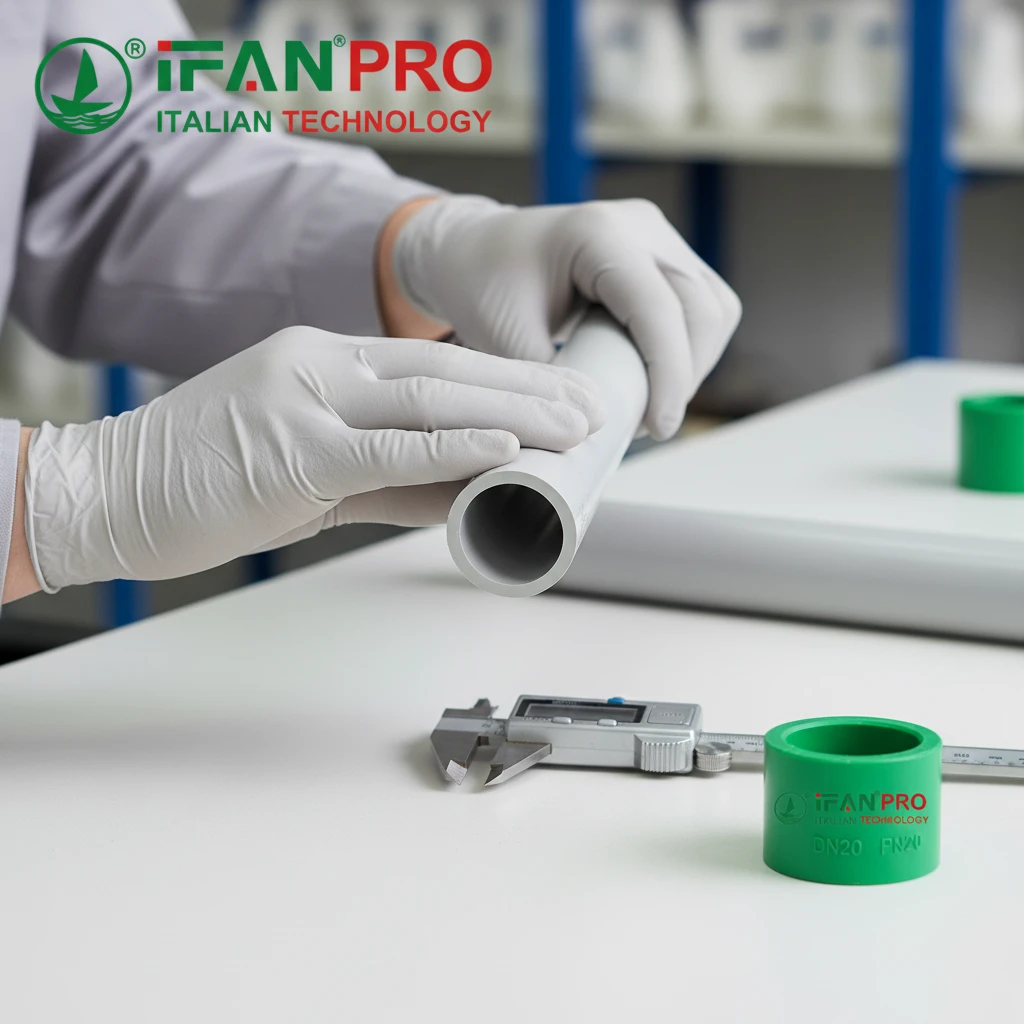
You must measure it. Use a caliper to check the wall thickness at several points around a cut piece of pipe. Compare it to the nominal thickness stated in the ISO 15874 standard for that pipe diameter and PN rating.
What Pipe Color Really Tells You
PPR resin in its pure, natural state is a translucent, milky white or beige color. The color you see in pipes is achieved by adding masterbatch pigments. The choice of color and pigment quality speaks volumes.
- Natural/White/Beige Pipes: These typically use high-quality, neutral titanium dioxide (TiO2) as a pigment and UV stabilizer. TiO2 is inert and helps protect the pipe from degradation by sunlight during storage and installation. This color is often preferred for hot water lines and is a sign of a focus on material performance over marketing.
- Green/Grey Pipes: These are also very common. Reputable manufacturers use stable, non-reactive pigments specifically formulated for plastics. The color should be uniform throughout the wall.
- Very Bright or Opaque Colors (e.g., Bright Green, Blue): Be cautious. While not always bad, very intense colors can sometimes be used to mask the yellowish tint of recycled or lower-grade material. Cheap organic pigments can also degrade over time, especially under UV exposure.
The Connection Between Color, Additives, and Lifespan
| Pipe Color | Typical Pigment/Additive | Implied Focus | Long-Term Performance Consideration |
|---|---|---|---|
| Natural White/Beige | Titanium Dioxide (high-quality) | Material purity, UV resistance. | Best for UV exposure, often indicates virgin material. Stable long-term. |
| Grey/Green (Muted) | Standard quality pigments. | Market standard, identification (hot/cold). | Good performance if pigments are stable. Check for color consistency. |
| Bright/Vivid Colors | Organic or cheap pigments. | Marketing, visual differentiation. | Risk of pigment fading or masking recycled content. Requires verification. |
The Key Takeaway: Do not judge a pipe by its color alone, but understand its meaning. Always prioritize precise, consistent wall thickness over any color. A perfectly thick green pipe is better than an uneven, off-spec white one. For critical applications, specify the required SDR or minimum wall thickness in your order contract and perform sample checks.
Conclusion
Distinguishing PPR quality involves checking visuals, performing simple tests, demanding real certifications, and verifying precise wall thickness. For guaranteed high-quality PPR pipes and fittings backed by full documentation, source your next project from IFAN.



 English
  Français
  Русский
  Español
Recent Comments