
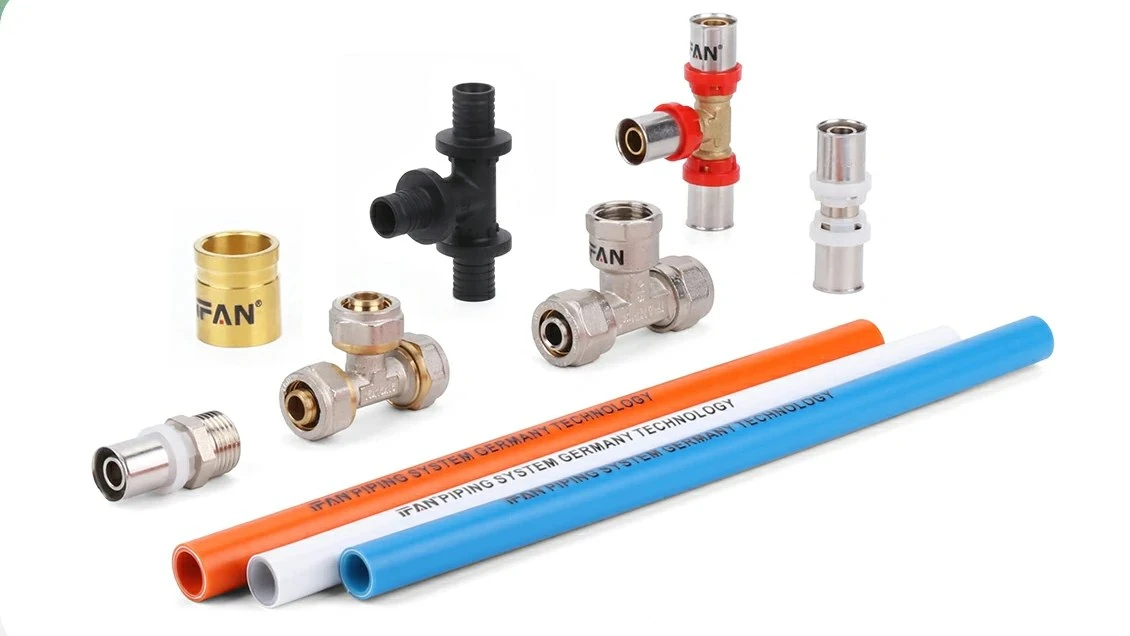
Six of the pages currently ranking for “PEX vs PVC” were measured before this one was written. They average 1,421 words, and they disagree with each other about which pipe is cheaper and which lasts longer — because none of them cites a standard for either claim. Meanwhile the two standards that actually govern these materials, ASTM D1785 for PVC and ASTM F876/F877 for PEX, have already answered the question in a way that makes “which is better” the wrong thing to ask. If you buy pipe for resale rather than for one house, the answer changes what you stock, not which side you pick.
- They are not competitors. Model plumbing codes list PEX under ASTM F876 for cold and F877 for hot or cold water. The vinyl material listed for hot water distribution is CPVC to ASTM D2846 — not PVC.
- The published pressure numbers are not comparable. D1785 rates PVC “for use with water at 73°F (23°C)” and stops there. PEX carries a long-term pressure class of 160 psig at 73°F plus a stated 100 psig at 180°F.
- The stock-list trap is in the small sizes. On mainstream dual-rated Schedule 40 lines the D2665 DWV mark starts at 1¼ in — ½ in and ¾ in sit outside it. Verify your own supplier’s exclusion list before selling small sizes as DWV-rated.
- Pipe price is the small half of the cost. Fitting count, joining labour, freight cube and dead stock move the landed number far more than the per-metre figure.
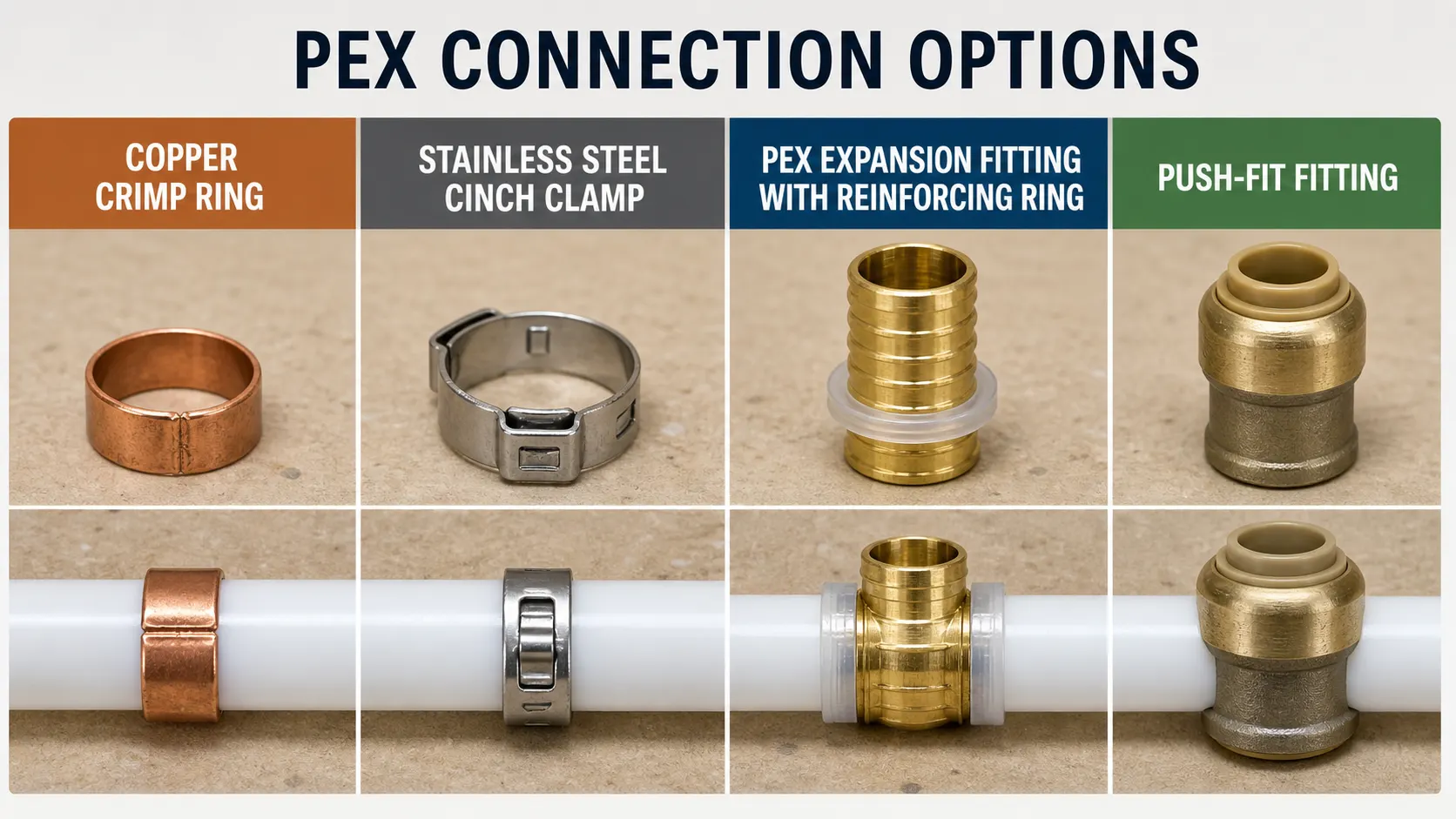
- Choosing PEX means choosing a joining system — crimp, cold-expansion, push-fit or press — and that decision locks more inventory than the pipe does.
- The comparison almost every page gets wrong
- PEX vs PVC at a glance: what each material is rated for
- Where the plumbing code draws the line
- The stock-list split: what each material adds to your inventory
- Where the cost actually sits
- Reading the print line before you accept a container
- Which one should you stock, and in what ratio?
- Frequently asked questions
The Comparison Almost Every Page Gets Wrong
Run the search and you get a DIY forum thread, three repiping contractors, a manufactured-home retailer and one pipe manufacturer. Read them side by side and the contradictions surface fast: they quote service lives for both materials that differ by decades between pages, one says PEX is more expensive, a third says PEX is cheaper once labour is counted. None of them attributes a single one of those numbers to a standard, a test method or a published document — and no standard for either material publishes a service life at all.
That is not sloppiness so much as a symptom. Those pages are written for someone deciding what goes into one house, where “which is better” is a real question with a personal answer. If you are buying by the pallet and reselling to plumbers, the question dissolves. Your customers are not choosing between PEX and PVC for the same job, because the code already assigned each material a lane — and a merchant who stocks the wrong ratio finds out through dead inventory rather than through a burst pipe.
So this article does not crown a winner. It does something more useful for a buyer: it shows where the line between the two materials is actually drawn, who drew it, and what falls on each side of it when you turn that line into a purchase order.
PEX vs PVC at a Glance: What Each Material Is Rated For
Start with what each standard says about itself, because this is where the popular comparisons go wrong in a way that matters commercially.
ASTM D1785 covers “poly(vinyl chloride) (PVC) pipe made in Schedule 40, 80, and 120 sizes and pressure-rated for water.” The ratings themselves live in Appendix X1, and X1.4 states the condition plainly: the pipe “is rated for use with water at 73°F (23°C) at the maximum internal pressures shown in Tables X1.1-X1.3.” The hydrostatic design stresses behind those ratings — 2000, 1600, 1250 and 1000 psi — are likewise stated for water at 73°F. There is no companion table for hot water in the specification, and that absence is the whole story.
The two rating bases are different quantities
PEX publishes a different kind of number. Under AWWA C904, PEX tubing carries a pressure class of 160 psig at 73°F derived from long-term hydrostatic strength testing, plus a separately stated elevated-temperature capability of 100 psig at 180°F. Its short-term burst minimums are 475 psig at 73°F, 210 psig at 180°F and 180 psig at 200°F. The pressure class rests on a hydrostatic design basis of 1,250 psi with a design factor of 0.50, giving a design stress of 630 psi. These figures are published by the Plastics Pipe Institute in its AWWA C904 water-service material; the tubing standard itself is ASTM F876.
Read those two paragraphs again and you will see the trap. A ½ in Schedule 40 PVC1120 pipe is rated 600 psi and a PEX tube is rated 160 psig, so PVC looks nearly four times stronger. But the PVC figure is a room-temperature pressure rating with no hot-water column at all, while the PEX figure is a long-term class that comes with a published hot-water number attached. Putting them in the same column without saying so is how a spec sheet misleads a buyer who has not read the appendix.
| Rating basis | PVC (ASTM D1785) | PEX (ASTM F876 / AWWA C904) |
|---|---|---|
| Stated at 73°F | ½ in 600 psi · 1 in 450 psi · 2 in 280 psi (Sch 40, PVC1120) | 160 psig pressure class |
| Stated at 180°F | Not published in D1785 | 100 psig |
| Minimum burst | Not published in D1785 alongside the rating | 475 psig @ 73°F · 210 @ 180°F · 180 @ 200°F |
| Form and sizing | Rigid sticks, Schedule 40/80/120 | Coil or straight, SDR 9, ¾–3 in CTS for water service |
One dimensional note that saves confusion on an order: PEX is sized to copper tube size, so the actual outside diameter runs ⅛ in larger than the nominal size, and the wall is one ninth of the average OD. A buyer cross-referencing a PEX size against a PVC schedule chart is comparing two different dimensional systems.
Where the Plumbing Code Draws the Line
The material listings in the model plumbing codes make the split explicit. PEX is listed for water distribution as ASTM F876 for cold water and ASTM F877 for hot or cold water. The vinyl-family material listed alongside it for hot and cold water is CPVC to ASTM D2846 — chlorinated PVC, a different compound with a different standard. Plain PVC to D1785 is a pressure-pipe material for cold-water service and, in dual-rated sizes, drainage.
This is why the “which is better for plumbing” framing collapses. In a typical building the two materials are not bidding for the same run. PEX takes the hot and cold distribution behind the walls; PVC takes the drain, waste and vent stack and the cold-water and irrigation runs. A merchant who sells both is not hedging a bet — he is supplying two different parts of the same job.
Where this bites a distributor rather than a plumber
The plumber on site rarely gets this wrong; he has an inspector waiting. The party who does get it wrong is whoever writes the catalogue copy. Describing a PVC line as suitable for “hot and cold water supply” because the fitting range looks similar to CPVC is a documented way to have a container rejected at the destination — and the correction lands on the seller, not the installer.
Hedge this one deliberately. Model-code listings are adopted, amended and enforced locally. The listings above are what the model codes carry; the authority having jurisdiction in your destination market is what governs an actual installation. Confirm the adopted code edition for the market you are shipping into before you print a datasheet claim.
The Stock-List Split: What Each Material Adds to Your Inventory
Here is the part no page-1 result covers, and it is the part that costs money. Each material drags a different tail of SKUs behind it.
PVC brings fittings and cement. It is rigid, so every direction change is a separate part. Joints are solvent-welded to ASTM D2672, with installation under D2774 and D2855, and the compound is typically a D1784 cell class 12454. A working PVC range means elbows, tees, couplings, reducers, adapters and unions in every size you carry, plus primer and cement as consumables that have their own shelf life.
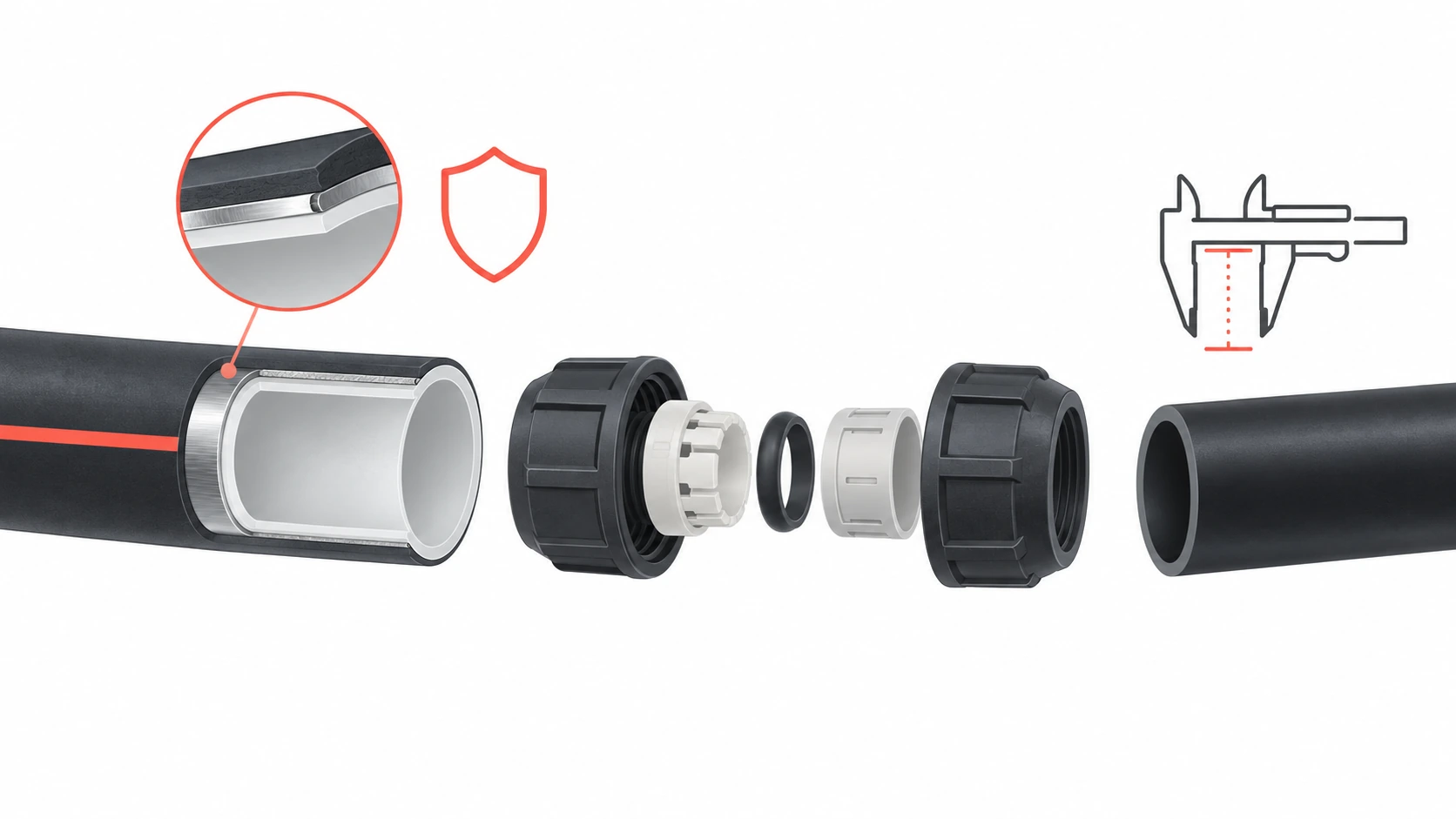
PEX brings a joining-system commitment. Coil form removes most of the fittings — a PEX run bends around obstacles that would each cost an elbow — but the fittings that remain are not interchangeable across systems. The joining standards in current use are ASTM F1807 (crimp ring), ASTM F1960 (cold expansion), ASSE 1061 (push-fit) and ASTM F3347 (press-fit with stainless sleeves). Stocking PEX means picking one or two of those and living with the tools, rings and fittings each requires.
The dual-rating size trap
This one catches experienced buyers. Schedule 40 PVC is commonly sold as dual-rated pressure and DWV pipe, which invites the assumption that one stock item serves both applications across the range. It does not. A mainstream manufacturer’s published range for dual-rated Schedule 40 runs 1¼ in to 24 in — the dual marking simply starts at 1¼ in, which means ½ in and ¾ in Schedule 40 are pressure pipe carrying D1785 alone. Individual product lines exclude other odd sizes on top of that, so read the range as a floor, not a complete exclusion list.
Practically, that means the small-diameter PVC on your shelf is pressure pipe only. If a customer orders ¾ in “PVC DWV” and you ship dual-rated stock assuming the small sizes carry the same marks, the paperwork will not match the print line on the pipe. Check the exclusions against your own supplier’s specification — they are a property of the product line, not a universal rule, which is exactly why they are easy to miss.

Where the Cost Actually Sits
Every page ranking for this query quotes a per-foot price, and every one of those figures is a retail number from a single market. For a buyer purchasing at wholesale, a per-metre comparison between the two materials answers almost nothing, because the pipe is the part of the cost that varies least. Four multipliers move the landed number more:
- Fitting count per run. Rigid pipe needs a fitting at every direction change; coil absorbs the bend. Two runs of identical length can differ by a dozen parts.
- Joining labour and tooling. Solvent welding needs primer, cement and cure time. Crimp and cold-expansion need a tool per system — a fixed cost the first order carries and later orders do not.
- Freight cube. Coil packs densely; rigid sticks are governed by length, not weight, and a 6 m stick sets the minimum dimension of everything around it. PEX also weighs five to six times less than copper, which is why service-line work shifted toward it on shipping cost alone.
- Dead stock risk. PVC fittings are broad, shallow and slow-moving in the odd sizes. PEX inventory concentrates in fewer SKUs but strands entirely if you later switch joining systems.
Run those four against your own order history and you get a number worth acting on. A single per-metre figure copied from a US retail blog will not survive contact with your freight quote.
On our own pricing, plainly: we do not publish a price band or an MOQ figure on this page, and we are not going to imply one — those numbers are quoted per enquiry and anything we printed here would be revised before you could act on it. What we can state is what we are: IFAN has manufactured plumbing pipe since 1993 from a 120,000 m² plant with about 610 staff, and we extrude PPR, PVC, CPVC, PPSU, HDPE, PEX (both PEXa and PEXb), PERT and brass under one roof — which is the reason a mixed PVC-and-PEX stocking order can ship as one consignment rather than two.
Our approvals list runs ISO 9001, ISO 14001, CE, WRAS, IAPMO, Intertek, EAC, Watermark and SAI Global. Ask for the certificate covering your destination market by name — coverage is per market and per product family, not a single blanket document. To quote, we need the size mix and the destination port first.
Reading the Print Line Before You Accept a Container
Both materials carry their credentials printed along the pipe. Learning to read that line is the cheapest inspection available to a buyer, and it works on a phone photo from the warehouse before the container is signed for. This is the documented incoming-check procedure, in the order it is worth doing:
- Standard designation — F876 or F877 on PEX; D1785 (and D2665 where dual-rated) on PVC. If it is absent, stop here.
- Material designation code on PEX (e.g. PEX 1306) — decode it against the table below before accepting the class.
- Size and SDR — PEX should read SDR 9; PVC should read its schedule. Confirm against the packing list, not the invoice.
- NSF marks — NSF/ANSI 14 and NSF/ANSI/CAN 61 on the pipe, and separately on the brass fittings.
- Production code and date — the traceability link if anything is disputed later.
Decoding a PEX designation code
PEX tubing carries a material designation code such as PEX 1306, and each digit is a performance category defined in ASTM F876. The first digit is chlorine resistance, the second is UV resistance, and the last two encode the hydrostatic design stress. “PEX 1306” is the minimum code accepted for water service under AWWA C904; codes like PEX 3306 or PEX 5306 exceed it.
| Digit | What it means | Why a buyer cares |
|---|---|---|
| Chlorine 1 | 25% of time hot at 140°F, 75% at 73°F | Intermittent hot water only — 25% of operating time at 140°F |
| Chlorine 3 | 50% of time hot at 140°F | Timed hot-water recirculation — 50% of operating time at 140°F |
| Chlorine 5 | 100% of time hot at 140°F | Continuous recirculation, no timer — hotels, hospitals |
| UV 3 | 6 months or more UV resistance | The AWWA C904 minimum; matters if stock sits in a yard |
If your market has continuous hot-water recirculation in commercial buildings, a chlorine-1 tube meets the letter of the water-service standard and is still the wrong product for that application. That is a specification conversation to have before the order, not after a warranty claim.
What to demand on both materials
Two certification marks apply across the plastics. NSF/ANSI 14 covers plastic piping system components and materials — PVC, CPVC, PE and PEX alike. The IPC, IRC and National Standard Plumbing Code have required compliance with it for many years, and the Uniform Plumbing Code now requires it too — so treat NSF/ANSI 14 as the baseline across the major North American model codes, and confirm adoption status for your own destination jurisdiction before you quote. NSF/ANSI/CAN 61 covers drinking-water health effects.
A mainstream PVC pressure line will list both alongside an IAPMO UPC listing — and on at least one such line the UPC-listed product must be requested at the time of order rather than being the default. That is worth asking about explicitly, because it is the kind of default that only surfaces after the container has shipped.
On the PEX side the fittings carry their own burden. Lead-free brass fittings must be certified to NSF/ANSI/CAN 61 and NSF/ANSI/CAN 372, and must also meet the dezincification-resistance and stress-corrosion-cracking requirements of NSF/ANSI 14. A compliant tube joined with a non-compliant brass fitting is a non-compliant system, and the fitting is the cheaper part to substitute quietly.

Which One Should You Stock, and in What Ratio?
If you supply general plumbing in a market that follows the model codes, the honest answer is both — in a ratio set by what your customers install, not by which material you prefer.
| Material | Best for | Not for |
|---|---|---|
| PEX | Hot and cold distribution, repipes, radiant and hydronic loops, buried service lines, retrofit work through finished walls | Drain, waste and vent; long unprotected outdoor exposure without a UV-rated code; customers unwilling to buy into one joining system |
| PVC | DWV stacks, cold-water mains, irrigation, pool and industrial cold-water lines, anywhere rigidity is an advantage | Hot-water distribution — that is CPVC’s listing, not PVC’s; tight retrofit routing; small-size DWV where dual rating does not apply |
A worked scenario you can reuse
A distributor supplying residential contractors in a mixed hot-and-cold market scopes a first combined order. Working from the code lanes rather than from preference, the reasoning goes: DWV volume is fixed by the number of bathrooms his customers build, so PVC quantity follows fixture count and skews to 1½ in, 2 in, 3 in and 4 in. Supply-side volume follows fixture count too, but in PEX at ½ in and ¾ in, because that is the listed hot-and-cold material. He orders the small PVC pressure sizes separately rather than assuming his dual-rated stock covers them, having checked that his supplier’s D2665 marking starts at 1¼ in.
Then the decision that outlasts the order: which PEX joining system. He asks his three largest customers which tool they already own. Two run crimp, one runs cold expansion — so he stocks F1807 crimp fittings deep and F1960 shallow, and does not attempt to carry four systems thinly. On chlorine class he checks whether any customer works on commercial buildings with continuous recirculation; if not, the water-service minimum is defensible, and if so he specifies the higher class for that segment rather than upgrading the whole range.
- Which code edition is adopted in your destination market, and does it list F877 for hot and cold?
- Which PEX joining system do your largest customers already own tools for?
- Does any customer segment need a chlorine class above the water-service minimum?
- Do the small PVC sizes you plan to sell as DWV actually carry the D2665 mark?
- Are NSF/ANSI 14 and NSF/ANSI/CAN 61 marks on the pipe and on the brass fittings?
One frequently asked question deserves a hedged answer rather than a slogan. On freezing, PPI TR-52 reports that PEX materials have lower thermal conductivity than metallic piping, which “can extend the time required to freeze the fluid within the system,” and that if freezing does occur the elastic nature of PEX typically allows it to expand. That is meaningfully better behaviour than rigid pipe — PEX conducts heat at 2.86 BTU·in/(ft²·hr·°F) against copper’s 196 — but “typically allows it to expand” is not “cannot burst,” and it should not be sold as a freeze guarantee.
If your next question is which material wins on the hot-water side specifically, that is a genuine head-to-head rather than a code split, and it is answered in our comparison of PEX, copper and PPR for hot-water service. For the fittings, sizing and certification detail behind everything above, the PEX pipe sourcing guide is the hub for this pillar, and the PEX pipe size chart covers the CTS dimensions referenced earlier.
Frequently Asked Questions
Not as a distribution material under the model codes. The vinyl-family material listed for hot and cold water is CPVC to ASTM D2846. ASTM D1785 rates PVC for water at 73°F and publishes no hot-water rating table.
The two publish different quantities, so the comparison does not resolve cleanly. PVC Schedule 40 shows higher room-temperature pressure ratings; PEX publishes a long-term pressure class plus a stated 100 psig capability at 180°F, which PVC does not have at all.
Per metre of pipe the answer varies by market and resin price, which is why published per-foot figures rarely transfer. For a buyer, fitting count, joining labour, freight cube and dead-stock risk move the landed cost more than the pipe itself.
Only through a transition fitting, never directly — PEX is joined mechanically under F1807, F1960, ASSE 1061 or F3347, while PVC is solvent-welded under D2672. In practice they meet at fixtures and appliances rather than mid-run.
It is the ASTM F876 material designation code: chlorine-resistance category 1, UV category 3, and 06 for the hydrostatic design stress of 630 psi. PEX 1306 is the minimum code AWWA C904 accepts for water service.
No. Dual marking to ASTM D2665 starts at 1¼ in on mainstream Schedule 40 lines, so ½ in and ¾ in carry D1785 alone. Individual lines exclude further odd sizes — verify against your supplier’s own specification.










 Français
  English
  Русский
  Español
Commentaires récents