
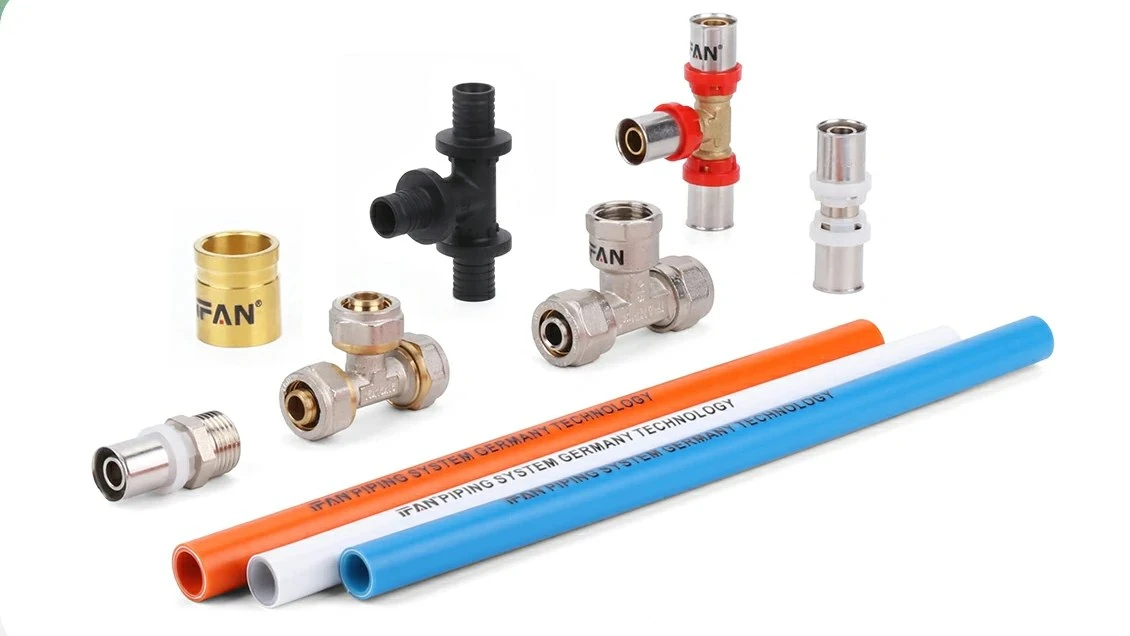
PEX-AL-PEX behaves like a metal pipe wearing a plastic coat, and that is exactly why its joints fail in ways plain PEX joints never do. A single-layer PEX barb forgives a rough cut because the pipe wall is soft enough to swallow it. Composite pipe does not forgive anything: there is a welded aluminium tube 0.065 in below the surface on 1/2 in pipe, and when you cut that pipe you expose a metal edge that sits directly in the path of an O-ring you are about to slide past it.
This page is the hub for everything IFANPRO publishes on PEX-AL-PEX connections. It answers the two questions the rest of the internet keeps separate — which fitting system do I buy and why did the joint I already made start weeping — because for a buyer standardising a project they are the same question. Get the profile and the preparation right at the purchase-order stage and the leak diagnosis never happens.
Key Takeaways
- Press jaw profiles are not interchangeable. U and TH are different geometries, and a fitting pressed with the wrong jaw can look finished and still leak. Confirm the profile on the offer, not on delivery.
- Calibrating and chamfering is not optional prep — it is part of the joint. The documented sequence is cut square, calibrate and chamfer, verify insertion through the check holes, then press. Skipping step two is the single most common cause of a displaced O-ring.
- ASTM F1974 fittings are qualified to 125 psi (690 kPa) up to 180 °F (82 °C) — and thermocycling is one of the named qualification tests, which tells you heat cycling is an anticipated failure mode, not bad luck.
- Compression is serviceable, press is permanent. Compression needs only a wrench and can be retightened; press needs the matching tool and cannot be undone. That choice drives your tooling budget more than your fitting budget.
- When the leak appeared tells you what caused it. Immediate means preparation, days means torque or profile, months-after-heating-season means thermal cycling on an already-marginal joint.
On This Page
- Why PEX-AL-PEX Joints Fail Where Plain PEX Joints Do Not
- The Four Connection Systems, and What Each Standard Actually Covers
- Press Jaw Profiles: The Compatibility Table Nobody Publishes
- The Preparation Sequence That Decides Whether the Joint Holds
- Choosing Between Press and Compression for Your Project
- Diagnosing a Leak by When It Appeared
- What This Means for Your Next Order
- What We Check on a Composite Fitting Before It Ships
- Frequently Asked Questions
Why PEX-AL-PEX Joints Fail Where Plain PEX Joints Do Not
Start with what the standard insists on. ASTM F1281 covers only composite pipe incorporating a welded aluminium tube; pipe whose metallic layer is merely overlapped and not welded together falls outside the scope entirely. That welded tube is the whole point of the product — it is what holds a bend in place, what limits oxygen diffusion, and what gives the pipe a thermal expansion coefficient far closer to metal than to plastic. It is also what makes the joint difficult.
Look at how little material you are working with. On the dimensional table a manufacturer publishes against F1281, 1/2 in CTS pipe runs an average OD of 0.636 in against an average ID of 0.490 in, giving a minimum wall of 0.065 in. Three-quarter-inch runs 0.990 in OD, 0.792 in ID, 0.089 in minimum wall. Inside that wall sits the aluminium. When a pipe cutter shears through it, the aluminium does not cut cleanly like the polyethylene either side of it — it deforms inward and leaves a burr with a hard edge.
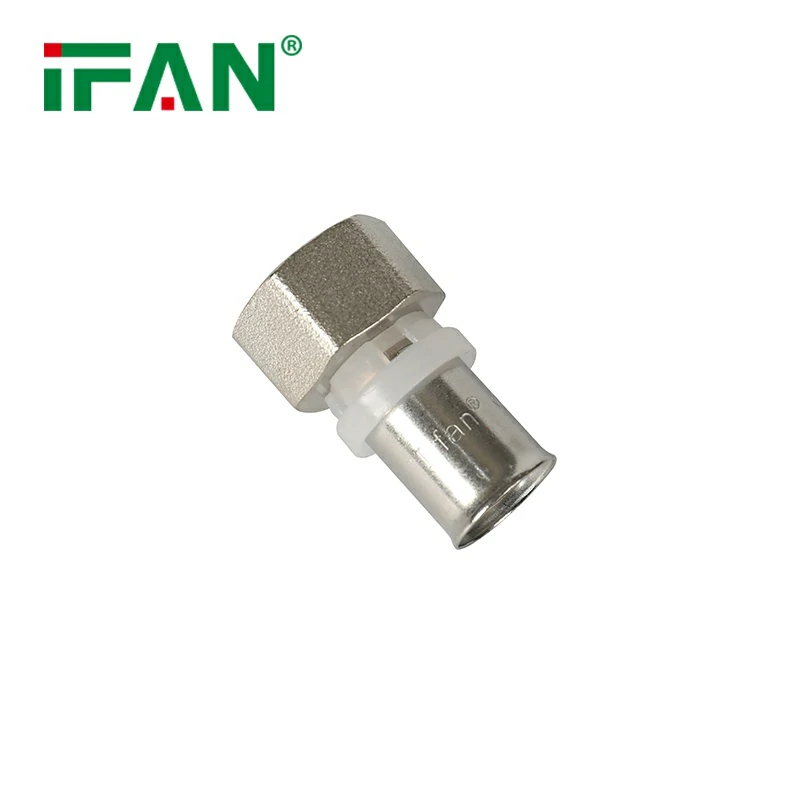
The O-rings sit in machined grooves on the fitting stem. Every burr on the pipe ID passes directly over them during insertion.
That burr then has to travel over the O-rings. Practitioners describe the mechanism the same way manufacturers do: if the reamer bottoms properly on the tube end and the ID is chamfered as intended, the fitting enters with the O-rings staying in their grooves — and if it does not, the rings are displaced and the joint leaks. A displaced O-ring is not a slow degradation. It is a seal that was never made, sitting behind a press sleeve that looks perfect from the outside.
The second difference is thermal. Because the aluminium dominates the composite’s expansion behaviour, a run that was assembled cold in a warehouse and pressure-tested cold will move differently once the heating season starts. ASTM F1974 anticipates this directly: thermocycling sits alongside hydrostatic burst and sustained pressure in the list of qualification tests a compliant fitting must survive. When a standards committee writes a heat-cycling test into a fitting specification, it is telling you that heat cycling is the thing that finds marginal joints.
Insider warning. A cold pressure test proves nothing about a marginal composite joint. The joints that embarrass a contractor are the ones that passed the test at ambient temperature in October and wept in December. If your handover protocol only tests cold, you are testing the easy condition.
This is why the corpus of advice written for plain PEX transfers so badly. Our own breakdown of the four PEX connection systems — crimp, clamp, push-fit and cold-expansion — is accurate for single-layer tubing, where the pipe itself is the sealing element pressed against a barb. On composite pipe the sealing element is an elastomer O-ring on a machined stem, and the pipe’s only job is to hold still. Different mechanism, different failure modes, different preparation.
The Four Connection Systems, and What Each Standard Actually Covers
Buyers routinely ask for “PEX-AL-PEX fittings” as though that were one product. It is four, governed by two different standards regimes depending on which market you are shipping into, and the regimes do not cover the same ground.
On the North American side, ASTM F1974 is the specification for metal insert fittings for both PEX-AL-PEX and PE-AL-PE composite pressure pipe. It recognises exactly two classes: fittings with a split ring and compression nut, and fittings with a copper crimp ring. Bodies must be wrought copper, cast copper alloy, machined brass or forged brass. The qualification suite is hydrostatic burst, hydrostatic sustained pressure, excessive temperature and pressure, and thermocycling — plus markings.
| System | Seal made by | Tool needed | Serviceable? |
|---|---|---|---|
| Compression (split ring + nut) | O-rings on stem, ring compressed by nut | Two wrenches | Yes — can be retightened or reopened |
| Copper crimp ring | O-rings on stem, ring crimped over pipe | Crimp tool + go/no-go gauge | No — cut out to replace |
| Press (stainless sleeve) | O-rings on stem, sleeve plastically deformed | Press tool with the matching jaw profile | No — permanent |
| Push-fit | O-ring plus grab ring | None (release clip to remove) | Yes — but least common on composite |
Notice what the North American standard does not cover: press fittings with stainless sleeves, which are the mainstream system in Europe, sit outside F1974’s two recognised classes. If you are sourcing for a European or Middle Eastern project you are working to EN ISO 21003 instead — a multi-part standard in which Part 2 covers pipes, Part 3 covers fittings and Part 5 covers fitness for purpose of the system as an assembled whole. That last part matters commercially: ISO 21003 treats the pipe and the fitting as one qualified system, which is the technical basis for the warranty language you will see refusing cover on mixed-brand assemblies.
You will also see DIN 16836 quoted on offers from Chinese and European suppliers. It is the German standard for polyolefin-aluminium multilayer pipes covering general requirements and testing — a pipe standard, not a fitting standard. A supplier answering “which fitting standard do you meet?” with “DIN 16836” has answered a different question, and that is worth catching at the quotation stage rather than at inspection.
One number worth memorising. ASTM F1974 fittings are intended for 125 psi (690 kPa) systems operating at up to and including 180 °F (82 °C) — but the PE-AL-PE variant of the same pipe family is held to 140 °F (60 °C). Same standard, same fitting shapes, 40 °F apart. If a supplier’s offer says “PE-AL-PE, suitable for heating,” ask which temperature they are certifying to.
Press Jaw Profiles: The Compatibility Table Nobody Publishes
This is the failure that costs the most money and gets written about the least. A press fitting is not pressed by a generic tool. It is pressed by a jaw whose internal contour matches the sleeve geometry the fitting was designed around, and the industry runs several incompatible contours side by side: U, TH, H, F and B, with V and M belonging to copper and steel systems rather than multilayer.
The rule is blunt. U and TH profiles are not interchangeable, and installers are told to use the jaw profile the fitting manufacturer specifies. The commercial proof of this sits in how multi-profile fittings are marketed: FIV’s LBP range advertises compatibility with five pressing profiles — TH, B, U, H and F — and Multinupi’s MULTI-PRESSING range advertises the same five clamp types. Cross-profile acceptance is only a selling point because single-profile fittings genuinely do not cross over.
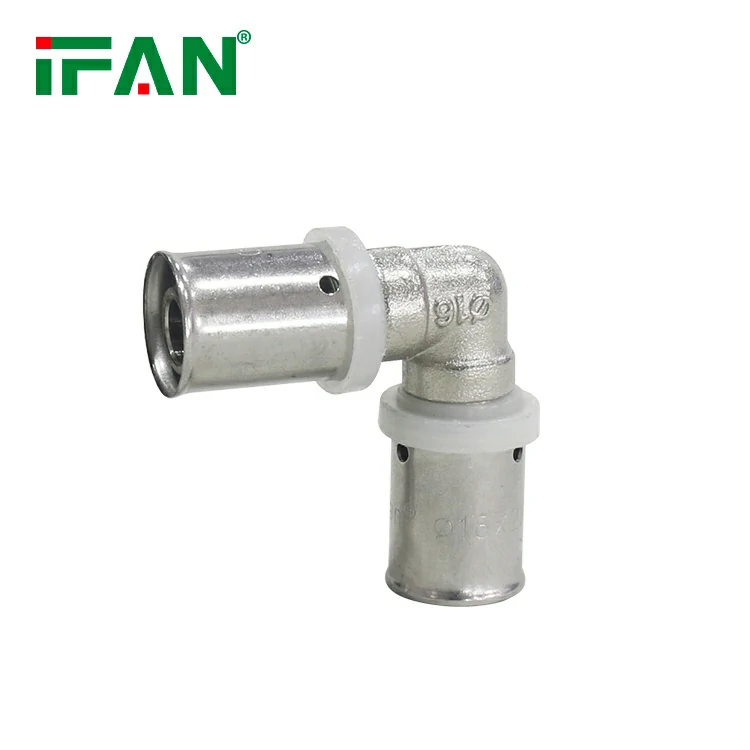
The sleeve contour, not the fitting body, is what the jaw has to match.
| Range | Profiles accepted | Dimensional coverage |
|---|---|---|
| FIV LBP | TH, B, U, H, F | Not published on the manufacturer FAQ |
| Multinupi MULTI-PRESSING | TH, U, H, B, F | 16–32 mm plus 20×2 mm; 14 mm and 40–63 mm single-clamp only |
| AC-FIX PRESS-MULTI | U, H, RF, RFz — but U only above DN 32 | DN 16–32 multi-profile; DN 40, 50, 63 U-profile only |
| Uponor S-Press PLUS | Manufacturer-specified jaw | 16–32 mm (brass or PPSU); S-Press 40–75 mm above that |
| IFANPRO 121UC (Mold U) | U profile | 16×2.0 mm and 20×2.0 mm as published on ifanpro.com |
Read the AC-FIX row twice, because it contains the trap. That range accepts U, H, RF and RFz jaws from DN 16 to DN 32 — and then at DN 40, 50 and 63 it is U-profile only. Profile compatibility narrowed within a single product family as the diameter went up. A buyer who validated compatibility on a 20 mm sample and assumed it held for the 50 mm risers has bought a tooling problem he will discover on site.
Uponor’s range shows the same discontinuity in a different form: S-Press PLUS covers 16–32 mm in brass or PPSU, and above that you move to a different family, S-Press, for 40–75 mm. The lesson for a purchase order is that “one system” is usually two systems with a boundary somewhere between 32 mm and 40 mm, and the boundary is where your installer’s tool inventory needs to be checked.
What to check before the profile question is closed
- Which profile does the fitting maker specify — one, or a named list?
- Does that list hold across every diameter in your size mix, or does it narrow at the large end?
- Which jaws does the installing crew already own, and for which tool body?
- If the site has mixed brands already installed, which profile is in the walls?
- Does the warranty language survive a jaw the manufacturer did not name?
Being direct about our own position: the IFANPRO 121UC range published on ifanpro.com is a Mold U system — U profile, in 16×2.0 mm and 20×2.0 mm. It is not a five-profile fitting, and pretending otherwise would put a buyer in exactly the situation this section warns about. If your crew is standardised on TH jaws, that is a real constraint to raise before an order, not after.
The Preparation Sequence That Decides Whether the Joint Holds
Fitting manufacturers publish this sequence, and it is short enough that people assume it is advisory. It is not. Each step exists because the step it protects fails without it.
The documented four-step joint
- Cut the pipe as clean and perpendicular as possible. An angled cut means one side of the aluminium reaches the O-ring before the other, and the seal is loaded unevenly from the first millimetre.
- Calibrate and chamfer the pipe interior with the proper tool. Calibration returns the cut end to true round; chamfering removes the aluminium edge from the O-ring’s path.
- Insert the fitting until the pipe is visible through the check holes. The holes exist for exactly this — visual proof of full insertion, before anything permanent happens.
- Place the jaw beside the plastic ring and press. Jaw position on the sleeve is specified, not approximate.
Step two carries the most weight and is skipped the most often, usually under time pressure on a repetitive run. A pipe cutter leaves the end slightly ovalised and the aluminium slightly turned in. Forcing a fitting into that end does two things at once: the out-of-round bore loads the O-rings asymmetrically, and the turned-in aluminium edge scrapes across them. The result is a joint that holds at ambient pressure and fails the moment the system sees a thermal cycle.
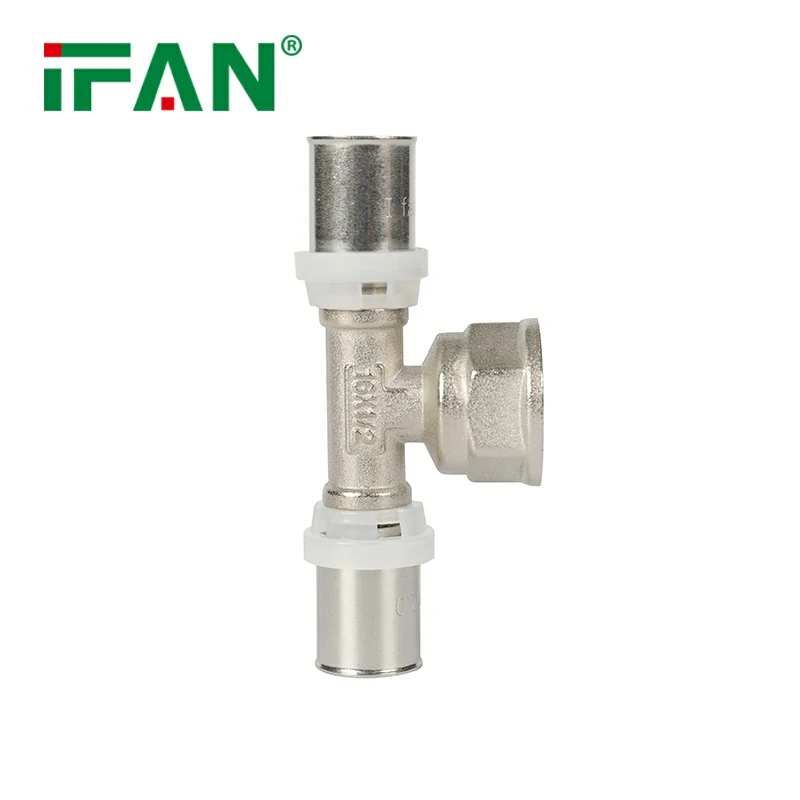
Check holes are an inspection feature. If you cannot see pipe through them, the joint is not ready to press.
Step three deserves a note about procurement rather than installation. Some fitting families are built with a Leak-Before-Pressed function, designed so that an unpressed joint reveals itself during the system tightness test rather than after handover. FIV publishes this as a feature of its LBP range. The published material does not state the pressure at which the reveal occurs, so treat the function as a safety net that catches the forgotten joint, not as a specification you can write a test protocol around.
One more variable buyers rarely specify: the elastomer. Water and gas service use different compounds — EPDM peroxide 70 Sh for water, yellow Teflon-coated NBR 70 Sh for gas in FIV’s range. They are visually distinguishable by colour precisely because installing the wrong one is a real and dangerous mistake. If your order covers both services, the O-ring compound belongs on the purchase order line, not in the assumption column.

▶
Cutting, calibrating and pressing multilayer pipe, demonstrated end to end (Multipipe Ltd). Watch step two — the calibration pass is the one crews skip.
Choosing Between Press and Compression for Your Project
The honest framing is that this is a tooling and labour decision wearing a fittings costume. Both systems seal on O-rings against a machined stem. What differs is what it costs to make the joint and what it costs to be wrong about it.
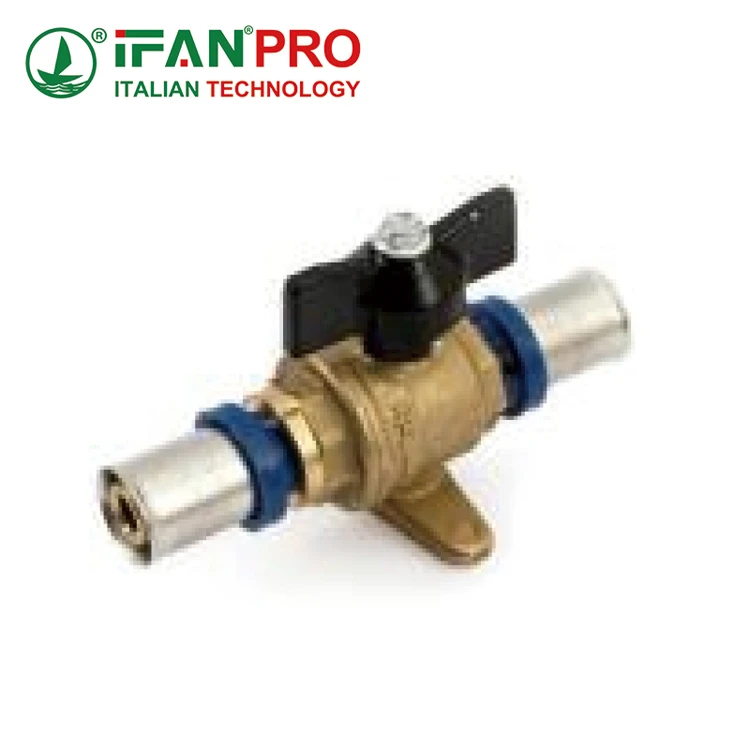
A U-profile press valve: brass body, EPDM O-rings, one permanent joint per press.
Compression is best for low joint counts, retrofit and service work, projects where the installing crew is not yours, exposed installations someone will later want to disassemble, and any job where you cannot guarantee the right press tool reaches the site. It needs only wrenches, it can be retightened, and a mistake costs a nut rather than a length of pipe.
Compression is not for concealed work in screed or walls, high joint counts where per-joint time dominates, or any situation where a joint might be over-tightened by an installer who thinks tighter is safer. Split rings deform once.
Press is best for underfloor heating manifold runs, buried and concealed joints, and any project where joint counts run into the hundreds and consistency matters more than reversibility. A press joint is made in seconds and cannot be under-torqued by a tired installer.
Press is not for a buyer who has not confirmed the jaw profile, or a site whose crew owns one tool body and a partial jaw set. The permanence that makes press attractive is the same property that makes a profile mismatch expensive.
A worked example, using only figures on this page. Take a 40-apartment underfloor heating job in 16×2.0 mm and 20×2.0 mm composite, roughly 900 press joints. Standardising on one U-profile system means one jaw pair for both diameters and no boundary crossing, because both sizes sit well inside the 16–32 mm band where profile ranges are widest. Now change one variable — add 50 mm risers. You have crossed the discontinuity: on the AC-FIX range that band is U-profile only, and on Uponor’s you have moved from S-Press PLUS to S-Press entirely. The 900 joints did not get harder. The twelve risers changed the tooling list, and if nobody priced that, the twelve risers are what delays handover.
Diagnosing a Leak by When It Appeared
Most leak guides sort by symptom. On composite pipe, sorting by timing is far more diagnostic, because each preparation failure has a characteristic delay before it shows itself.
| When it appeared | Most likely cause | What to do |
|---|---|---|
| Immediately, on first fill | Displaced or cut O-ring from an unchamfered end; or the joint was never pressed | Cut out and remake. Do not re-press. |
| Within hours to days | Partial insertion, or wrong jaw profile giving an incomplete sleeve deformation | Check insertion depth on adjacent joints; verify the jaw against the maker’s spec |
| After the first heating season | Thermal cycling finding a marginal joint that passed a cold test | Treat as systemic — sample-inspect the batch, not just the weeping joint |
| Years in, at compression joints only | Relaxation of a nut, or an elastomer at end of service life | Retighten once to spec; if it weeps again, replace the fitting |
The row that changes a buyer’s behaviour is the third one. A leak appearing after the first heating season is almost never a single bad fitting — it is the population of joints made the same way by the same crew, and the cycle simply found the weakest one first. Replacing only the visible leak on that pattern is how a contractor ends up back on site three times in one winter. Our detailed walk-through of permanently solving leaks in PEX-AL-PEX connections covers the O-ring and valve-side remedies once you have identified which population you are dealing with.
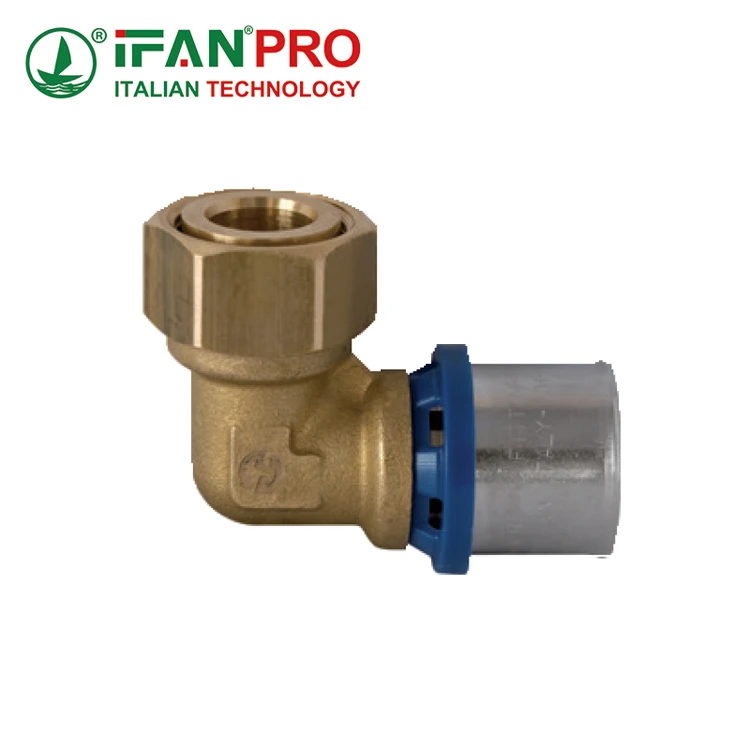
Designing union points into long runs is what makes the third row survivable.
One correction to a common assumption: a press joint that leaks cannot be rescued by pressing it again. The sleeve has already been plastically deformed, and a second press on a deformed sleeve does not restore the geometry the seal depends on. Cut it out. The same logic applies in reverse to compression joints — they tolerate exactly one retighten, and an installer who keeps turning the nut is destroying the split ring rather than improving the seal.
Finally, rule out the pipe before blaming the fitting. If the tubing is genuinely to ASTM F1281 it is rated 200 PSI at 73 °F, 125 PSI at 180 °F and 100 PSI at 200 °F, with the aluminium limiting oxygen diffusion to 0.006 g/m³. Composite pipe within those limits does not fail in the middle of a run. When it does, you are usually looking at pipe whose aluminium layer was overlapped rather than welded — which, as the scope of F1281 makes clear, is not F1281 pipe at all. Related reading: how PEX-AL-PEX handles high temperatures and PEX vs PEX-AL-PEX.
What This Means for Your Next Order
Everything above collapses into a handful of lines that belong on an enquiry. Suppliers answer specific questions specifically and vague questions with brochures, so the difference between a useful quotation and a useless one is usually set before the supplier reads it.
- Spec range. State every diameter and wall in the mix, not just the dominant one — the 16×2.0 and 20×2.0 band behaves differently from anything above 32 mm.
- Jaw profile. Name the profile your crew owns. IFANPRO’s published 121UC range is U profile; if you need TH or H, say so at enquiry rather than at inspection.
- Compliance target. ASTM F1974 for North America, EN ISO 21003 for Europe and much of the Middle East. Naming the regime prevents a DIN 16836 pipe certificate being offered as a fitting answer.
- Service and elastomer. Water or gas, because the O-ring compound differs and is not interchangeable.
- MOQ and lead time. IFANPRO does not publish either as a fixed figure; both are set per project against your size mix and shape count. Ask for them against your actual bill of materials and you will get a real number instead of a range.
- Verification. Ask what test evidence accompanies the shipment and against which clause. “ISO 9001” is a management-system answer to a product question.
On price structure, the honest answer is that composite fitting pricing moves with brass, and no supplier who quotes you a fixed annual price for a brass-bodied fitting is describing how the market works. Expect quotations to be validity-dated. If you are working out how the sourcing side of this fits together more broadly, our guide to wholesaling PEX pipe from China covers the commercial mechanics that sit downstream of the specification work on this page, and the PEX pipe and fittings catalogue lists the 121UC shapes by name.
If you already know your profile and your size mix, the fastest next step is to send that spec over and have it checked against what is actually in production. Written spec in, written answer back — that is the whole exchange, and it is aimed at buyers who have done the profile homework above rather than at anyone still deciding between systems.
What We Check on a Composite Fitting Before It Ships
This is documented outgoing procedure rather than a claim about any individual order, and it is written here because a buyer comparing offers should know which checks to demand of whoever he buys from — including us.
- Sleeve profile identity. The 121UC range is a single-profile Mold U system, so the check is that the sleeve contour on the shipped part is the U contour the range is specified around — a mixed pallet is the failure this prevents.
- O-ring seating and compound. Both rings present, seated in their grooves, and EPDM for water service. A missing second ring is invisible once the fitting is boxed.
- Stem bore and check holes. Holes clear and positioned so an installer can actually see pipe through them — the insertion check in step three only works if the holes are unobstructed.
- Dimensional conformity to the published size. 16×2.0 mm and 20×2.0 mm are the sizes on the site; anything outside that is a special, not a stock line, and should be quoted as one.
Where we stop is worth stating too. Pressure and thermocycling qualification under ASTM F1974 or EN ISO 21003 is type testing on a design, not a per-carton test, and no supplier who tells you otherwise is describing how the standards work. Ask for the type-test evidence and the clause it was run against; treat “we test every piece” as a red flag rather than a reassurance.
Frequently Asked Questions
Can I use plain PEX fittings on PEX-AL-PEX pipe?
No. Plain PEX barb systems seal by compressing the pipe wall against a barb, while composite fittings seal on O-rings against a machined stem. The dimensions and the sealing mechanism are both different, and ASTM F1974 exists specifically to cover composite pipe fittings.
Are U and TH press jaws interchangeable?
No. They are different compression geometries, and installers are directed to use the profile the fitting manufacturer specifies. Only fittings explicitly marketed as multi-profile accept both.
Do I really have to calibrate and chamfer every cut?
Yes. The documented sequence is cut square, calibrate and chamfer, verify insertion through the check holes, then press. Calibration restores true round and chamfering keeps the aluminium edge off the O-rings.
What pressure and temperature are PEX-AL-PEX fittings rated for?
ASTM F1974 fittings are intended for 125 psi (690 kPa) systems at up to 180 °F (82 °C). The PE-AL-PE variant is held to 140 °F (60 °C), so confirm which pipe family a supplier is certifying.
Can a leaking press joint be pressed a second time?
No. The sleeve has already been plastically deformed, and re-pressing does not restore the geometry the seal depends on. Cut the joint out and remake it with a fresh fitting.
Which standard should I quote on a purchase order?
ASTM F1974 for North American fittings, EN ISO 21003 for European multilayer systems. DIN 16836 is a pipe standard, not a fitting standard, so it cannot answer a fitting compliance question on its own.










 Français
  English
  Русский
  Español
Commentaires récents