
Radius Systems explicitly answers a practical mismatch: its supplied fitting has 4.0 mm terminal pins, while the control-box leads have 4.7 mm connections. Its answer is a suitable terminal-pin adaptor. That is a connection solution for the stated combination, not permission to connect every fitting to every controller. Confirm the actual fitting, lead ends and controller requirements before ordering an adaptor.
The Radius March 2024 brochure, FAQ on printed page 34, also describes a different case: its larger 5.7 mm-pin fittings use 80 V and require the correct control box and leads. Keep that electrical requirement separate from a plug’s physical fit.
Key Takeaways
- Identify the actual fitting, batch, controller, output leads and fitted tips.
- Specify lead-side and fitting-side connections separately.
- A maker-supported adaptor addresses an interface, not the entire equipment capability.
- Verify voltage and procedure support independently of mechanical fit.
- If identities or suitability remain unresolved, ask the equipment supplier before ordering.
Watch the IFAN HDPE electrofusion background video on YouTube
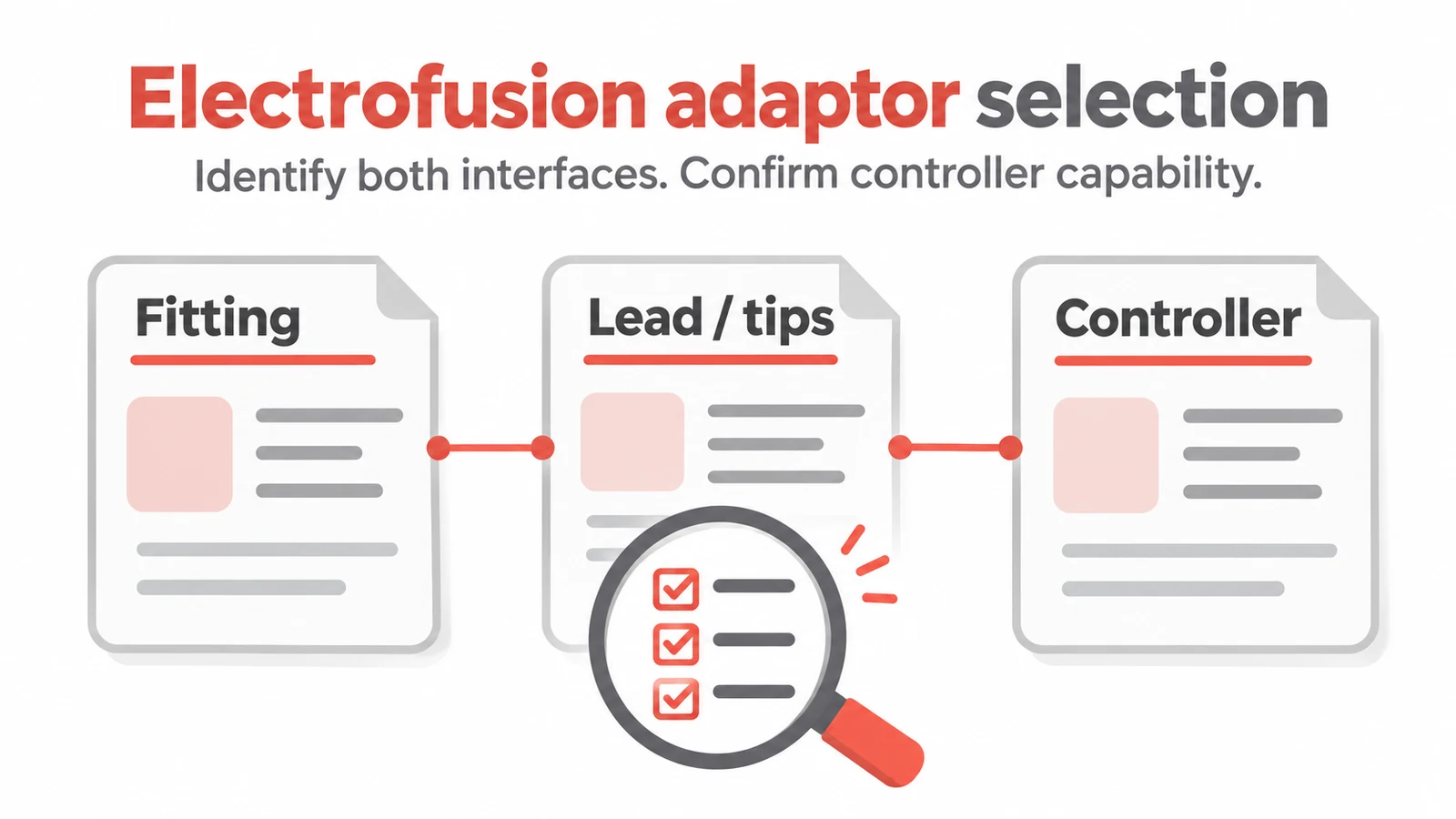
Identify the fitting and both ends of the proposed connection
Record the fitting manufacturer, exact product and batch identity, terminal requirement and fitting label. Next record the controller model and the actual output-lead assembly fitted to it. Include any detachable tips or existing adaptors. Buying from the controller’s brand name alone can miss a lead or tip change.
PLASSON’s historical 2019 pin-change notice is a useful warning about identification. It announced a change from 4.7 mm to 4.0 mm fitting pins without changing catalogue numbers, using batch identification to track the difference. That notice also describes universal tips and adaptors. Its historical service offers and relative dates do not establish what is fitted to a particular controller today.
The purchasing question is therefore specific: which connector arrangement joins this output lead to this fitting, under the equipment maker’s instructions? Keep the lead-side and fitting-side descriptions separate in the request. A bare “4.0/4.7 adaptor” description leaves the supplier to infer which end you need.
- Identify the actual fitting and batch, controller, output leads and fitted tips.
- Confirm the lead-side and fitting-side terminal interface; verify documented suitable universal tips before deciding whether a separate adaptor is needed.
- Check required voltage and fusion procedure against the controller capability separately from physical fit.
- If any equipment identity or capability remains unresolved, stop selection and ask the equipment supplier; otherwise continue under the applicable installation instructions.
Resolve physical connection and controller suitability separately
A correctly selected adaptor addresses the terminal interface. It does not, by itself, establish that the controller supports the fitting’s required voltage and fusion procedure. Check those requirements against the fitting instructions and the controller’s documented capability before treating the equipment set as ready.
HÜRNER’s accessories catalogue lists distinct terminal and adaptor forms, including round, flat, pinch-in and COOL-FIT entries alongside different sizes. Use the specified accessory identity, not only a matching number. The catalogue’s range illustrates why an unlabelled adaptor taken from a tool bag is an unresolved item.
| What is established? | Decision | What remains? |
|---|---|---|
| Correct equipment; terminal size differs | Identify the maker-supported adaptor | Confirm its exact connection arrangement |
| Tip fits; controller capability unknown | Keep equipment selection unresolved | Confirm fitting voltage and procedure support |
| Controller has documented suitable universal tips | Check whether a separate adaptor is needed | Verify actual fitted tips and fitting requirements |
This is an equipment-selection check. It does not replace the complete HDPE fusion procedure, preparation, clamping or joint acceptance. It also supplies no instruction to alter pins, modify leads or override a controller rejection.
| Record | Evidence to retain | If unresolved |
|---|---|---|
| Fitting | Manufacturer, product/batch, label, terminal requirement, required voltage and procedure | Ask for the missing identity or requirement |
| Lead / tip | Actual output-lead identity, fitted tip markings, supported accessory reference | Do not assume universal tips |
| Controller | Exact model and documented voltage/procedure capability | Keep equipment readiness unresolved |
Three equipment requests with different answers
Case A: the Radius FAQ mismatch. The identified fitting has 4.0 mm pins and the lead connection is 4.7 mm. Request the suitable adaptor arrangement described by Radius, while separately confirming the controller supports that fitting. Once those requirements are established, continue under the applicable installation instructions; the adaptor itself is not a completed-joint approval.
Case B: a larger Radius fitting marked for the 80 V system. Its brochure associates the 5.7 mm terminal with that higher-voltage requirement. Asking only for something that makes the lead fit misses the controlling issue. Identify the correct controller and leads for the actual fitting. Do not generalise Radius’s pin/voltage pairing into a universal rule for other manufacturers.
Case C: a PLASSON controller said to have universal tips. Check the actual tip identification and applicable instructions before purchasing a conversion set. The 2019 notice explains why suitable universal tips can remove the need for a separate adaptor, but it cannot prove that this particular machine still carries those tips. If the tip identity cannot be established, resolve that question with the equipment supplier.
Write the request so the supplier can resolve it
Send the fitting label and product/batch reference, controller model, output-lead identity, actual tip markings, clear photographs of both connection interfaces and the proposed accessory reference. Ask the equipment supplier to confirm the lead-side connection, fitting-side connection and suitability for that equipment combination. Record its answer against the items supplied.
If a resistance rejection has already occurred, retain the message and use the controller-specific resistance-mismatch guide. Ordering an adaptor is a different task from resolving a fault, and this page gives no retry permission.
When discussing a potential pipe fittings order, include the equipment interface in the specification. You can ask IFANPRO to check availability against the identified fitting specification. Matching fittings, accessories and documentation require confirmation; no IFANPRO adaptor stock or controller-support service is established here.
Conclusion
A supported adaptor can resolve a terminal mismatch. A supported universal tip can avoid an unnecessary accessory. Neither choice substitutes for confirming the controller’s suitability for the fitting that will actually be installed.
Frequently Asked Questions
Does a physically fitting adaptor prove compatibility?
No. Confirm the fitting requirements and the controller’s documented voltage and fusion-procedure support separately.
Does the PLASSON 2019 notice identify my current tips?
No. It is historical context. Check the actual fitted tips and applicable equipment instructions.
Should I alter a pin or override a rejection to make a connection?
This guide provides no permission to modify pins or leads, override a controller rejection, or retry a rejected operation.
By IFAN · Manufacturer-source equipment-selection guidance. Confirm actual equipment with its supplier.












 Français
 English
 Русский
 Español
Commentaires récents