
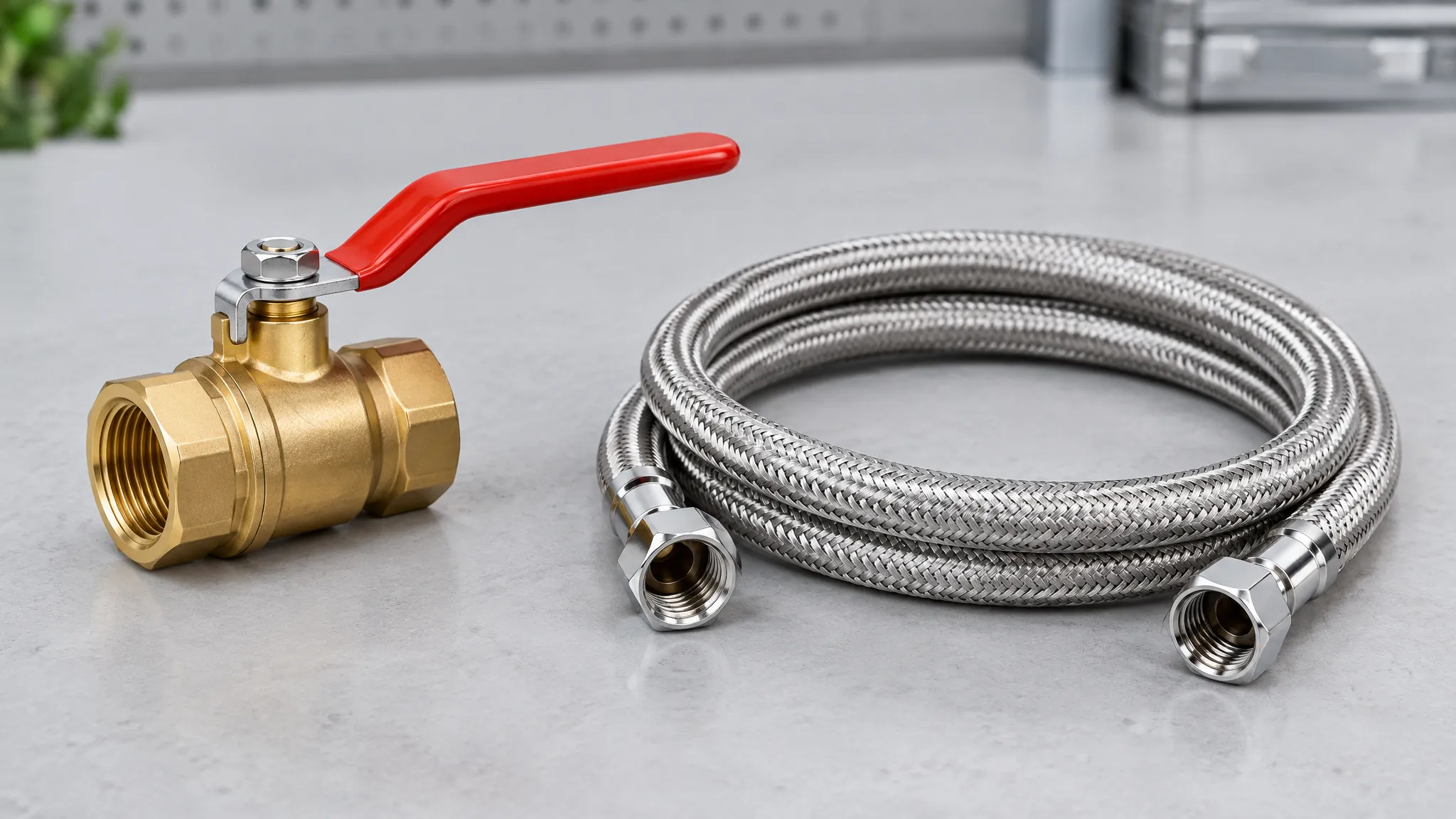
The two numbers land on the same quotation, but they belong to different products. EN 13828:2025 is the European standard for manually operated copper alloy and stainless steel ball valves, DN 6 to DN 100, up to PN16 and 65 °C in building water supply. EN 13618:2016 covers flexible hose assemblies, braided or not, rated to 1 MPa (10 bar) and 70 °C, that connect taps, heaters and similar appliances. A kit of a quarter-turn valve and a braided tap connector therefore needs two test reports, one per standard.
Neither report proves the materials are fit for drinking water. Both standards hand that question to national rules, so the hygiene approval is a third document.
Key Takeaways
- EN 13828:2025 = ball valves, DN 6–DN 100, PN10 or PN16, 65 °C with 90 °C excursions of 1 h maximum.
- EN 13618:2016 = flexible hose assemblies, PMA 1 MPa (10 bar), 70 °C maximum.
- BS EN 13828:2003 was withdrawn on 28 February 2025; its scope ran from DN 8 to DN 100 and up to PN 10.
- EN 13618 Table 2 lists 15 characteristics: 4 for fittings and sleeves, 11 for the hose assembly.
- Hoses built into electrical appliances fall under EN 61770, not EN 13618.
- Hygiene sits with national rules; EU positive lists of starting substances, compositions and constituents for materials apply from 31 December 2026; they are not a product approval.
Below, the Ultimate Handyman channel puts a flexible pipe under water pressure on the bench. It is a workshop demonstration, not an EN 13618 test report, so watch it for the idea of a pressure check rather than for any pass value.

Which Product Each Standard Covers
The quickest proof is the catalogue code the standards bodies file them under. EN 13828 sits in ICS 23.060.20, ball and plug valves. EN 13618 sits in ICS 23.040.70, hoses and hose assemblies. Both were written by the same committee, CEN/TC 164 “Water supply”, which is one reason buyers treat them as a pair.
| Item | EN 13828:2025 (ball valve) | EN 13618:2016 (flexible hose) | Verdict: what to ask for |
|---|---|---|---|
| Product | Manually operated ball valves in buildings | Hose assemblies, braided or not | One report per product, never one for both |
| Sizes | DN 6 to DN 100 | Threads G 1/4 to G 1 1/4 (Tables 3–4) | Tested DN or thread must match yours |
| Pressure | PN10 or PN16 class | PMA 1 MPa (10 bar) | PN class printed on the valve and report |
| Temperature (°C) | 65 max; 90 for 1 h | 70 max | Hot side: check both limits |
| Materials named | Copper alloy and stainless steel bodies | Stainless or plastic braid; no aluminium | Material list for every wetted part |
| Current edition | 2025; 2003 withdrawn | 2016; replaced 2011 | Edition year on the report |
| Not covered | Water hygiene | Water hygiene; hoses built into appliances (EN 61770) | Separate national hygiene approval |
Source: EVS product pages for EN 13828:2025, EN 13828:2003 and EN 13618:2016 (scope, ICS); BSI Knowledge edition pages; EN 13618:2016 clauses 1, 4.1.4, 4.1.5 (iTeh sample); EN 13828:2025 foreword (UNMS SR preview). Verdict column is our buying guidance.
| Scope limit | Valve EN 13828 (°C) | Hose EN 13618 (°C) |
|---|---|---|
| Continuous maximum | 65 | 70 |
| Excursion, 1 h max | 90 | — |
What EN 13828:2025 Changed Against the 2003 Text
The 2003 edition applied “primarily to copper alloy ball valves”, DN 8 to DN 100, up to PN 10 (10 bar). The 2025 edition names stainless steel alongside copper alloy, starts at DN 6, and sorts valves into two classes, PN10 or PN16. The temperature rule did not move: 65 °C distribution temperature, with occasional excursions to 90 °C for one hour at most.
BSI published BS EN 13828:2025 on 28 February 2025 and withdrew the 2003 text the same day. CEN gave its members until August 2025 to adopt it. The foreword lists what else moved: revised scope and Tables 1, 2 and 4, extended end connections, adapted full bore and half bore sizes, and updated design rules, test methods and marking.
Here is the practical warning. A declaration dated 2026 that cites “EN 13828:2003” quotes a withdrawn document, and a PN16 claim against the 2003 text makes no sense, because that scope ended at PN 10. Ask for the 2025 edition on the report, or for a written reason it is still the older one.
The EN 13828 Test Sequence for a Ball Valve
Clause 6 of the 2025 edition sets a test sequence first (6.1), then the checks. Grouped the way a buyer reads them:
- Mechanical: operating torque (6.3), resistance against torque (6.4) and bending (6.5), torque on captive rotating nuts and tail pieces (6.6), stop resistance (6.7).
- Hydraulic: leak-tightness (6.8), hydraulic strength (6.9), resistance against pressure jumps (6.11), angular seal (6.12), and replenishment of the water held between ball and body (6.10).
- Acoustic: an acoustic group determined by the EN ISO 3822 laboratory method (clause 7).
- Endurance: resistance against 90 °C water (8.1) and mechanical endurance of the handle or other control device (8.2).
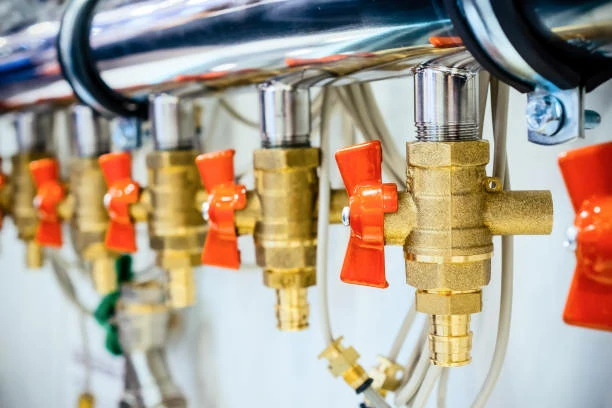
Two design clauses matter before any test runs. Clause 5.5 defines full bore and reduced bore flow areas, the same choice covered in our full-port vs reduced-port brass ball valve guide. Clause 5.1 covers body materials and corrosion, and the normative references include EN ISO 6509-1, the dezincification test for brass, plus EN ISO 9227 salt spray. Our note on dezincification in brass explains the corrosion risk that test addresses in aggressive water.
What a report must not do is stop at “leak-tight”. Thirteen named checks sit in clauses 6 to 8; a two-line summary that skips the acoustic group or the endurance test tells you which ones were not run.
The EN 13618 Test Regime for a Braided Hose
The current edition is BS EN 13618:2016, which replaced the 2011 text. It splits its checks between the end fittings and the finished assembly. Table 2 of the standard is the list a lab report should reproduce line by line.
| Part tested | Characteristic | Clause / test | Check in the report |
|---|---|---|---|
| Fittings, sleeves | Dimensions | 4.2.2.1 / A.1 | Thread and length vs your drawing |
| Fittings, sleeves | Stress corrosion | 4.2.2.2 / A.2 | Ammonium test to ISO 6957 |
| Fittings, sleeves | Tightening torque | 4.2.2.3 / A.3 | Torque value and result stated |
| Fittings, sleeves | Bending | 4.2.2.4 / A.4 | Pass result per fitting type |
| Hose assembly | Length | 4.2.3.1 | Measured vs ordered length |
| Hose assembly | Flow rate | 4.2.3.2 / B.1 | Flow value for the tested bore |
| Hose assembly | Leak tightness, hydrostatic | 4.2.3.3 / B.4 | Test pressure and hold time stated |
| Hose assembly | Tensile stress | 4.2.3.4 / B.3 | Tensile load and result stated |
| Hose assembly | Pressure cycling | 4.2.3.5 / B.5 | Impulse count to the 2016 text |
| Hose assembly | Pressure jumps | 4.2.3.6 / B.6 | DN and test pressure stated |
| Hose assembly | Temperature cycling | 4.2.3.7 / B.7 | Cycle result stated |
| Hose assembly | Frost resistance | 4.2.3.8 / B.10 | Result after freezing |
| Hose assembly | Corrosion resistance | 4.2.3.9 / B.8 | Method new in 2016 |
| Hose assembly | UV resistance | 4.2.3.10 | Required for plastic braid |
| Hose assembly | Flexibility | 4.2.3.11 / B.9 | Bending result on the assembly |
Source: EN 13618:2016 Table 2 and clauses 4.1–4.2 (iTeh sample of SIST EN 13618:2017); European foreword for the 2016 changes. Right-hand column is our checklist; test values are in the paid standard.
The material rules are blunt. Sleeves must be corrosion-resistant metal, aluminium is not allowed anywhere, and braiding must be stainless steel wire or plastic wire or band. Choose a plastic braid and the UV resistance test becomes mandatory.
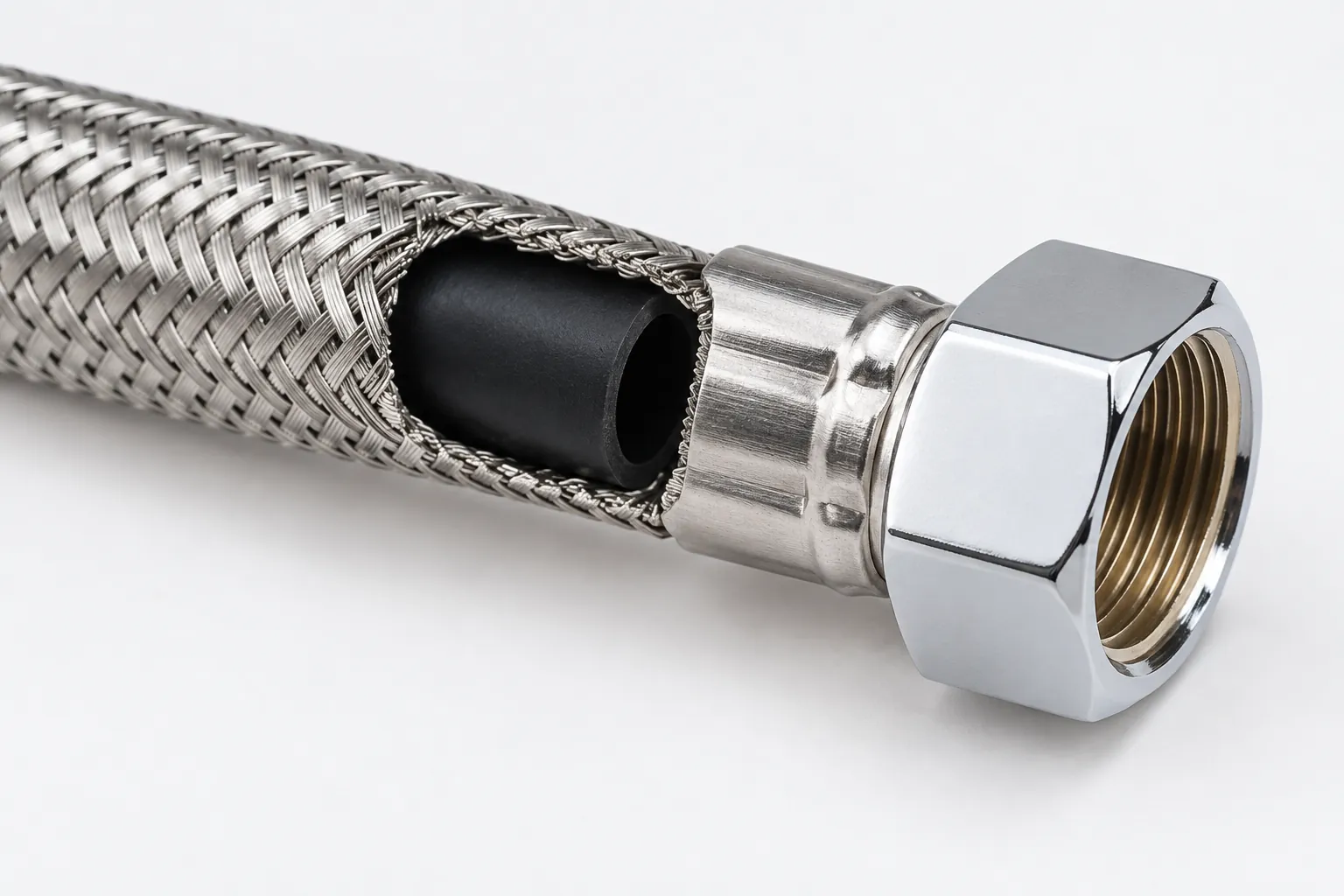
The 2016 revision also changed what an old report proves. It cut the impulse count in the durability test, fixed the DN and test pressure for the pressure-jump test, and added new corrosion and UV methods. A 2011-edition report cannot show results for tests that did not exist yet.
One quick bench check needs no lab. A G 1/2 female nut needs at least 6 mm of useful thread under Table 4; measure a pre-production piece against that before mass production starts. Hose assemblies built into an electrical appliance, such as the inlet hose supplied as part of a washing machine, fall under EN 61770 instead, according to the scope note; a separately sold connector stays within EN 13618.
What Neither Standard Proves: Drinking-Water Hygiene
EN 13618 clause 4.1.2 says wetted materials must not harm health or change taste, smell or appearance, then defers to “national regulations and testing arrangements, where they exist”. The EN 13828:2025 introduction goes further: it states the document gives no information on whether the product may be used without restriction in any EU or EFTA member state.
So a hose that passes all 15 characteristics can still be refused at a UK site. In the UK, WRAS tests fittings mechanically against the Regulator’s Specification and puts non-metallic materials through BS 6920:2000 parts 1–3, and a WRAS Fitting Approval lasts 5 years at most. Our WRAS vs NSF comparison covers that route.
The EU is replacing national lists with European positive lists of starting substances, compositions and constituents for materials, which apply from 31 December 2026 under Decision (EU) 2024/367. They govern what a material may be made of, not whether a finished valve or hose has passed a test. The EU Drinking Water Directive compliance guide walks through the switchover dates.
How to Read the Test Report Before You Order: Lead Time and MOQ
Five checks, in the order that saves the most time:
- Standard and edition. EN 13828:2025 for the valve, EN 13618:2016 for the hose. Anything older needs a reason.
- Tested-item identity. DN, thread form (G to EN ISO 228-1 or R to ISO 7-1), PN class (PN10 = 10 bar, PN16 = 16 bar) and hose length in mm must match the SKU you are buying.
- Clause-level results. Every Table 2 line for the hose; clauses 6 to 8 for the valve, acoustic group included.
- Who tested and when. Laboratory name, report number and test dates on every page.
- Surveillance. Annex C of EN 13618 recommends ongoing surveillance testing; ask whether any is done and how often.
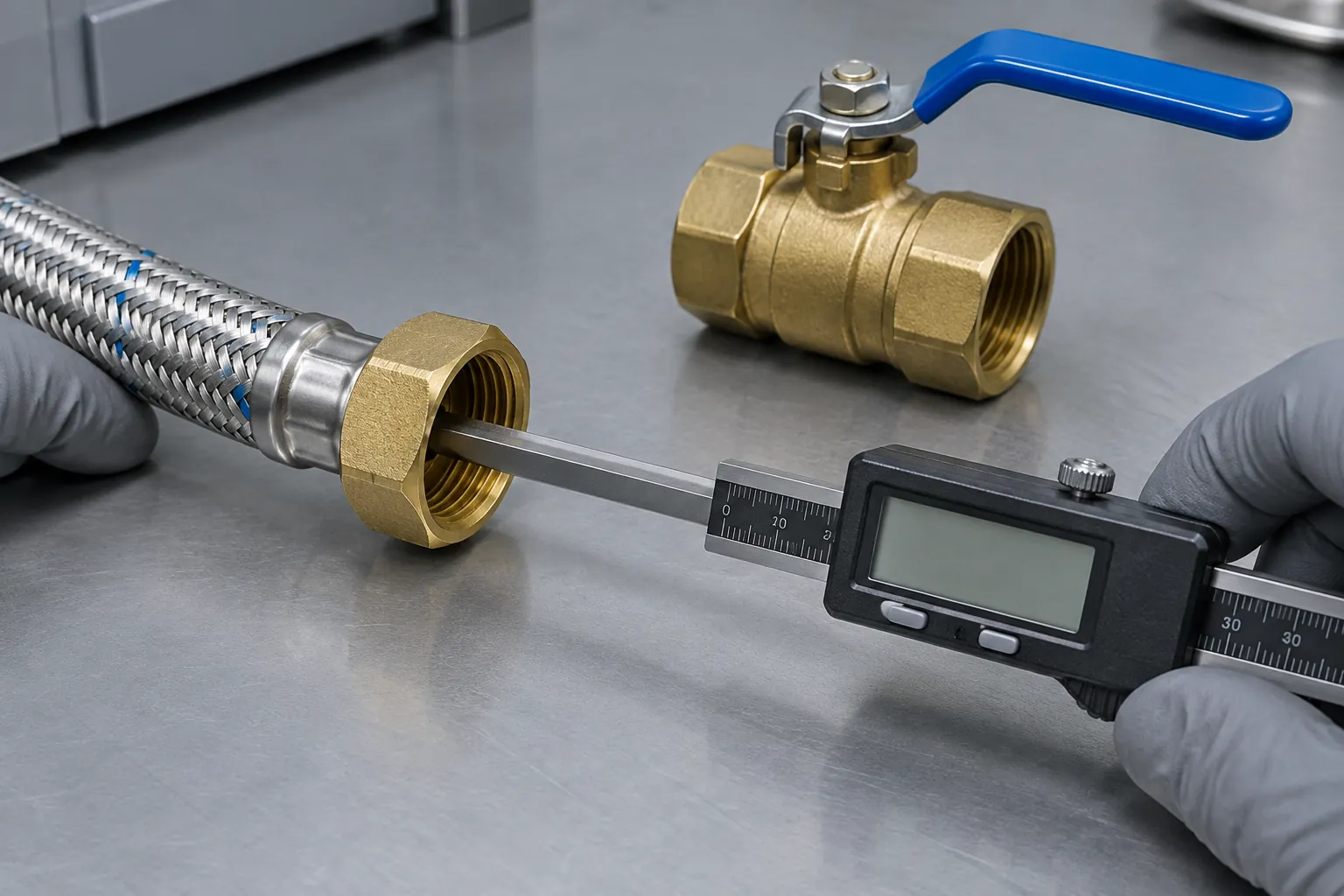
Lead time follows from check 2. If a current report already covers your exact SKU, the valve or hose ships on normal production time. If it does not, ask the supplier which tests still have to be run, get the lab’s booked dates in writing, and set your ship date after them. Ask the lab whether your thread and length are covered by the tested item; until the report says so, treat them as untested.
MOQ works the same way: ask whether it applies per SKU or per tested series. Our published brass valve range cites neither standard today, so ask us, as you would any supplier, for the report per SKU before you promise EN 13828 to your own customer.
Frequently Asked Questions
Is EN 13828 a flexible hose standard?
No. EN 13828 covers manually operated copper alloy and stainless steel ball valves for potable water supply in buildings, DN 6 to DN 100, up to PN16. Flexible hose assemblies for drinking water installations are covered by EN 13618.
What is the current edition of EN 13828?
EN 13828:2025. BSI published BS EN 13828:2025 on 28 February 2025 and withdrew BS EN 13828:2003 the same day. The 2025 edition starts at DN 6 instead of DN 8 and classifies valves as PN10 or PN16.
What pressure and temperature does EN 13618 cover?
EN 13618:2016 covers flexible hose assemblies with an allowable maximum operating pressure (PMA) of 1 MPa, which is 10 bar, and a maximum operating temperature of 70 °C, used to connect sanitary tapware, heaters and similar appliances.
Does EN 13618 cover hoses built into appliances such as washing machines?
Not when the hose is an integral part of the appliance: flexible hose assemblies intended to be used as integral parts of electrical appliances are covered by EN 61770, as the note to the EN 13618 scope states. A separately sold connector stays within EN 13618.
Does an EN 13618 or EN 13828 report prove drinking-water safety?
No. Both standards leave water hygiene to national regulations. A UK buyer will look for a WRAS approval, and in the EU the European positive lists of starting substances, compositions and constituents for materials apply from 31 December 2026. Those lists govern what a material may be made of; they do not approve a finished valve or hose.
Conclusion
The trade-off is paperwork against risk. Asking for two clause-level reports and a hygiene approval adds a few emails before the deposit; skipping them leaves you holding a valve tested to a withdrawn edition, or a hose that passed every mechanical test and still fails the site’s water rules.
Put the product, the standard and the edition on the PO: EN 13828:2025 for the ball valve, EN 13618:2016 for the hose, plus the destination’s hygiene mark.

 Français
  English
  Русский
  Español
Commentaires récents