
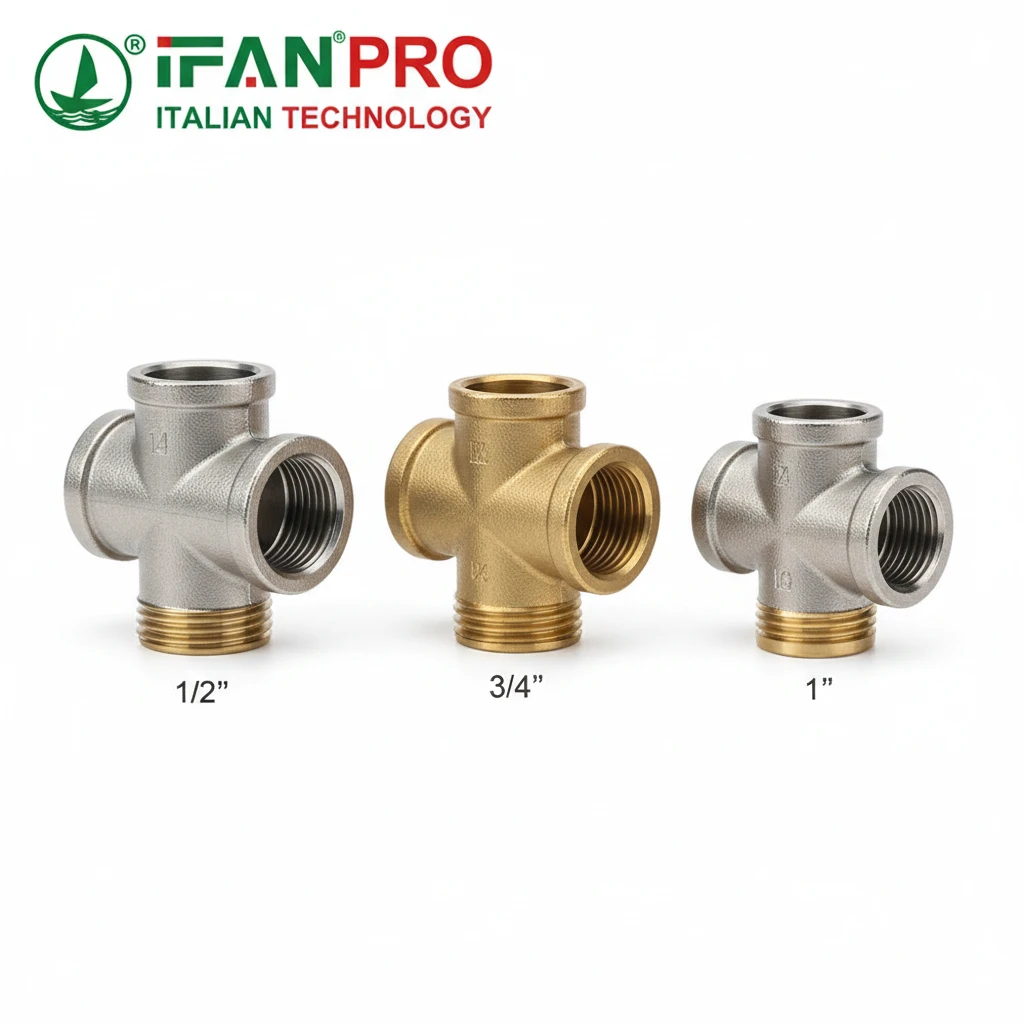
I once watched a contractor install the wrong size cross tee on a commercial job. The system pressure dropped immediately, and we had to tear out the wall to fix it. That costly mistake taught me the importance of proper sizing.
Choosing the right female threaded cross tee depends on matching the fitting size to your specific flow requirements and system pressure. The three common sizes—1/2″, 3/4″, and 1″—serve different purposes. 1/2″ fittings work best for residential fixtures, while 3/4″ and 1″ sizes handle higher flow demands in commercial systems.
Now, let’s examine each size in detail to help you make the right choice for your project.
What Core Specifications and Thread Standards Should You Understand?
I’ve seen countless orders fail because buyers ignored thread standards. A fitting with the right size but wrong thread type simply won’t connect.
Female threaded cross tees must match both the nominal pipe size and the specific thread standard used in your region. The two main standards are NPT (National Pipe Taper) in North America and BSP (British Standard Pipe) in many other countries. These threads are not interchangeable, and using the wrong one will cause leaks or connection failures.

Understanding Nominal Pipe Size
The size markings on fittings—1/2″, 3/4″, and 1″—refer to nominal pipe size, not the actual physical dimensions. This can confuse many buyers.
For example, a 1/2″ female threaded cross tee does not measure exactly half an inch across its opening. Instead, the nominal size refers to the pipe size it connects to. The actual inside diameter varies slightly based on the pipe material and schedule. This standardization allows different materials to work together in one system.
Here is a simple breakdown of actual inside diameters for standard schedule pipes:
| Nominal Size | Actual Inside Diameter (Approx.) | Common Wall Thickness |
|---|---|---|
| 1/2 inch | 0.622 inches | 0.109 inches |
| 3/4 inch | 0.824 inches | 0.113 inches |
| 1 inch | 1.049 inches | 0.133 inches |
The Critical Difference: NPT vs. BSP Threads
This is where many projects go wrong. NPT and BSP threads look similar but have different angles and pitch. They will not seal properly together.
NPT Threads:
- Tapered design that creates a mechanical seal as you tighten
- Thread angle of 60 degrees
- Most common in North America
BSP Threads:
- Can be parallel (BSPP) or tapered (BSPT)
- Thread angle of 55 degrees
- Common in Europe, Asia, and many other regions
Attempting to connect an NPT fitting to a BSP thread will result in a loose fit. Even with sealant tape, these mismatched threads will likely leak under pressure. Always verify which standard your system uses before purchasing.
Pressure Ratings and Material Considerations
The material of your cross tee directly affects its pressure-handling capability. Common materials include:
| Material | Typical Pressure Rating | Best Applications |
|---|---|---|
| Brass | Up to 400 PSI | High-pressure water, gas lines |
| PP-R with brass inserts | Up to 200 PSI | Residential plumbing, corrosion resistance |
| Stainless Steel | Up to 1000+ PSI | Industrial, high-temperature |
| PVC/CPVC | 100-400 PSI | Low-pressure, chemical resistance |
Always check the manufacturer’s pressure rating for your specific fitting. Never exceed this rating, even if the pipe itself can handle higher pressure.
Why Is 1/2 Inch the Ideal Choice for Home Water Supply and Bathroom Fixtures?
Homeowners often oversize their fittings, thinking bigger means better. In residential plumbing, this approach usually causes more problems than it solves.
The 1/2 inch female threaded cross tee is ideal for home water supply because it matches the flow requirements of standard bathroom and kitchen fixtures. Most faucets, shower heads, and toilets connect to 1/2 inch supply lines. Using this size ensures proper water pressure at each fixture and simplifies installation with readily available components.

Matching Flow Rates to Fixture Requirements
Each plumbing fixture in a home requires a specific flow rate to function properly. Standard bathroom fixtures typically need between 1.5 and 2.5 gallons per minute (GPM). A 1/2 inch pipe at typical residential pressure (40-60 PSI) can deliver approximately 4-6 GPM. This provides enough capacity for one fixture while maintaining good pressure.
Consider these typical residential fixture flow rates:
| Fixture Type | Typical Flow Rate (GPM) | Supply Line Size |
|---|---|---|
| Bathroom Sink Faucet | 1.5 | 1/2 inch |
| Kitchen Sink Faucet | 2.2 | 1/2 inch |
| Shower Head | 2.5 | 1/2 inch |
| Toilet | 1.6 | 1/2 or 3/8 inch |
| Washing Machine | 2.0-3.0 | 1/2 inch |
The 1/2 Inch Advantage in Home Applications
Using 1/2 inch cross tees in residential systems offers several practical benefits:
Cost Efficiency: 1/2 inch fittings cost significantly less than larger sizes. For a typical home with dozens of fittings, this adds up to real savings.
Easier Installation: Smaller fittings are lighter and easier to handle in tight spaces. Behind bathroom walls and under sinks, working space is often limited. A compact 1/2 inch fitting fits where larger ones cannot.
Compatible Availability: Hardware stores stock 1/2 inch fittings abundantly. If you need a replacement quickly, you can find one easily without special ordering.
When 1/2 Inch May Not Be Enough
However, 1/2 inch has limits. In larger homes with multiple bathrooms, the main supply lines often use 3/4 or 1 inch pipe. The 1/2 inch cross tees work perfectly for branch lines to individual fixtures. But using them as main distribution points can restrict overall flow.
For example, if you install a 1/2 inch cross tee to supply both a shower and a toilet, running both simultaneously may cause noticeable pressure drop. In such cases, stepping up to 3/4 inch for the distribution point makes sense.
When Should You Choose 3/4 and 1 Inch Sizes for Commercial HVAC and High-Flow Systems?
I’ve worked on commercial projects where undersized fittings caused entire system failures. The difference between residential and commercial flow demands is substantial.
3/4 and 1 inch female threaded cross tees serve as standard sizes for commercial HVAC systems, industrial processes, and high-flow residential applications like whole-house distribution manifolds. These larger sizes handle the increased volume required for heating and cooling coils, equipment connections, and multiple fixture supply without excessive pressure drop.

Understanding Flow Capacity Differences
The relationship between pipe diameter and flow capacity is not linear. A small increase in diameter produces a large increase in flow capacity. This happens because cross-sectional area increases with the square of the radius.
Let’s compare the flow capacities at typical commercial pressure (60 PSI):
| Size | Cross-Sectional Area | Approximate Flow Capacity | Typical Applications |
|---|---|---|---|
| 1/2 inch | 0.30 sq in | 4-6 GPM | Individual fixtures |
| 3/4 inch | 0.53 sq in | 8-12 GPM | Branch lines, small equipment |
| 1 inch | 0.86 sq in | 16-20 GPM | Main distribution, large equipment |
As you can see, moving from 1/2 to 3/4 inch nearly doubles flow capacity. Moving to 1 inch doubles it again. This makes larger sizes essential for commercial work.
Commercial HVAC Specific Requirements
HVAC systems present unique challenges for pipe fittings:
Continuous Operation: Unlike residential systems that cycle on and off, commercial HVAC often runs continuously during occupied hours. Fittings must withstand constant pressure and temperature cycling.
Higher Temperatures: Heating systems may carry water at 180°F or higher. This thermal stress affects seal materials and can cause expansion-related leaks in undersized fittings.
Equipment Connections: Boilers, chillers, and air handlers typically have 3/4 or 1 inch connection ports. Matching fitting size to equipment ports ensures proper flow and simplified maintenance.
Pressure Drop Considerations
In commercial systems, pressure drop becomes critical. Long pipe runs and numerous fittings all contribute to total system resistance. Engineers calculate this carefully.
A 1/2 inch cross tee creates more turbulence and resistance than a 1 inch tee. In a large system with many fittings, these small losses add up. Using properly sized larger fittings keeps total pressure drop within acceptable limits.
The table below shows typical pressure loss per 100 feet for different sizes:
| Pipe Size | Pressure Loss at 10 GPM | Pressure Loss at 20 GPM |
|---|---|---|
| 1/2 inch | Not recommended | Not possible |
| 3/4 inch | 8.5 PSI | Not recommended |
| 1 inch | 2.2 PSI | 7.8 PSI |
This data shows why 3/4 inch works for moderate flows, but 1 inch becomes necessary as volume increases.
How Do You Match Fitting Sizes to Your Project’s Flow Requirements?
Selecting the right size requires more than guessing. I recommend a simple calculation method that prevents costly mistakes.
To match fitting sizes to your project’s flow requirements, first calculate your total expected flow rate in gallons per minute. Then select a fitting size that operates comfortably below its maximum capacity, typically using 75-80% of the pipe’s theoretical maximum. This safety margin accounts for future expansion and prevents pressure problems during peak demand.

Step-by-Step Sizing Method
Follow this practical approach to determine the right size for your application:
Step 1: List All Connected Fixtures
Write down every fixture or outlet the cross tee will supply. Include future connections if you plan to expand.
Step 2: Add Up Total Flow Demand
Use standard flow rates for each fixture type. For residential, this means:
- Bathroom faucet: 1.5 GPM
- Kitchen faucet: 2.2 GPM
- Shower: 2.5 GPM
- Toilet: 1.6 GPM
- Washing machine: 2.0 GPM
For commercial applications, check equipment specifications for exact requirements.
Step 3: Apply a Diversity Factor
Not all fixtures run simultaneously. In residential applications, a diversity factor of 40-50% works well. Commercial systems may use 70-80% depending on usage patterns.
Step 4: Compare to Pipe Capacity
Match your adjusted total flow to the recommended capacity ranges:
| Fitting Size | Recommended Flow Range | Maximum Intermittent Flow |
|---|---|---|
| 1/2 inch | 0-4 GPM | 6 GPM |
| 3/4 inch | 4-8 GPM | 12 GPM |
| 1 inch | 8-15 GPM | 20 GPM |
Common Sizing Mistakes to Avoid
Through years of experience, I’ve seen these errors repeatedly:
Mistake 1: Oversizing for No Reason
Some installers choose larger fittings “just to be safe.” This wastes money and can actually reduce flow velocity. Very slow flow allows sediment to settle in pipes.
Mistake 2: Ignoring Pipe Length
Long pipe runs create friction loss. If your cross tee sits far from the water source, you may need the next size up to compensate for pressure drop along the way.
Mistake 3: Mixing Incompatible Materials
Brass fittings with plastic pipes require careful transition methods. Direct contact between dissimilar metals can cause galvanic corrosion. Always use appropriate dielectric unions when mixing materials.
Practical Sizing Guide by Application
| Application Type | Recommended Size | Key Considerations |
|---|---|---|
| Single bathroom branch | 1/2 inch | One fixture at a time typical |
| Two bathrooms branch | 3/4 inch | Accounts for simultaneous use |
| Main house manifold | 1 inch | Feeds entire home system |
| Commercial restroom bank | 3/4 or 1 inch | Multiple fixtures running together |
| HVAC equipment connection | Match equipment port | Usually 3/4 or 1 inch |
| Industrial process line | Calculate based on GPM | Include safety factor |
Conclusion
Choosing the correct female threaded cross tee size ensures proper system performance and prevents costly failures. For residential fixtures, stick with 1/2 inch fittings. For commercial or high-flow applications, select 3/4 or 1 inch based on your calculated demand. IFAN offers precision-threaded cross tees in all three sizes, manufactured to strict NPT and BSP standards with certified materials for reliable long-term service.












 English
  Français
  Русский
  Español
Recent Comments