

An old buried PE pipe is not automatically too old for electrofusion. Its age also does not establish that a clean-looking surface is suitable for fusion. Before approving a repair, identify the host pipe, service and exposure history, then separate manufacturer-permitted surface preparation from unresolved damage, chemical exposure and product compatibility. Keep the affected proposal on hold wherever those questions remain unanswered.
This is a pre-fusion eligibility review for a repair coordinator or trade buyer. It does not instruct an operator to fuse a contaminated pipe, prescribe a cleaning chemical or approve an alternative joining method. Work on an existing main needs the responsible utility or designer’s procedure and trained personnel.
- Pipe age is a history input, not a universal expiry date.
- Cleanliness, geometry and chemical condition are different acceptance questions.
- Removing a surface layer does not prove the condition of the remaining pipe wall.
- Keep old host-pipe history separate from the storage history of a new fitting.
- Record what would release each hold before ordering repair components.
Related IFAN electrofusion category demonstration. It does not establish eligibility of an old installed pipe. Playback has not been manually verified.
Start with the buried host pipe, not its age alone
The practical question appears in ISCO’s published electrofusion webinar: would the speaker recommend electrofusion on a pipeline buried for roughly two decades, where soil conditions and pipe condition may have changed? That is a concrete question in a published discussion. It is not a verified IFANPRO customer case or evidence of search volume.
The answer is conditional. The speaker considers what has been in the ground, possible contaminants and the actual condition of the pipe. His preference for another method in a particular situation is not a universal rule against electrofusion on old PE. Nor does it authorize that other method on the pipe in front of the crew. The useful lesson is to establish the operating and exposure context before assuming that a preparation routine answers every suitability question.
Identify the pipe from reliable markings, asset records and the project documents. Record its material and dimensional family, service, known repairs and the environment at the proposed joint. If those records disagree, preserve the disagreement. A fitting chosen from nominal size alone cannot resolve an unknown pipe designation or an unsuitable host material.
Then distinguish a documented water-main repair in an understood environment from a pipe recovered beside a historical industrial spill. These descriptions are illustrative review inputs, not real project reports. They create different evidence needs even if the pipes have been underground for the same number of years. Age has not changed; knowledge of exposure has.
What surface preparation establishes—and what it cannot
Electrofusion depends on correctly prepared mating surfaces. The GF Central Plastics installation manual treats pipe preparation, handling and fitting condition as controlled parts of the process. The current PLASSON explanation also distinguishes scraping and cleaning. Use the actual fitting manufacturer’s procedure; a cleaner or sequence accepted by one manufacturer is not automatically accepted by another.
Surface preparation addresses the specified surface condition. It cannot, on its own, certify an unknown chemical-exposure history or demonstrate that the host pipe retains its required properties. A wipe that removes visible residue has shown removal of that residue. It has not identified everything previously in the soil, established the depth of any affected material or supplied a product compatibility assessment.
| Question | Relevant evidence | What does not answer it |
|---|---|---|
| Is the pipe/fitting combination eligible? | Identified pipe, dimensions, service and matching manufacturer instructions | A fitting that appears to slide onto the pipe |
| Can the required surface be prepared correctly? | Actual condition, appropriate tooling and the applicable preparation procedure | Repeated extra scraping until the surface looks new |
| Is historical exposure unresolved? | Asset/site history and manufacturer or engineering assessment of the concern | A clean photograph or a successful wipe |
Geometry remains a separate limit. Do not remove uncontrolled additional wall material to overcome a concern about an unknown host pipe. The roundness and over-peeling review addresses the different problem of a coupler that will not enter correctly. Re-rounding changes shape; removing material changes dimensions. Neither establishes the chemical history of the wall.

Three cases produce different dispositions
Case one: identified pipe and documented history, with a preparation issue. Suppose the service, material and exposure context are supported, but the proposed joint area needs assessment under the fitting procedure. Continue with the responsible team’s normal eligibility and preparation checks. This is permission to complete a review, not an article-issued release to fuse. The actual condition must still meet the applicable requirements.
Case two: clean-looking pipe with unresolved industrial exposure. Hold the affected repair proposal for technical evaluation. Record the possible exposure, affected location and missing history. A cleaning demonstration does not close that item. Ask the responsible engineer or manufacturer what evidence is needed and whether the proposed method remains applicable. Do not select a different fusion method solely because a webinar speaker preferred it in a related example.
Case three: acceptable history but incompatible or unidentified components. Hold the component match. A documented benign environment does not establish fitting compatibility. Obtain the actual pipe and fitting identification and applicable instructions before advancing the proposal. Good answers to the history question cannot replace the dimensional and application checks.
For a countercheck, change only the exposure history in Case one from documented to unknown. The apparent cleanliness, pipe age and proposed fitting stay the same. The history item must reopen. If the record still says “surface cleaned, approved,” it has treated a preparation observation as evidence for a different question.
Make each hold specific enough to resolve
A useful repair record contains the pipe identification and service; proposed fitting and tooling; location and condition of the intended fusion zone; known exposure history and uncertainty; the applicable manufacturer documents; and the person responsible for disposition. Attach photographs as observations, without asking them to prove material chemistry or the absence of previous contamination.
| Missing input | Why it matters | Reconsideration rule |
|---|---|---|
| Host material or dimensions | The proposed fitting’s scope cannot be established | Compare reliable identification with its exact instructions |
| Exposure history | The concern may extend beyond removable surface residue | Obtain a responsible technical assessment of the stated exposure before releasing that item |
| Preparation eligibility | Required surface preparation may not be achievable within permitted dimensions | Apply the identified procedure and actual condition criteria; do not invent a deeper-peeling allowance |
Keep this host-pipe record separate from the new fitting’s storage-history assessment. An unopened fitting cannot make an unknown host pipe acceptable, and a satisfactory host pipe cannot release a fitting with unresolved storage or damage concerns.
For a component enquiry, submit the exact pipe and fitting identifiers, dimensions, service, operating conditions and relevant history. IFANPRO’s availability response must not be read as engineering approval of an old main or an instruction to proceed with a particular repair.
Submit the repair specification for an availability check
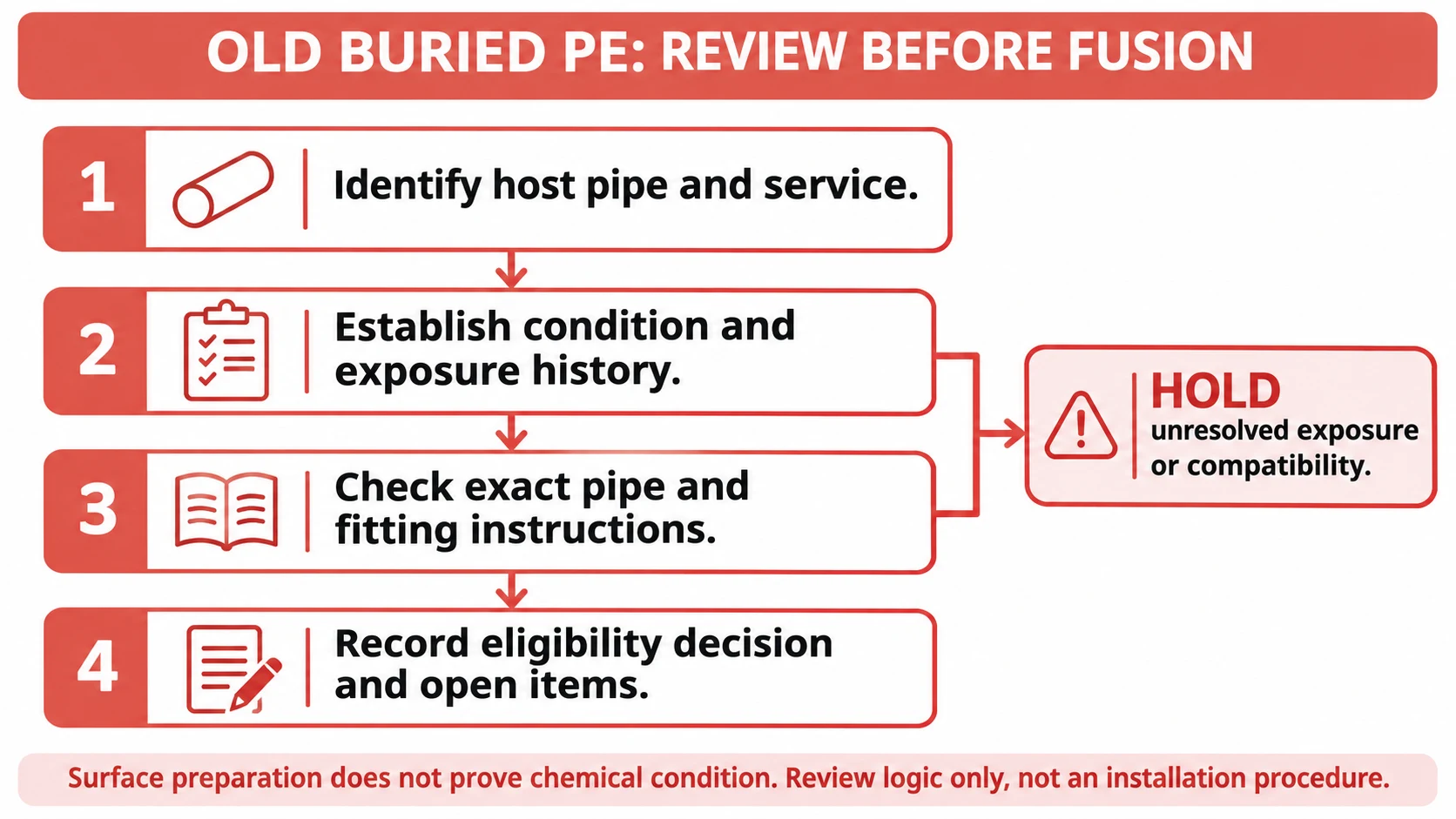
- Identify host pipe and service.
- Establish condition and exposure history.
- Check exact pipe and fitting instructions.
- Record eligibility decision and open items.
Conclusion
Review an old buried PE pipe through separate eligibility questions. Establish what the host pipe is, what it has encountered and whether the specified joint can be prepared within the applicable instructions. Age alone does not reject it; a clean surface alone does not approve it. A precise hold and release condition is more useful than either shortcut.
Frequently asked questions
Does old PE automatically require replacement?
No universal age cutoff is established here. Actual identification, history, condition and applicable engineering requirements determine the review.
Can more peeling remove an unknown exposure concern?
Do not assume so. Additional material removal changes dimensions and cannot be used as an invented clearance for unknown chemical condition.
Is butt fusion automatically the alternative?
No. Any alternative needs its own pipe condition, access, equipment and procedure acceptance.









 English
 Français
 Русский
 Español
Recent Comments