
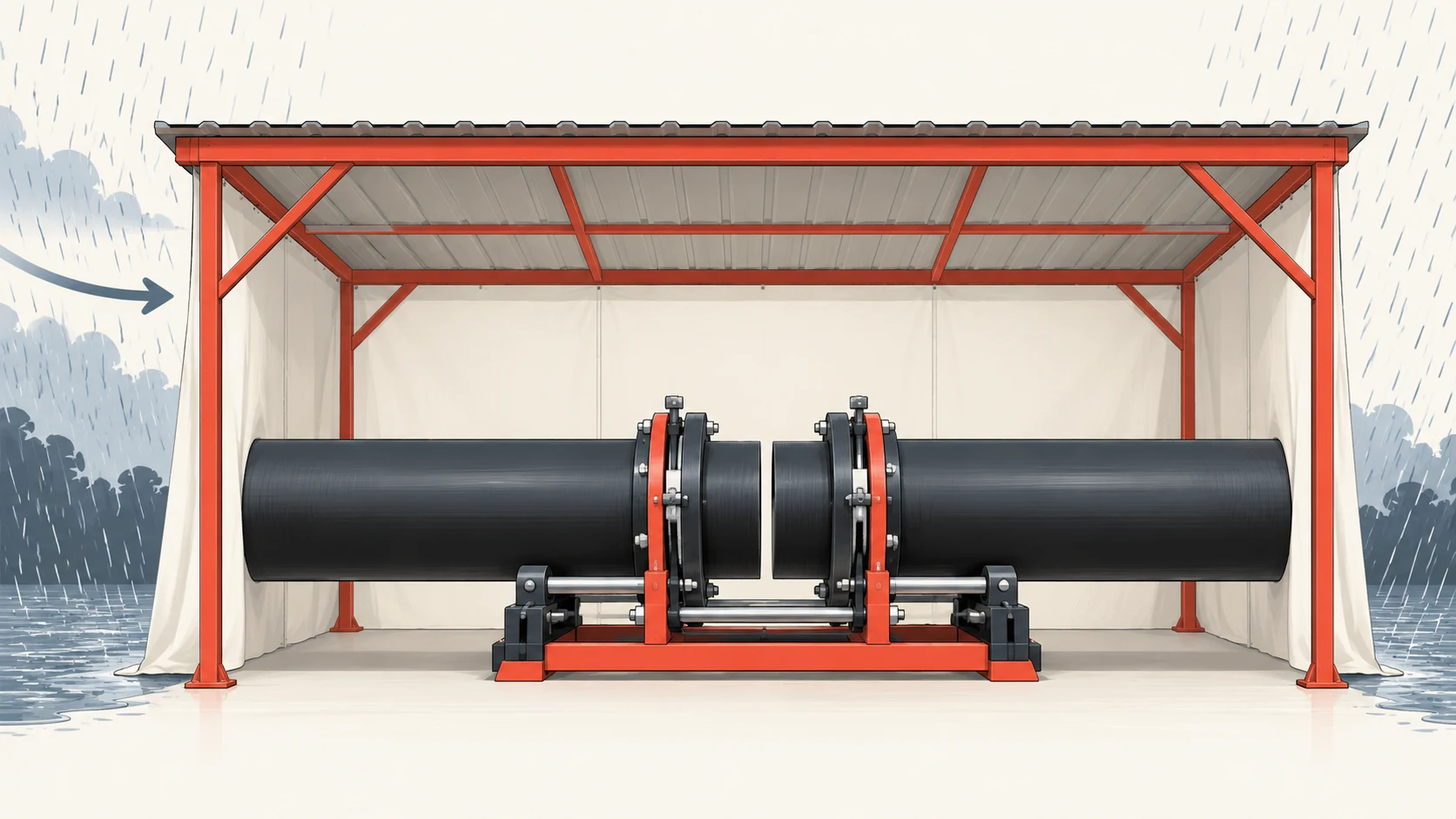
Yes, HDPE pipe can be butt-fused while it is raining outside, provided the fusion operation is sheltered and the jointing surfaces stay clean and dry. No, that does not permit joining wet pipe ends under an ineffective cover. If rain, wind-driven spray or airborne contamination reaches the work, suspend fusion until protection is effective. Keep the qualified joining procedure; rain is not a reason to improvise heater settings.
The practical question is whether you can protect the actual operation, including the heater and the inside of the pipe. A roof over the machine is only part of that answer. The guidance below concerns butt fusion of PE pressure water pipe; it is not an electrofusion timing guide or a replacement for the pipe, equipment and project procedure.
Key takeaways
- Rain outside a suitable shelter does not automatically cancel butt fusion.
- Exposed rain or contamination at the joint makes the operation unacceptable.
- A canopy can be sufficient in light rain; heavier or wind-driven precipitation may require enclosure.
- Check moisture inside the pipe, not just its outside surface.
- A heated shelter can create condensation or disturb dust.
- Changing heater temperature or joining pressure to compensate for weather is not the solution.
Decide by conditions at the joint, not the forecast

A forecast describes the area. The fusion decision concerns a small work zone that the crew must control throughout preparation, heating, joining and cooling. PPI Municipal Advisory Board guidance MAB-08, effective February 2022, calls for shielding against precipitation and wind effects and keeping pipe ID and OD free of moisture near the heater. Its scope is HDPE pressure water systems, with local adaptation by the utility or engineer.
| Observed condition | Decision | Reason |
|---|---|---|
| Rain outside; protected zone and jointing surfaces remain dry and clean | Fusion may proceed under the applicable qualified procedure | Protection is achieving its purpose |
| Roof present, but spray or dust enters at the sides | Improve protection before proceeding | A roof alone does not control contamination |
| Moisture remains at the joint or protection cannot exclude contamination | Suspend fusion | The necessary conditions are absent |
This decision does not establish joint quality by itself. It establishes whether the weather protection is adequate to use the joining procedure. For method selection and the wider joining sequence, read our HDPE pipe fusion guide.
Choose protection for the rain you actually have
WL Plastics’ WL114-0309 weather bulletin distinguishes light precipitation, where an overhead canopy may suffice, from heavier precipitation, where a fully enclosed shelter is appropriate. It requires suspension when wind-driven precipitation or airborne contamination cannot be excluded.
The useful distinction is therefore performance, not the shelter’s name. An enclosure with an open windward entrance can fail where a well-positioned canopy succeeds in gentle vertical rain. Neither arrangement is automatically approved merely because somebody calls it a fusion tent.
Allow space for the operator and the equipment’s full movement. A shelter that prevents contamination but obstructs the joining operation creates a different problem. MAB-08 specifically addresses working space and operator mobility; protection must accommodate the work rather than force the work around the shelter.
Check the bore and the conditions inside the shelter
WL Plastics explains that air entering open pipe ends can travel through the bore, cooling the heater or melted ends and carrying contamination. Suitable end covers or plugs may be needed under the applicable procedure. Closing the sides around the machine does not necessarily stop airflow through a long pipe.
Warmth is not proof of dryness either. Radius Systems’ January 2026 cold-weather advisory warns that a heated shelter can produce condensation. It also warns against disturbing dust with a warm-air blower or directing that blower at the pipe instead of warming the sheltered area evenly.
These mechanisms explain two otherwise confusing observations: a sheltered joint can still become contaminated, and a warm work zone can still contain wet jointing surfaces. Inspect the conditions you need rather than treating “covered” and “heated” as completion labels.
Do not make the heater hotter to beat the rain
WL Plastics explicitly says not to change heating-plate temperature or joining pressure to compensate for weather. MAB-08 likewise says not to alter the specified heating-plate temperature range for cold conditions. Weather provisions may affect preparation, protection and heating time within the qualified procedure; they do not justify a crew inventing a new parameter set.
Radius’s advisory separates butt fusion from electrofusion and gives system-specific ambient provisions. Its electrofusion input options must not be imported into a butt-fusion instruction. This article supplies no universal cold-weather timer, temperature cutoff or extra-pressure allowance.
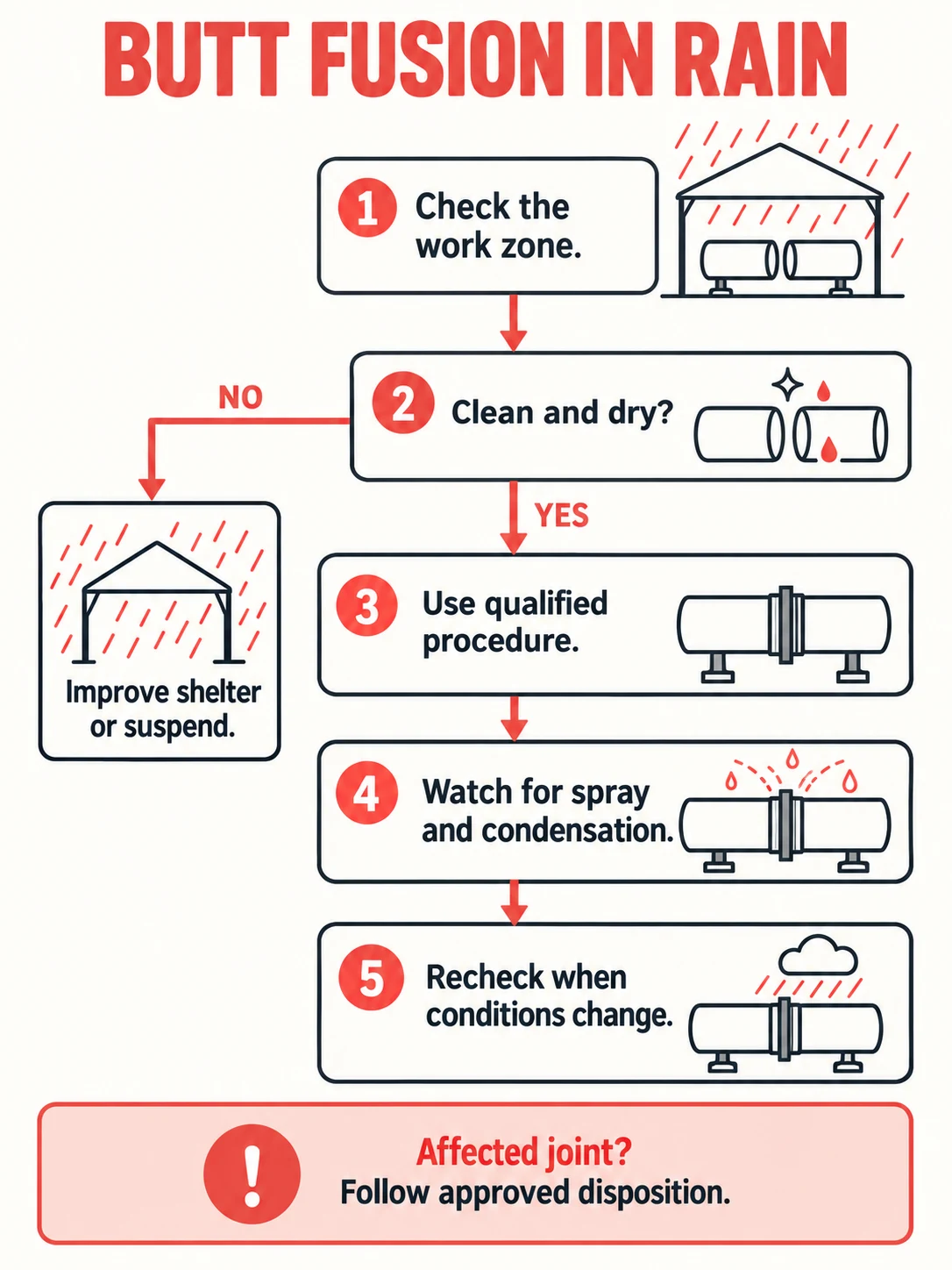
- Check the work zone
- Clean and dry?
- Use qualified procedure
- Watch for spray and condensation
- Recheck when conditions change
Two completed weather decisions
Illustrative scenario 1: steady light rain without crosswind. Assume the project procedure permits the operation, a canopy allows full machine movement, the heater and prepared surfaces stay clean and dry, and bore airflow is controlled where required. The decision is to proceed under that procedure. Rain is falling, but it is excluded from the process. Adding heat simply because the forecast says “wet” would solve the wrong problem.
Illustrative scenario 2: a gust drives spray beneath that same canopy. The prepared surfaces are no longer protected. The decision changes to suspend fusion and provide effective protection. If enclosure later excludes the spray, that resolves the weather-protection issue; it does not erase an interruption or prove that an already affected joint is acceptable.
| Change in the scenario | What changes in the decision? |
|---|---|
| Light rain becomes wind-driven spray | The canopy is no longer adequate; suspend and improve protection |
| Enclosure excludes spray but condensation remains | Do not resume with wet jointing surfaces |
| Protection and clean, dry conditions are restored | Use the applicable procedure’s preparation and interruption requirements before the next joint |
After a rain interruption, distinguish the next joint from the affected joint
Before resuming, check that protection still works, jointing surfaces are clean and dry, equipment can operate properly and moisture is not entering through the bore. Recheck after changes in wind or shelter heating. This is a condition check derived from the weather guidance, not a new welding procedure.
For a cycle already interrupted or exposed, follow the approved procedure and responsible project authority’s disposition. This article does not authorize reheating a suspect joint, adding a second cycle or accepting it because its bead looks neat. Solving the shelter problem protects subsequent work; it does not certify previous work.
When selecting the pipe and fittings for the job, keep material, OD, SDR and joining requirements together. Discuss your HDPE pipe and fitting requirements with IFANPRO, identifying the project country, sizes, SDR and required joining procedure. Product availability and documentation need confirmation for the specified order; site welding acceptance remains with the project.
Conclusion
Make the rain decision at the fusion zone: protected, clean and dry can allow work to continue; uncontrolled spray, moisture or contamination means stop and correct the conditions. Choose shelter by what it excludes, check the bore as well as the outside, and preserve the qualified joining parameters.
FAQ
Does a fusion tent guarantee that rain work is acceptable?
No. It must actually keep precipitation and contamination away while allowing the full operation. Condensation or water entering through the pipe can defeat an otherwise enclosed shelter.
Can I increase heater temperature in cold rain?
Do not increase it merely to compensate for weather. Use the applicable qualified procedure’s weather provisions and specified heater range.
Does this apply to electrofusion too?
The clean, dry work-zone principle matters, but electrofusion has its own fitting and controller instructions. Do not transfer butt-fusion parameters or interruption decisions to electrofusion.
Can an exposed joint be accepted once the rain stops?
Dry weather does not establish that joint’s acceptability. Use the approved procedure and project authority’s disposition for the affected joint.












 English
 Français
 Русский
 Español
Recent Comments