
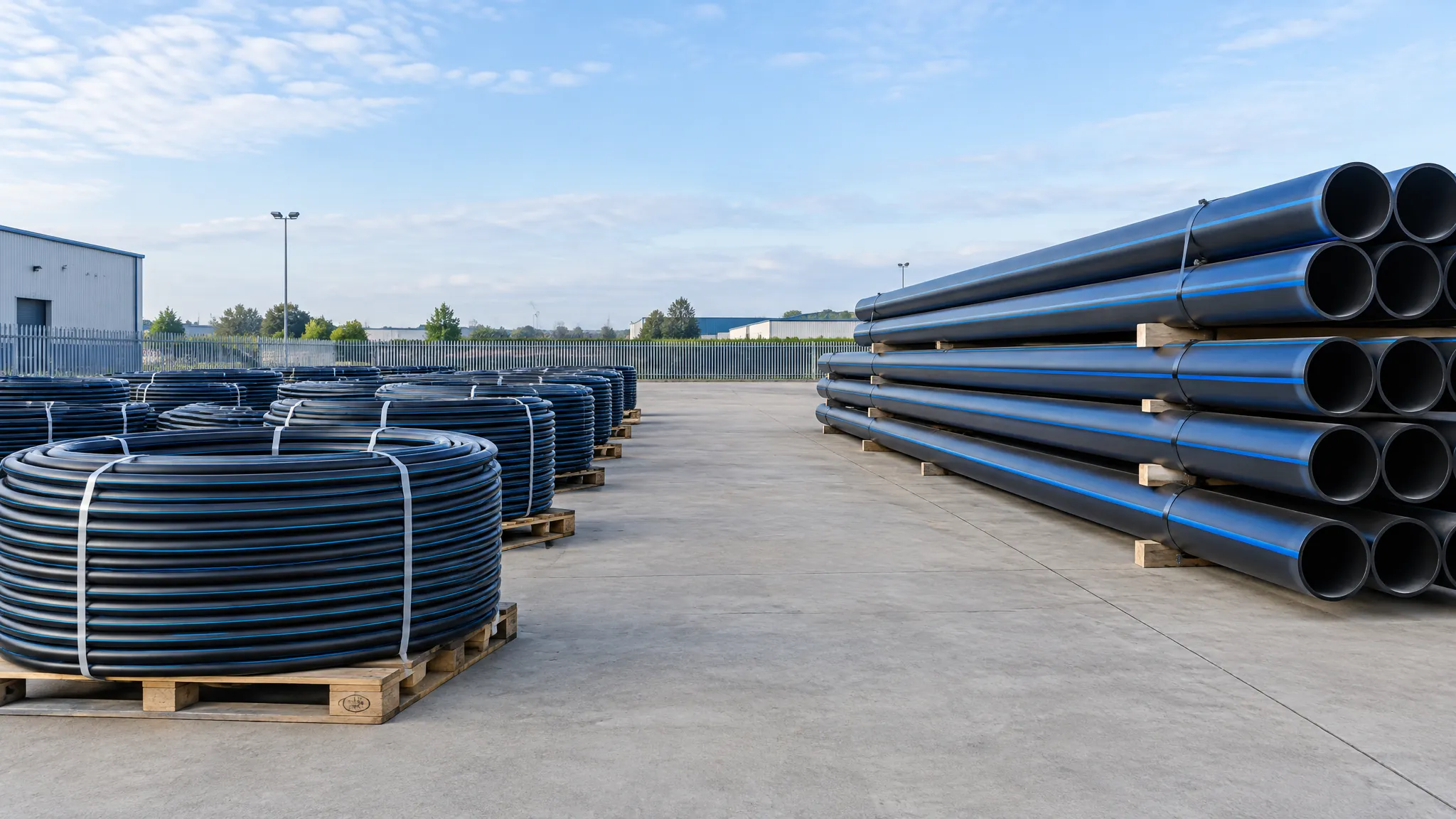
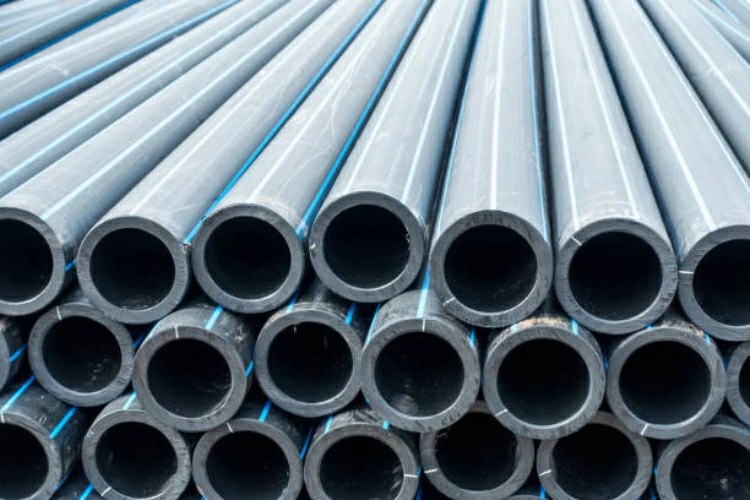
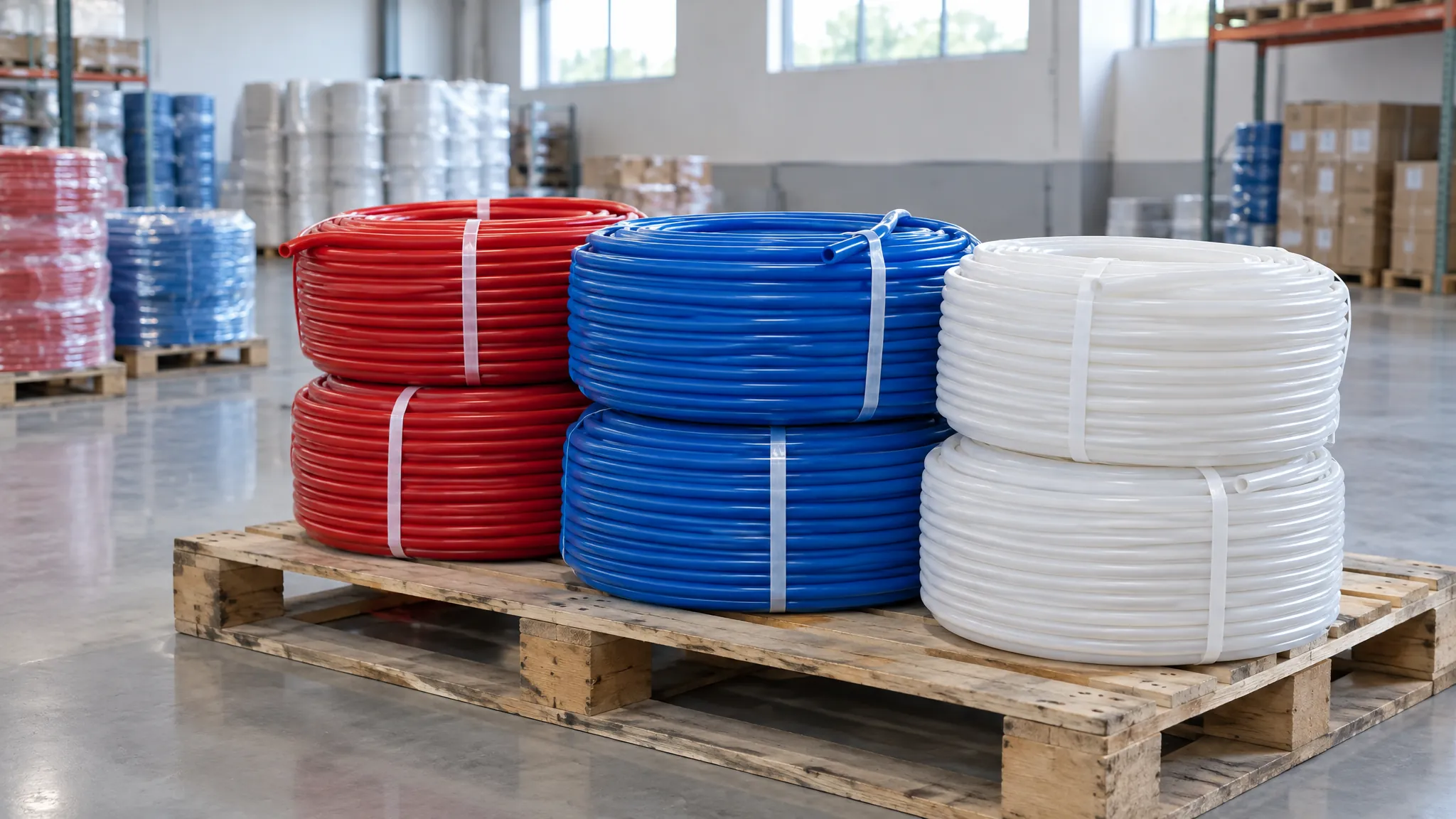
Order HDPE pipe in coils when the bore is small and the run is long. Most pipe of 4 in and smaller can be coiled. Coils are typically limited to 6 in and smaller in US practice and to 180 mm in metric practice, and one coil can put several hundred metres in the ground without a joint. Order straight lengths from about 90 mm upward, where the pipe is butt fused or electrofused section by section and roundness at the joint matters more than the number of joints.
The catch sits in the product standard. ISO 4427-2:2019 clause 7.2 leaves the maximum out-of-roundness of coiled pipe to agreement between the manufacturer and the end-user, so a coil order with no ovality line has no ovality limit. Three numbers then settle the order: the coil core, the ovality the fusion crew must restore, and whether the pipe fits the container. A 40 ft straight length is 163 mm too long for a 40 ft box.
Key Takeaways
- Coils are typically limited to 6 in and smaller (PPI Handbook). PE100+ lists coils up to 180 mm and straight lengths of 6, 10, 12, 15, 24 and 30 m from 90 mm up.
- ISO 4427-2:2019 clause 7.2 leaves the maximum out-of-roundness of coiled pipe to agreement between the manufacturer and the end-user. Put a number on the order.
- Industry coil cores (PPI TN-6, 2021): 48 in for 2 in pipe, 70 in for 4 in and 6 in. On 6 in pipe that core is only 10.6 times the OD.
- Electrofusion (PIPA POP001 Issue 9): ovality below 1.5% of DN or 3 mm, whichever is smaller, under DN 315. That is 1.65 mm on DN110.
- A 40 ft straight length (12,192 mm) is 163 mm longer than the 12,029 mm minimum internal length of a 40 ft container.
- A 1,000 m run takes 83 joints in 12 m lengths and 1 joint in 500 m coils.
Below, a Fate Farms PA crew tries to roll out a 500 ft coil of 3 in HDPE pipe.

Where the Coil Stops and the Straight Length Starts
The PPI Handbook of Polyethylene Pipe puts the practical line in two places. Most pipe of 4 in or smaller can be coiled, some manufacturers coil up to 6 in, and depending on diameter a single coiled length can run to 10,000 ft. Pipe of 4 in and larger is usually cut to specified lengths, and the standard straight length for extruded pipe is 40 ft, with shorter lengths or lengths of 60 ft or more made where transport rules allow.
Metric supply follows the same shape. The PE100+ Association lists straight lengths for diameters of 90 mm and above in standard lengths of 6, 10, 12, 15, 24 and 30 m, free-standing coils up to 180 mm, and drums for longer lengths than a coil can carry. It also notes that coil and drum lengths are usually limited by transport, which is the constraint this guide keeps returning to.
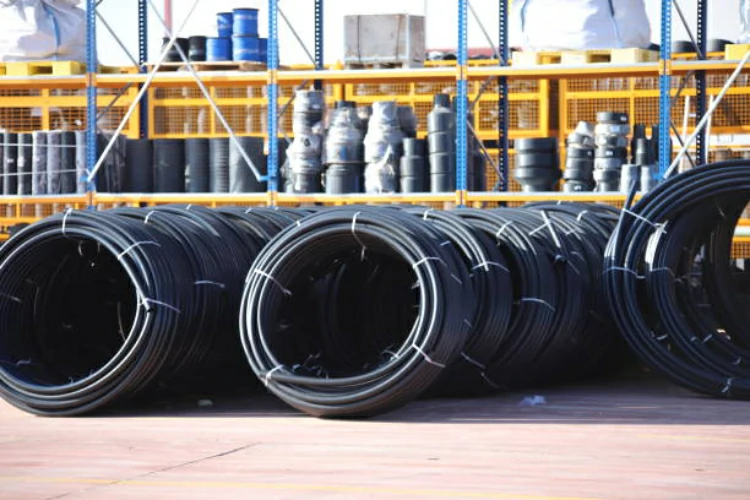
The US standards split at the same diameter. ASTM D3035-22 covers pipe from IPS 1/2 to 3 in, while ASTM F714-25 starts at DIPS 3, IPS 4 and metric 90 mm. For water utilities, AWWA C901-25 covers 3/4 in (19 mm) through 3 in (76 mm) for water service, and AWWA C906-21 covers 4 in through 65 in (100 mm through 1,650 mm). Check which specification the drawings name before choosing the form: C901 sizes sit inside the coilable range, while C906 starts at 4 in, where coiling becomes the exception.
| Size band | Usual form | US standard | Watch point | Best for |
|---|---|---|---|---|
| Up to 63 mm / 2 in IPS | Coil | ASTM D3035-22, AWWA C901-25 | Coil ovality is a contract term | Service lines, irrigation laterals, long runs |
| 75 to 90 mm / 3 in IPS | Coil or straight | D3035-22 to 3 in; F714-25 from DIPS 3 | Coil core 62 to 70 in (TN-6) | Rural mains, drill pulls with a coil trailer |
| 110 to 180 mm / 4 to 6 in IPS | Straight; coil by agreement | ASTM F714-25, AWWA C906-21 | Tight core, re-rounding at every joint | Trenchless runs where joints cost most |
| Above 180 mm / above 6 in | Straight lengths | ASTM F714-25, AWWA C906-21 | Length against truck and container | Mains and fused strings |
Source: PPI Handbook of PE Pipe (2022 printing) Chapters 2 and 4; PE100+ Association; ASTM D3035-22 and F714-25 scopes; AWWA C901-25 and C906-21 titles; PPI TN-6 (2021).
The band from 3 in to 6 in (90 mm to 180 mm) is where the choice is real. Below it, coils win on almost every count; above it, straight lengths are the only practical form. The rest of this guide is about deciding inside that band, and about writing the order so the coil you choose arrives usable.
The Coil Core Decides the Ovality, and ISO 4427-2 Leaves It to Your Contract
Coiling bends the pipe around a core. The outer wall of each wrap goes into tension, the inner wall into compression, and the section flattens to relieve the stress. PPI explains the mechanism in TN-61, a 2024 note on HDPE conduit: ovality grows as the pipe diameter rises and as the bend radius falls, and it is worst on the innermost layers. Conduit leaves the extruder typically under 3% oval, yet the inner layers of 6 in IPS coiled conduit may be 20% oval or more when first taken off the reel. Those are conduit figures, not pressure pipe limits, but the physics is the same.
The core diameter is therefore the first number to ask for. PPI TN-6 (revised 2021) surveyed the smallest coil inside diameters in use for polyethylene pressure pipe. Table 2 lists them with the core expressed as a multiple of the pipe OD, which is the figure that predicts ovality.
| Pipe size (IPS, in) | DR range | Core (in) | Core (mm) | Core / OD (times) |
|---|---|---|---|---|
| 1/2 in | 9, 11 | 23 | 584 | 27.4 |
| 1 in | 9, 11, 13.5 | 24 | 610 | 18.3 |
| 1-1/4 in | 7, 9, 11 | 30 | 762 | 18.1 |
| 2 in | 7 to 17 | 48 | 1,219 | 20.2 |
| 3 in | 7, 9, 11 | 62 | 1,575 | 17.7 |
| 4 in | 7 to 17 | 70 | 1,778 | 15.6 |
| 6 in | 7 to 17 | 70 | 1,778 | 10.6 |
Source: PPI TN-6 (2021) Table 1; ratios calculated on IPS OD from the PPI Handbook Appendix A.2. TN-6 reports current practice, not minimum limits.
The last row explains why 6 in coils are hard work. The 2007 edition of ISO 4427-2 set the minimum coil bore at 18 times the nominal diameter (clause 6.4), and PPI recommends 18 times the actual OD for conduit drums. A 6 in coil wound on a 70 in core sits at 10.6 times its OD. PPI’s conduit note gives the reason for conduit: reels and coils top out at about 120 in (3.04 m) across for shipping height, so 4 to 6 in sizes are wound tighter than 18 times. The pipe is bent harder than the rule of thumb, so it arrives more oval.
| IPS pipe size (in); 3 in split by DR | Core / OD (times) | 18 x rule (times) |
|---|---|---|
| 1/2 | 27.4 | 18 |
| 1 | 18.3 | 18 |
| 1-1/4 | 18.1 | 18 |
| 1-1/2 | 24.7 | 18 |
| 2 | 20.2 | 18 |
| 3 DR7-11 | 17.7 | 18 |
| 3 DR13.5-17 | 20.0 | 18 |
| 4 | 15.6 | 18 |
| 6 | 10.6 | 18 |
Now the clause. ISO 4427-2:2019, amended in 2023, is the current edition. Its Table 1 caps out-of-roundness for straight pipe at the point of manufacture, for example 1.5 mm at dn 63, 2.2 mm at dn 110 and 3.2 mm at dn 160. Clause 7.2 then says that for coiled pipes the maximum out-of-roundness shall be specified by agreement between the manufacturer and the end-user. The 2019 edition moved coiled pipe and lengths into clauses 7.4 and 7.5, so quote the clause from the edition named on the contract. If the order says nothing, the coil has no ovality limit to reject against.
What number to write is a project decision, but there is a published benchmark. ASTM F2160, the conduit standard PPI quotes, allows 7% ovality for 2 in IPS and smaller, 10% for coiled conduit above 2 in through 3 in, and requires re-rounding to 10% or less for larger coils where the application needs it. For pressure pipe that will be electrofused, the next section shows why the joint needs far less than that.
What the Fusion Crew Has to Get the Pipe Back To
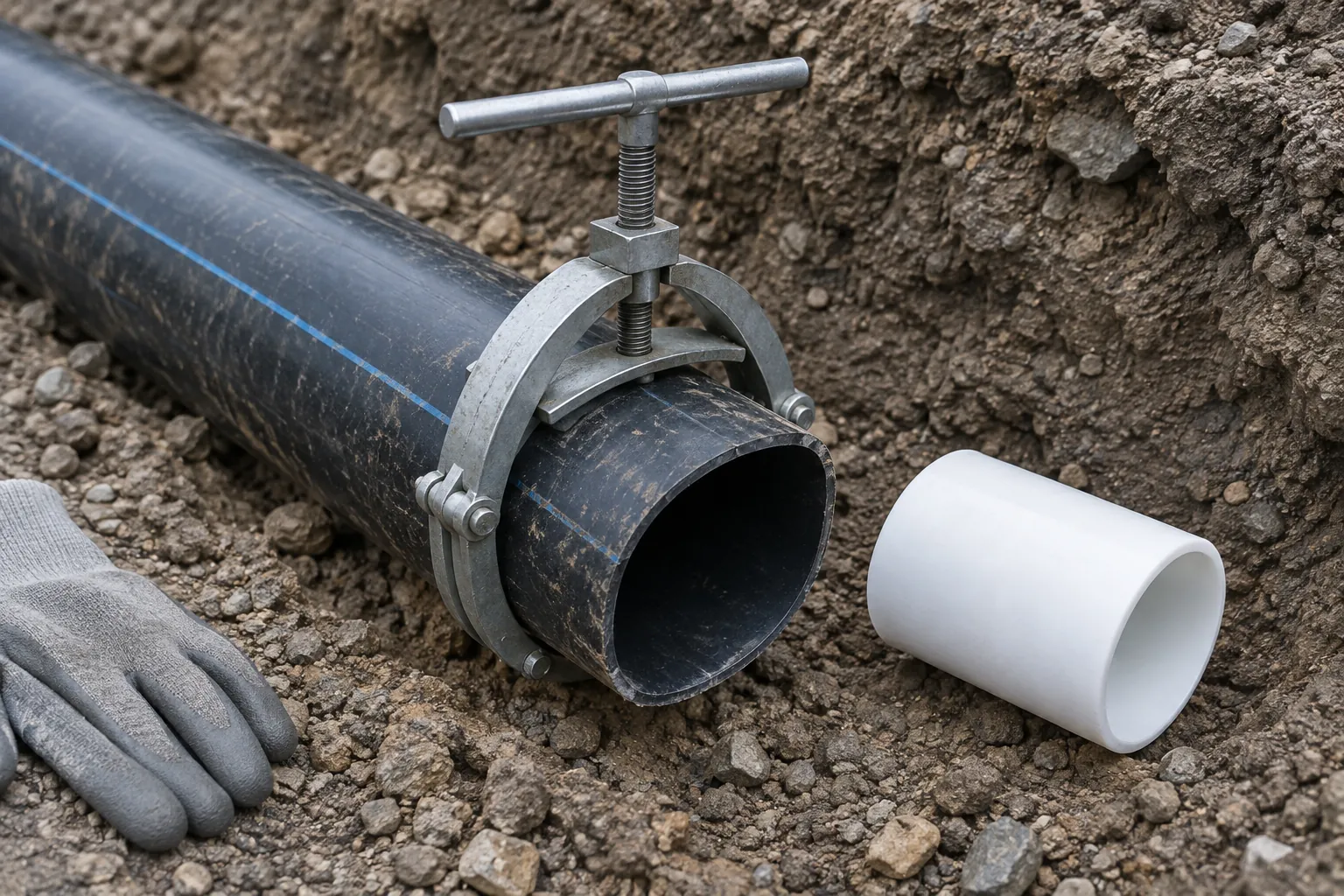
An electrofusion socket closes a small, even gap around the pipe. Ovality makes that gap uneven. PIPA POP001 Issue 9 (November 2024), the Australian industry guideline for electrofusion jointing, sets the acceptance line at the fusion zone. For pipe below DN 315, d1 minus d2 (maximum minus minimum OD) must stay below 1.5% of DN or 3 mm, whichever is smaller. At DN 315 and above the limit is 1% of DN or 5 mm. Flat spots may not exceed 3 mm deep, and re-rounding tools stay on through welding and cooling.
Compare that with the product standard. On DN110, 1.5% is 1.65 mm, but ISO 4427-2:2019 lets a straight dn 110 pipe leave the factory with up to 2.2 mm of out-of-roundness. On DN63 the joint allows about 0.9 mm against a factory limit of 1.5 mm. So even straight pipe can meet its standard and still need re-rounding clamps at the joint, and coiled pipe, which the standard does not cap at all, needs them as a matter of routine. Budget clamps for every electrofusion joint on coiled stock.
| Nominal size | EF limit (mm) | ISO factory (mm) |
|---|---|---|
| dn 63 | 0.945 | 1.5 |
| dn 110 | 1.65 | 2.2 |
PIPA lists four fixes when coiled pipe will not sit true in the clamps:
- Butt weld a short length of straight pipe to the end of the coil and make the electrofusion joint on that.
- On a warmer day, lay the coil out and restrain it at several points so the curvature relaxes.
- Pull the pipe through coil straightening equipment as it is unrolled.
- Fit two alignment clamps, both mounted eccentrically to the joint.
Mechanical joints need a round end too. PPI’s conduit note recommends a clamp-type rounding tool before fitting a coupler on the larger coilable sizes, and it advises cutting off and discarding the first and last few feet of each coil, where the tie-downs deformed the pipe. If the tees, caps and valves in our HDPE pipe fittings range will join small coiled PE, measure the pipe end before assembly. Allow for the end cut-off when you order coil length: a coil sold at a round number of metres delivers less usable pipe. Butt fusion itself is covered in our HDPE pipe fusion guide.
Freight: What Fits Through the Door and Down the Box
Container limits are fixed by ISO 668. The Hapag-Lloyd container specification prints the ISO minimums. Internal length is 5,898 mm in a 20 ft box and 12,029 mm in a 40 ft box, internal width is 2,350 mm, and the door opening is 2,337 mm wide and 2,261 mm high (2,565 mm on a 9 ft 6 in high cube).
| Item | Size (mm) | Box limit (mm) | Clearance (mm) | Verdict |
|---|---|---|---|---|
| 40 ft straight length in a 40 ft box | 12,192 | 12,029 | -163 | Does not fit; order a shorter cut |
| 6 m straight length in a 20 ft box | 6,000 | 5,898 | -102 | Does not fit; use a 40 ft box |
| 12 m straight length in a 40 ft box | 12,000 | 12,029 | 29 | Fits with almost no handling room |
| 2 in coil, 9 layers on a 48 in core | 2,305 across | 2,337 door width | 32 | Fits laid flat |
Source: ISO 668 minimum internal and door dimensions as printed in the Hapag-Lloyd Container Specification; coil geometry calculated from PPI TN-6 and PPI Handbook Appendix A.2.
The first row is the costly surprise for anyone buying to ASTM F714 and shipping by sea. The US standard straight length is 40 ft, and 40 ft is 12,192 mm, which is 163 mm longer than the inside of a 40 ft container. Metric buyers meet the mirror case: a 6 m length is 102 mm too long for a 20 ft box, and a 12 m length leaves 29 mm in a 40 ft box. Put the cut length on the order and set it against the container you will book, not against the truck the supplier uses at home.
Coils are limited by the door instead of the length. As a geometry check, take 2 in IPS pipe (60.3 mm OD) on the 48 in (1,219 mm) core from TN-6. Nine layers bring the coil to about 2,305 mm across, just inside the 2,337 mm door width when loaded flat. Ten wraps high, about 603 mm, that coil holds about 498 m and weighs about 474 kg in DR 11. These are estimates from dimensions, not a supplier coil size, but they show the method: core plus two pipe diameters per layer, against the door.
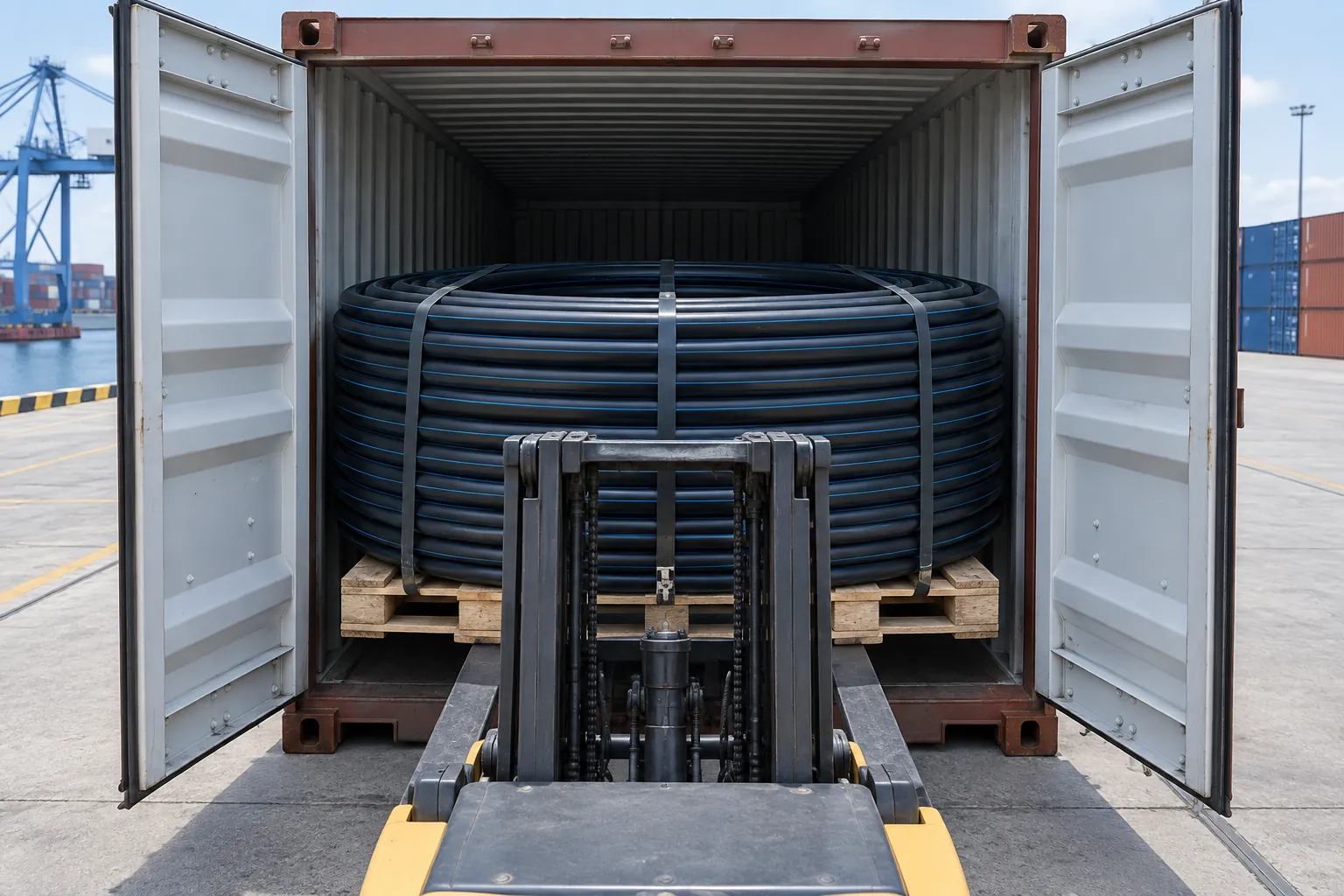
Stowage and the choice between mixed loads belong in our guide to importing pipe: Incoterms and packaging. For the ordering decision, the rule is shorter. Straight lengths need a cut length that fits the box; coils need a diameter that clears the door.
Site Labour: Joints, Uncoiling and Laydown Space
Joints are where site labour goes. A 1,000 m run takes 84 straight lengths and 83 joints if the pipe comes in 12 m lengths, and 166 joints in 6 m lengths. The same run in 100 m coils takes 9 joints, and in 500 m coils it takes 1. Each joint is a fitting to prepare, make and record, and a fusion joint adds heating and cooling time, so on small-bore work the coil removes most of that labour.
Coils bring their own work. Coiled pipe keeps its curve. The PPI Handbook sets the minimum cold bend radius by dimension ratio: 20 times the OD at DR 7 to 9, 25 times at DR 11 and 13.5, 27 times at DR 17 and 21, and 34 times at DR 26. Where a fitting or flange sits in the bend, the radius opens to 100 times the OD. A coil laid in a trench wants to snake, and that curvature has to be pulled out before the fittings go on.
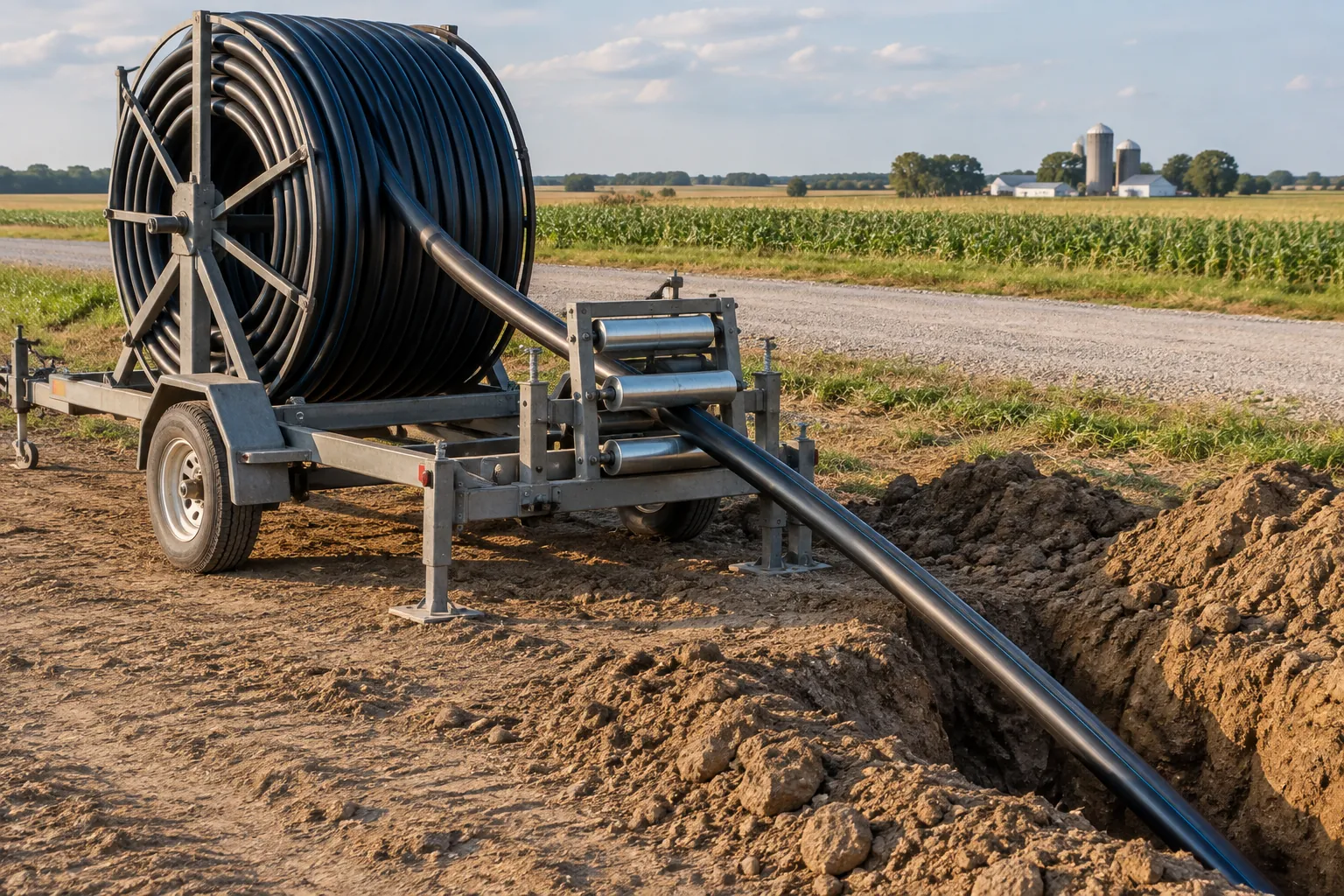
Temperature decides how hard that is. PE stiffens near and below freezing, though it stays ductile below -40 °C, so the PPI Handbook tells crews to allow more time for any handling that bends the pipe. PPI’s conduit note puts the threshold at 45 °F (7 °C), below which coil-set takes more force to remove. The same note warns that coil-set grows with time in storage and with daily temperature cycles, and recommends first-in, first-out stock rotation. An importer holding coils in a yard should rotate them the same way.
On trenchless work the balance tips toward coils. For a directional-drill crossing, the PPI Handbook says a fused string of straight pipe needs laydown space beginning about 75 ft beyond the exit point and 35 to 50 ft wide, while coiled pipe needs considerably less. On a narrow road reserve that difference can decide whether the crossing is possible at all; our trenchless HDPE installation guide covers the pull itself.
Which Form to Order, Project by Project
The decision comes down to where the labour falls and what the joint needs. Table 4 gives the verdict by project type; the size bands from Table 1 still apply.
| Project | Order | Why | Watch |
|---|---|---|---|
| Farm or irrigation line, 20 to 63 mm | Coils | Few joints, fast laying | Agree coil ovality; cut coil ends |
| Water service lines, 3/4 to 2 in | Coils | Continuous run to each meter | Compression or electrofusion needs a round end |
| Directional drill, 3 to 6 in | Coils if the rig has a trailer | Small laydown area | Re-round before pullback |
| Open-cut main, 110 mm and up | Straight lengths | Round ends for fusion | Cut length against the container |
| Stock for resale, 90 to 180 mm | Straight lengths | Easy to count and cut | Coil-set grows in the yard |
Source: Verdicts drawn from PPI Handbook Chapters 2, 4, 7 and 12, PPI TN-6 and TN-61, PIPA POP001 Issue 9 and ISO 668 container minimums.
A worked case shows how the columns combine. A contractor lays 1,000 m of 63 mm PE100 SDR 11 pipe across farmland to a set of valve boxes. In 12 m lengths that is 83 joints; in 100 m coils it is 9, one at each valve box. The coil pipe is not capped for ovality by ISO 4427-2, so the order states a maximum, and the crew carries re-rounding clamps because an electrofusion joint on DN63 allows about 0.9 mm. Coils win, on the condition that both lines are on the paperwork.
Inside the 3 in to 6 in band, the tie-breaker is the joint method. If every joint will be electrofused, straight lengths save re-rounding at each one. If the run is long, the route curves and the joints are few, the coil saves more than the re-rounding costs, provided a straightener and clamps are on site.
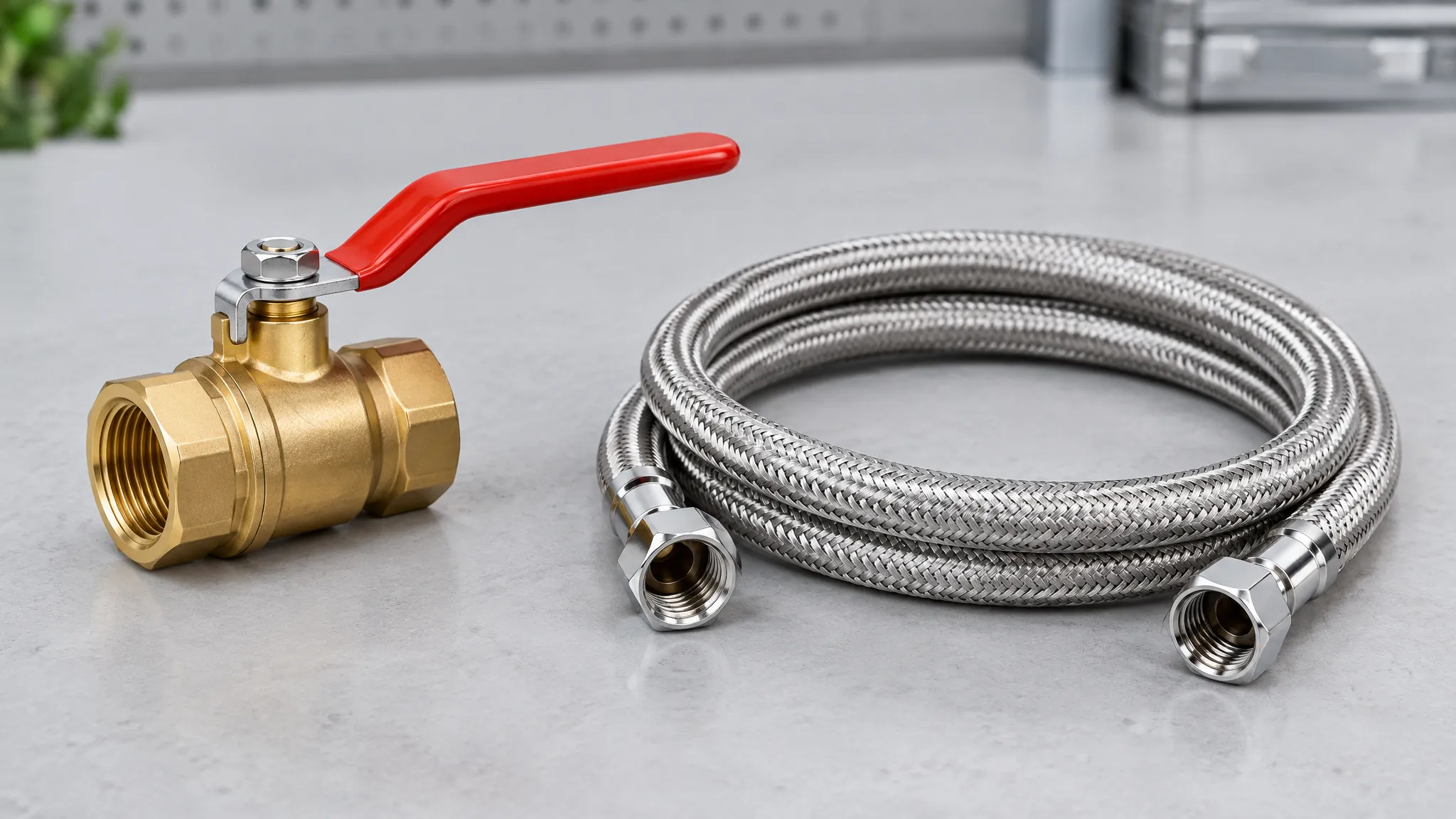
For importers and contractors who have settled on coils or straight lengths and now need the joints. The range below is the HDPE fitting and valve side of the system; pipe form, coil length and cut length are quoted against your order, not a catalogue.
What to Write on the Purchase Order
Because ISO 4427-2:2019 leaves coil ovality to the contract, and its 2007 edition did the same for length, the order has to carry both. Seven lines cover the form decision:
- Standard and edition, such as ISO 4427-2:2019 or ASTM F714-25, with SDR or DR and PE grade.
- Form: coil, drum or straight length.
- Coil core diameter in mm, checked against Table 2 for your size and DR, for example 1,219 mm for 2 in pipe.
- Maximum out-of-roundness on the coil, in mm or %, and where it is measured.
- Length and tolerance: coil length in metres, or straight cut length set against the container.
- Marking: the 2007 edition of ISO 4427-2 required coils to be marked sequentially with the metreage remaining; confirm the current wording with the supplier.
- End protection and packing: capped ends, coil strapping points and the number of coils per pallet.
Where We Stop
Price, minimum order and lead time follow from those lines, and we have not published figures for them here. The Product Bible behind this site holds no coil sizes, coil lengths, MOQ or delivery times for our HDPE pipe, and our certification list (ISO 9001, CE, WRAS, NSF/IAPMO and others) is company level, not per product. What we can give is how each number is built, so any quote can be compared line by line:
- Price structure: ask for a price per metre that names the form, plus drums, pallets and cutting as separate lines. A coil price and a straight-length price for the same pipe are not comparable until packing is split out.
- MOQ: ask whether the minimum is set per size and SDR, per full coil or per extrusion run, and whether a non-standard coil length or cut length raises it.
- Lead time: ask for the number of days from deposit to ex-works for each size in each form, stock and made to order stated separately, and whether a new coil core or cut length adds days.
For wall and SDR choices before any of this, see our HDPE pipe sizes and SDR chart, and for vetting the supplier who will answer these lines, our HDPE pipe supplier selection guide.
For buyers who know their size, SDR and standard and want coil and straight-length options priced side by side. Send the order lines above and the container you plan to book.
Conclusion
Choose coils for small bores and long runs, straight lengths from about 90 mm up and wherever joints are electrofused section by section. Then write coil core, maximum coil ovality and length onto the order, because the standard leaves them to you. Set every cut length against the container before the order is confirmed.
Frequently Asked Questions
What is the typical length of an HDPE pipe coil?
There is no fixed figure. The 2007 edition of ISO 4427-2 left lengths to agreement between purchaser and manufacturer, so coil length is a line on the order. The PPI Handbook notes coiled lengths over 1,000 feet in certain diameters and up to 10,000 feet depending on diameter.
What are the standard straight lengths of HDPE pipe?
In US practice the PPI Handbook gives 40 feet as the standard straight length, with shorter lengths or lengths of 60 feet or longer depending on transport limits. For metric pipe of 90 mm and above, the PE100+ Association lists 6, 10, 12, 15, 24 and 30 metres.
Does coiled HDPE pipe need re-rounding before jointing?
Often, yes. PIPA POP001 Issue 9 accepts electrofusion ovality below 1.5% of DN or 3 mm, whichever is smaller, under DN 315. That is 1.65 mm on DN110, so coiled pipe usually needs re-rounding clamps at the joint.
Will 40 ft HDPE pipe fit in a 40 ft container?
No. A 40 ft straight length (12,192 mm) is 163 mm longer than the 12,029 mm minimum internal length of a 40 ft container under ISO 668. Order a cut length that fits the box, such as 12 m or less.










 English
  Français
  Русский
  Español
Recent Comments