
You have four quotations for the same HDPE pipe. Two of them say PN16. The cheapest is 30% under the others, every supplier calls itself a manufacturer, and every one of them has a PDF certificate with a logo on it. You cannot tell which of the four is selling you the same product — and nothing you can find online tells you how to check, because every page that ranks for hdpe pipe supplier is written by a company that wants to be the answer.
That is the actual problem with this search. It is not a shortage of suppliers. It is that the people answering the question are all bidding on it.
Key takeaways
- This page gives you a procedure, not a list of company names. A supplier ranking published by a pipe manufacturer is worth nothing to you, so we do not publish one.
- The pipe carries its own evidence. ISO 4427-2 requires seven specific elements printed at least once per metre. You can audit them this afternoon from a photograph.
- “PN16” is not a specification. SDR 11 is PN 16 in PE 100 and PN 12,5 in PE 80 — the same wall, a different pipe, and often the entire price gap between two quotes.
- A conformity certificate for pipes does not cover fittings or joints, and it does not grant potable-water clearance in your country. The standard says both things in its own text.
- For the UAE, ECAS is mandatory and lasts one year. An expired certificate is a border problem, not a paperwork problem.
What This Guide Gives You — And What It Deliberately Does Not
The trade this page is offering you
Search this term and you get supplier homepages and directory listings. The directories are the more frustrating result, because a list of forty company names with no criteria attached leaves you exactly where you started, only with more tabs open. What is missing from the entire first page is the thing you actually need: a way to rank the names you already have.
So this article does something different, and you should know within thirty seconds whether that trade suits you. We are a pipe manufacturer. A “top ten suppliers” ranking written by us would be marketing wearing a lab coat, and you would be right to discard it. What we can offer instead is the qualification procedure that a competent buyer runs — built from the text of the governing standard and from published market-access rules, structured so you can apply it to any supplier on your list.
Including us. Every check below works the same way when you point it at IFANPRO, and that is the point of writing it this way.
Four numbers we are not going to invent for you
There is a second half to that honesty. A buyer at this stage wants four numbers — stock range, coil length, lead time and minimum order — and articles like this one routinely supply them as “typical industry” figures that were never true of any particular factory. A lead time you read in a blog post is not a lead time. It is a sentence.
We are not publishing IFANPRO’s HDPE stock diameters, coil lengths, port-to-port transit times or minimum order quantities in this article, because they are not documented to a standard we are willing to cite. What we do instead is better for you anyway: the section on the four numbers shows you what governs each one and how to make any supplier commit to it in writing. Extracting a real figure from a named supplier beats reading a generic one here.
Who should read on
- Best for: importers and distributors qualifying a new factory, project procurement building an approved-vendor list, and anyone holding quotes they suspect are not comparable.
- Also useful for: contractors who have been handed a supplier by a client and want to know what they are inheriting.
- Not for you if: you want a company shortlist, or you are buying a single coil for a domestic job — the verification effort here is priced for repeat or container-scale purchasing.
Manufacturer, Stockist or Trader: The Three Questions That Tell Them Apart
Almost every company selling HDPE pipe describes itself as a manufacturer or a supplier, and both words are doing a lot of hiding. There are three distinct businesses behind them, and the difference decides your price, your lead time and — critically — who can actually answer a technical question when something goes wrong on site.
You do not need a factory visit to tell them apart. You need three questions, and the value is in what a wrong answer sounds like.
Question one: which diameters run on the same line, and what does a changeover cost you?
HDPE pipe is extruded continuously, and a line is tooled for a diameter band. Changing from one diameter to another means changing the die and the calibration sleeve, restarting, and scrapping the pipe that comes out during stabilisation. A real manufacturer knows this in his bones and will answer in terms of run length — which sizes he can group into one production run, and what minimum quantity makes a changeover worth doing for you.
A trader cannot answer this question at all. He will convert it into a delivery question, because his cost structure has no changeover in it. That deflection is the signal, and it is unmistakable once you know to listen for it.
Question two: give me the production period code from a delivery you made last month
Every pipe made to ISO 4427-2 carries a production period marking — a date or a code. In the 2007 edition of the standard, Table 6 gives the example “0204” and requires it to be traceable to year and month, and, where the manufacturer produces at more than one site, to the production site as well. Ask a supplier to send you the code from a specific recent consignment and to tell you which line and plant it maps to.
A manufacturer produces this in minutes; it is how his own quality records are indexed. A trader has to go and ask somebody, and what comes back is often a code he cannot explain. You have learned who is upstream of whom without anyone having to admit anything.
Question three: which edition of the standard does your certificate name?
ISO 4427 has been revised — the material in this article is read from the 2007 edition, and a 2019 edition superseded it. This question is not a trap about which edition is better. It tests whether the person you are dealing with knows what is written on his own certificate, and a supplier who cannot name the edition has almost certainly never read the document he is invoking.
A stockist is not the wrong answer
This is not a hierarchy with the factory at the top. If you need 40 metres of three diameters next Tuesday, a local stockist holding inventory is straightforwardly the right choice, and going direct to a factory for that order wastes everybody’s time. The distinction matters when your order is large enough that a production run is possible, or technical enough that you will need someone who can answer for how the pipe was made. Choose the type that fits the order, not the one with the best word on its letterhead.
Read the Pipe Itself: The Seven-Element Marking Check You Can Run Today
Here is the most useful thing in this article, and it costs nothing. Pipe made to ISO 4427-2 is required to carry its own identification, printed along the wall, and the standard specifies exactly what must be there. You can ask any supplier for a clear photograph of the pipe wall and audit it against the list below before you have spent a cent.
Clause 11.2 of the 2007 edition sets the marking frequency at not less than once per metre, and Clause 11.1 requires the marking to be permanent, legible without magnification, and printed in a colour that differs from the pipe’s own colour. Those requirements exist so that pipe can still be identified after years in a trench — which means a supplier whose pipe is unmarked or faintly marked has a problem that goes well beyond paperwork.
| Required element | Example from the standard | What its absence tells you |
|---|---|---|
| Standard number | ISO 4427 | The pipe is not claiming conformity at all — everything else is unanchored |
| Manufacturer’s identification | Name or symbol | No accountable maker; a claim you cannot trace to anyone |
| Dimensions (dn × en) | 110 × 10 | You cannot verify wall thickness against what you ordered |
| SDR series (for DN > 32) | SDR 11 | The pressure claim cannot be cross-checked — see the SDR section below |
| Material and designation | PE 80 | The grade is asserted only on paper, never on the product |
| Pressure rating in bar | PN 12,5 | Site crews cannot confirm they are laying the right class |
| Production period (date or code) | 0204 | No batch traceability — a defect claim has nothing to attach to |
Run this on the photograph and you have converted a vague impression of a supplier into a specific finding. A pipe marked with all seven does not prove the supplier is good. A pipe missing three of them proves something quite definite.
Two extras worth checking in the same photograph
Coils have an additional requirement that is quietly useful to a buyer. The standard requires coils to be sequentially marked with the metreage so the remaining length is readable off the coil itself. If you have ever argued with a supplier about whether a coil was short, you will see immediately what that gives you: the pipe counts itself, and the argument becomes a matter of reading it.
Colour is the other one. Under Clause 5.2, pipes are blue, black, or black with blue stripes — and blue pipe or black pipe with blue stripes is intended for drinking water only. The same clause carries a warning worth passing to your site team: for above-ground installations, blue components and components with non-black layers should be protected from direct UV light. Black carbon-loaded pipe tolerates sunlight; the blue identification layer is not there for its weathering performance.
The Grade Claim: Why PE100 On The Pipe Is Not Proof Of PE100
PE 100 costs more than PE 80 and permits a thinner wall for the same pressure, which makes it the single most attractive thing on a pipe to overstate. And a print legend is just ink. So the useful question is not whether the pipe says PE 100 — it is what that designation is a claim about, and what document settles it.
The designation is a claim about the resin’s minimum required strength classification, established by long-term hydrostatic testing and extrapolation under ISO 9080. It is a property of the compound the pipe was made from, certified upstream of the pipe factory. This is why a serious supplier can always point at a resin classification, and why “it is PE 100 because that is what we run” is not an answer.
The numbers that substantiate the claim on the pipe
Downstream of the resin, the pipe itself has to survive hydrostatic tests that differ by grade. These are the figures to ask for on a test report, because they are grade-specific and a report that quotes the wrong stress for the claimed grade is self-refuting.
| Test condition | PE 100 hoop stress | PE 80 hoop stress |
|---|---|---|
| 20 °C, 100 h | 12,4 MPa | 10,0 MPa |
| 80 °C, 165 h | 5,4 MPa | 4,5 MPa |
| 80 °C, 1 000 h | 5,0 MPa | 4,0 MPa |
All three are water-in-water tests on three test pieces, and the requirement is that no test piece fails during the period. Notice what the 80 °C rows are doing: they compress decades of service into days by raising the temperature, which is the only practical way to interrogate a material whose selling point is a fifty-year design life.
The one clause that tells you whether a test report was read or filed
Clause 7.3 draws a distinction that most buyers never learn, and it is the most revealing thing you can raise with a supplier’s quality manager. A fracture in a brittle mode in less than 165 hours is a failure, full stop. But if a test piece fails in a ductile mode inside 165 hours, the standard permits a retest at a lower selected stress for a longer qualifying period — 5,3 MPa for 256 hours, 5,2 MPa for 399 hours, down to 5,0 MPa for 1 000 hours in PE 100.
Ask what the failure mode was. A quality manager who understands why the standard treats brittle and ductile failure differently is running a real test regime; brittle failure at short duration points at the material, which is precisely why the standard refuses to let it be retested away. If the question produces confusion, you have learned that the reports are being filed rather than read.
SDR And PN: The Cross-Check That Catches A Mis-Priced Quotation
This is the section that pays for itself. When two quotations for “PN16, 110mm” differ by a wide margin, the usual assumption is that one supplier is hungrier. Frequently they are quoting different products, and the standard’s own table shows exactly how.
SDR is the standard dimension ratio — outside diameter divided by wall thickness. It sets how much material is in the pipe. PN is the pressure rating that results, and it depends on both the SDR and the material grade, because a stronger resin carries more pressure at the same wall.
| SDR | PN in PE 100 | PN in PE 80 |
|---|---|---|
| SDR 9 | PN 20 | PN 16 |
| SDR 11 | PN 16 | PN 12,5 |
| SDR 13,6 | PN 12,5 | PN 10 |
| SDR 17 | PN 10 | PN 8 |
| SDR 26 | PN 6 | PN 5 |
Read the SDR 11 row slowly, because it is where the money hides. If you asked for PN 16 and a supplier quotes SDR 11 in PE 80, he has quoted PN 12,5 — a pipe with a lower pressure rating than you specified, at a price that will look competitive because the wall is the same. The pipe is not defective and the supplier may not even be deceiving you. He answered the specification you actually wrote, and you wrote an incomplete one.
A worked example you can reuse tomorrow
Suppose you are buying 110 mm pipe for a buried potable main at PN 16, and three quotes come back. Here is the whole procedure, and it takes about ten minutes.
- Force each quote onto three fields: grade, SDR, PN. Any quote that cannot supply all three is not yet a quote — send it back rather than comparing it.
- Check the pair against the table. PE 100 at SDR 11 is PN 16 and matches your spec. PE 80 at SDR 11 is PN 12,5 and does not, whatever the header of the quotation says.
- Cross-check the wall thickness. For 110 mm at SDR 11 the standard gives a minimum wall of 10,0 mm and a maximum of 11,1 mm. A quotation offering 110 mm SDR 11 with an 8 mm wall is describing something that is not SDR 11.
- Re-price on mass, not on metres. A thicker wall is more resin, and resin is most of the cost. Once the three quotes describe the same pipe, the remaining spread is a real commercial difference and you can negotiate it.
- Write the specification properly next time: “PE 100, SDR 11, PN 16, to ISO 4427-2, blue or black with blue stripes.” Now every quote is comparable by construction.
One caution on the arithmetic. The published PN values assume a design coefficient of 1,25; the relationship is PN = 20σs / (SDR − 1), where the design stress is the material’s MRS divided by that coefficient. Some national codes and some project specifications require a higher coefficient for buried mains or for gas, which lowers the permitted pressure for the same pipe. If your project specification names a coefficient, it governs — check it before you rely on the table.
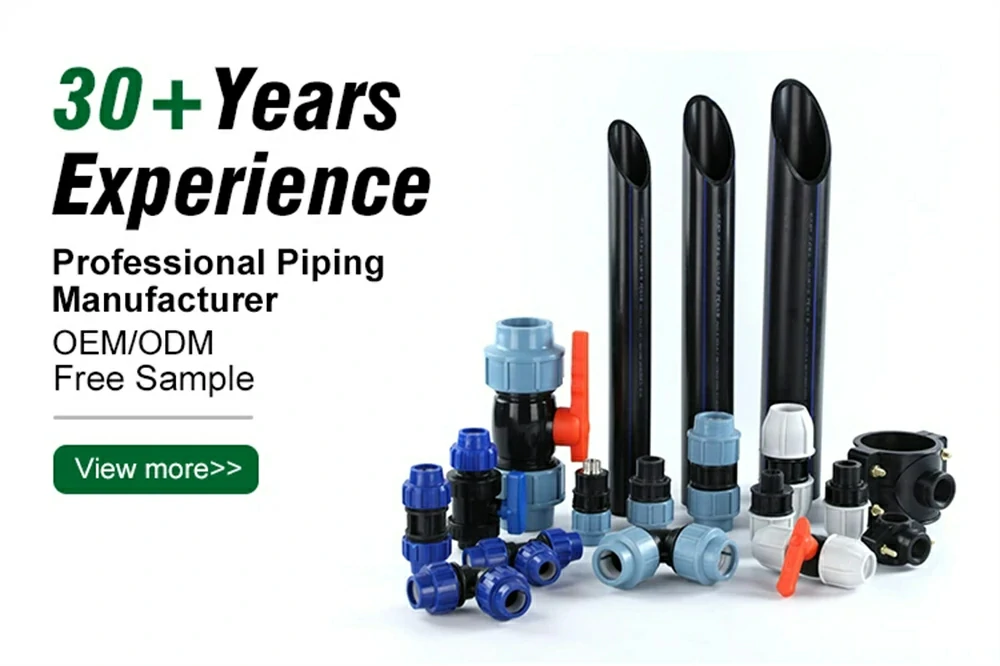
If your requirement is the fittings side of the system rather than the pipe run, our HDPE fittings catalogue lists the compression and threaded range — saddle clamps, valves, tees, elbows and caps — and is the fastest way to see whether a supplier’s fitting range covers the connections your drawing actually calls for. For the pipe-size side of the question, our HDPE pipe size guide sets out the diameter and wall tables in full.
The Document Set: What To Demand, And What Each One Does Not Cover
Suppliers send certificates. Buyers file them. Almost nobody reads what the certificate actually covers, and that gap is where the expensive surprises live — not in forged documents, which are rare, but in genuine documents doing far less work than the buyer assumed.
There are four test reports worth naming explicitly in your RFQ, and two of them tell you more about a factory’s discipline than any audit summary will.
The four reports, and what each one exposes
| Report | Requirement in ISO 4427-2:2007 | What a bad result actually means |
|---|---|---|
| Hydrostatic strength | No failure at the grade-specific stress; see the table above | The grade claim is not supported by the pipe as made |
| Oxidation induction time (OIT) | ≥ 20 min at 200 °C, taken from the inner wall surface | Under-stabilised material — it may pass pressure tests today and age badly |
| Melt mass-flow rate change | Change by processing within ± 20 %, pipe measured against the compound | Over-processed or reprocessed material, or an extruder run too hot |
| Elongation at break and reversion | Elongation ≥ 350 %; longitudinal reversion ≤ 3 % with no surface effect | Brittleness, or frozen-in extrusion stress that shows up as distortion |
The OIT figure deserves a moment because it is the one buyers skip. Polyethylene needs antioxidant to survive processing and then to survive decades in service, and OIT measures how much protection is left in the pipe after it was made. A pipe can pass every pressure test and still be under-stabilised — which is a problem that surfaces in year eight, long after everyone involved in the purchase has moved on. The standard requires the test piece to be taken from the inner wall surface, the side in contact with the water, so ask which part of the wall it was cut from.
The melt flow rate check is the closest thing to a regrind detector available on a routine report. Reprocessing material shifts its flow behaviour, so comparing the pipe against the compound it came from is a direct measure of what happened in between.
Three scope traps that catch experienced buyers
Now the part that matters more than the reports themselves. A certificate covers precisely what it says it covers, and these three gaps are routinely assumed away.
- Pipes are not fittings. ISO 4427 is split into parts: Part 1 general, Part 2 pipes, Part 3 fittings, Part 5 fitness for purpose of the system. A conformity certificate against Part 2 says nothing about the fittings, and Clause 10 sends the joints themselves to Part 5. If you are buying a system, you need documents covering the parts you are buying — and the joint is where systems fail.
- The standard has a pressure and temperature ceiling. Its scope covers a maximum operating pressure up to and including 25 bar at a 20 °C reference temperature. Applications running constantly above 20 °C are directed elsewhere in the standard family for derating. If your line runs warm — process water, a hot climate with shallow cover, an above-ground run in the Gulf — the headline PN is not your working pressure.
- ISO 4427 does not clear the pipe for drinking water in your country. The standard says so itself: it “provides no information as to whether the products may be used without restriction”, and existing national regulations are in force. Potable approval is a separate, national question — WRAS in the UK, for instance, certifies that a material tested to BS 6920 does not leach harmful substances, taint taste or odour, or promote microbial growth. That is a materials-safety approval, not a pressure rating and not a quality-system certificate. Three different documents, three different questions.
How to phrase the request so the answer is checkable
Do not ask “are you certified?” — the answer is always yes and it costs the supplier nothing. Ask for the certificate number, the issuing body, the edition of the standard it references, its expiry date, and the product scope it names. Then ask whether the reports relate to your diameter and SDR or to a different size in the range.
Every one of those is a fact you can verify with the issuing body. “Are you certified” is not.
Buying Into The Gulf: What ECAS And EQM Change About Your Shortlist
If the destination is the UAE, a supplier who satisfies every check above can still be the wrong choice, because market access is a separate gate from product quality. This is the question behind the steady search volume for an HDPE pipe supplier in the UAE, and the directory listings that dominate those results do not address it at all.
The mechanism is the Emirates Conformity Assessment Scheme. ECAS requires exporters and importers trading with the UAE to comply with quality and safety requirements for regulated products in order to clear customs and place goods on the market, and building and construction is one of the regulated categories. The certificate is issued by notified bodies on behalf of the ministry and functions as proof that the product has been approved federally.
The one-year clock, and why it is a shipping risk
An ECAS certificate of conformity runs for one year. That short validity is the practical trap for a buyer placing repeat orders against a supplier qualified some time ago: the pipe has not changed, the factory has not changed, and the certificate quietly lapsed between your first order and your third. The consequence lands at the border, on a container you have already paid for.
So the question to a supplier is not whether he holds ECAS. It is the expiry date on the specific certificate covering the product you are buying, and who renews it. Put the expiry date in your own calendar rather than trusting his.
EQM, and when the higher tier is worth insisting on
Alongside ECAS sits the Emirates Quality Mark, and the distinction is worth understanding before you specify either. According to guidance published by conformity-assessment bodies operating the schemes, ECAS is a product-level certification valid for one year, while EQM requires a full factory and QMS audit before the mark is granted, is valid for three years, and is highly regarded by government procurement agencies in Abu Dhabi and Dubai. Intertek similarly describes the EQM scheme as requiring the manufacturing organisation to implement a quality management system ensuring continuous compliance.
The practical reading for your shortlist: if you are supplying private projects, ECAS is the access requirement. If you intend to bid public work in Abu Dhabi or Dubai, a supplier without EQM may narrow what you can bid on, and that is a commercial constraint to establish before you build a business around him rather than after.
Verify this against the current rules before you commit
Conformity schemes and their regulated-product lists are revised, and the detail above is drawn from published guidance by certification bodies rather than from the regulation itself. Treat it as the map, not the territory: confirm the current requirement for your specific product and destination emirate with a notified body or your customs broker before you place an order. For clarity, IFANPRO holds ISO 9001, ISO 14001, CE, WRAS, NSF/IAPMO, Intertek, EAC, Watermark and SAI Global certification — ECAS and EQM are not among them, and we are not claiming otherwise.

Local counter or direct import — the honest way to decide
Buyers frame this as a quality question. It is a stocking-cost question, and framing it correctly makes it easy to answer.
A UAE trading company holding stock in Dubai carries the inventory, the finance cost, the certification renewal and the currency risk, and prices those into the metre rate. You are paying for availability and for someone local who is liable. Importing directly removes that margin and hands you every one of those costs and risks instead, along with a lead time measured in weeks rather than hours. Neither is smarter than the other; they suit different order books.
- Buy locally when your requirement is irregular, your sizes vary job to job, your site needs material the same week, or a project specification requires a locally approved supplier for liability reasons.
- Import directly when your volume is predictable enough to plan container quantities, your size mix is stable, you can carry stock, and you have somebody who can read a test report — because at that point the local margin is the largest single line you can remove.
- The test that settles it: work out what a month of holding your own stock costs you in cash and space. If that number is smaller than the local premium on the same volume, importing is worth the work. If it is larger, the counter is not overcharging you — it is doing something for you that you would rather not do yourself.
If you are moving toward direct import, the packing, incoterm and documentation side deserves its own preparation — our guide to importing pipe, incoterms and packaging covers the terms that decide who carries which cost.
The Four Numbers Every Supplier Should Give You In Writing
We said at the top that we would not print generic figures for stock range, coil length, lead time and minimum order. Here is the substitute, and it is the more valuable thing: what governs each number, and the phrasing that turns a comfortable answer into a commitment.
Apply this to every supplier on your list. Apply it to us as well — a supplier who resents being asked these questions has told you something useful.
Stock range versus catalogue range
Every catalogue lists more sizes than the factory holds or runs regularly. That is not deception — it is the difference between what a line can produce and what is in the yard today. The gap becomes your problem when a size you assumed was routine turns out to need a dedicated production run.
Ask it this way: “Of the sizes on my schedule, which are in stock now, which run on a regular cycle and how often, and which require a dedicated run?” Three categories, in writing. The answer reorganises your buying plan immediately, because the third category is where your lead-time risk actually lives.
It helps to know what the outer envelope of the product even is before you ask. ISO 4427-2 tabulates nominal sizes from 16 mm up to 2 000 mm, across the SDR 6 to SDR 17 series shown earlier, within a scope limited to a maximum operating pressure of 25 bar at 20 °C. That is the range the standard describes — no single factory runs all of it. Most extruders are tooled for a band, commonly with a break somewhere in the mid-hundreds of millimetres where the line, the coiling equipment and the handling gear all change, which is also why coil supply gives way to straight lengths as diameter climbs.
So the useful question is not “what sizes do you do” — every catalogue answers that generously. It is where their band starts and stops, and where the coil-to-straight-length crossover sits, because that crossover changes your freight, your jointing method and your site handling all at once. For our own part: IFANPRO manufactures HDPE pipe and fittings alongside PPR, PEX, PVC and PPH lines, and the specific stock diameters, SDR combinations and coil lengths we hold at any moment are quoted against a live schedule rather than published as a fixed list. Ask us for them the same way you would ask anyone else — in the three categories above.
Coil length — a contract term, not a standard one
Buyers are often surprised that there is no standard coil length. The standard is explicit about it: no requirements have been set concerning particular lengths of coiled or straight pipe or the tolerance on them, so lengths must be supplied by agreement between purchaser and manufacturer. If it is not in your contract, it is not agreed.
Two related points are governed, and both are worth writing in. The minimum internal diameter of a coil must be not less than 18 times the nominal pipe diameter, which prevents buckling and kinking — and also determines how much space a coil occupies in a container, so it feeds directly into your freight cost. And because coils must be sequentially metre-marked, your delivered length is verifiable on arrival. Specify the coil length, the tolerance on it, and the remedy for a short coil.
Lead time — make it commit, not estimate
A lead time quoted as a single number is nearly always production time with the rest of the chain quietly omitted. What actually governs it: whether your sizes need a changeover, where you sit in the current order book, whether the resin grade is in stock, sailing frequency on your route, and congestion at both ends. Any of those can move the date more than the extrusion itself.
Ask it this way: “Split the lead time into production days, days to port, sailing days and expected clearance days, and tell me the last date you can accept a size change without resetting it.” That final clause is the one that reveals whether a schedule is real, and it is worth more than the total.
Minimum order — usually a structure, not a number
On extruded pipe, a single MOQ figure rarely tells the truth, because the real constraint is the changeover. A run is economic at a certain length, so the minimum tends to be expressed per diameter and per SDR — and a mixed load of eight sizes can be harder to accept than a single-size order twice its total volume.
Ask it this way: “What is the minimum per diameter and SDR combination, and what does my size mix do to it?” Then send your actual mix. A supplier who answers with one number for everything has probably not modelled his own production cost, which is worth knowing before you rely on his schedule.
Price — why a bare per-metre figure is not one
HDPE pipe is mostly resin by cost, and resin is a traded commodity that moves. A per-metre price with no resin basis and no validity date is a conversation opener, not a price, and comparing two of them tells you very little.
Ask it this way: “Quote per metre and per kilogram, state the resin grade and the price validity date, and name the incoterm.” Per kilogram is the honest basis for comparing suppliers, because it strips out the wall-thickness differences that make a per-metre comparison meaningless — which is the same trap as the SDR mismatch above, wearing different clothes.
Write The Inspection Into The Contract Before You Need It
Everything so far happens before you commit. This last step is what makes committing to a new supplier rational at all: a cheap, self-administered acceptance test, agreed in writing before the container ships. You need a tape, a caliper and the numbers below.
The single most useful fact here is that the outside diameter tolerance is one-sided. The minimum mean outside diameter equals the nominal diameter exactly, and the entire allowance sits on the plus side.
| Nominal size | Mean outside diameter (min to max) | Max out-of-roundness |
|---|---|---|
| 110 mm | 110,0 to 110,7 mm | 2,2 mm |
| 160 mm | 160,0 to 161,0 mm | 3,2 mm |
| 250 mm | 250,0 to 251,5 mm | 5,0 mm |
| 315 mm | 315,0 to 316,9 mm | 11,1 mm |
| 400 mm | 400,0 to 402,4 mm | 14,0 mm |
| 630 mm | 630,0 to 633,8 mm | 22,1 mm |
Two cautions on how to use this table fairly, because a buyer who applies it wrongly will reject good pipe. The ovality limits are measured at the point of manufacture — coiled pipe deforms in the coil and relaxes after uncoiling, so the standard leaves ovality on coils and on straight lengths of 710 mm and above to agreement between the parties. And the diameter figure is a mean, so take several measurements around the circumference and average them rather than condemning a delivery on one caliper reading.
Wall thickness, and the weight cross-check that needs no tools at all
Wall thickness is where underspecified pipe is most often found, because it is the largest cost lever a supplier has. For 110 mm the standard allows 10,0 to 11,1 mm at SDR 11 and 6,6 to 7,4 mm at SDR 17; for 160 mm, 14,6 to 16,2 mm at SDR 11 and 9,5 to 10,6 mm at SDR 17.
The cross-check most buyers miss is that wall thickness has a mass consequence you can weigh. A coil or bundle materially lighter than the calculated mass for its declared dimensions is telling you something the paperwork is not. You do not need a laboratory for this — you need a weighbridge ticket and five minutes of arithmetic, and it is the fastest whole-consignment screen available to anyone.
Agree the remedy before the container ships
The checks are only worth running if a failure has a consequence. Write into the purchase order which characteristics will be checked on arrival, how many lengths are checked, the tolerance applied, and what happens on a fail — replacement, credit, or rejection of the consignment, and who pays the return freight. Agreeing this while everyone is still friendly costs one paragraph. Agreeing it after a delivery is disputed costs considerably more.

One thing worth watching before the pipe is ever inspected
Most HDPE failures in service are joint failures, not pipe failures. If your crews are new to butt fusion, the Plastics Pipe Institute — the North American industry trade association, not a supplier — publishes a short, neutral introduction to how the joint is made and why the process parameters matter.

“Basics of Butt Fusion” — Plastics Pipe Institute. Click to play on YouTube.
For the jointing decision itself — which method suits which diameter and which site conditions — our guide to HDPE pipe fusion methods goes through the trade-offs. If you want the material background behind everything above, what HDPE pipe is and where it is used covers it.
Where our own answers stop
Since the whole article invites you to point these checks at us, it is only fair to say in advance where our answers run out. On the standards side we can answer fully: grade, SDR and PN for a given schedule, the marking on the pipe, and the test reports listed above with the certificate scope and expiry attached. Those are documented facts and a supplier who cannot produce them is not really in this conversation.
What we will not do is quote a stock range, a coil length, a lead time or an MOQ in a web page, for the reason this article has argued throughout: those four move with the order book, the resin market and the size mix, and a number published today would be wrong by the time you read it. They come back against a live schedule, in writing, in the three-category form described above.
On ECAS and EQM we will point you to a notified body rather than interpret UAE regulation for you. Reading a scheme’s current scope is their job, and a supplier who confidently tells you what your customs position will be is telling you something he cannot know.
Your Shortlisting Checklist
Everything above collapses into a sequence you can run against any supplier, in roughly this order, stopping as soon as one of them fails badly enough to matter.
- Establish what they are. Changeover economics, a production period code from a real delivery, and the edition on the certificate. Three questions, one phone call.
- Audit a photograph of the pipe wall against the seven required marking elements, and check the coil metre-marking while you are there.
- Force the specification onto grade, SDR and PN, then cross-check the pair against the table and the wall thickness against the standard.
- Request the four reports — hydrostatic, OIT, MFR change, elongation and reversion — and confirm they relate to your size, not a different one in the range.
- Check the scope of every certificate: pipes or fittings, which edition, which expiry, and whether potable approval for your market is a separate document.
- Settle market access for the destination — for the UAE, the ECAS expiry date on the specific product, and whether EQM matters for the work you intend to bid.
- Get the four numbers in writing with the phrasings above, and price per kilogram as well as per metre.
- Write the acceptance test into the purchase order, with the tolerance, the number of lengths checked and the remedy agreed before shipping.
None of this requires a factory visit, a laboratory or a consultant. It requires a supplier willing to answer specific questions specifically — and the ones who are not willing identify themselves in the first two steps, which is exactly what a shortlisting procedure is for.
Frequently Asked Questions
How can I verify a PE100 claim without sending pipe to a laboratory?
Ask for two things: the resin’s ISO 9080 classification from the compound supplier, and a hydrostatic test report on the pipe. For PE 100 the report should show no failure at 12,4 MPa hoop stress for 100 hours at 20 °C. Then confirm the pipe is physically marked PE 100.
Two suppliers quoted PN16 at very different prices. Is the cheap one poor quality?
Often it is a different product, not a worse one. SDR 11 gives PN 16 in PE 100 but only PN 12,5 in PE 80. Ask both for grade, SDR and PN together, and compare per kilogram rather than per metre.
Does an ISO 4427 certificate mean the pipe is approved for drinking water?
No. The standard states it provides no information as to whether products may be used without restriction, and that national regulations apply. Potable approval is a separate national document — WRAS in the UK, for example, which certifies material safety tested to BS 6920.
What certification does HDPE pipe need to enter the UAE?
Building and construction is a regulated ECAS category, so an ECAS certificate of conformity is the access requirement, valid one year. Ask for the expiry date on the certificate covering your specific product, and confirm the current rule with a notified body before ordering.
Is there a standard coil length for HDPE pipe?
No. ISO 4427-2 sets no requirement for coil or straight lengths or their tolerance, leaving it to agreement between purchaser and manufacturer. Specify the length and its tolerance in your contract, and use the coil’s sequential metre marking to verify what arrives.
How do I tell a manufacturer from a trading company?
Ask which diameters share a production line and what a changeover costs. A manufacturer answers in run lengths and minimum quantities; a trader redirects to delivery times, because his cost structure contains no changeover.
Why does oxidation induction time matter to a buyer?
OIT measures the antioxidant protection left in the pipe after processing, and ISO 4427-2 requires at least 20 minutes at 200 °C. Under-stabilised pipe can pass pressure tests today and degrade years later, so it is the test that protects your warranty rather than your commissioning.








 English
  Français
  Русский
  Español
Recent Comments